Virtual Card Number

Mastercard Expands Virtual Card Controls: What B2B Suppliers Should Check Before Accepting More VCN Payments

The news of a payment settled by a virtual card excited you until you saw the statement with a settlement fee higher than you expected. Without an invoice, it felt like free money. A settled card payment, easy to process, but expensive.

In July 2026, Mastercard made virtual cards easier to issue for buyers. This translates to increased spend pushed to virtual cards for you as a supplier. This means more card spend arriving with less friction on the buyer’s side. This document is to help you accept the card payment offer.

This document spells out the details on: what’s really different? What is a virtual card number? Why is accepting a virtual card like accepting a payment by check? Why does the right data help you get back some of your settlement fee? Why is straight-through processing a better option than manual keying? Why does reconciliation trip up suppliers? And lastly, what do you need to really verify before accepting higher volumes? Accepting a virtual card payment in B2B is a good decision. It is a bad decision only if the price was never checked.
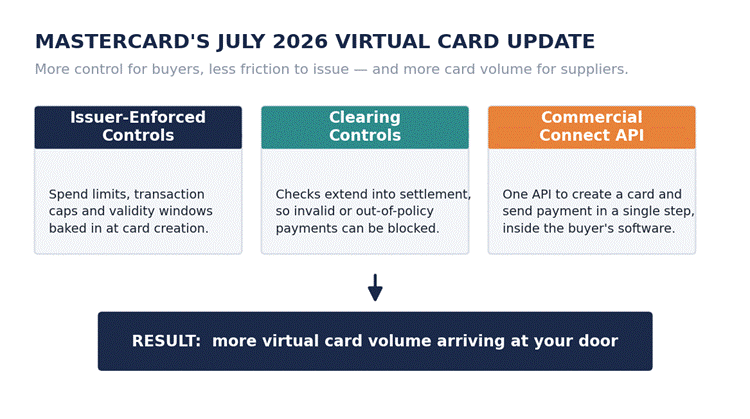
image 130

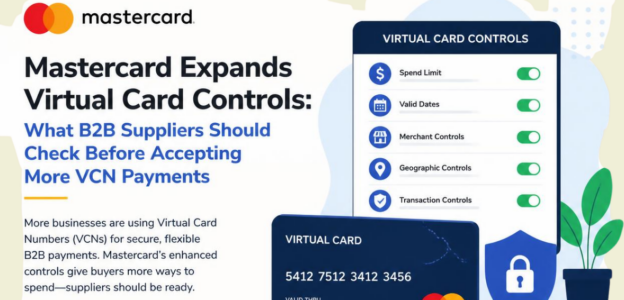
Figure 1. Mastercard’s July 2026 update tightens control and lowers friction for buyers, which means more virtual card volume heading toward suppliers.

The Update: Mastercard Tightens Control and Widens the Funnel
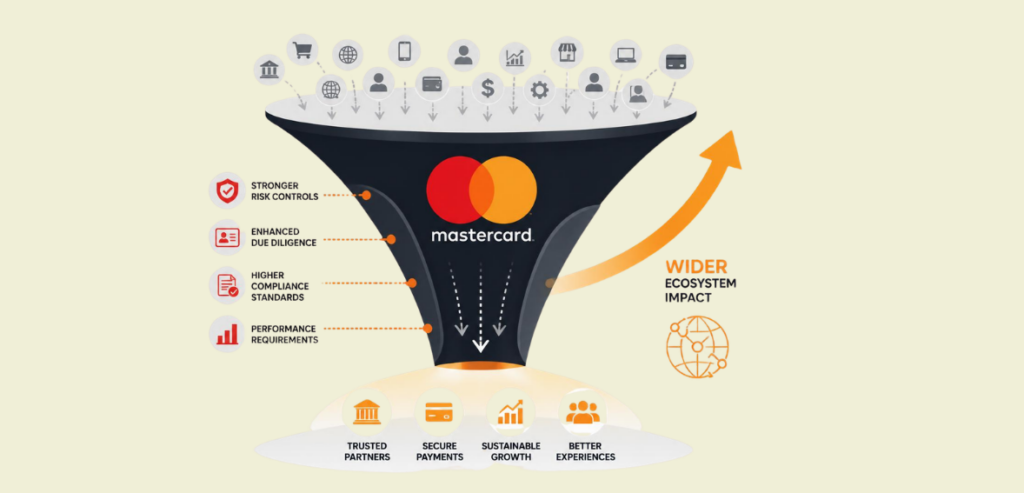
Mastercard Tightens Control and Widens the Funnel

Mastercard made the announcement on July 23, 2026, with the theme “More Control, Less Friction.” Their commercial virtual card platform introduced some friction-reducing features that allow both card purchasers and card issuers to have better controls and oversight. While the friction in the process of creating and sending virtual cards to suppliers is reduced, it, unfortunately, increases the card payment flow to suppliers.

The Platform Behind the Controls

Mastercard In Control

“Mastercard In Control” provides virtual card capabilities combined with the latest updates to their platform and governs capabilities offered by Mastercard. This latest release has two primary features. The first feature is an issuer controls feature allowing banks to enforce spend limits and card expiration controls when the card is issued. The second feature is clearing controls. This feature allows checks to extend beyond the initial transaction authorization to the settlement. This means that even if the transaction is approved, the transaction can be blocked during the settlement process.

Mastercard also mentions that the fraud rate on virtual cards is significantly lower than the fraud rate on traditional cards, and these controls are meant to reduce the fraud risk even further. The practical takeaway for suppliers is that the virtual card transaction that is hitting their payment processing terminal has much stricter controls regarding the spend, use, and expiration of the virtual card.

A Single Front Door for Buyers

Commercial Connect API

This section of the announcement deals with plumbing. Don’t tune out yet. At its core, half of the deal centers around the convenience of using the new API that Mastercard designed as a result of feedback from 69% of firms that struggle to integrate payment mechanisms into the myriad of operational platforms that they utilize across their businesses. They have named their APIs “Commercial Connect.”

One of the immediate benefits is that one can now generate a virtual card and drive the payment process all within a single action. Additionally, Commercial Connect integrates with a growing number of Expense, Accounts Payable, ERPs, and Travel booking solutions. As a result, they are embedding their payment capabilities into multiple layers of the corporate payments ecosystem.

Citi has the new controls and capabilities as the first bank to implement the live controls, with a global rollout planned for the remainder of 2026. Mastercard’s Commercial Connect also creates the capability to generate virtual cards within the existing customer software. As a result, expect to receive customer requests for the acceptance of virtual cards more often.

What a Virtual Card Number Actually Is
What a Virtual Card Number Actually Is

Before you assess the value of accepting a virtual card, it may help to understand what you receive in exchange for the payment. A virtual card number (VCN) is a card number that, like any physical card, is linked to a commercial card account, but is issued on-demand and for a particular purpose.

Most virtual cards are designed for one and only one purchase, are locked to a payment or a vendor, expire after a predetermined and short time, and have an amount matching the invoice loaded on them. After the purchase is made, the virtual card number becomes useless.

This design provides several distinct advantages to buyers of services or products that accept virtual cards. First, a virtual card number cannot be reused, even if it is exposed. Second, even if the card number is exposed, the number cannot be used to make a purchase that exceeds the predetermined amount.

Finally, the design of a virtual card number creates a digital record of the purchase that is tied to the invoice associated with that purchase. The latest controls from Mastercard are intended to further secure this model. From the supplier’s standpoint, accepting a virtual card means accepting a commercial card payment and provides all the economic implications associated with accepting a commercial card.
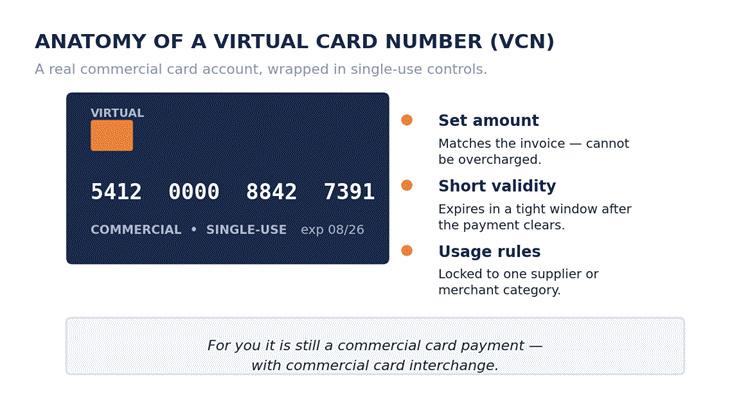
image 131

Figure 2. A virtual card number is a real commercial card account wrapped in single-use controls: a set amount, a short validity window, and rules about where it can be used.

Why VCN Acceptance Can Cost Suppliers More

It’s not a rare occurrence that a customer’s most costly payment method to you is a virtual payment card. This isn’t a new phenomenon due to changes with MasterCard. This is how commercial virtual cards work. Knowing how they function helps you know where the costs are and should minimize the surprises you will face.

To begin, it’s useful to know the nature of the card. Virtual payment cards are an extension of a corporate, purchasing, or business card and fall into the same high-cost commercial cards category as compared to consumer credit and debit cards that you would find at a retail cash register. Interchange fees vary widely, and for commercial cards the rate is often from 2.5 to 3% and sometimes higher, while traditional wire or ACH payments may cost a dollar or less. A payment with a virtual card may cost you several percent of a five-figure invoice in the B2B world.

The second consideration is the payment method. Virtual payment cards are often sent to suppliers via email, and the card information is manually typed into a payment terminal. This method falls into a card-not-present payment and is the highest-risk payment method, and as such, the networks assign the highest interchange to this method. It is also the most expensive method for a supplier to receive a virtual payment card.

Fortunately, you have some flexibility with regard to cost. Two factors drive cost, and both are up to you. One of those factors is the information you send along with the transaction. The other is the method used to process the payment. This document focuses on both of those factors.
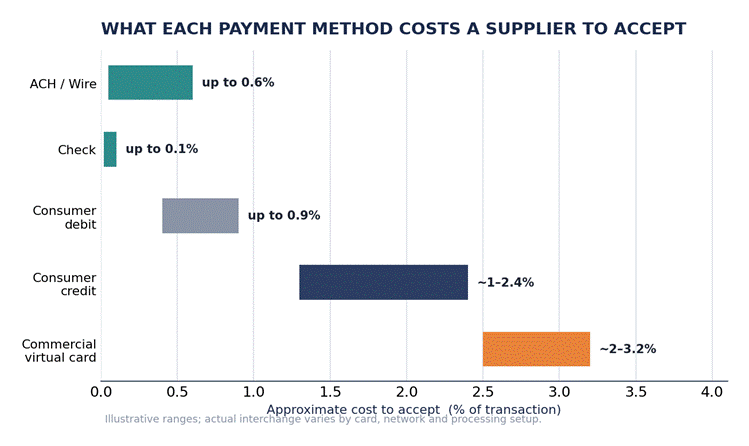
image 129

Figure 3. Acceptance cost by payment method. Commercial virtual cards sit at the top of the range, which is why the data you attach to them matters.

Level 2 and Level 3 Data and Lower B2B Interchange
Level 2 and Level 3 Data and Lower B2B Interchange

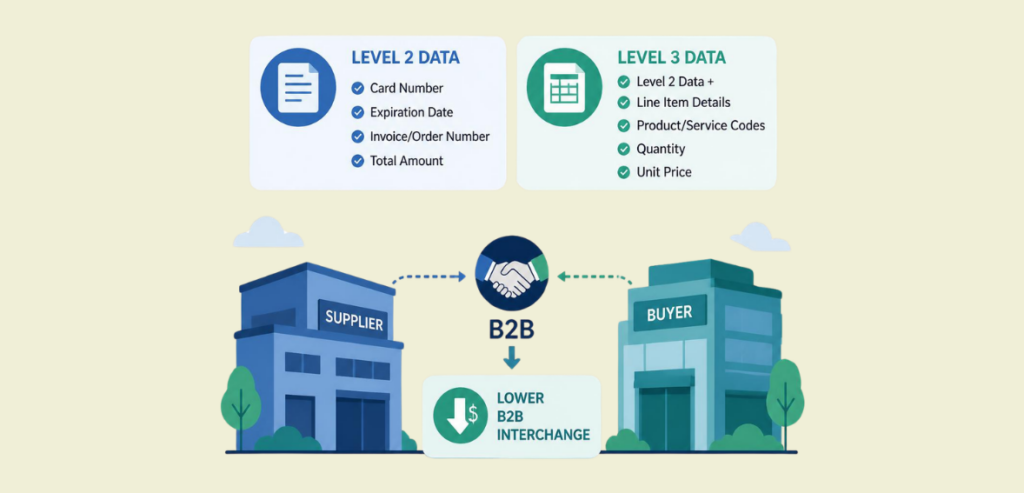
This is the lever that most suppliers don’t use. The card networks provide lower interchange rates for commercial card transactions when you supply additional data about the payment. The reasoning is that detailed and verifiable transaction data appears to be an authentic business transaction instead of a possible fraud, and lower-risk transactions merit lower rates. This improved data is typically offered in two levels, Level 2 and Level 3, and they are often the largest potential cost savings on B2B card acceptance.

What Level 2 Data Adds

Level 2 is the first enhancement to a standard transaction. A Level 1 payment provides only the merchant name, transaction date, and total amount. Level 2 payments include the total sales tax amount and either a customer code or purchase order number. The customer code or purchase order number must be provided, and the tax value often cannot be zero.

Transactions fail to qualify for Level 2 for many reasons, but this is the most common. Once you qualify for Level 2, each transaction will incur a slightly lower interchange fee of 30 to 60 basis points (0.30% to 0.60%). For Level 2 transactions, the cost of a lower interchange fee often makes the cost of the system upgrade worth it. Level 2 transactions are typically used for high-value invoices.

What Level 3 Data Adds

Level 3 goes even deeper, into full line-item detail. In addition to all the requirements of Level 2, a Level 3 transaction includes item descriptions, product or commodity codes, quantities and units of measure, unit costs, line-item totals, and freight or duty amounts. It is basically your invoice, in the format that all the card networks require, and meeting that standard can earn approximately another 50 to 100 basis points on top of the Level 2 savings. When combining the two, suppliers can save up to 1% to 1.5% of the overall cost of qualifying commercial card spend. For a $50,000 payment, that is a savings of $500 for each 1% reduction.

There are a few things that keep this honest. Only commercial cards qualify for these tiers, meaning that consumer cards and travel and entertainment cards (for example, hotels, airlines, and restaurants) are generally excluded no matter what data you provide. Also, the networks are constantly changing the rules.

For example, Visa recently revamped their enhanced-data program and eliminated their standalone Level 2 rate for Visa business cards, while Mastercard still continues to support the traditional Level 2 and Level 3 structure. Although the details are changing, the fundamental idea still applies. Richer data buys cheaper acceptance.
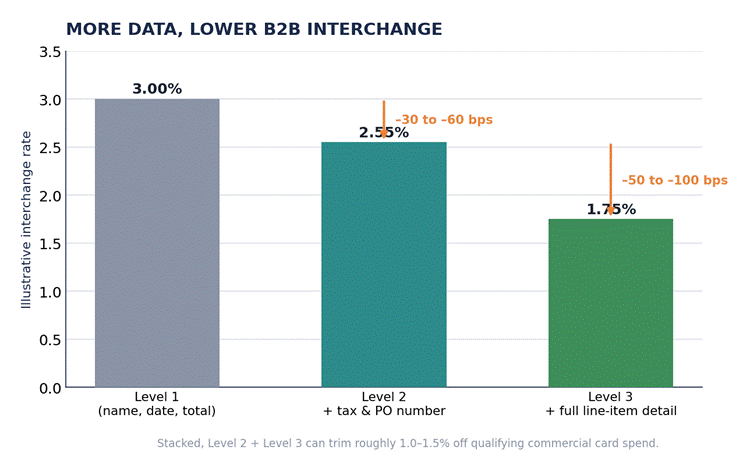
image 133

Figure 4. Each step up the data ladder unlocks a lower interchange rate. Level 3 detail can cut roughly one to one and a half percent from qualifying commercial card cost.

Straight-Through Processing vs Manual Keying

Data is just one part. The other part is how payment processing works, and whether or not you will ever utilize that enhanced-data discount you could potentially capture. Essentially, there are two options for how you can accept virtual cards: either you do it through manual entry, or you do it through straight-through processing (STP).

Most suppliers end up doing manual entry, whether they like it or not. When a virtual card is sent, it’s been found that one of your coworkers has to go to the email, copy the virtual card, and enter it into the payment terminal. After doing this, they have to go and match the payment with the invoice and record it into the accounting system.

While this method works, it is slow, can be done incorrectly, and ends up causing the transaction to fall into the card-not-present (CNP) tier and lose money. It’s not surprising that 42% of suppliers in the US say that the manual processing and reconciliation is the biggest obstacle to accepting virtual cards.

With straight-through processing, a lot of the manual work can be removed. With this processing, the virtual card details can be sent to the payment processor. Authorization requests can be generated independently, and payment can flow to the accounting system, signaling to match the payment with the invoice.

No one copies a card number, and no one makes a mistake entering a card number. The biggest advantage is operational, saving several hours and significantly reducing errors. For suppliers that do a lot of transactions, the savings alone is significant.

Processing also automates the addition of Level 2 and Level 3 data that qualifies for a lower processing fee. Unlike before, there is no need for manual data entry. The difference is most significant for manufacturers, distributors, and healthcare suppliers with high card transaction volumes.
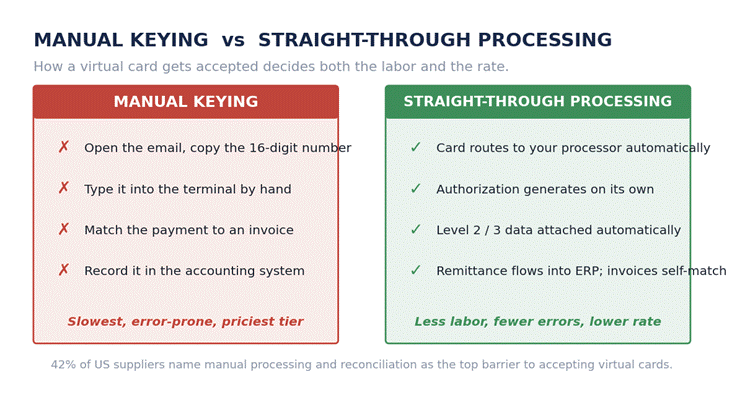
image 132

Figure 5. Manual keying is slow, error-prone, and lands in the costliest interchange tier. Straight-through processing automates entry, authorization, and reconciliation.

Reconciliation of Virtual Card Payments
Reconciliation of Virtual Card Payments

There is an added cost for virtual cards beyond just the interchange fee. The cost includes figuring out what each payment was for. This part of the virtual cards system slowly takes a toll on a supplier’s finance team, and it is worth paying attention to this system before accepting large volumes of virtual cards.

This is the issue with virtual card payments. When a payment is made with a virtual card, the payment often does not match a specific invoice or order. As a result, a finance team member has to determine what payment corresponded to what invoice, if the payment was for the entire invoice amount, and how to record this payment in the accounting software.

The process of matching payments to invoices is done manually, and the impact of this system is directly proportional to the card volume. The volume of virtual card payments is essentially the volume of the reconciliation work, unless there is some technology to change this. The real cost of virtual card payments for suppliers is in the reconciliation work, not in the transaction fees, which is why suppliers resist virtual cards.

The solution is to require remittance data and system integration automation from the beginning. A good payment integration system offers the payment along with the remittance data and pushes it into the accounting system to clear the invoices. The recent systems from Mastercard and their integration partners focus on connecting virtual card payments to the systems where matching will occur. Before accepting higher volumes of cards, this is the only question that needs to be answered.

Will your team recognize the purpose of the payment instantly, or will someone have to waste time looking for payment details?

What to Verify Before Accepting More VCN Volume

A short pre-flight check can be assembled at this stage. None of this means you have to decline customers. It allows you to say yes to increased virtual card volume while still keeping your margin intact rather than eroding it while saying yes at a cost to you.

Let’s start with the effective rate. Your effective rate is the total cost of card fees (a.k.a. the total you pay in card fees) divided by your total card volume. Put another way, how much do you think acceptance costs you right now? Your effective rate is the baseline for the starting point of that answer, and it is also the starting point for that answer at any later date. Next, check to see if your current processing arrangement has Level 2 and Level 3 data, because if it does not, then you are most likely paying the highest rate on every single commercial card.

Take a look at how virtual cards are sent to you now because the most expensive and least reliable way of doing this is a batch of emailed numbers generated through a manual entry by the cardholder. Look at the payments and be honest about how many hours this reconciliation consumes.

Lastly, look at the other payment methods your customers would prefer to use because for some business relationships, an ACH or wire arrangement is a better deal for both parties than a card would ever be. The end goal is not to accept every single virtual card or to deny them, but rather to understand your numbers before the volume increases.

Getting a B2B Acceptance-Cost Review

Most suppliers can’t answer these questions on the fly, and this is the purpose of the formal acceptance-cost review. The economics behind commercial card acceptance become more complex with matrices of interchange that stretch to hundreds of rows, and with network rules that change from year to year. A formal review simplifies this, and tells you, in monetary terms, your standing and what you need to do to improve it.

The review starts with analyzing your actual processing statements and determining your true effective rate. It analyzes how much of your processing volume qualifies for enhanced-data rates, and how much processing volume pays a premium for missing that data. It identifies your readiness and capability of passing Level 2 and Level 3 data, and models the potential fee and labor savings of STP, and the relative cost of accepting commercial cards compared to ACH or other payment methods for your specific clientele.

The result is the measurement of what you are paying for your current services and what you stand to gain with a more optimal service. With the increase of volume of commercial card transactions on the back of the new Mastercard policy, that measurement is the difference between a positive impact on your cash flow and a silent drain. If you are unclear on the costs of accepting virtual cards, a review is the quickest way to find out.

Conclusion

The source of the issue is not the virtual card, and it is definitely not “free money.” It’s a commercial card payment that has the highest acceptance cost of most of the ways you can be paid by a customer. Mastercard’s update in July 2026 does not change that. What does change is that virtual cards will be easier for your buyers to issue and send. That’s right, more requests are coming, and the suppliers who have prepared for them will thrive.

Preparation is very simple and easy. Just be aware that a virtual card is a commercial card and price it that way. Capture the Level 2 and Level 3 discounts, which could be a reduction of more than a full point on spend that qualifies. Eliminate the manual input of data and implement straight-through processing to avoid paying the highest rate and losing hours to data entry.

Demand remittance data so that the growing volume of data will not create a reconciliation burden. Analyze the costs before you expand, and get a true acceptance-cost review if the costs are a mystery. Accepting more virtual card payments will truly become the easiest, most convenient payment method for your customers, and the acceptance cost for you will be controlled and predictable. The easiest payment method will also be the most expensive if you don’t implement any of these suggestions.

Frequently Asked Questions

  1. What is a virtual card number?

    A single-use card number is connected to a buyer’s commercial account. This number is typically restricted to a single payment for a specified amount and a limited time span.

  2. Why do virtual card payments cost more to accept?

    They travel on commercial cards that have higher interchange rates, and because of manual keying, they land in the most expensive processing tier.

  3. How does Level 2/Level 3 data lower B2B card costs?

    Sending tax, purchase order, and line-item detail qualifies commercial transactions, resulting in interchange savings of approximately one to one and a half percent.

  4. Should a supplier accept virtual card payments?

    Yes, most of the time, if you know the cost and can capture the enhanced-data rates. For some relationships, ACH or wire transfer may be best for both sides.

  5. How do I reduce the cost of accepting business cards?

    Activate Level 2 and Level 3 data. Change from manual entry to straight-through processing and perform an acceptance-cost review to identify your gaps.
Nuvei Acquires Payoneer

Nuvei to Acquire Payoneer for $2.75B in Cross-Border Payments Push

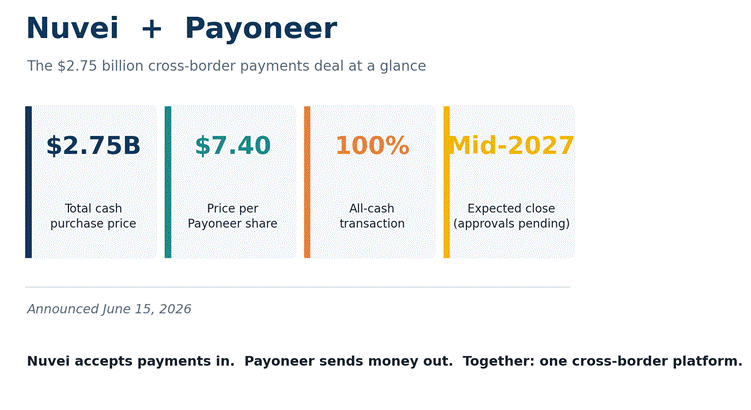
On June 15, 2026, Nuvei reached an agreement to acquire Payoneer in a $2.75 billion cash transaction, which represents one of the largest acquisitions of its kind, paying $7.40 per Payoneer share. The acquisition expresses Nuvei’s interest in cross-border payment solutions in an increasingly global economy.

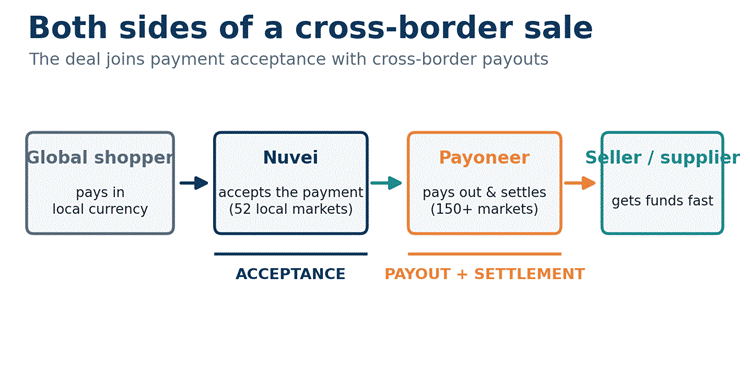
As Nuvei acquires Payoneer, the reasoning behind the acquisition is straightforward. Payoneer specializes in cross-border payment solutions for transferring money, whereas Nuvei specializes in payment solutions for receiving money. The acquisition thus has the capability to offer a comprehensive solution for the sending and receiving of cross-border payments. Subject to shareholder and regulatory approvals, the transaction is expected to be closed by mid-2027.

The article explains what is purchased in the deal, why it is important, and what a small business seller should do.

image 126

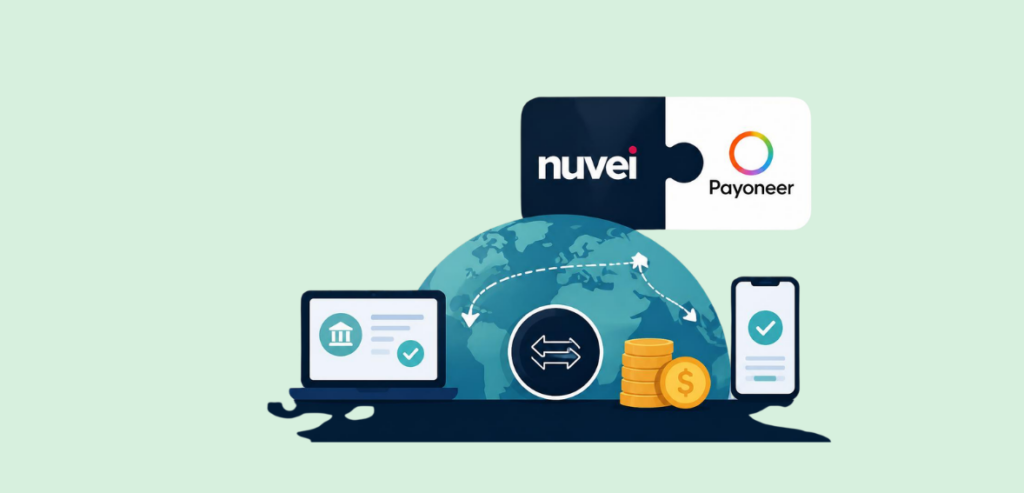
Figure 1. The Nuvei–Payoneer deal at a glance.

Nuvei Acquires Payoneer: What Nuvei Is Buying and the Cross-Border Thesis

What Nuvei Is Buying and the Cross-Border Thesis

Nuvei’s acquisitions go well beyond revenue; they go after reach. Payoneer offers cross-border payouts, multi-currency accounts, and a banking network that settles in over 150 markets. Payoneer also has payment services and banking licenses in China and India. It can cost years to build these licenses. To buy them is an easier route.

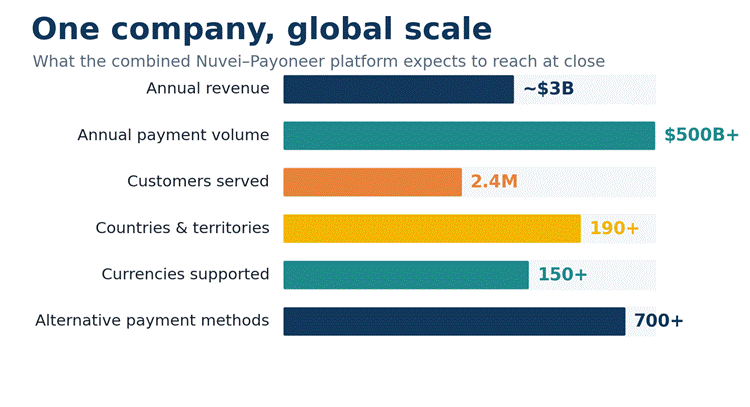
The combined company would become a large company. Management estimates that the company would have $3 billion in annual revenue and $500 billion in payment volume processed. The company would have 2.4 million clients and a reach of over 190 countries and territories. The company would support 150+ currencies and 700 alternative payment methods. The primary goal of the acquisition is to gain this scale.

image 127

Figure 2. Expected scale of the combined platform at close.

Nuvei

Nuvei is a payment processing firm located in Canada. It supports merchants in accepting payments through local acquiring services in 52 markets. Nuvei has advanced fraud and risk tools. In 2024, Advent International took it private. This acquisition is Nuvei’s first major investment in cross-border and B2B payment services under Advent’s ownership. These markets offer greater growth opportunities than traditional card processing services.

What Payoneer Does for Online Sellers and Freelancers Today

What Payoneer Does for Online Sellers and Freelancers Today

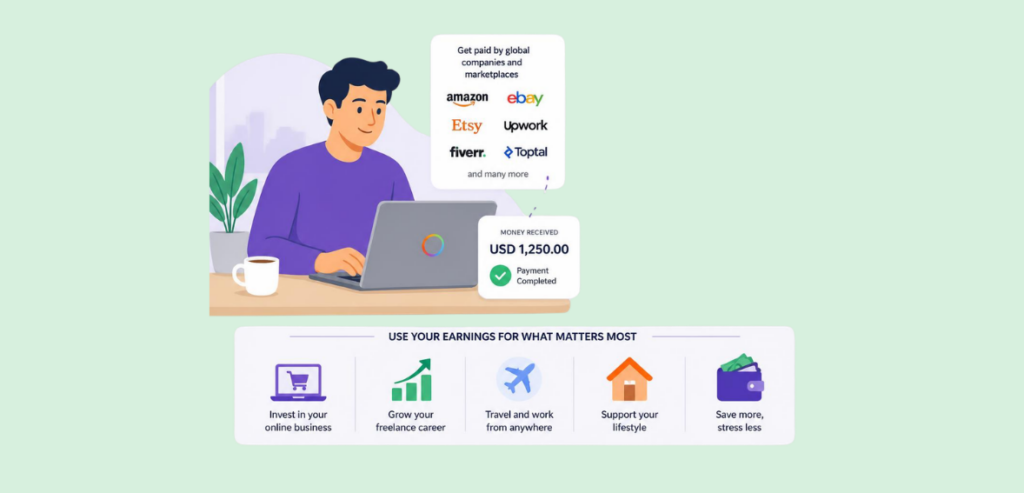
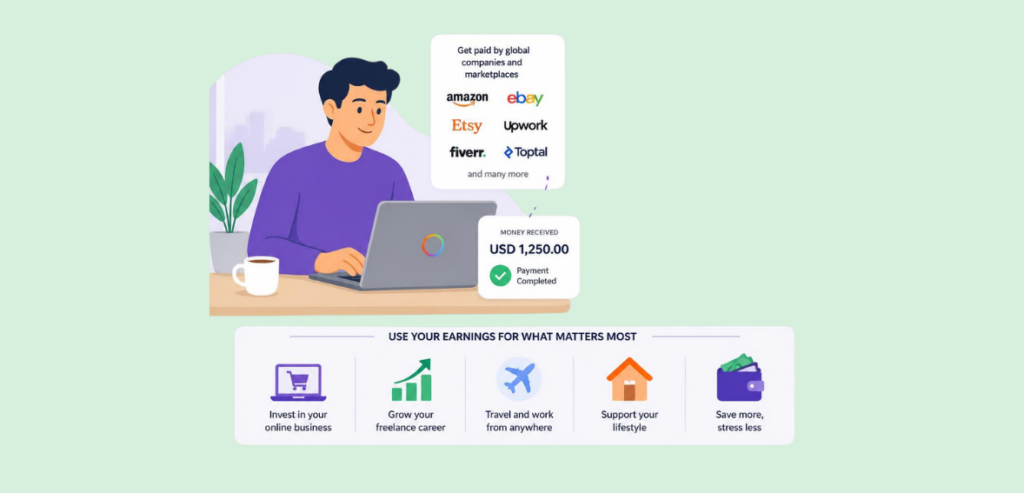
Payoneer made its reputation by serving the clientele that banks often bypass. Consider the freelancers in Manila, dropshippers in Lahore, and small businesses in Shenzhen. These sellers receive money from customers and marketplaces located in other countries. The process was slow and expensive until Payoneer alleviated that.

Payoneer

Payoneer is a financial service spanning borders and designed for small to medium businesses with a global reach. Normally, when a seller registers an account, the seller is provided with localized account details for multiple currencies. This allows marketplaces to pay sellers as if they were local. Payoneer allows sellers to maintain account balances, convert currencies, and cash out funds to their card or home bank. Payoneer has a few other services, as well. Payoneer has recently ventured into digital banking and stablecoins. These services can be offered in a more comprehensive way once Payoneer becomes a subsidiary of Nuvei.

Why Cross-Border Payments Are Consolidating Now

There is an expected reason behind this. Growth in standard card processing is stagnating. As a result, payment companies are focusing on the sub-sectors of the payment industry that are growing the most. Cross-border and B2B payments are some of the fastest-growing sub-sectors. In this case, paying for growth is more efficient than waiting to grow by earning it.

Additionally, there are some tectonic shifts in the industry. Forrester speaks of the demand for integrated financial services platforms to serve the payment, collection, and foreign currency transaction needs, and which service embedded finance and offer a means of customer retention. It’s no longer about having five different tools. It’s about having one. Nuvei combined with Payoneer is a direct response to that demand.

This merger also follows an evident trend. Mastercard purchased BVNK. Stripe purchased Bridge. Airwallex purchased Leapfin. Companies in this segment now have one of three options. Merge with a peer. Collaborate. Or be acquired.

image 127

Figure 3. The Nuvei–Payoneer deal joins a broader consolidation wave.

What It Means for Marketplace Sellers

Marketplace sellers are the big winners here. These are the merchants who sell cross-border on Amazon, eBay, Etsy, and Walmart. These sellers collect payments in one currency and pay their suppliers in another. Because of the thin margins, every currency conversion and every settlement delay is a loss for these sellers.

A combined Nuvei and Payoneer will enable marketplace sellers to receive their payouts faster, cheaper, and with more transparency. Because of fewer middlemen, Payoneer is more likely to absorb the cost of the payment. Fewer middlemen also means fewer reconciliation headaches for the sellers. For cross-border e-commerce, that end-to-end control is the actual value.

One of the costly trade-offs of having one provider on both sides is that it creates a lot of dependence on that one provider. This will be discussed in more detail below.

Multi-Currency Acceptance, Payouts, and Settlement in Plain Terms

Multi-Currency Acceptance, Payouts, and Settlement in Plain Terms

As a small seller, it’s important to know how terms like these affect you as a seller.

If you’re selling across borders, most likely you will want to set prices in your customers’ local currencies instead of forcing them to see the price in US dollars. With that, a customer in Germany is seeing a price in Euros, and a customer in Japan is seeing a price in Yen. Setting prices in local currencies increases your conversion rates because pricing is more familiar and comfortable.

The payout is the opposite of the payment. So that’s money going out to pay someone. It could be paying the person who provided you a service (a freelancer), a supplier, or a commission earner (an affiliate) who is located in a different country. Good payout services offer low-cost payouts to many different countries and many currencies.

Settlement is when the payment you’ve received officially clears and is now yours. When the settlement process is slow, your cash is tied up. Payoneer’s network offers same-day and real-time settlement for many countries. With multi-currency payments, the speed and cost are what separates the good from the bad.

image 128

Figure 4. Acceptance and payout on both sides of a cross-border sale.

The Agentic-Commerce and Stablecoin Angle

Both companies referred to things yet to come. The integrated system is designed for agentic commerce and native financial services designed for stablecoins. Currently, these are fast-emerging trends.

Agentic commerce refers to the shopping and purchasing done on behalf of a user by software agents. An example here is an AI ordering supplies by the minute. This requires a payment system that can handle the requirements, as there is no human oversight. Creating this is a wager on the future interactions of commerce.

Stablecoins are digital currencies that are pegged to something like the dollar. More practically, stablecoins are a low-cost method of transferring value internationally. Payoneer implemented stablecoins before this agreement. This can allow Nuvei to implement this work at a greater scale. For a global commerce platform, these solutions can reduce the cost of transferring value internationally.

What an SMB Selling Internationally Should Evaluate

Your needs change little in the wake of a big merger. Selecting the right provider will still be based on the same practical considerations. Start with corridor coverage. Does the provider have the right presence in the countries where you sell to and buy from? Just because a provider has a great platform in Europe doesn’t mean the provider is strong in your key Asian corridor.

Once you have corridor coverage, the next thing to look at is cost. What are the foreign exchange costs? Do you have a flat fee with a high cost of currency conversion? What is the cost of funds and settlement time? Does your cash arrive in one day or in five? Do they have the right licenses and cover the markets you need to enhance reliability?

Concentration risk is important to consider as well. Having your acceptance and payout with one provider may be really convenient, but that provider may end up locking you in. That’s why a lot of careful sellers have a backup for critical corridors. Convenience is great, but a single point of failure may not be.

What to Watch as the Deal Heads Toward a Mid-2027 Close

Nothing changes overnight. The deal has yet to obtain shareholder backing or secure the necessary clearances from regulators in multiple nations. Cross-border transactions, by their nature, contain a variety of sensitive licenses, resulting in protracted reviews. Pay close attention to those approvals first.

Next, pay attention to the pricing. During the consolidation process, the pricing can be reduced through increased efficiency, or pricing can be increased through the reduction in competition and improved market position. Once the systems are unified, the selling parties should monitor the pricing that they are charged, and the pace at which the systems are integrated. Historically, Mergers and Acquisitions (M&As) offer the promise of a unified system, but deliver a duo of disjointed systems. The pricing that the selling parties will be charged will be the true indicator of whether the merger has resulted in a significantly improved system by the year 2028.

Finally, monitor the scheduled release of the roadmap features, particularly with regard to stablecoins and agentic commerce. The completion of these features will mean that the deal is on target. If these features are released after the target date, the deal will be considered a more typical-scale transaction.

Conclusion

The Nuvei Payoneer deal demonstrates the future trend of money movement. Acceptance and payout functionalities are being combined into unified systems. Providing cross-border payments for small businesses becomes a focus area instead of an afterthought. For marketplace sellers and freelancers, this has the potential of quicker payouts and reduced costs, and combines payouts into a single system.

While promising, results are what ultimately matter. The deal won’t close before mid-2027, and integration will be even longer. This is a good signal, and sellers are encouraged to review their current systems. Sellers should evaluate their payment systems, overall costs, and alternative payment solutions. The best plan is to prepare and assess the new company based on the solutions they provide rather than their announcements.

Frequently Asked Questions

  1. What is Nuvei acquiring and for how much?

    Nuvei is purchasing Payoneer for $2.75 billion in cash at $7.40 a share. The deal is set to complete in the middle of 2027.

  2. What does Payoneer do?

    Payoneer helps freelancers and global small businesses receive cross-border payments in over 150 countries. Payoneer offers multi-currency accounts, payment cards, and payment solutions.

  3. Why do cross-border payments matter for small online sellers?

    Faster and more cost-effective cross-border payment solutions benefit sellers, as payments no longer eat into pricing margins. Sellers earn and spend in diverse currencies, resulting in higher costs and longer payment times.

  4. What is multi-currency settlement?

    Multi-currency settlement means the funds clear in your chosen currency, often the same day, freeing up cash sooner to restock inventory or pay your staff.

  5. How does this affect marketplace sellers?

    Sellers on Amazon, eBay, Etsy, and Walmart would receive quicker and cheaper payouts from one payment processor. This results in more dependency on one vendor.

Fiserv's new CEO

Fiserv Names a New CEO After a 70% Stock Slide: Here Is What It Means for Your Payments

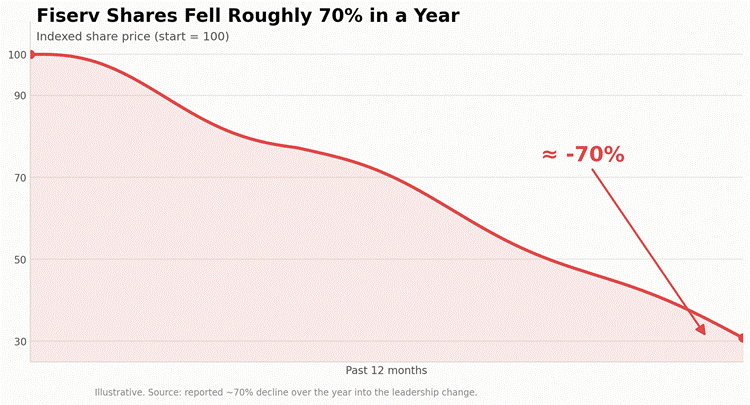
A payment processor should, by design, be the most boring vendor in your company. They move money in the background and never grab a press headline. So, it’s fair for small business owners to briefly step away from their sales when one of their largest processors starts making frequent swaps for their Chief Executive, in a year losing almost 70% of their stock. Call it the Fiserv effect.

Fiserv’s largest payment processing competitor, Square (now called Block) made huge strides in the payment processing world, most likely due to the turbulent changes in management at Fiserv. In 2026, Fiserv’s new CEO, Takis Georgakopoulos, appointed as its 3rd CEO in 18 months, led the company after its stock took a massive hit and several lawsuits continued to plague the company.

This article will briefly explain the leadership changes at Fiserv and why you should be aware of this massive payment processing competitor and its effect on the stability of payment processing in your business. Additionally, you will get a glimpse at the daily impact a processor like Fiserv has on your payments and how to discern true stability beyond charts.

What you will receive are the questions you should ask your own provider. Information will also be included here for the case for choosing service over sheer size and the signals you should watch as Fiserv attempts to climb back. Your response should be attention, not alarm. The intention here is to help you evaluate, in a calm manner, if your payment processor is a partner or simply a connection.

image 122

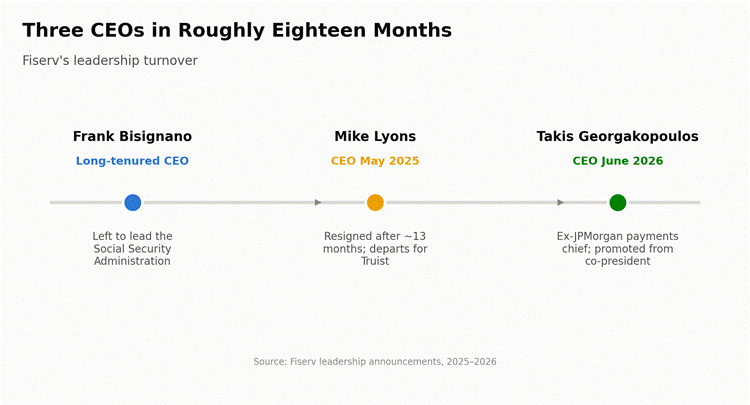
Figure 1. Three chief executives in roughly eighteen months. A closer look at Fiserv’s leadership turnover.

Fiserv’s new CEO: What Changed at the Top of Fiserv and the Timeline of Turnover

What Changed at the Top of Fiserv and the Timeline of Turnover

Frank Bisignano is the latest focus of the story. He was in charge of Fiserv for quite a long time. He was the person who oversaw Fiserv’s integration of First Data. He also had a brief stint overseeing the Social Security Administration after a federal appointment. His departure from Fiserv was problematic for the company since they lost one of their top executives at a pivotal point. The board was subsequently forced to look for a candidate beyond the company.

Mike Lyons was the candidate beyond the company. He was hired from PNC Financial Services Group (his former employer) for the role of company president and chief executive and officially became the chief executive in May 2025. He had a rough start with the firm and, after just five months on the ground, called for a necessary and critical company reset.

He said that the firm had been working under grossly misplaced expectations for the firm’s future growth regarding sales and operational efficiencies. Essentially, the expectations from the stock market were unrealistic. The stock price fell sharply. About a year after his appointment, he left for the dual role of president and chief executive at a bank, faithful to his previous employment. He joined Truist shortly thereafter.

Truist

Lyons will start his role at Truist Financial in September 2026. This is relevant to us as a chronological note. This hire is interesting because the executive who joined a troubled processor and was meant to be there for the long haul left for a bank in less than a year and a half. This is not the nature of a well-managed processor. This is the nature of an executive looking for stability.

Takis Georgakopoulos has been placed in that position as of June 2026. He is not a stranger to the company. He joined Fiserv in 2024 and progressed rather quickly from being a senior advisor to the COO to co-president of the Technology and Merchant Solutions group. Before joining Fiserv, he spent 17 years at J.P. Morgan Chase, where he was in charge of Global Payments.

Gordon Nixon, the board chairman, praised Georgakopoulos for his efforts to modernize the firm’s merchant services platform and for incorporating AI within the platform. To reinforce the bench, Fiserv promoted Dhivya Suryadevara to president and CFO; they issued a multi-million dollar retention award. The message was stability; the reality is that this is the third leadership change in 18 months.

Why Leadership Churn at a Major Processor Matters Downstream

You might wonder why any of this should be relevant to your business. You don’t participate in Fiserv board meetings, nor do the consumers of your services attend earnings calls. Although there are connections, they are indirect and infrequent. It is understanding the connections that distinguishes useful concern from pointless anxiety.

New executives change focus. Each new chief executive plans a new central focus for the organization, which in turn plans a new focus on the allocation and usage of a company’s resources. Fiserv has designated 2026 as a “reset” year for them. While “reset” years are generally a time for cost discipline, this can manifest as smaller support teams and slower updates for product enhancements, as well as quiet and subtle cost increases for services.

While cost discipline is not inherently a poor practice, the consequences of these actions are generally felt by customers as longer wait times for services and renewal letters requesting the new costs. It is these actions that are felt by customers of the organization months after a new chief executive has taken up their post.

Clover

Clover serves as the best example of how strategy from the top impacts the bottom. Clover is Fiserv’s point-of-sale system, which they acquired with First Data in 2019. Clover powers numerous small business cash registers. When the executives developed aggressive growth goals for Clover, disappointment translated to lawsuits and rage from investors.

For a merchant, the lesson is not about the stock. But rather, the cash register system in your business is connected to a corporate growth story. When the growth story is not strong, they will be forced to generate more revenue from account to account. The difference between a growth-focused partner and a service-focused partner is clear.

image 125

Figure 2. Fiserv shares lost roughly 70% of their value over the year leading into the leadership change.

Where Processors Like This Sit in Everyday SMB Payments

Most merchants never lay eyes on their processors. They encounter terminals, card readers, or online checkout pages. Behind the scenes, there’s a long chain of companies, many of which are bundled together (not always conveniently). Understanding the chain helps you understand what you are actually purchasing, and who you can call to fix the link (if you can call them).

When a purchase is made, the transaction leaves the merchant’s terminal and travels to a payment processor. The payment processor’s job is to route the transaction to one of the card networks, and then to the issuing bank for approval, and then route the transaction back to the terminal. The payment processor is also responsible for the settlement of the transaction, as well as the statements you receive detailing the fees, and also the support line you call when something goes wrong.

Fiserv does this at a massive scale. According to the Nilson Report, Fiserv is the largest merchant acquirer in the U.S., number one in both total purchase volume and total transactions. Through Clover, its own sales teams, and its bank and software partnerships, Fiserv serves merchants of all sizes.

Fiserv

Fiserv isn’t one product, and your bank likely uses Fiserv without their name being on the door. Your point-of-sale could be Clover. Your bank statements could be from a reseller who buys Fiserv processing and marks it up. This is why two merchants can be Fiserv clients and yet have a completely different experience. This is also why looking at the size of a company offers very little information about the service you will actually receive. A company can be the largest acquirer in the country while a small merchant feels like a rounding error.

What Stability Actually Looks Like: Support, Uptime, and Contract Terms

What Stability Actually Looks Like

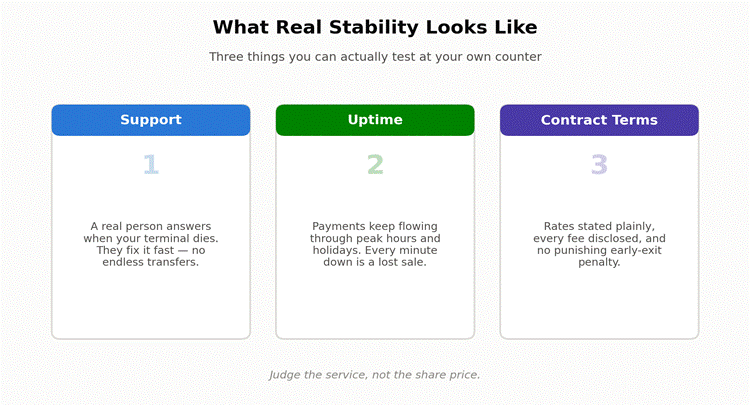
Steady stock prices are nice, but they are not what runs your business. The true stability, the kind you can touch and feel, comes from three things that you can actually measure: the quality of support, the reliability of the system, and the fairness of the contract. A processor can look volatile and unhealthy on Wall Street while still treating you with great service, and vice versa. When it comes to service, judge it, not the stock price.

Support is the first pillar. True stability means a human actually answers the call when your terminal dies during a Saturday rush as opposed to a menu that you just loop back into. It means the support agent resolves your call and you don’t get passed around to different support teams while customers are left waiting. Uptime is the second pillar. Your processor should be keeping your payments flowing during busy times, holidays, and outages, because any time that is downtime is a time you can’t make a sale. Inquire about the contract.

Contract Terms

Contract terms determine the kind of relationship you will have with a provider. Good contracts outline your rates, include full transparency, and allow you to leave with no penalty. Bad contracts have hidden pricing structures, unexplained monthly fees, and multi-year contracts with very high exit fees. Read contracts and statements. The processors with understandable contracts are the ones with the longest relationships. When a provider’s finances take a hit, surprise fees will be the first place you will notice the pressure.

image 123

Figure 3. Real stability rests on three testable pillars: responsive support, dependable uptime, and honest contract terms.

The Signs a Merchant Is Being Underserved by a Big Processor

Poor service is an insidious problem. A vendor that used to answer your calls. Now sends you to a portal. A statement with understandable line items can become nonsensical. An owner neglected by their vendor is often the last person to recognize vendor neglect. The ability to recognize neglect earlier helps you solve the problem before you experience the impact of the neglect during your peak season.

The most obvious and early sign of neglect is cold support once you call for help and are forced to endure multiple transfers. If issues are closed without follow-up, you have been ticketed. A second sign of neglect is the slow and gradual increase of fees. Look out for unexplained charges, above-quoted rates, and uncommunicated annual rate increases. The third sign of neglect is a sudden change of terms, support equipment, or pricing with no prior notice.

The last two signs also help to define a neglectful vendor relationship. The first is the strong push to buy equipment or support that you do not need. The second is the feeling that your interests no longer matter to the vendor. These feelings and pushes you get when your vendor is servicing billions of transactions a year is a good reason to find a new vendor.

You deserve a provider that treats your business as a priority, not as just a number.

Questions to Ask Your Provider About Service and Continuity

Questions to Ask Your Provider About Service and Continuity

You don’t need deep knowledge of payments to test your processor. Have your questions ready. Then observe how they respond. Good processor partners respond clearly and quickly. Poor processor partners are vague, lose focus, or respond slowly. The responses are important, but the response style is often the most important part.

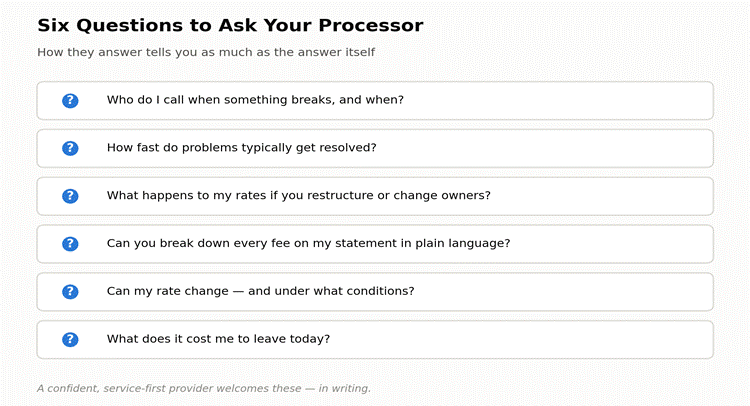
Start with support and stability. Ask who you call if something breaks, if that support is staffed during your business operating hours, and how long you should expect to wait on support to solve the problem. Ask what happens to your account and your rates if the company is acquired, restructures, or if there is a leadership change, since you have most likely seen a large company do exactly that.

Then ask your money questions. Ask for a plain-language explanation of each fee. Ask if your rates can change and what conditions would allow for that to happen. Finally, ask the future questions. Ask what happens to your equipment and your pricing when the current contract ends. Then ask if you are on a month-to-month, or if you are locked in.

Merchant Services

Merchant services refer to all the components tied to the processing of transactions, and it is the part of the system that addresses these concerns. The most competent merchant services companies address the tough questions. A confident, service-centric merchant services company answers these tough questions and documents the answers. Those who avoid, postpone, or obscure the answers to the tough questions with fine print have shown what kind of partner they will be when things are tough. It is most prudent to ask the tough questions before needing the answers.

image 124

Figure 4. Six direct questions that reveal whether your processor is a partner or just a pipe.

The Case for a Service-First Merchant Services Partner

There is a general assumption that larger payment processors are somehow safer. The Fiserv example disputes that assumption. While larger payment processors tend to be more efficient and have a greater network, that does not prevent payment processors from losing their clients, cutting their guidance, or being treated as just one of their millions of clients. For a lot of small businesses, a service-oriented provider is a better choice, since their focus is solely on the client’s needs.

A service-oriented provider competes on the strength of the relationship, not on the size of the client base. This leads to distinct positive changes a business owner can appreciate. Support is usually local or at least dedicated, so the support staff knows their clients. Pricing is clear because a service-oriented provider stays in business by keeping their clients happy.

Their contracts are fair, and their communication is proactive. Keeping the client informed is the service-oriented provider’s greatest communication strength. When the leadership at a large payment processor changes, it is the service-oriented provider’s commitment to service that keeps their client’s business thriving.

The core of this argument is about alignment. A large payment processor is primarily concerned with their stockholders, growth goals, and the pressures of their publicly traded company. A service-oriented merchant services partner is primarily concerned with the merchants they serve, because losing a client is an immediate loss. Neither model is perfect, and a lot of small clients are served well by large firms.

The last year has taught small business owners a lot. If you have real stability, your business could survive better than something you could value by looking at the stock market. Pick the business partner who will succeed if you do.

What to Watch as Fiserv Works to Return to Growth

Fiserv isn’t going anywhere. Having the largest merchant acquiring business in the nation has its advantages, especially with the new chief executive who has familiarity with the business. The company has labeled 2026 a transition year and has communicated to investors to expect a dip before a recovery. The upcoming quarters will be important for merchants and observers to indicate if the turnaround will be legitimate. There are a few things to pay attention to.

The first thing to look for is stability within the leadership. Georgakopoulos kept his executive team, and along with the board, has shown a preference for retention. If that team stays and the plan holds, this will show stability and be a mark of improvement. If more senior members depart, the chaos will continue. The next thing to look for is guidance. Fiserv has reaffirmed a target of 1-3% organic revenue growth, with adjusted earnings per share in the range of $8 to $8.30. Meeting or exceeding this goal will be indicative of improvement.

With respect to Clover and the lawsuits, the small business segment of the company is best represented by Clover. Healthy incremental growth is positive for the small business merchants that rely on the small business segment of the company. The investor and cybersecurity lawsuits are in court and are a distraction to the company as they drain resources. For your business, the most important thing to watch is your service.

For the next year, monitor your hold times, fee assessments, and account statements. The turnaround you care about most isn’t the one reported in the earnings call. It’s the one you measure at your counter.

Conclusion

There’s nothing to panic about when a processor has a new chief executive officer (CEO). It happens that the largest companies often swap out their higher-level management. Especially when looking at the swipe card industry. However, there are signs that indicate a lot more is going on than just a reshuffle. An admitted reset with unrealistic assumptions, lawsuits, a 70% dip in share price, and 3 different CEOs in 18 months are not signs of a healthy company. Things that you can expect to see with a company that quietly handles a large share of the payment processing in the US are thinner support, higher fees, and a growing disinterest in helping smaller clients.

At this point, the reaction doesn’t need to be panicked. It just means paying more attention. The feeling of loss of support that most clients see happens to a lot of companies. You have the ability to judge Fiserv with more control than you think. You can test the level of support that you believe is the right fit for you, the uptime of the system, and most importantly, the terms of the agreement. If you have to start asking hard questions to Fiserv, you should be looking for a new provider that believes that their success is related to yours. Service is what you feel. Look to Fiserv for a recovery, but look to yourself first.

Frequently Asked Questions

  1. Who is Fiserv’s new CEO?

    In June 2026, Takis Georgakopoulos became the company’s CEO. He also worked at Fiserv starting in 2024 and previously led global payments at JPMorgan Chase.

  2. Why does my payment processor’s leadership matter to me?

    New management changes priorities and can pass the effects of cost-cutting down to you as reduced support or increased prices. Disturbance at the upper levels of management can, months later, affect your counter as well.

  3. What should I look for in a reliable payment processor?

    Assess three things you can evaluate: responsive human support, consistent uptime during your busiest hours, and a straightforward contract with no concealed charges, harsh exit penalties, or anything of that nature.

  4. How do I know if I’m getting good merchant services support?

    You get in touch with a real human being in a timely manner. They resolve the issue. You don’t get charged fees without explanation. Unexplained fees and bad service are red flags.

  5. Can I switch processors if the service is poor?

    Yes. First, check if your contract has any early termination fees. Then, you should switch to a provider that has better customer support and pricing. It would be better if the new provider worked on a month-to-month basis, too.

Deluxe Acquires Celero Commerce

Deluxe Acquires Payments Processor Celero Commerce in $625M Deal

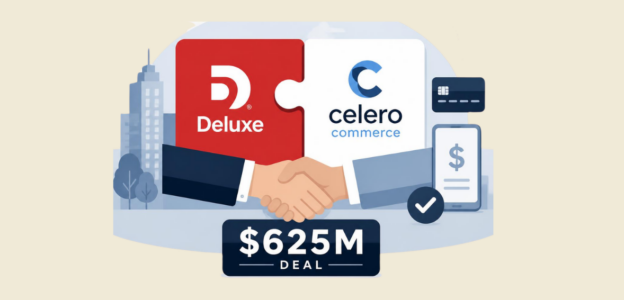
A 110-year-old check printer is betting big on the future of digital payments with a multi-million dollar investment. Deluxe Corporation has planned a $625 million all-cash acquisition of Nashville payments processor Celero Commerce, as of June 18, 2026. Deluxe famously mailed physical checkbooks to half of the postal addresses in the United States. Now, Deluxe wants to help small and medium-sized businesses move money.

As Deluxe acquires Celero Commerce, it speaks volumes about the state of the merchant acquiring business and suggests Deluxe has prioritized the payments processing business. Deluxe is also a key player in the ongoing consolidation of merchant acquirers in an environment that has experienced unprecedented coupling and reshuffling in payments processing.

For the small business owner, this is not an abstract story from the world of finance. Deluxe acquiring a payment processing business means that the processing company in the small business owner’s local market may acquire a different name, different business model, and a different customer support system.

This report explains what Deluxe acquired, why the check company is making big moves in the payment space, and what the continued wave of acquisitions means to the small businesses that will be most affected.

image 121

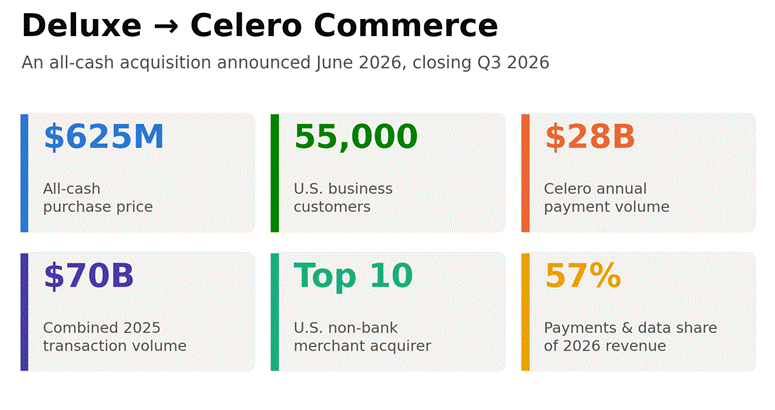
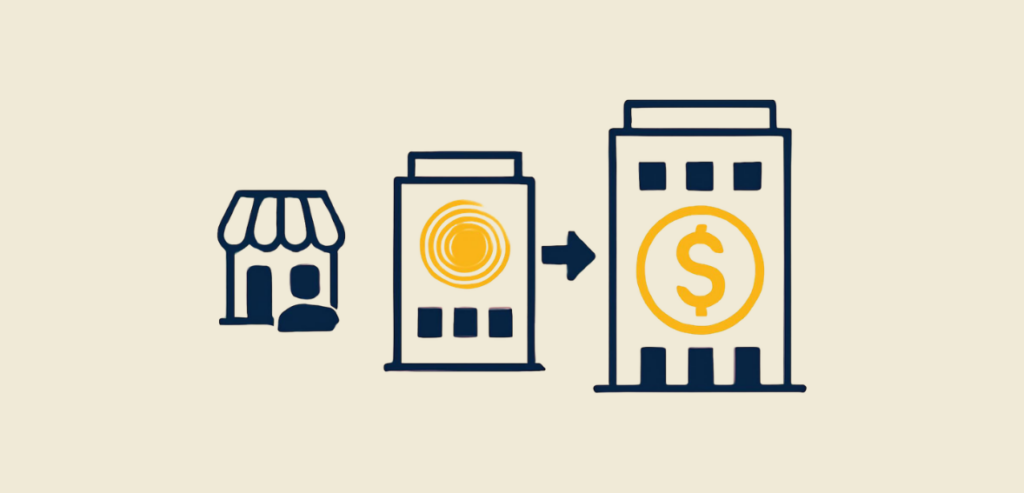
Figure 1. The Deluxe–Celero deal at a glance: a $625 million all-cash purchase that pushes the combined firm into the top ten U.S. non-bank merchant acquirers.

Deluxe Acquires Celero Commerce: Why a Check Company Is Going All-In on Payments

The all-cash purchase price is $625 million. Deluxe is purchasing a $375 million incremental term loan and a draw from its revolving credit facility. They announced the agreement on June 18, 2026, and anticipate closing the purchase in the 3rd quarter. Deluxe has plans to buy scale to a business they have been slowly growing for several years.

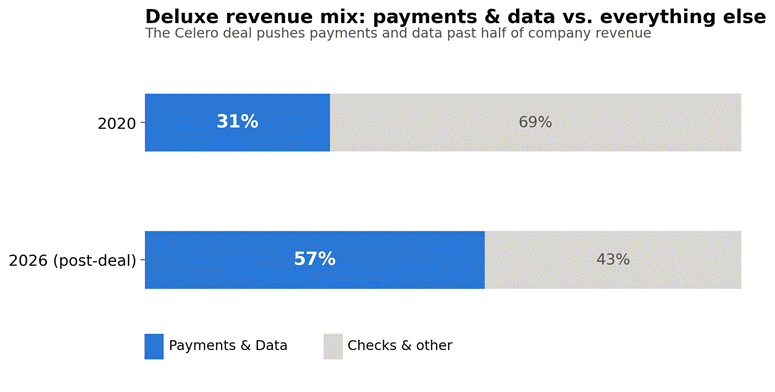
For most of Deluxe’s history, the company made money from checks, forms, and various paper supplies that financed their operations. Deluxe has been gradually changing its focus to payments and data. The Celero acquisition is their most significant commitment to that focus. After the acquisition, payments and data will comprise 57 percent of Deluxe’s 2026 projected revenue. In 2020, payments and data comprised 31 percent of Deluxe’s revenue. Deluxe is a payments company now.

image 119

Figure 2. Deluxe’s revenue mix has flipped toward payments and data, projected to reach 57 percent in 2026 after the Celero deal, up from 31 percent in 2020.

Deluxe Corporation

Deluxe Corporation

Image Source

Deluxe was founded in 1915 and is one of the oldest business services companies in America. Deluxe gave us the paper check and printed checkbooks for banks and consumers. Though check printing provided steady cash flow, this business model was headed for permanent decline. Under Barry McCarthy, Deluxe repositioned the company with an emphasis on merchant services, data, and digital payments. The Celero acquisition is evidence of this strategy. McCarthy said the acquisition was a good way to quickly change the company’s focus and the money they make to the payments and data services that Deluxe offers. From this acquisition, it is clear that Deluxe is all in in this line of services.

Celero Commerce

Celero Commerce

Image Source

Celero was founded in 2018 as the fast, newer half of the partnership. They are based in Nashville and provide integrated payment processing and business management software and services with data services to small and mid-sized businesses. Celero has about 55,000 business customers and processes about $28 billion in payments a year. In 2025, Celero reported revenues of $200 million at a healthy 28 percent adjusted EBITDA margin.

Celero services businesses through 375 active partners, including banks and vendors of business software, and added about 60 partners in 2025. Founder Kevin Jones said this combination is “an exciting next chapter” for Celero, as it will allow them to further pursue their mission through Deluxe’s resources and extensive reach.

These two companies combined become a large entity. In 2025, the two companies combined processed about $70 billion in gross transaction volume. This volume allows the combined partnership to be classified as one of the top 10 non-bank merchant acquirers in the USA. Deluxe also stated that this deal should positively affect adjusted earnings per share within the year and provide over $15 million in cost synergies over the next 24 months. For a company still transitioning out of its paper-focused past, this deal provides justifiable numbers for the expected cost.

The Consolidation Wave Reshaping Merchant Acquiring

Deluxe’s decision stems from a larger context. Merchant acquiring is a consolidating industry, and Deluxe’s acquisition of Celero represents a smaller undertaking in a larger massive undertaking. The industry has been filled primarily with smaller to medium processors. Within the context of industry consolidation, that crowd is rapidly disappearing.

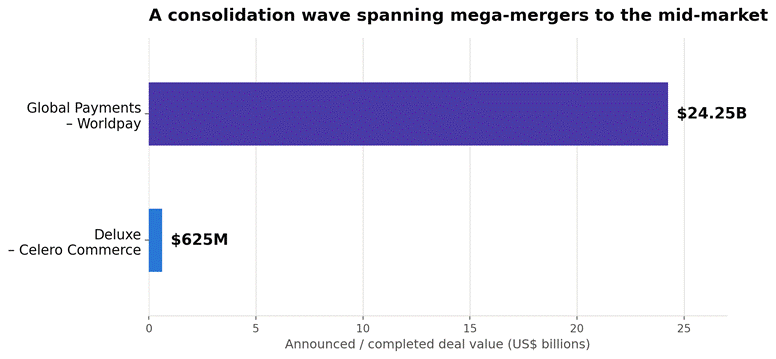
The largest example dwarfs the Deluxe deal. In January 2026, Global Payments acquired Worldpay for $24.25 billion, one of the largest deals in the history of the payments industry. In the same three-party deal, FIS acquired the Global Payments issuer solutions business. The reconfiguration of the payments processors has been characterized as a simplification of portfolio offerings and a pivot towards software-centric merchant services. Relatively, the Deluxe-Celero acquisition reflects the same trend.

image 118

Figure 3. Recent deals show the scale of merchant acquiring consolidation, from Global Payments’ $24.25 billion Worldpay purchase down to mid-market moves like Deluxe–Celero.

The driving forces behind the wave are easy to see. Payments is an industry of tight margins and high tech costs, so the business is all about scale. The bigger processor shares the burden of compliance and fraud and platform investments among a greater number of customers. The point of sale and invoicing software is where the processors have control of the customer relationship, and that is really the game. And private equity keeps financing the wave; the Worldpay sale was one of the largest deals in the history of its private equity owner, GTCR. The processors are getting larger, and there are fewer independent names in the game. For the small merchant, the shock is when processors in the merchant’s ecosystem get acquired, and there are fewer familiar names left.

What Happens to Small Merchants When Their Processor Is Acquired

What Happens to Small Merchants When Their Processor Is Acquired

For most owners, the practical question cuts through all the deal math: what happens to my account when my processor gets bought? The honest answer is usually very little, at least in the short term. Card payments continue to clear, deposits continue to show up, and the terminal on the counter continues to work. Acquirers pay a great deal of money to purchase a merchant portfolio because they want to keep the merchants. Disruption is bad for business for both sides.

The changes, however, are more likely to show up later and more quietly. After a deal goes through, merchants may notice the company on their statements is different, the support phone number is different, and/or they are moved to a different terminal or platform. Pricing is likely to change, and in some cases, the acquirer may improve pricing as they absorb the account. In some cases, pricing may get worse, and a new fee may appear after the introductory offer is over. Most contracts are transferred as is, so any early termination provisions and long commitments are transferred to the new owner.

The real risk is more likely to be a slow decline in service rather than outright chaos. The promised rates may not survive the transition, and the account manager may also disappear and be replaced by a general support queue. A well-run acquisition is also likely to have a positive outcome for the merchant, so none of these changes is guaranteed.

Keep an eye on changes in ownership. Read the statements that follow a sale carefully and verify that the contract you signed is still valid. A processor changing ownership is a good reason to check if the contract is still valid.

The Decline of Checks and the B2B Shift to Digital Payments

Deluxe’s decision to spend $625 million to remove itself from its past makes sense only when you consider the death spiral of the paper check. The decline is no longer slow and steady. It’s practically vertical. Only 2.5 percent of all consumer payment transactions in the United States are settled by a paper check. The payment method that was once the primary means by which Americans settled their bills and conducted their financial transactions has all but disappeared.

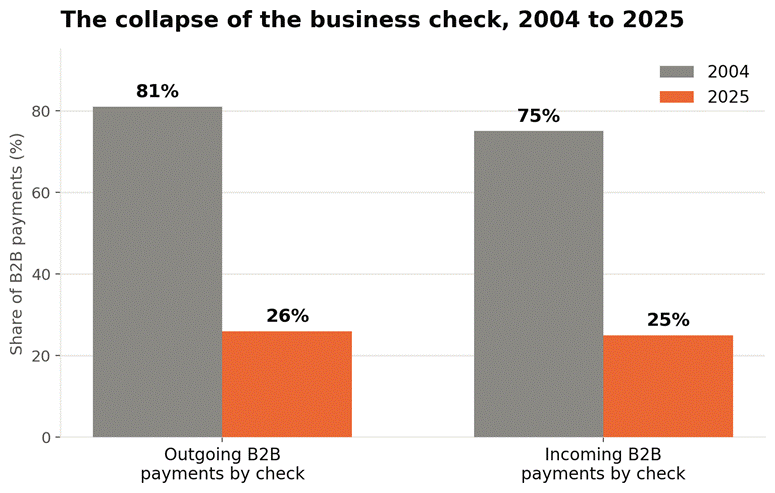
The decline of the paper check can be documented by what can be described as the slow death of the transactional paper check in the business world. The paper check held on far longer in the business world as a means of sending payments. A recent study observed that in 2004, 81 percent of outgoing business transactions were conducted by a paper check. By 2025, that number fell to 26 percent. Incoming payments will follow a similar trend, decreasing from 75 percent to 25 percent of total business transactions. Even the government has implemented measures to increase the shift away from paper checks to electronic transactions.

image 120

Figure 4. B2B check use has collapsed since 2004, with both outgoing and incoming payments falling by roughly 50 percentage points as businesses move to digital rails.

Digital rails didn’t make money disappear, and checks are becoming digital. In the same time frame, payments made through the ACH network more than doubled, going from 2.9 billion to 7.4 billion, and the dollar amount practically doubled, going from $28.3 trillion to $58.2 trillion. There are a few reasons why businesses are going paperless. Digital payments are cheaper, more secure, and more convenient. This is bad news for Deluxe, and the check business will continue to decline. The only way to grow now is to have part of the digital payments. Part of that is Celero.

Questions to Ask Before You Sign With Any Processor

There is a lesson hidden in the countless deals for merchants. In a marketplace dominated by constant mergers, what your prospective processor is sold for isn’t what you need to worry about. You want to ask what you can expect for today’s payment processing fee and what the deal’s long-term implications are. A little detail hunting will help you avoid a lot of future heartburn.

Instead of asking what the payment processing fee is, first ask for the total cost of acceptance. You can ask about the payment processing pricing model; is it interchange-plus, tiered, flat, or otherwise? In addition to the payment processing fee, what are the payment processing monthly minimums, statement fees, PCI compliance fees, gateway fees, and chargeback fees? In reality, what are the contract’s early termination and length provisions? Long contracts with large early termination fees will potentially be the long-term deal that will protect a bad relationship and get you stuck if the company is sold. What is the payment processing fund withdrawal and clearance policy? Is a rolling reserve held against your account?

Consolidation creates some urgent questions. Is your payment processing rate guaranteed, or is it an introductory rate? What is the advance notice when your pricing is changing? You need to ask what happens to your payment processing terms when the company is sold or if the company has the right to assign your contract without your consent. When a company is sold, who keeps your payment processing data and your customer data?

You should ask how support is structured. Do you get a direct support contact or do you just have access to a support line? How fast do they expect to solve your issues? These answers will help you determine if you are signing on with a stable partner or if you are just maintaining a contract for a rate that may not last the year.

Contract, Rate, and Service Red Flags to Watch in a Consolidating Market

There are warning signs in any market and signs in a consolidating market should make merchants even more cautious. The most obvious example is a contract with a hidden exit. If a contract has a multi-year term and a large early-termination fee, or an agreement that renews automatically each year, trapping you unless you physically remove it during an extremely brief time frame, then it is designed to make you pay for the slip even if you don’t use the service. In a market where anything can happen overnight, being locked in a contract is the opposite position you want to be in.

The main focuses of rate red flag concerns center around what is absent. Be very cautious of a quote that is significantly less than the market average. The difference is usually made up through fees that were not disclosed to you. The same can be said with tiered pricing that places transactions in large “non-qualified” buckets that are vague, teaser rates that are made to expire, and extremely curt statements that make you unable to figure out what you actually paid. These are all signs of a processor that is competing on obscurity. If a salesperson cannot straightforwardly explain your effective rate, that is a warning.

Service red flags are disclosed through a company’s lack of service even before an actual contract is signed. Vague answers about who your support is, the lack of an escalation path, the failure to put promises in writing, and pressure to sign quickly all show a lack of service. In markets full of mergers, even the stability of the provider is something to take into consideration.

A processor that is transparent with its support and terms is more likely to be a partner you can trust throughout any future ownership changes.

Why Service and Stability Matter as Much as Rate

Merchants know that rate is the most important factor when selecting a processor. But as the market consolidates, factors like service and stability are increasingly important as well. If you’re losing deposits because of a failed system migration, or if no one is working on your account and chargebacks are dragging on, a little savings on your rate means nothing. The cheap processor ends up being your most expensive choice because of lost sales and time.

Something like stability is hard to quantify but is important. A processor that has a good service record, consistent stability, and stable ownership is less likely to surprise you. In a consolidating market, a company that honors its terms, maintains its support, and communicates clearly regarding its changes and mergers is a valuable partner. Although stability is hard to quantify, it determines whether you have to solve payment issues every time you sell something.

The bottom line is to consider the value of the service, not just the rate. A good, fair, and transparent rate, stability, and value of service will always be a better deal than a rigid contract and a cheap call center. The Deluxe-Celero deal is a good example of how the name on your statement changes, but service and stability should be valued even then.

What to Watch Next in Processor M&A

The deal-making is not likely to slow down any time soon, but there are a few trends to keep an eye on. The first trend would be more of the same: the large processors acquiring software-led companies that have strong merchant relationships to acquire the customer. Expect the mid- market to be a busy place as larger companies acquire other companies to strengthen their market positions. This is also true for Celero. Larger companies are more likely to acquire companies to build their business as opposed to building their business from the ground up.

The true test of the consolidation will show how well the integrated companies are able to provide better technology and pricing for small to mid-sized businesses (SMBs). The elimination of competition will likely result in price increases, as is the case for other large mergers. After an acquisition, the price of any offered service may increase, and the service quality may improve. If it doesn’t, it’s likely the company is reneging on the promises that were made during the merger. Watch the continued shift from paper. For each check that is converted from a paper check to a digital payment, it gives legacy companies such as Deluxe a reason to forcefully acquire companies to keep up with the digital payment revolution.

Small to mid-sized businesses will benefit from remaining flexible and having the ability to adjust. Pay attention to contracts that allow you to move or change if there are new terms. After a change in ownership, always watch your statements. Concentration of market power will dictate which financial institution/processors will be providing merchant services to your business.

Conclusion

Deluxe spending $625 million buying Celero Commerce is a big deal. Deluxe is a company largely operating in the paper check space that is now diversifying and buying its way into digital payments. Check payments are in steep decline. This deal pushes payments and data to 57% of Deluxe revenues and makes the resulting company one of the top ten non-bank U.S. merchant acquirers. This deal is evidence of a legacy company choosing to reinvent itself over continuing its downward trajectory.

For small merchants, this deal is one small piece of a much bigger story. This is further evidence of consolidation in the acquirer marketplace, from the $24.25 billion Global Payments – Worldpay deal down to more mid-market deals such as this one. The first-order effects of a processing company being acquired are sometimes benign, but the second-order effects, such as new fees, new names, and service that is now much less customer-oriented, can be profound. The same defense is more important now than it was before. You must ask the hard questions much more than before, watch out for red flags for contracts and rates, and consider stability and the quality of your service well above the costs. A processor that was chosen for its transparency and reliability is one that you can trust to retain that reliability when ownership changes.

Frequently Asked Questions

  1. What did Deluxe acquire and for how much?

    In an agreement announced in June 2026, Deluxe has planned to buy payments processor Celero Commerce for $625 million in an all-cash transaction. This purchase is expected to close in Q3 2026.

  2. What is a merchant acquirer?

    A merchant acquirer is a company that processes card payments for businesses and transfers money from the customer’s account to the merchant’s account. It manages the behind-the-scenes work for every card payment a business accepts.

  3. What happens to my account if my payment processor is bought?

    Initially, only minor changes happen, and payments continue to go through as before. However, you should check your bank statements after every acquisition, as there may be a new company name, fee changes, or a platform migration.

  4. How do I choose a payment processor?

    Look beyond the headline rate and consider the total cost of acceptance. Review contract duration and penalties for early contract termination. Examine the quality of the service and the stability of the provider when placing your order, alongside or in preference to the price.

  5. Are paper checks still used in business?

    Yes, but it has decreased significantly. In 2004, B2B check payments made up approximately 80% of total business payments. By 2025, this number dropped to around 25% as businesses continue to make the transition to ACH and other digital payments.

Open USD

Visa, Mastercard, and Coinbase Launch “Open USD” in 140-Business Stablecoin Consortium

Visa, Mastercard, and Coinbase have made a very public bet as they’ve joined over 140 other companies to launch Open USD, the latest venture to create a dollar-backed stablecoin for business payments, placing the card networks in the midst of a decade-long war with crypto. The news came out in July of 2026. The stablecoin is designed for all business owners and merges payments with the crypto space innovatively, and for the business owner watching from the sidelines, this means stablecoin payments have moved to the next phase. The infrastructure for stablecoin payments is now here.

This is a significant leap forward, and with participants like Visa, Mastercard, and major technology firms, this consortium is a who’s who of global finance and technology. The innovation is even enough to disturb the current market leaders. The announcement and implications will be discussed, as well as the reasons this venture still has significant drawbacks.

What Open Standard and Open USD Are, and Who’s Behind Them

What Open Standard and Open USD Are

There are two components to the launch. One is the organization, and the other is the coin to be issued. Knowing the split is important because without the split, the governance model would not make sense.

Open Standard

Open Standard is the independent organization responsible for the release and management of the new token. They aim for neutral governance. Instead of one company monopolizing the token and profiting from it, Open Standard is managed by a board of directors comprised of member partners. The goal, as stated, is to make decisions for the benefit of the collective rather than for individual token issuers. Zach Abrams is the founding CEO and also the CEO of Bridge, Stripe’s stablecoin subsidiary. This means Open Standard is directly related to one of the largest developers of digital payments.

The organization is attempting to create a particular perception of itself. They want to appear as a public utility service rather than a startup. They want people to think of them like the early stages of card networks, which were created as banking cooperatives. Open Standard is presenting the same ideology for the era of stablecoins.

Open USD

Open USD is OUSD for short. It aims for a value pegged to the US dollar. Designed to operate continuously, including weekends, OUSD aims to settle cross-border transactions with minimal delay. The coin is anticipated to go live in 2026, with the consortium and its rules being formally introduced in the summer of that year. Some reports claim that OUSD will be issued directly on the Tempo blockchain on its launch, which will be the first blockchain to support OUSD, unlike other general-purpose crypto networks.

Abrams stated his position on what OUSD brings to the market. Current stablecoins have their merits. However, to bring the technology to the mainstream and allow businesses to operate at scale with the technology, a token that is open and aligned with the businesses’ interests is needed.

The 140-Company Lineup

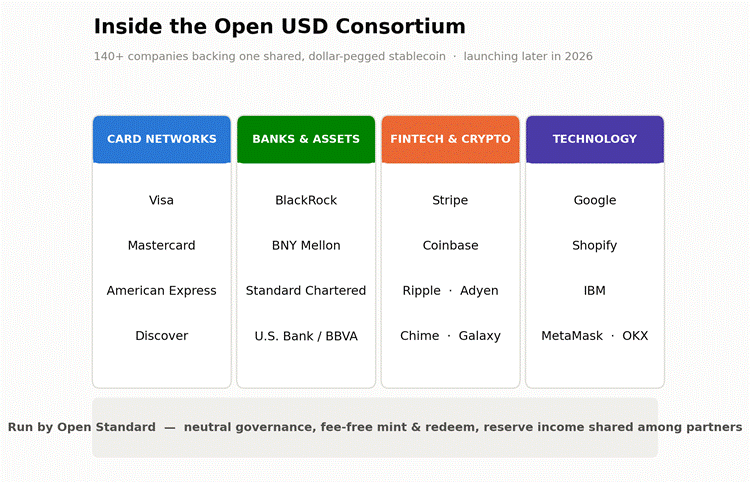
The project’s partner list gives it real value. In the payments space, we find Visa, Mastercard, American Express, and Discover, while in the banking and asset management space, we find BlackRock, BNY Mellon, Standard Chartered, U.S. Bank, BBVA, Huntington, and Citizens Bank, with BNY Mellon announced as the custody partner for the reserves. In the fintech and digital asset space, we find Stripe, Coinbase, Chime, Adyen, Ripple, Galaxy, Bybit, OKX, and MetaMask. Finally, we find Google, Shopify, and IBM in the technology space.

The combination of traditional finance, payments, and crypto in a single project is very uncommon and is the primary reason for the significant interest in the launch.

image 116

Figure 1: The Open USD consortium spans card networks, banks, fintech, crypto and technology.

What Is a Stablecoin? Plain English and Why the Dollar Peg Matters

What Is a Stablecoin

Strip away the jargon and a stablecoin is a simple idea. It is a digital token that aims to keep a consistent value. The most common model is to the US dollar, where one token should equal one dollar. The only thing a stablecoin has to do is keep its value.

This is where stablecoins and Bitcoin diverge. The high volatility of Bitcoin prices makes it impractical for use as a standard to compare the value of goods and services, like a cup of coffee. Stablecoins, theoretically, do not have price volatility due to their reserves, where real dollars are held for each token in circulation. Therefore, if one stablecoin is sent, the recipient knows they are receiving one dollar and not a risk of losing value due to price fluctuations.

The peg is essential because payments cannot have volatility. When a payment is completed, the recipient knows the amount paid is the amount that was received, and if the price fluctuates, the payment system would be rendered useless. Therefore, the confidence in the reserves and the peg are the foundations of stablecoins. The peg is lost, and the reason for the token is lost. Therefore, the regulations regarding reserves described below are the most important feature.

Why the Networks Are Backing One Now: The GENIUS Act Context

Timing is certainly the most apparent issue here. Stablecoins have been around for some time, so why are Visa and Mastercard jumping into this space in 2026 and not 2021? The short answer is regulation.

The GENIUS Act

The GENIUS Act, or the Guiding and Establishing National Innovation for U.S. Stablecoins Act, was signed into law in the United States in July 2025. It provides the first federal framework for payment stablecoins. It provides guidelines for previously grey regulations. All payment stablecoins must hold reserves of one to one, with high-quality, liquid assets.

Stablecoin issuers must be chartered or licensed (either federally or by the states), and any bank wishing to issue a stablecoin must do so through a regulated subsidiary. There are monthly attestations, and the reserves must be certified by the Chief Executive and Chief Financial Officers. Stablecoin issuers must comply with anti-money laundering regulations, and issuers must not offer any interest or yields to the holders.

For large institutions, these regulations are a significant change. There is no longer a stablecoin compliance risk. Rather, there is a defined product that institutions and banks can build. With the new regulations, large payment institutions are now able to issue payment stablecoins.

Visa and Mastercard

Regarding the networks themselves, this is defense. Their business is moving money and collecting fees. If someone else uses a faster, cheaper settlement token that cuts across their rails, that is a risk to them. By building the Open USD, they get to design the product instead of watching from a distance. Mastercard’s approximately $1.8 billion acquisition of the stablecoin company BVNK showed the same impulse. “Speed used to be the main differentiator, but the focus has to be on reliability, governance and interoperability,” said Visa executive Jack Forestell. The incumbents want to control the standard now that the railroads are in place.

What “Fee-Free Mint and Redeem” and Shared Reserves Actually Mean

Two phrases in the announcement do the heavy lifting. Both phrases indirectly criticize the methods employed to profit by the current stablecoin market leaders. Minting refers to the process of creating new tokens by depositing dollars, while redeeming means the conversion of tokens back to dollars. Open USD claims it will allow businesses to perform both processes without any costs or limits. For businesses transferring a large amount of money, there is currently a fee for both processes. Thus, eliminating these fees is a marketing strategy targeting treasurers and payment businesses.

However, the biggest disruption in the announcement comes from the phrase Shared reserves. When a stablecoin issuer is in the market with billions of dollars in reserve, the funds remain in short-term instruments and the stablecoin issuer profits from the reserves. Open USD claims that after the management fee, the profits from the reserves will no longer be the issuer’s profits, but profits will be distributed to partners.

Circle

That design focuses on the incumbent’s vulnerable point. Circle, the creator of USDC, generates the majority of its business from exactly this reserve interest. A competitor returning that revenue to partners undermines the core business. The market took notice right away, as Circle stock plummeted on the first day of the announcement, in part due to major backers such as BlackRock and BNY supporting the new competitor. Ark Invest Analysts are less confident Circle will lose its position. They feel Circle has a lot of benefits in distribution that may be difficult for new competitors to achieve. Tether, the issuer of the largest dollar stablecoin, also holds the largest market share and will be difficult to remove from that position.

image 115

Figure 2: Tether and Circle dominate today’s stablecoin market. Open USD is the new challenger.

Where Stablecoins Could Touch Merchants First: Cross-Border and Settlement

When business owners encounter stablecoins, it won’t be when a customer pays in stablecoin at the point of sale. They’ll likely already have stablecoins in their business long before that. Historically, cross-border payments have been the first major business use case for stablecoins. The existing systems are slow and expensive.

Let’s consider a supplier. A traditional payment (e.g., a wire) will take several days and pass through several banks along the way, resulting in several fees. A dollar stablecoin can be sent across the world in a matter of minutes for minimal cost, at any time, with no intermediary banks. For a business that pays overseas vendors or receives international revenue, that system is a major operational improvement. This is the main use case for Open USD, and is why banks and payment processors are involved.

The second major use case is for settlement. If a business accepts a card payment, the money can take several days to be credited to their account. Stablecoin settlement can reduce that wait time to near-instant. Stripe has indicated that Open USD has the potential to become the default settlement token for the businesses on its platform.

This would allow stablecoin settlement to be implemented in the background for regular transactions, with the business not interacting with the token at all. Back-office settlement is most likely to be the first use case for stablecoins.

The Honest Caveat: Still Mostly Used for Trading, Not Payments Yet

Here is the part the press releases gloss over. Even with the wins in the stablecoins space, stablecoins are currently barely used for payments. There is a massive gap between promise and reality.

Research from the Federal Reserve Bank of Kansas City, published in late 2025, quantified stablecoins. With a total market cap of about 300 billion dollars, 48.8 percent of stablecoins were used for crypto trading, 29.3 percent were for transfers, and 21.2 percent were idle in wallets.

Only 0.7 percent were used for payments. That translates to less than 1 cent for every dollar of stablecoin activity that made a payment for goods or services. Monthly payment volume, although it has been growing, was in the range of low tens of billions of dollars, while the stablecoin market cap was in the hundreds of billions of dollars.

image 117

Figure 3: Payments remain under 1% of all stablecoin activity, despite the hype.

That number should set expectations. The infrastructure is coming, the law is enacted, and the biggest players are involved. However, user habits have not evolved. Currently, most stablecoins are traded within the confines of the crypto economy; they circulate between various exchanges and protocols and rarely leave the crypto economy to be used for settling payments.

Open USD is marketed as an improvement on stablecoins by the mainstream players. The issuance of Open USD is not proof of the change that is being anticipated. A headline should inform a merchant and not pressure them.

Questions to Ask Before Stablecoin Acceptance Is Relevant to You

Questions to Ask Before Stablecoin Acceptance Is Relevant to You

What questions should business owners ask themselves to look at this without being sold on the hype? For faster and cheaper settlements to improve your cash flow, do you frequently move money across borders? How about your customers and suppliers? Do they prefer to transact this way?

Or is this a solution searching for a problem within your business? Is your existing payment processor going to support Open USD, and therefore, you might benefit from this without making any changes? Finally, are you still willing to accept the digital cash token along with the remaining tax, accounting, and compliance issues that require you to still hold a digital token?

Most small businesses that service the domestic market (and have had their same-day banking needs satisfied) will find that the acceptance of stablecoins has no relevance at this point. There are important differences for exporters, importers, global freelancers, and platforms that pay creators around the world. It is wise to keep a patient approach and avoid adopting technologies too early, since it is clear that not all technologies operate in the same manner.

What to Watch as Open USD Goes Live

The real test will happen during the official launch in late 2026. There are a few ways to assess if this will be infrastructure or remain a headline. See if Open USD is released on time. If it is, then see if it maintains its dollar peg during its first real use. Also, see if it maintains its shared reserve model during the stated launch.

The true test of that model will be if it erodes due to pressure from regulators or profit. Finally, see if Stripe and the card networks, among many others, direct substantial settlement through the system. The true test of demand will be the settlement, not the partnerships.

Don’t forget about the current players in the market. Open USD will not define the whole market, as Circle and Tether will respond, and how they respond (cutting fees, sharing revenue, etc.) will be as important as Open USD.

If in the next year the payments share starts to increase as Open USD launches, then this will prove that they are not just redesigning the market for stablecoins. If the payments market share continues to stay below 1% then Stablecoins don’t really serve a payment function and are just a tool for trading.

Conclusion

Open USD’s introduction into the market is exciting, not because a new token is available, but because of the companies involved and how Open USD has been organized. When trade giants such as Visa, Mastercard, and BlackRock, in addition to over a hundred other companies, agree to share governance and reserves, it is safe to say that regulated stablecoins will be a core building block of payment infrastructure.

The GENIUS Act cleared the legal hurdles, and the consortium is going through with it. For now, the most identifiable change for merchants will be faster cross-border payment transactions and faster payment transaction settlement.

These will most likely be done by payment processors. The hype is kept in check, however, by data. Trading, not payments, will continue to be the main stablecoin activity for now. The most prudent approach is to acknowledge the shift and adapt if it makes sense for your business. Open USD could be the first stablecoin to bring payment services to merchants, but it is not the first to provide stablecoin services.

Frequently Asked Questions

  1. What is a stablecoin?

    A stablecoin is a digital token that has a value that is usually equal to one US dollar and is backed by reserves. The purpose of stablecoins is to combine the best of both worlds by having the speed of crypto and the stability of regular money.

  2. What is Open USD?

    Open USD will be a business payments-focused dollar-pegged stablecoin designed by the Open Standard consortium, which is a group of 140 companies that includes Visa and Mastercard. It is expected to launch the business payments-focused stablecoin in 2026.

  3. Why are Visa and Mastercard launching a stablecoin?

    The newly passed legislation in the US makes regulated stablecoins possible. As for the legislation, if a competing entity owns the cheap settlement token, it could pose a threat. Supporting Open USD means that the networks will set the standard and not get circumvented.

  4. Can businesses accept stablecoins yet?

    Some merchants can. But adoption is still early. And payments currently represent a small fraction of stablecoin use. Faster settlement, which their payment processor will likely automate, will probably be the first noticeable benefit for most merchants.

  5. What is the GENIUS Act, and what did it change?

    Signed into law in July 2025, the GENIUS Act created the first framework for structuring payment stablecoins at the federal level in the U.S. Inclusive of payment stablecoins, it mandates full one-to-one reserves, charters for issuers and monthly reporting of reserves.

GoHenry

Barclays Acquires Kids’ Money App GoHenry as Acorns Keeps the US Business

A large retail bank has just acquired the first children’s debit card. In June 2026, Barclays reportedly agreed to purchase the UK arm of GoHenry, the money app for 6-to-18-year-olds, for approximately £180 million. The company’s US parent, Acorns, has sold GoHenry to Barclays as part of a corporate realignment. Acorns will keep GoHenry’s US branch as Acorns Early, thus dividing the brand. Barclays gets the UK branch while Acorns gets the US.

Compared to Barclays’ literal and figurative financial muscle, this purchase is small. The acquisition is meaningful for a different reason. This is the first clear example of the embedded finance trend extending the furthest to date, down to the crafting of financial products for kids. This deal will signal to any company that has a family-centric business focus how and where customer loyalty efforts should ideally start. This shows why GoHenry is attractive to Barclays and what implications this deal has for banks and merchants outside of the banking sphere.

image 112

Figure 1. The deal splits GoHenry by geography: Barclays takes the UK business, Acorns keeps the US operation and its European arm.

What Barclays Bought and the US-vs-UK Split With Acorns

What Barclays Bought and the US-vs-UK Split With Acorns

Simply divide the elements to see the structure. Barclays will purchase GoHenry’s U.K. business, GoHenry’s U.K. brand, and the GoHenry app, while Acorns will retain the balance. The transaction is expected to be completed in the fourth quarter of 2026, pending regulatory approval. GoHenry will continue to operate as its own brand and app, under Barclays, and will not be integrated into the main bank overnight.

Barclays

Barclays presented the acquisition as a family play instead of a fintech play. The bank’s logic is lifecycle banking. Winning the parent customer means they will probably win the child as a customer. The bank is attempting to hold the relationship from the first child’s debit card all the way to the family mortgage and pension. The financial cost of the acquisition is minor.

Acorns

In April 2023, Acorns purchased GoHenry to extend its reach beyond the US. Acorns sold GoHenry’s UK division, enabling the firm to focus on the US and allowing Acorns to maintain its youth finance division in the US. Acorns’ Chief Executive, Noah Kerner, stated that the sale enables GoHenry to serve many more kids in the UK. Acorns also retains PixPay, the European teen money sub-company, continuing its family-centered fintech in the region.

What GoHenry Does and Why a Major Bank Wanted It

To understand the GoHenry app, it’s best to look at the functionality. GoHenry is a money management app for children that is far more than a beginner bank app. GoHenry allows parents to set parameters and load funds to a child’s actual debit card, which children can use to make purchases both online and in-store.

GoHenry

Louise Hill’s mission “to make every kid smart with money” started with the founding of her company in 2012. Now, Hill’s company has developed an app that serves users as young as 6. The app gives users a card, chores, and allowance tools, savings goal tracking, money lessons, and has parental controls (for transaction monitoring and category spending blocks) built in. GoHenry is currently serving more than 500,000 children in the UK and an estimated 2.3 million children globally. GoHenry is a subscription-based company, allowing it to operate without money management conflict (as many of its competitors do). As such, GoHenry is a suitable acquisition for banks.

Barclays understands this – so it paid the price GoHenry wanted. Barclays now has instant access to a trusted and established user base and an app designed to engage families and children, cultivating habits and securing brand loyalty in their future adult customers.

The Bigger Signal: Embedded Finance Reaching Youth and Family Niches

Embedded Finance Reaching Youth and Family Niches

To understand why this deal matters, consider it a sign of something much larger. Embedded finance is integrating financial services like payments, cards, savings, or lending into non-bank platforms. It is the “pay in four” option at checkout and the payment wallet in a ride-hailing app. Now, it is a debit card in a children’s chore tracking app.

This deal is just one of many that is aimed at the lucrative embedded finance market. The market for embedded finance was worth an estimated $145 billion in 2025 and is expected to reach $2 trillion by 2034, at a compound annual growth rate of over 30%. Banking for the youth and their families is simply the latest embedded finance market to be captured. When Barclays invests in a kids money app, it is saying this market is no longer fringe. It is actually a competitive market.

image 114

Figure 2. The embedded finance market is projected to grow more than tenfold between 2025 and 2034, with youth and family among its newest segments.

Why the Next Generation of Cardholders Is Being Onboarded Early

You don’t need to be a financial genius to understand the main driver behind the strategy being discussed here. Banks have discovered how sticky financial relationships are. Once customers open a main account, they are unlikely to open a new one elsewhere for the remainder of their lives. This makes it most cost-effective for banks to target children to secure these customers for life.

Investing in a ten-year-old is not financially beneficial with a GoHenry card for today, but that is not the point. The point is to be part of the child’s money life early on. This is why many banks target children. By offering a GoHenry card to children, Barclays is first in line to provide financial services to the next adult generation with a credit card before their competitors even get to pitch their services.

image 113

Figure 3. A kids’ card is the entry point to a decades-long banking relationship, from first allowance to mortgages and retirement.

What Businesses That Serve Families Can Take From the Trend

You are not required to be a bank to take these lessons. Any business that works with families has the same opportunity Barclays just bought – to build an early, trusted relationship with both the parent and the child. The early and useful relationships are the ones that are rewarded the most.

Think about the businesses that have great regular contact with families. These are gyms, tutoring centers, kids’ activity clubs, and family subscription services. All these businesses interact with the same families repeatedly. All these contact points can be enhanced with a financial or loyalty component. The point of contact can be a stored-value card or a loyalty card integrated with the academy’s concession. The insight is not to provide financial technology, but to see that families are increasingly looking for and expecting financial technology within the services that they already use. These solutions make the businesses that provide financial technology integrated services the most sticky.

Financial Wellness as an Engagement and Loyalty Angle

Financial Wellness as an Engagement and Loyalty Angle

This matters outside of the plumbing. GoHenry did not win over parents by providing a card. They earned the trust of parents by saying they would help parents teach their kids about money. Framing teaching kids about money as a service and not a product creates a loyal customer base, as it helps parents become more financially well-off.

Parents worry about kids growing up with the same guilt about money and no financial advice. A brand that offers a solution to that worry, by providing a lesson, setting a goal to save, or by providing a simple financial dashboard, will earn loyalty and goodwill, which in turn becomes retention. Parents will appreciate the tool and thus become loyal customers. The lesson any family-oriented business will learn is to provide the solution first. That solution is a financially confident and capable child, and the transaction can be out of sight. The wellness of the parent is the means, the engagement is the end, and the loyalty is the outcome.

Where Embedded Finance Shows Up for Everyday Merchants

For merchants, understanding this concept can be a little abstract until it reaches the point of sale. In reality, the trend of embedded finance touches most businesses via the applications that they currently use. Most of the time, this does not involve custom development.

It appears as “pay-over-time” options at checkout, branded gift and stored-value cards, instant refunds to a stored-value wallet, and flexible financing for larger purchases. These capabilities are bundled by payment and point of sale providers, making the activation of any of these capabilities as simple as flipping a switch in a settings menu. The most applicable element of the GoHenry story is that finance is an embedded feature in other products and services. A merchant that recognizes this trend is able to reach customers, including the younger customer segment, in the places that they already are.

What to Watch Next in Family and Youth Fintech

The GoHenry deal is a milestone, not a finish line. Expect more competition and more players in this space. Rivals like Greenlight, Step, and Current focus on the same families, and a bank-formed GoHenry will force them to enhance their offerings.

There are three main things to keep an eye on. First, other major banks are likely to create their own youth banking offerings or make purchases similar to Barclays. Second, more advancements and integrations in the space are expected. The offerings will likely move from prepaid cards to banking, investing, and credit services as the child gets older. Third, there will be scrutiny and more regulations around these offerings. Banking services for kids create scrutiny for data, marketing, and service fees. Family and youth-centered financial technology services are likely to become the main services offered, and the Barclays acquisition is likely the first of many large purchases made for this space.

Conclusion

This is a story about timing and trust, with branding stripped away. Barclays reportedly wanted to pay £180 million for a children’s app to strengthen the connections they expect to maintain for the next fifty years, while Acorns maintained the US business to protect this turf outside the US. The specifics of the deal will fade, but this deal structure will not. Banking is being integrated into the most common activities of a large segment of the US population, and the connections are getting started at the youngest age ever.

For business owners, the useful response to a bank’s children’s money app is not pain from seeing the bank’s big deal. It is the recognition that the factors that made the children’s money app a bankable deal—including formative loyalty, integration, and a financial wellness connection—are also within the reach of almost any service that is directed at families. You don’t have to be a bank to do this. You have to know that the tools of financial management are moving into the services people already trust, and position your service among them. Start your relational connection with a great service, and they will stick with you.

Frequently Asked Questions

  1. What did Barclays acquire and why?

    Barclays is said to have purchased GoHenry’s UK business for about £180 million. The acquisition allows Barclays to build a relationship with current customers and families that may yield future clients.

  2. What is GoHenry?

    Children and teens from ages six to eighteen can use GoHenry to learn about money practically. With GoHenry, children and teens can have their very own prepaid debit card, and parents can have peace of mind knowing that they have parental control over the card. GoHenry users can also set savings goals.

  3. What is embedded finance in simple terms?

    This refers to financial instruments, such as bank and payment cards, incorporated conveniently into non-bank products, payment systems, or savings. A common example is the pay-over-time option during the checkout process.

  4. Why are banks buying youth-focused money apps?

    Once the financial relationships are established, it becomes challenging to change them. Hence, the financial institution captures the customer for life if they capture them during childhood. From this perspective, offering a kids’ card is a low-cost customer acquisition strategy.

  5. What does the family-fintech trend mean for small businesses?

    Families seem to expect that the services they use will provide them with some type of financial products or money tools. Businesses that provide tools with loyalty programs, stored value, or pay-over-time will have deeper customer retention.

Bank-Backed BNPL

JPMorgan and Bank of America Roll Out Their Own Buy Now, Pay Later Plans

The checkout feature that lets you pay over time has shifted from fintechs to banks. Klarna, Affirm, and Afterpay reigned over that ‘pay in 4’ line. All the banks could do was sit and watch. That’s over. As of June 2026, Bank of America, along with the other big players, JPMorgan Chase, Citi, and U.S. Bank, will offer their customers the ability to pay in installments. Now, 4 out of the 5 largest banks have jumped on the opportunity to offer customers the ability to pay in installments.

For the small-to-mid-size business owner, this is less about banking news and more about you (and your customers) at the checkout line. The Bank-Backed BNPL options means your customer will likely have an option to pay in installments via the card they already use. Your customer will also expect to pay later when they check out with you. This guide clarifies what the banks have planned, the differences from Klarna and Affirm, and their new focus on debit cards that offer these plans.

It also gets practical and explains how widely available BNPL will be, what additional pay-over-time options will mean for your checkout, and how to add pay-over-time options WITHOUT having to completely overhaul your payment stack. The goal is to provide a clear answer to the question every merchant is now asking, which is whether pay-later options should be offered, how, and when.

image 101

Figure 1. BNPL originations climbed from under 20 million loans in 2019 to more than 335 million in 2023, the growth curve the banks are now chasing.

What the Big Banks Announced and How Their Plans Differ From Klarna and Affirm

JPMorgan and Bank of America

It’s a simple headline. The largest U.S. banks are not going to leave a big payment market to the fintechs. Each bank built its own version, and while there are some variations in the details, the result is the same. The bank that you already hold a card with now wants to be your pay-over-time provider too. This is what each bank rolled out.

Bank of America

As the most recent example, Bank of America is offering a flexible-payment plan starting June 2026. With this plan, customers can make a purchase and choose to have that cost divided into equal payments over the next three to eighteen months. Unlike traditional payments that incur a cost each month with the potential of a balance remaining, Bank of America charges a preset, one-time cost that the customer pays in advance. This plan emulates the functions offered with a payment app, but Bank of America offers the function on cards already in the consumer’s possession.

JPMorgan Chase

JPMorgan Chase made the biggest splash in the buy now, pay later crowd with their “Pay in 4” product associated with debit purchases. For the cost of a five-dollar fee, if a payment is missed, a customer is allowed to evenly distribute purchases between the values of fifty dollars and four hundred dollars over four separate payments. Chase has been the first to market with this product and has expanded it across multiple channels. The hyperlink to the debit is important, and we will revisit this construct to highlight why it is the most disruptive factor in the entire Pay in 4 story.

Citi and U.S. Bank

Citigroup was the first to use a flexible payment model for its credit cards in 2019. However, unlike most companies, Citigroup didn’t provide a debit card equivalent. U.S. Bank entered the market with a credit card in 2025, allowing users to divide a purchase into three equal payments over three months, with a small fee (around 1.5%) for extending the payment. Other local banks like KeyBank and Old National are also introducing their own products. It’s obvious that the market is changing, and installment lending is going beyond fintech and into traditional banking.

The main difference that banks have over the fintechs is both trust and payment systems. Klarna, Affirm, or Afterpay reach their customers through a separate account and app, and they underwrite every customer at the point of sale. The banks reach their customers through an account and a card in their everyday banking. The banks are relying on a customer relationship that may be years old. It is the same convenience at checkout, but very different systems are behind it.

Klarna and Affirm

The fintech originals set the standard for what customers expect today and should therefore help us establish a benchmark. Affirm and Klarna essentially built their models within the merchant’s checkout and introduced customers to an instant “pay over time” option for purchases.

Customers may prefer this option over using a credit card. Both firms approve customers instantly, take the risk of nonpayment, and pay merchants the full amount. The reach of both firms is extensive and is the primary reason banks decided to enter this market, rather than forgo it. To understand one large fintech player in this market, you can check out the Afterpay, Block, and Cash App Pay analysis to see how this system functions for merchants.

Credit-Card Installments vs the Newer Debit-Card BNPL Twist

Credit-Card Installments vs the Newer Debit-Card BNPL

Most bank installment plans are attached to a credit card. The customer has an extended credit line, and the bank offers to convert a large purchase to a series of monthly payments. While useful, this is not a novel idea. Real innovation is happening on debit.

Debit-based BNPL is a new idea, and is the reason why Chase is offering this product. Around 130 million people in the US rely on debit to make purchases. Many of these people either do not own a credit card or prefer not to use one. Traditional BNPL from the fintechs was designed to cater to these debit-first consumers, and is a large reason for their rapid growth. Now, the banks are offering these consumers the ability to make purchases directly from their checking account, and not from any line of credit.

image 97

Figure 2. Credit-card installments simply repackage an existing credit line, while debit BNPL reaches the large group of shoppers who avoid credit entirely.

For merchants, it increases the chances a customer will say yes to a larger sale. A shopper who would otherwise never incur a credit balance may now buy a $200 item by using their debit card to pay $100 for each of the two installments. With the bank taking care of the details, the customer feels in control, and a sale that may have otherwise been lost now goes through. This is the quiet debit twist promise and is the feature most likely to show up at your checkout in the coming year.

The Data: How Widespread BNPL Use Has Become (and Who Uses It)

It is easy to see buy now, pay later (BNPL) methods as catering to a specific type of online consumer, but the data indicates such a view is myopic. BNPL methods have quickly transitioned from a peripheral payment option to a popular and convenient method of payment, making the deliberate choice to disregard the option a legitimate threat to a business’ strategy.

Looking at the numbers from the Consumer Financial Protection Bureau, BNPL loan originations have increased from approximately 19.8 million loans in 2019 to around 335.8 million loans in 2023. In the same period, the dollar value of the loans in the market increased from approximately $2.7 billion to $45.2 billion. In 2023, there were 53.6 million BNPL users, an increase of 12 percent in a single year. These numbers reflect a payment method that has permeated the retail industry, as BNPL methods have become a popular payment choice.

image 98

Figure 3. BNPL adoption is broad and skews young, with more than a third of adults and half of those under forty using it recently.

As the coverage of the service increases, so does its depth of use. For example– in 2023, the average BNPL user borrowed from each lender 6.3 times compared to 5.7 times in 2022. In addition, each user spent an estimated 848 dollars in the BNPL service that year. Surveys from early 2026 showed that 37 percent of adults in the United States (and about half of adults under 40) used BNPL services in the last 90 days. The typical loan that users take is around 135 dollars, meaning that this service is less likely to be used for big purchases and is likely used for small, more frequent purchases. So, if you are a merchant, then this is the service that your consumers want, whether you are offering it or not.

Why Bank-Backed BNPL Users Report Higher Satisfaction

Bank-Backed BNPL Users Report Higher Satisfaction

Merchants should take an interest in the following finding. According to J.D. Power, users of the Buy Now Pay Later (BNPL) service from banks reported greater satisfaction when compared to users of the service from traditional FinTech companies. This finding is especially important because understanding the greater satisfaction from bank-provided BNPL services will help merchants predict trends in the eCommerce and payments market.

The most plausible explanation for the greater satisfaction from bank-provided BNPL services is trust and seamless integration. Unlike traditional fintech-named BNPL services, if a bank offers its own BNPL service, it is offered for use within the customers’ bank account, card, and banking statements. This means that customers do not have to worry about a new app, a new brand, a new loan, or payment data. This reduces the anxiety associated with banking loans, which results in greater satisfaction.

The greater satisfaction can be explained by the confidence customers have in banks compared to fintech companies. Fintech is known for rapid and aggressive growth, and this can cause anxiety and a lack of confidence in customers. Because banks are large and financially regulated, customers have confidence in the banking system. For a merchant, the payment service system providing greater satisfaction to customers will have a lot of positive impacts. It translates to fewer payment disputes, fewer returns of purchased goods, and a positive experience of eCommerce, which diminishes the anxiety and stress associated with shopping.

What More BNPL Options Mean for a Small Merchant’s Checkout

The banks are onboard, the fintechs are entrenched, and customers have adapted to all of it. What changes for you? It’s time to prepare for pay-over-time to be integrated into every modern checkout system.

When pay over time was only a part of the fintech world, it was an optional service for most merchants. It is no longer an optional service. Now that the largest banks have begun to push installment services through their cards, the real ambient nature of the service is just beginning. Your customers will be exposed to the service (through their banking apps) time and time again. With each exposure, the expectation that they can pay over time with you grows. A system that only allows checkout by pay-in-full is beginning to feel antiquated. The same way that customers felt the need to go to a store that did not only accept cash.

image 99

Figure 4. As bank and fintech options multiply, pay-over-time moves from a differentiator to a baseline checkout expectation.

It’s safe to say that, as with most things, competition has an upside and a downside as much for your business as for Buy Now Pay Later (BNPL) service providers. In the long term, the BNPL competition causes the service fees to decline and the offerings to increase, which benefits merchants. Greater competition among pay-over-time service providers, for example, allows merchants to implement pay-over-time features via integrated fintech solutions or through payment card networks. Today, the bigger concern is not whether a pay-over-time checkout solution is warranted, but rather what the solution’s impact will be on your business. This touchstone focuses on the long term and the willingness to invest in a pay-over-time solution that has a positive impact on your business.

The Cost-and-Conversion Question: Lift vs Fees vs Cannibalization

This is where you find out if you should implement BNPL in your business or avoid it. There’s a cost associated with offering pay-over-time, so you have to be careful with your analysis. Weigh the boost in sales against the payment processing fees and the risk of cannibalizing potential sales—that is, paying BNPL fees on sales you would have made anyway.

Let’s start with the boost in sales, as it is significant. Research shows that implementing BNPL during the checkout process results in sales with larger average order values (AOV) and an increase in sales conversion rates. There’s an increase in sales when you offer checkouts with pay-over-time that can increase average order values (AOV) by 10-30%, and many BNPL providers state that the improvement can be even greater depending on your product offerings. Many shoppers will not purchase if the total cost is high, however, if you offer pay-over-time with a total of $400, shoppers will be much more willing to purchase the product offering.

The Fee Side of the Ledger

Now for the cost. BNPL comes at a higher cost than standard card processing. A merchant should be aware. Standard card processing cost typically runs about two to three percent. BNPL cost is typically four to eight percent. Klarna typically charges about 3.3 to 6 percent plus a flat fee, Affirm charges about 6 percent, and Afterpay about 5 percent. Although it is more expensive, it buys you the sales lift and transfers the repayment risk from you to them, but it does cut into your margin and will only be worth it if the increased volume is greater than the cost.

image 100

Figure 5. BNPL acceptance costs roughly two to three times standard card processing, so the sales lift has to be large enough to cover the gap.

The Cannibalization Trap

The most insidious risk is probably cannibalization. If a customer was going to buy an item for one hundred dollars anyway and you incur a six percent BNPL fee on it, you have given away margin on a sale you had. BNPL earns its cost when it incentivizes customers to buy an item that would not have been purchased, and not when it redirects a sale to a more expensive option. The math is most precise when it is clear that when BNPL is offered, average order value and conversion rates increase. The BNPL fee is justified when it offers large orders and the fee is cost neutral. If the opposite is true, you pay customers to pay you more slowly. If your card costs are a concern, our guide to ecommerce payment processing gives you the baseline you should refer to.

How to Add Pay-Over-Time Without Rebuilding Your Payment Stack

The good news about providing pay-over-time options for small businesses is that it no longer requires a lot of engineering effort. The market has progressed to the point that offering pay-over-time options is a near plug-and-play process, and in most cases, you do not need to modify your core systems to enable it.

Many modern payment and e-commerce systems have buy-now-pay-later (BNPL) capabilities. Enabling it is usually as simple as selecting the right provider within your payment systems dashboard, and the pay-over-time option is added to your checkout. Because these options typically work within your current payment processor and your current e-commerce system, you avoid most of the headaches of a new system integration, new payment terminals, or a new reconciliation process. The payment provider takes the risk of approving the customer and the repayment risk, and you receive the full payment within a day or two, less the payment provider’s fee.

The smarter way to approach this offering is to view it as a settings change rather than a systems change. Look first at the current capabilities of your payment provider, and offering pay-over-time for higher-cost products is the most reasonable first step. Based on the relatively new technology in the checkout space that enables purchasing via installments, it is reasonable to assume that the purchasing landscape will change rapidly in the near future.

With BNPL, we should feel like we’re flipping a switch, not renovating the whole store.

What to Watch as Banks and Fintechs Keep Competing

One thing we do know is that the market is going to keep changing and not stabilize. Banks and fintechs are competing for the same checkout moment, which will continue to change what merchants have available to them. Below are trends that will be important to monitor.

Monitor the fees first. Price competition occurs, and merchants end up with better outcomes when large banks enter the markets that were originally dominated by fintechs. Also, monitor the debit expansion. Chase’s model of splitting payments is likely to be adopted by other banks, and therefore, when payments are split, shoppers will have the option to do pay over time without the use of credit. Lastly, watch and see how these financial innovations are integrated into the card networks and banking apps your customers use. The more integrated these financial innovations are, the more customers will expect these innovations.

The practical approach for a merchant is to remain flexible. Be adaptable to changes in the market. Choose a payment infrastructure that allows you to change providers as the market changes. Continue to measure your outcomes against the fees. The value of a competition between banks and fintechs is positive if you view buy now pay later as a lever to constantly adjust rather than a once-and-done decision.

Conclusion

JPMorgan and Bank of America’s launches of Buy Now Pay Later (BNPL) services may grab the media’s attention, but this is also proof that fintechs no longer own the ‘pay-over-time’ space. Now, it comes in the form of the cards your customers already use. Bank BNPL is familiar, will most likely improve Customer Satisfaction (CSAT), and even has a debit-based option to reach customers your offer credit couldn’t. From a merchant’s point of view, this will be a game changer. More customers will expect an installment option, and a pay-in-full-only checkout will feel like a limitation.

BNPL should not be rushed into. There is most likely an increase in sales with higher value transactions, and a greater rate of transaction, however, the costs will also increase to 2-3x the cost of a standard card transaction. Your sales should not be negatively impacted. Keep an eye on the order value and transaction conversion after launching the service. The ‘pay-over-time’ option is probably already integrated into your payment solution, so start with that and expand the service offering only when justified. The banks and fintechs will continue to compete and shift the market, so be flexible and offer different service options to justify the cost. Bank BNPL will present you with opportunities and not limitations.

Frequently Asked Questions

  1. What is bank buy now, pay later and how is it different from Klarna?

    It enables customers to divide a purchase into equal installment payments. Unlike Klarna, this option relies on a card and account already in the customer’s possession, requiring no additional app or account.

  2. Should a small business offer BNPL at checkout?

    Usually, yes. This is the case when you sell higher-priced items and the larger shopping cart value minimally impacts the cost. Begin with the least amount, compare the increase to the cost, and only expand where the numbers justify it.

  3. Does offering installment payments increase sales?

    Typically, Buy Now Pay Later (BNPL) increases the average order value by 10 to 30 percent. It also enhances the checkout conversion rates, particularly with larger purchases. The benefit is only recognized when it is additional (incremental) sales, not for the sales you already made.

  4. What does BNPL cost a merchant?

    Expect charges around four to eight percent for each transaction compared to the standard two to three percent for typical card processing. You get the money first, and the provider carries the repayment risk, so you get charged that fee.

  5. Is BNPL available on debit cards now?

    Yes, JPMorgan Chase has a debit-based “Pay in 4.” Debit BNPL is growing rapidly in the market and allows customers to split payments directly from checking with no credit involvement at all.

Surcharge Backlash

How to Talk to Customers About Card Fees Without Losing the Sale

Your customers aren’t mad about card fees. It’s about the lack of communication. A customer taps the card they have tapped hundreds of times before and is met with an unexpected fee. This customer is now instantly thinking about all the times they have been taken advantage of by a business they considered trustworthy. Your customer thinks they have been given a fee to use your business, but the fee was negligible. The surcharge backlash impact was not.

Most owners don’t understand that the customer is not upset about having to pay card processing fees. The fees are expected and commonplace. Most customers have paid a processing fee before. The customers who do stop using your service are no longer considering the percentage of the fee. They are upset about the lack of communication. This guide is to help your business achieve better communication.

You will learn how to talk to customers and explain a processing fee in a manner that your customer is more inclined to accept, how to reframe a fee as a payment choice, how to convey the message through signage and staff scripts, how to handle the very rare upset customer, how to confirm your fee and communication are compliant, and a plan to implement this new communication strategy within a week. Communicating the fee correctly will save you sales.

image 4

Figure 1. The same fee lands very differently depending on whether the customer heard about it first.

Why Most Surcharge Backlash Is a Communication Problem

Surcharge Backlash Is a Communication Problem

Customers think nothing extra comes out of your pocket when their credit card or debit card goes “swipe.” Because of this, when customers notice sudden added fees on their statements, they don’t understand that every card swipe costs money and therefore think you are charging extra money for your products. Because of this, your customers will perceive you as stealing from them, and begin to look for alternative solutions, quoting the “stealth charges” as the reason. The problem is not the amount of the fee; the problem is that the fee surprises them.

Considering the additional costs, nearly 60% of cardholders don’t consider a surcharge by itself a reason to complain. What’s worse, many of those same customers say they would switch to another vendor over a surprise surcharge. The reason for this contradiction is that the surcharge itself is not the issue; it’s the unexpected fee, discovered at the moment customers are about to pay, when they are most vulnerable.

image 8

Figure 2. Most shoppers have already met a surcharge, yet many would still walk over a badly handled one.

This development should benefit you. Communication issues are the easiest to resolve. You cannot influence the costs on card networks, and there are times you cannot eat those costs. However, you have full control over the information provided to the customer before they get to the register. Essentially, every point in this guide aims to move the moment of discovery earlier. Instead of the unpleasant surprise at checkout, you can provide the customer with a notification well in advance. An expected fee is just background noise, and that is the ideal situation.

Surcharge, Cash Discount, or Service Fee in Plain Customer Language

To explain a fee to a customer, you first need to understand what fee you have. The industry has four words for this, and they are not synonymous. Each term has its own fee rules and its own feel at the counter. Choosing the wrong term will confuse the customer and may also put you on the wrong side of the card networks.

Surcharge Versus Cash Discount

A surcharge means a percentage is added to the price when a customer pays with a credit card. The price as seen by the customer remains as is, but the fee is displayed on a separate line at the checkout. On the other hand, a cash discount means the posted price is increased to cover the cost of card acceptance, and the price is then reduced for customers who pay by cash or debit. The cash discount and credit card surcharge may result in the same price, but the perception of the price will be different. A surcharge is perceived as an additional cost, whereas a cash discount is perceived as a payment received for a service.

The cash discount vs credit card surcharge mechanics balance in pricing, but they do not in the perception of the price, and that is what is most important to a business. Consumers will always perceive a deal favorably over a price increase. However, in pricing, the surcharge or cash discount must be kept honest. Discounts can be claimed only if a surcharge is legitimately in place. If a surcharge is dressed up as a discount, customers and card networks will treat it as a surcharge.

Convenience Fees and Service Fees

The other two terms are more specific, and most small businesses shouldn’t go for them. Convenience fees are charges for people who choose to pay with one of the other payment methods, like paying online instead of in person, and are restricted to certain scenarios by the card networks. Service fees are even more specific, and are reserved for card acceptance by government and educational institutions. Using either term in a loose manner invites confusion for the customer and compliance issues for the business. For the average shop, salon or clinic, the real choice is between a clear surcharge and a cash discount framing.

The Framing That Works: Choice and Savings, Not Penalty

Two companies can charge the same price and receive completely different responses. This is primarily due to relative framing. Framing a price as a penalty for using a credit card versus framing it as a price that is a few cents less for cash or debit is the same effective price for both. Framing is not spin. It is narrating the true price and value in a customer-acceptable manner.

Lead With the Reason, Not the Charge

A cost that is explained generates customer forgiveness. Therefore, you should tell them the reason for the fee first. If a customer pays with credit, card networks charge you. If you choose the option of not absorbing the fee, it is fair that you charge customers who choose to pay with credit. Passing the cost along means customers who pay cash are not subsidizing those who pay by card. This sentence explains everything. You are being fair to everyone.

image 6

Figure 3. The same fee, reframed from a penalty into a choice, changes how customers respond.

Always Point to the Free Path

A choice is only a choice if there is another door. This is the most important habit in successful communication. Whenever you mention a card fee, also mention how to avoid it. Fees are completely waived by payments made by debit, cash, or check. That simple addition changes the entire communication. The message no longer communicates that the customer is being trapped into a fee. Rather, it provides the customer a choice, which most people will still decline, shrugging and paying with the card anyway. However, the trapped feeling is completely avoided, and a customer with a way to avoid a fee is rarely dissatisfied.

Signage That Does the Talking Before the Counter Does

You have already had the best surcharge conversation before anyone spoke. Good signage does this. It shifts the moment of discovery from the register to the doorway and the menu, where the information is presented in an “I’m just telling you” way rather than a “surprise, gotcha” and is, therefore, not a problem. Additionally, signs that are clear and unambiguous assist in meeting a compliance requirement, so doing them right is a win.

Where the Signs Have to Go

Card network rules and common sense agree on where to place surcharge notices. A notice should be placed at the point of entry, which is the front door of a physical store or the landing page of an online store. A second notice belongs at the point of sale. The reasoning is that no customer should get to the point of sale without knowing the fee that they are about to pay. The surcharge is to be displayed on the receipt as a separate line and should not be included (merged) in the total amount paid.

image 7

Figure 4. Disclosure belongs at two points: the entrance and the register, so the fee is never a checkout surprise.

What the Sign Should Actually Say

The wording and placement of signs is valuable. A friendly, law-abiding sign describes the fee, explains how it relates to your cost, and identifies the cost-free option. A clear template is: “We add a small surcharge of X% on credit card purchases, which is not greater than our cost of acceptance, and we never surcharge cash or debit.” This one sentence is designed to accomplish each of the three tasks.

It describes the fee, explains the fee is not a benefit to the company, and illustrates the way to avoid the fee. Use large font, a friendly tone, and plain language. A sign that has the appearance of a legal warning will create the same anxiety that you are trying to avoid.

The 15-Second Staff Script (and What Never to Say)

Signage introduces, but your team finishes. The response your team gives in that critical moment when a customer asks you about the fee in those few seconds defines whether that moment will be calm or turn sour. That is why the script has to be short, warm, and consistent from each and every employee. A confident one-liner is reassuring. Providing a fumbling, apologetic response will invite an argument.

The Line That Works

Post the wording below on the wall near the cash register and teach your staff how to answer complaints about card transaction fees with it: “To use the credit card payment option, a processing fee will be applied, and this is noted on the signage that’s placed by the entrance. If you want to avoid the fee, you can use cash or a debit card.”

Then tell your staff to smile and give the response without dragging it out or wasting any more of the customer’s time while the line forms behind them. With the wording posted, the staff has the option of instantly handing the customer the answer. There is no need for an apology or a long explanation, since neither of those serves the customer.

What Never to Say

What your team should never do is just as significant. Never criticize the customer’s card, argue over who pays what, or become defensive when someone complains. Responses like “that’s just our policy” or “everyone does it now” are combative and dismissive. Lines staff must also avoid including: “let me do the math for you” or “the fee is temporary, I promise”. The goal is to move the customer, briefly and politely, to the next stage in the process. A customer is likely to be calm and composed when the staff behind the counter exhibits the same attitude and treats the fee as a normal, no-big-deal occurrence.

Handling the Upset Customer Gracefully

how to handle customers gracefully

Most customers won’t care enough to complain. A select few might. When this happens, and there’s pushback, the instinct is to get defensive. That’s the wrong move. The upset customer isn’t really unhappy with the three percent fee. They are feeling surprised or disrespected or are feeling that they are being financially squeezed, and that fee is where it all came to the surface. Most of the time, if you address the feeling, the fee stops mattering.

Acknowledge, Redirect, Offer the Exit

This approach is straight to the point and works almost every time. It helps to acknowledge the customer’s frustration. A customer who feels heard quickly calms down. Then provide the reason, in as few words as possible, that due to the increased costs of accepting cards, we decided to add a fee rather than increase all prices.

Then provide the offer: cash or debit avoids the fee, and you are happy to process the sale that way. Most people just need to feel heard and be given a clear direction. The fee to accept card payments was never the real concern; it was the feeling that they had no other options.

Know When to Just Waive It

Limits exist, and successful businesses adhere to those limits. It is almost always correct to forgo a minor fee for a customer of true value. The economics of the situation support waiving the fee. A single charge is negligible compared to the value of a customer who is likely to return for the long term. In those few situations, give your customer service staff the authority to remove the fee without having to call in a supervisor.

This also provides the opportunity for a little customer service magic where that staff member can say something like “no problem, I’ve taken that off for you” and then the customer has a positive experience that they talk about. If you are being inflexible about charging a few cents, then those few cents are probably the most expensive fee you will ever collect.

A Quick Compliance Gut-Check Before You Launch

For the communication to land, the fee program behind it must be legitimate, and the conditions here are particular. This is more of a ‘sense check’; however, this is not comprehensive, and you should definitely give the full compliance brief a read before implementing this. That said, a few requirements tend to snag the majority of businesses, and if you address those, you will mitigate the greatest risks.

The Rules That Trip People Up

First, consider where you do business. Only a handful of states completely ban credit card surcharging, so where you do business largely determines whether you can implement a credit surcharging program. The next consideration is cost. While you can surcharge for the cost of accepting the payment, the cap on surcharges is generally three percent. Next is the debit rule. This is an absolute Federal rule, and you can never surcharge debit or prepaid cards, even if the customer runs the card as a credit transaction.

Lastly, your processor (acquirer) must be notified 30 days in advance of the surcharging program, since the card networks no longer take that notice directly, and every surcharge must be listed as a separate line item on the receipt.

The Card Networks Set the Ceiling

Visa and Mastercard

Because the card networks set the caps for everyone, their rules should be acknowledged. Visa limits credit card surcharges to three percent of the transaction. Mastercard permits four percent, but to stay compliant, most processors impose the three percent cap. The disclosure requirements that both networks have are already covered here and include a separate line on the receipt and signage at the entry and checkout.

Since these rules are dictated by the networks and not by a state, they are applicable wherever the cards are accepted. The network requirements should be considered the minimum in comparison to your state’s law. Thus, your program should satisfy the greater of the two.

A One-Week Rollout for Staff and Signage

A lengthy project plan isn’t necessary for you to launch this successfully. You need a week along with the correct order of operations. Launching too quickly causes the checkout surprises you’re trying to avoid. A short rollout saves you the trouble of losing goodwill. Below is a sequence that is effective for a small business.

image 5

Figure 5. A calm one-week rollout moves the fee from surprise to expectation before it ever hits a receipt.

From Notice to Normal in Seven Days

Confirming compliance and providing the required notice to your processor at the start of the week means the legal groundwork is done before any customer hears a word. During the next few days, prepare and print the signs for the door and the counter, and write a short staff script. By midweek, inform your team of the new updates and walk them through the staff script, and have staff practice asking and answering the questions until the answers become natural.

Two or three days before activation, give your customers notice through email, booking confirmations, and a note at the counter. This way, your regular customers will hear the information from you and won’t have to discover it on the activation day. During the activation day, the staff fluently knows the answers to all questions, and the customers are already expecting the fee, which is the whole point.

Conclusion

Card fees don’t lose sales. Withholding information does. Every adverse response to a fee occurs because a customer was blindsided by a charge. Fix the communication, and the charge is a non-issue.

The strategy itself is simple. Choose the right label so you can describe the fee honestly, and frame it as a choice rather than a trap. Let your signage do the talking early; discovery happens at the door, not at the counter. Give your employees a simple script, warm empathy, and the no-argue discipline, and your customers will feel acknowledged and move on.

Waive the fee when your regular customer is upset. Meet the basic legal and regulatory requirements first, and then roll out the strategy in one calm week of no surprises. This doesn’t require you to absorb costs; it requires you to tell your customers the truth, kindly and early, and show them how to avoid the charge. This preserves your margin and your sale.

Frequently Asked Questions

  1. How do I tell customers I’m adding a card surcharge?

    Tell them in advance. Tell them the reason. Announce the new policy and issue a price change notice a few days in advance via email, booking confirmations, and a note at the counter. Leave no customer shocked at the register. Lead with the reason. Card networks charge a fee on every credit transaction, and you’re not raising prices across the board to cut margin, so this fee is being passed to the customer. In the same communication, suggest the free alternative. Pay by debit, cash, or check to avoid the fee. The goal is to make the price change expected and perceived as fair when the customer first sees the fee on a receipt.

  2. What’s the difference between a surcharge and a cash discount?

    A credit card surcharge raises the price by a percentage and is displayed as a separate charge line at checkout. A cash discount is the opposite. You raise your listed prices to cover card fees, then minimize them for cash and debit payments. The end price may be the same; however, psychologically and emotionally, customers are more inclined to appreciate a discount than an added charge. Whatever you decide to implement, it’s vital that your business practices are consistent with the label you select because your customers will very quickly recognize any time you disguise a surcharge as a discount.

  3. What should staff say when a customer asks about the fee?

    An excellent, warm, and confident response should take no longer than 15 seconds to communicate that a small card fee for processing is posted on the sign by the door. Debit and cash transactions avoid the fee. It is a fact and policy posted for all to see, with a free alternative right there should they wish to take it. Lengthy apologies, explanations of who pays what, or saying, “that’s just our policy,” invite arguments and fights. When your team treats the fee as routine, almost all customers do the same. Treat the fee as an exception, and customers will treat it as one too.

  4. Will I lose customers if I pass on card fees?

    If done correctly, the communication around surcharges can help retain customers, rather than losing them. Surcharging has become commonplace. In fact, most cardholders have encountered surcharges, so the concept is no longer novel. Most customers leaving and taking their business do not leave due to the fee, but because of the surprise when they see it, for example, when it is not communicated clearly and/or ahead of time. People will not be upset with the fee, and in most cases, will move on. Framing a surcharge, or any communication around it, as a choice and clearly offering a fee-free option as a way to pay ensures that most customers accept the charge and move on. A lost sale is bad, but the far more common outcome is customers switching to fee-free debit or cash, which is exactly the tradeoff you want, rather than walking away.

  5. What signage do I need when surcharging?

    You have to post two notices – one at the point of entry (the front door or the landing page of your website) and one at the point of sale (the checkout page). These notices have to state what the fee is, relate it to the cost of acceptance, and mention the free alternative. An example is to say that you add a small percentage to credit purchases, which is equal to the cost of acceptance, and you never surcharge cash or debit. In addition to the notices, you are required to provide a receipt that shows the surcharge as a separate line item (i.e., you are not allowed to hide the surcharge in the total). Visible, friendly, clear signage will help you remain compliant and help maintain your trust.

Slow Season

Beating the Slow Season: Off-Peak Promo Ideas for Salons and Spas

Every salon and spa experiences similar quiet times, like the Tuesday afternoons that never book up, the lulls that follow the holidays when the phone goes quiet, or the mid-summer slow spells when the clients are on vacation instead of in your chair. The empty hours feel like a problem that has to be solved, and the usual solution is a twenty percent off special posted on a sign in the window. It works only temporarily. Then the deal-seekers come, the regulars wonder why they paid the full price, and the valley comes back the next month, only deeper.

The slow season time of the year doesn’t always have to be viewed that way. The goal of the business is to fill the gaps and bring the income that is expected in the future closer to the present and convert the single-time visits into booked appointments. If executed properly, the slow times for a business can become the time of the most potential income for a business instead of the time of most planned markdowns.

The goal of this guide is to share the ways that salon marketing will fill your slow days while avoiding the situation of training your clients to wait for a sale. It will illustrate the cost of unnecessary discounts to your business, the value of time-sensitive offers and prepaid packages, and the most effective, highest value habit your business could implement during checkout. By the end, you will have a promotional calendar that fills your valleys while protecting your rates.

image 87

Figure 1. The off-peak system moves demand into the gaps instead of cutting price across the board.

Why Blanket Discounts Hurt More Than They Help

Why Blanket Discounts Hurt More Than They Help

The general discount is what most owners will default to first. It is also the most damaging. A general discount teaches the clients you want to keep and continue doing business with to wait, attracts clients you do not want to have, and eats into your profit margins, which you cannot afford to lose. The why behind this is the basis for the next smarter business decisions you will make.

The Deal-Seeker Trap

Discounted services may attract new customers, but look at who those discounts actually attract. Your new customers become bargain hunters and are gone until your next discount. It doesn’t help your business, because they will not make your services a regular habit, nor will they pay full price. To make things worse, your new bargain customers will be more demanding than your typical clientele. Your time is precious, and your chair time is gone on the least likely customers to return.

Discounts are easily noticed by your existing customers. Your regulars who pay full price will be the first to notice your discount, and your regulars will feel like they have been betrayed and punished for their loyalty. Your discounts will erode the trust of your most faithful customers and damage your business in the long run, because your services will seem like they are always up for negotiation. Frequent markdowns devalue your services, and customers will be unwilling to pay full price when the discount is no longer available.

The Margin Math a Discount Hides

The actual expense is in the numbers that most owners never run. Discounting a service is not a small reduction. It cuts into your profits. It also requires more volume than a slow season can provide. With typical salon gross margins of around thirty percent, a twenty percent discount means you have to fill two hundred percent more appointments to make the same money as before the discount. The challenge is, during your slowest weeks, you definitely cannot fill that many appointments.

image 90

Figure 2. The extra volume needed just to break even climbs fast as the discount deepens.

The facts show that caution is warranted. Just about fourteen percent of clients abandon a salon to find lower prices. The greatest percentage (almost sixty-eight percent) of clients drift away due to feeling neglected. That one statistic completely reframes the slow-season dilemma. Clients do not want a cheaper service. They want to feel appreciated and have a reason to return. The answer is client retention, and not markdowns. The retention of clients, just by five percent, can yield profits of twenty-five to ninety-five percent. That is a return that no markdown will achieve.

Fill the Dead Hours: Time-Based and Last-Minute Offers

Time-Based and Last-Minute Offers

Some discounting is an important strategy. The trick is executing discounting with precision. The biggest flaw with a blanket sale is that it discounts for every potential customer buying your services. This includes customers that would have happily paid full price for a Saturday booking. The opposite effect is created with time-sensitive offers. Time-sensitive offers direct the discount at the hours you are unable to sell.

Off-Peak Pricing That Protects Your Peak

The idea is that your Saturday is booked and your Tuesday at two is up for grabs, so they should not be offered the same deal. A small incentive to clients midweek will fill those otherwise empty midweek slots. Flexible clients, retirees, remote workers, and parents with school-aged children will take those slots. Your weekend slots remain booked because the weekend clients, who want those slots, pay for them. It is not a discount. It is pricing your calendar the same way an airline prices a midweek flight.

This is effective because the deal is offered for a time and not for the service. A midweek “happy hour” blowout deal prices the hour, not the service. It is a nice perk, and it does not impact your busiest windows. It fills the hour you most want to fill and offers a specific reason for a specific group of clients to use it. The discount is small, the focus is clear, and your brand is priced at full value where it matters most.

Last-Minute Fills Without Training Discounters

The other “dead hour” is the mysterious one — the one that doesn’t appear until a cancellation happens. A chair that suddenly frees up an hour ahead is an hour of work that would otherwise earn nothing. The challenge is to keep the offers unpredictable and rare, so people can’t strategize to take advantage of the offers when they become available.

Filling Sudden Gaps Through a Marketplace

Booksy

Last-minute bookings are now easier with the help of marketplace apps. Booksy is a booking application for salons and barbers that reveals same-day appointment openings to nearby customers. With this application, filling your time slots to gain new clients is easier than promoting a discount to your loyal clients. By using this feature, the marketplace acts as a way for your business to gain new clients.

The same warning that applies to everything is present here as well. Do not push last-minute deals to your loyal clients; use the marketplace to reach new people instead, or your loyal clients will learn to search for discounts.

Prepaid Packages and Memberships That Pull Revenue Forward

Prepaid Packages and Memberships

Discounts push money from your business, but prepaid plans pull payments forward. Memberships and packages pull funds forward and create cash flow for your business. The change from paying in advance instead of per visit smooths the impact of the slow season on your business more than any discount ever could. Prepaid plans and memberships help you create customer loyalty, which helps end the slow season.

Why Prepaid Beats One-Off Bookings

Every month is a gamble with one-time clients. They might choose to come back, or they might not, and your revenue is unpredictable. A member has already paid and has committed to a routine. Members are gold because they visit much more regularly than one-time clients. There is a notable difference. A one-time or casual client without a loyalty plan visits on average about four times a year. A member visits on average about seven times a year. More visits equal less idle time on your most dreaded weeks.

image 91

Figure 3. Members visit more often and are worth several times more over three years than one-off clients.

The difference in value over time is greater than the difference in visitation. In three years, a non-member is worth about $350 to $600. During the same period, a loyalty member is worth an estimated $1,200 to $2,800. Retention reinforces the picture. Loyalty members have an approximate retention rate of 78 to 85 percent, while the rest have a rate of 55 to 65 percent. A membership doesn’t just help with a slow Tuesday. It significantly helps to rebuild your entire revenue floor.

Do Memberships Work for Small Salons and Spas?

Small businesses think memberships are a strategy used by large businesses. That is not the case. A small studio or salon feels the financial impact of an empty chair more. Memberships provide a predictable form of income. They benefit small businesses more. To offer memberships, you do not need a complicated app or thousands of clients. You need one honest offer that your clients want.

Memberships offer a lot of flexibility. A salon can offer a monthly membership for a blowout, a prepaid membership for six color appointments, or a spa club that has one facial a month and a member discount on all services. The prepaid per-visit price should sit just below your walk-in price, low enough to reward commitment while still protecting your margin. Once that number is set, anything beyond it is a benefit for the client. With prepaid memberships, the business is protected. With clear membership terms and real perks, even a small salon can count on its loyal clients to provide steady income.

Rebooking at Checkout: The Single Highest-Leverage Habit

Each tactic in this guide is a standalone success strategy. This one is particularly phenomenal. It is cost-free, takes 10 seconds to implement, and grows to bring in tens of thousands of dollars yearly. It is simply booking the clients’ next appointment prior to them leaving the salon. Most salons don’t have this in their processes. Salons that have mastered this process have little to no slow seasons.

image 92

Figure 4. Lifting the rebooking rate from 50 to 70 percent can add tens of thousands in annual revenue.

Why the Chair-Side Ask Wins

The best time to book a client for their next appointment is right after their service. They leave the salon looking and feeling great. Their beautiful look helps them to envision their next appointment! If you let them leave without booking their next appointment, that feeling will fade and their calendar will get increasingly busy. Ask the client to book their appointment before they leave the salon to turn a feeling into an appointment.

It is easy to see the positive effects booking a client for their next appointment has for a salon’s revenue. An increase of rebooking rate by 10% has the potential to increase a salon’s revenue by 15 to 20% annually. For a salon of average size, increasing the rebooking rate from 50% to 70% could potentially increase revenue $40,000 to $80,000 annually.

Salons that have a rebooking rate of 70% or higher spend 30% less on client acquisition, meaning they have much lower costs to attract new clients. Booking an appointment at checkout hovers around an industry standard of 30% to 35%. The top salons reach 70% or higher. The difference is all in the habit!

Scripts That Turn “Maybe” Into a Booking

Success hinges on your approach. “Let us know when you’d like to come back” puts the work on the client, and they’re likely to leave it unfinished. You’re better off saying, “You’re due in six weeks. Should I book you in for the same time on Thursday?” An offer with a time frame makes the decision easy, and active requests beat passive requests three to one because they eliminate the work that the client would otherwise have to do.

Resistance is not a stopping point; it is the prompt for your next line. When a client says “I’ll call later,” you cannot accept that and let them drift. Offer a hold they can confirm later, or send a reminder and follow up with a text. This is especially true because the follow-up channel is not equal. A follow-up by text is much more likely to be seen than one sent by email. If you’re going to remind a client to come in, do it by text.

Gift Cards as Off-Season Cash Flow

Gift cards are the unsung heroes of offseason cash flow. Gift cards are sold to bring in cash to address slow seasons. The cards are redeemed later, when the recipients book their service. With gift cards, business can be done even in the offseason, and cash can be collected before the services are rendered. Gift cards even have a bonus that many business owners are unaware of.

Cash Today, Service Later

The mechanics provide a huge advantage to a seasonal business. You collect the total payment when a client purchases a card. The service and its cost, however, happen at a later time. You can run a gift-card push to collect the revenue early and provide the service later during a busier time when you have the capacity to do so. Many salons used this strategy to sell gift cards during pandemic closures. They were able to sell gift cards to keep cash flowing while the salons were closed. The same strategy can be used during any predictable business lull.

An automatic upsell is also a part of this system. When a client comes to redeem their gift card, they usually spend an additional 20 to 30% beyond the card’s value. This also adds a new client to the business. This is not a discount for you; you have actually received the payment to introduce yourself to this new client.

The Breakage Bonus

Finally, there’s breakage, which is the industry term for value that gets sold, but never gets redeemed. Significant portions of gift card balances get neglected. Some researchers have even argued that gift card values that go unspent can even reach twenty percent on average, and that half the consumers have gift cards that were never fully redeemed at any point. In the United States, Americans are holding approximately twenty-one billion dollars in gift card value that has never been redeemed.

image 88

Figure 5. A large share of gift card value is redeemed and lifts spend, while forgotten balances become pure margin.

Breakage occurs when customers forget to redeem the gift cards they purchased. Breakage leads to real profit, as there is no chair to staff and no service to deliver. Even though breakage is a great bonus, it shouldn’t be part of a business strategy. A business model that counts on customers forgetting what they paid for is a model built on sand. Breakage will happen on its own, so consider it a gift, and keep your expiration terms fair and legal. Try to design your gift card program so that most gift card customers are repeat customers and spend more money.

Referral Mechanics That Bring Lookalike Clients

Acquiring new clients is costly, and we all know how costly that can be. There is one exception: clients who come through referral. When you have a happy client, and they send their friend to your business, you, more often than not, receive an advance introduction, have some credibility, and can be sure the referred client will be of the same caliber as the client who referred them. That is the secret. The best clients you have in your business usually know people who will be equally good clients for your business as well.

Why Referred Clients Are Worth More

A referral gets around the hardest part of marketing, which is building trust. While clients are still getting to know you, a referral comes to you with an advantage. Statistically, referred clients are worth more than double what an advertising client is worth, and they stay with you longer. In the first year, almost three-quarters of referred clients still visit the salon compared to only four out of ten clients gained through advertising.

Now take that into account with the costs of gaining a client’s attention through advertising. To gain a new client through paid advertisement, it costs between forty-five and one hundred twenty dollars, and in most cases, those clients are one-off visits. A referral is worth a small thank-you gift to you, and provides a loyal client who spends more, and refers again. During a slow business season, to fill more chairs, it is better to prompt for referrals than to advertise.

An Offer That Rewards Both Sides

The most effective referral programs reward both the referrer and the new client. Without a mutual reward system, it can feel as though you are using your client to advertise. The system with a reward credit for the referring client and a bonus for the new client makes the referral feel generous instead of a business transaction. The client looks good, and the new client is not coming into the business with the feeling of being sold to.

Keep the reward tied to something that pulls the new client in more, like a credit that goes toward a future visit instead of a discount on the first visit. This solves the deal-seeker problem with the added benefit that the reward only takes effect if the new client decides to come in again, and the loyal client is not left with the feeling of having planted a business transaction. Instead, the loyal client is rewarded for the relationship that they helped to establish.

Win-Back Texts for Clients Who’ve Drifted

Every salon has clients that stop coming for no reason. Most of the time, they’re not even unhappy with the service. Clients sometimes just get busy with the things going on in their lives and start coming in less and less often. Drifted clients are the most overlooked asset for any business. This is because clients that have drifted know the business and the people that work there well, and they’re the easiest clientele to get back. A single, good, well-timed text to a drifted client can get them coming back like they used to.

Timing the Nudge

You want to identify silence before it turns into a habit. If a client has been coming every six weeks, then starts drifting and comes back ten weeks later without booking, it signals that they are still coming, but drifting away. That is the time to give the client a gentle nudge. If you wait a year to give them a nudge, then you are competing with many other salons that they have gone to. To prevent them from forming other habits, it is best to reach out after the first cycle is missed.

Most clients leave because they feel like they have been forgotten, not because of the price. If you reach out to them, you show them that you noticed, and this can help with the recovery process. The recovery process has been showing good results. A good win-back offer recovers twenty-two to twenty-eight percent of clients that have been lost, and this benefit is much greater than the cost of a few automated texts. The texts will be read because they are opened almost 100 percent of the time.

The Message That Reopens the Door

An effective win-back note has an inviting tone and sells softly. It is a reminder to the client that it has been a while since you have interacted, and it makes the return convenient by including a time-based booking prompt. Including a small incentive works to your advantage when it is a value-adding surprise, like a complimentary add-on, and not a discount. It is better for the client to feel missed than that they are being marketed to.

Automating the Win-Back Text

Vagaro

Reaching out to all clients to win them back is where most people fall short. Tools like Vagaro automate win-back messaging by identifying clients who’ve missed their usual rebooking and allowing you to send a custom message. Rather than thinking about win-back, you can focus on other high-impact tasks. Scheduling and messaging are critical, but the real value is when the messaging maintains the human touch. Consistency in messaging that is targeted to clients at risk of leaving is worth far more than a one-time, elaborate campaign.

A Slow Season Promo Calendar That Protects Price

Tactics serve a purpose, but a calendar protects those tactics. Without a calendar, your clients learn that a sale is always just around the corner. Work your tactics against your actual valleys, rotate them to avoid permanence, and you fill the gaps while your full price is maintained the rest of the year.

Map Your Valleys Before You Fill Them

You cannot fill a valley you have not measured. Step back and review a year’s worth of bookings and identify the real demand lags. Which weeks, days, and hours have bookings consistently low or nonexistent? Most salons notice their dips become predictable from the post-holiday stretch in January, low summer bookings due to vacation travel, and the absence of business during the middle of weekdays. Getting specific about your low demand intervals allows you to create targeted offers to fill those gaps. Discounts to fill time slots that would sell anyway become unnecessary.
image 89

Figure 6. Match each tool to the valley it fills so no single offer ever becomes the everyday price.

Having the map means each tool can find its right place. Prepaid packages and gift card pushes work well during the long post-holiday slump when customers have less cash, but you still need revenue coming in. Off-peak deals help you during the year-round slow midweek and midday periods. Referral campaigns and win-back texts are the best forms of promotions to do just before a slow period to help fill the calendar before it becomes empty. It’s all about the placement, so every promotion is targeted to a weakness instead of covering the entire business.
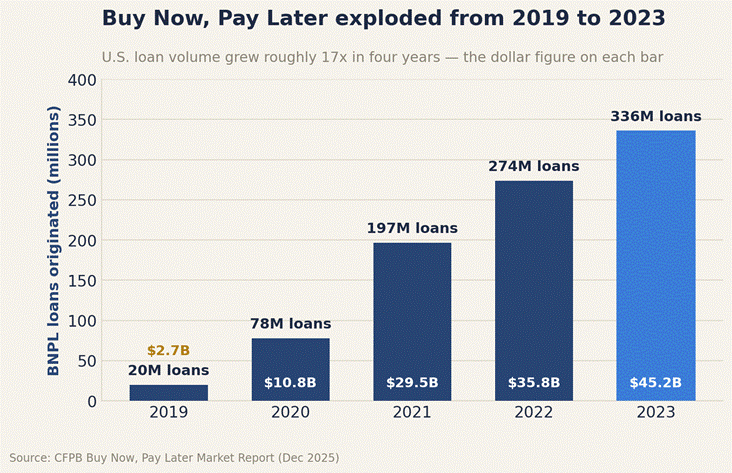
Rotate Offers So None Becomes the Norm

The problem with any promotion that recurs is that clients come to expect it. A referral bonus that is offered all year long is no longer special. A standing midweek deal eventually is what your clients now view as your regular price. The way to defend against this is through rotation. If you run a gift card push followed by a membership drive, no single promotion will be in place long enough for clients to reset their expectations.

With rotation, each promotion feels fresh. Clients are excited to see a new offer instead of tuning out a banner they have seen for months. Your rack rate stays fixed and visible, and every promotion is designed to lead clients back to full price.

This is the goal with the slow season calendar. The promotions pull revenue and demand into the gaps, and through all of it the rack price never changes.

Conclusion

The slow season is not a discount problem. Thinking of it this way is why salons have a hard time selling services. Blanket markdowns lead to selling discounted services to clients you would not earn repeat business from, while the real lost revenue comes from the 68% of clients who leave because they feel forgotten. Solve the 68% problem, and clients will start filling your appointment calendar without you having to do anything else. The ideas in this guide are simple concepts that address your gaps in appointment demand and make a future time appointment easier to sell to a client, all while maintaining your current pricing.

The key to solving the problem is the order of operations. Move away from the across-the-board markdowns and instead make time-sensitive offers to fill gaps for specific time slots. Bring future cash into your salon with prepaid services and sell them at a discount to increase business loyalty. The rebooking ask at checkout is the most important habit; no other solution returns so much for so little time. Focus referrals on bringing in your ideal, most profitable clientele, and use win-back texts to recover the clients you have lost and want back in the salon.

Use scheduling to set boundaries on discounts that focus on appointment gaps, and keep rotating to stop stagnation and increase business bookings. The slow season is not a discount problem. It is lost potential time that the business could be earning income. You can easily fill appointment gaps and increase your business bookings without discounting your services.

Frequently Asked Questions

  1. How do salons fill slow days without discounting everything?

    Instead of discounting everything, aim the value at the gap. Focus on midweek time slots. A time-limited offer that fills genuinely empty slots during midweek can move flexible clients to your valleys, while keeping your busy weekend slots at full rate. Rather than a standing sale, fill unpredictable last-minute cancellations with same-day openings. Prepaid packages, rebooking, and win-back texts raise demand on top of that. Get the sale rather than training your clients to wait for a discount.

  2. Do memberships work for small salons and spas?

    The empty chair becomes a much larger revenue loss for small businesses, since they have fewer customers. In this case, the small business is the salon. Hair salons do not have complex business structures with many employees, so they can operate most efficiently with steady prepaid revenue. It will actually make your business simpler. Just one reasonable offer can help your salon thrive! Consider creating a “single blow-dry” offer or a planned “visits per month” prepaid color packet. A membership makes your customers much more loyal. Set the per-visit price of a prepaid color plan just below your walk-in color price, and require enough visits, three or more, for the commitment to pay off for both sides.

  3. How do I get clients to rebook before they leave?

    When you’re at the chair, ask to book them for the same day and time in the next booking period. A question like, “You’ll be due in six weeks. Shall I book you for the same Thursday?” is better than a “call us when you’re ready” response. If there is hesitation, don’t allow them to leave without booking. Hold the date and send a reminder text. You can expect a revenue increase of fifteen to twenty percent for a ten-point increase in rebooking. Making the ask a habit for all stylists is one of the highest revenue-impacting asks.

  4. What’s a good referral offer for a salon?

    Both your client and their friend deserve a benefit that enables the introduction to be perceived as a generous act instead of a business transaction. The current client will receive a credit for their next appointment, while the friend will receive a welcome bonus, which is an incentive given at the business’ discretion to the friend that will be received during their second appointment. This is a clever way of ensuring a return client, instead of a one-time bonus-seeking client. This is further incentive to create a referral program, as compared to other methods of acquiring clients; clients obtained through referrals are typically more valuable, as approximately seventy-four percent of referred clients remain active with the business at least a year after their first appointment.

  5. How can a spa boost revenue in the off-season?

    Bring in cash sooner and add value to your current clientele. You can sell gift cards to create instant revenue for services that you will provide in the future when your business is busy. When customers redeem a gift card, they tend to spend more than the redeemable amount, and any remaining value on the card is profit. Gift cards and prepaid memberships help improve cash flow and guarantee revenue, while automated texts to former clients help bring back clients that you’ve lost. Identify the weeks your business is slow, create a specific offer to bring clients in, and rotate your offers to help keep your prices intact throughout the year.

Local SEO AI Overviews

Local SEO in the AI Overviews Era: Fast Wins for Service Businesses

At 9 PM, a homeowner’s kitchen sink begins to leak. This homeowner doesn’t open ten tabs like everyone else. Instead, they search for “emergency plumber near me.” Often, they don’t even bother to click a result when an AI Overview supplies them with three local plumbers from the map pack. If you aren’t one of the three businesses, then you don’t exist to this homeowner.

This is local SEO in the age of AI. The first answer to a large percentage of local queries is now being written by AI. Local SEO AI Overviews are now dominating local queries. The businesses appearing in AI Overviews are exclusively the businesses that rank in the traditional map pack. In fact, practically nothing has changed regarding what drives local visibility. Being local is more cutthroat than ever. Businesses that implement the basics of local SEO are gaining prominence, while the majority of businesses are becoming less visible as the query is answered without them, completely out of their control.

This guide shows service businesses from trades to professional services where and how to begin to implement local SEO in the area where they work to gain the competitive advantage over other local services that do the same.

What Changed: Local Search in the Age of AI Overviews

When watching Google Search Results change, one key thing to note is that AI summaries have taken the prime real estate on listings. Google’s AI Summaries are already showing up on most searches, and data from most affected industries are showing drastically reduced click rates to listings as AI Summaries are providing the information.

This is understandably a problem for Local SEOs, but at the same time, Google AI Summaries create the outputs from the same inputs as a Google Business Profile: a good amount of customer reviews, a good amount of local citations, and a good amount of on-page content.

AI Overviews do not create a separate ranking system with its own rules. They have created a new interface that is layered on the same trust signals that local searches have always been reliant on. The businesses that have AI Overviews created for them are the businesses that dominate the local searches map pack.

One study that has been widely referenced on restaurant searches has found that businesses that ranked in the top three of the local searches were referenced in AI answers 25.9% of the time. It is worth noting that the other local businesses did not receive any references at all. This completely changes the conversation. The reward for excellent local SEO is AI visibility, and not having to learn a new skill.

image 81

Figure 1: Local pack rankings feed directly into AI Overview and AI Mode visibility.

Does Google Business Profile Still Matter with AI Search?

Does Google Business Profile Still Matter with AI Search

Google Business Profile (GBP), previously called Google My Business, powers the map pack, the knowledge panel, and a lot more when AI Overviews suggest a local business. It is the most powerful tool for local SEO, especially for small businesses in the AI era. As of now, recent industry surveys estimate that GBP signals account for 32% of local pack ranking factors, compared to on-site SEO, local reviews, citations, and behavioral signals. In other words, GBP signals are more important than any other single factor.

There is no more denying the importance of GBP for local businesses. It is the core of local SEO, and businesses must complete every field of the profile to achieve the best performance in the local SEO sphere. This means businesses must choose the most appropriate business category, complete every field of service and product listings, add and update business hours, add real photos (not stock photos) of the business, and update the profile regularly. AI pulls structured data to answer queries. If GBP is incomplete, AI will overlook the profile and the business will lose traffic to other businesses with complete profiles.

How Do I Rank in the Google Map Pack?

For a long time, Google has explained map pack rankings in terms of three areas: relevance, distance, and prominence. Of these three, distance, aka proximity to the searcher, is the most important and is also something that cannot be adjusted with any amount of SEO. This is because distance (or proximity) relies entirely on the location of the customer at the time of the search.

Relevance is determined by the Google Business Profile search query match, hence the importance of the correct Google Business Profile category selection. A general contractor (who has the Google Business Profile category of ‘contractor’) will lose visibility to the contractor (who has the Google Business Profile category of ‘plumber’) when someone searches for plumbing-related services. Rounding out the three is prominence: the combination of review volume and quality, consistency of citations, on-page website authority, and behavioral engagement (clicks, calls, requests for directions, etc.).

Whitespark’s Local Search Ranking Factors Survey

Since proximity is not something you can optimize, a smart small business local SEO strategy focuses on what a business owner can actually control: profile completeness, category accuracy, review velocity, citation consistency, and website content that is relevant to the area. Whitespark, a local search data and software company, conducts an annual survey of a few dozen top local SEO professionals to see how much impact each of these factors has. Below is a chart that shows some relevant data from their 2026 report.

image 82

Figure 2: Approximate weighting of controllable local pack ranking factors, based on Whitespark’s 2026 survey of local SEO experts.

Two outdated tactics to be discarded in local SEO are geotagging photo files and Google Post keyword stuffing. There are no measurable ranking advantages of either in controlled tests. One study that tracked 441 keywords over nine weeks found no ranking movement related to Google Business Profile Posts. Focus on the SEO fundamentals instead of wasting time on these tactics.

How Many Reviews Do I Need to Rank Locally?

How Many Reviews Do I Need to Rank Locally

You can’t really pinpoint the magic number of reviews needed to enter a map pack, and the data reflects that as well. Take review signals; they account for approximately 16 to 20 percent of local pack ranking weight, and that number is expected to grow. What affects the ranking the quickest is review velocity, which is the steady influx of reviews as opposed to a singular focus.

Google can’t tell that a business is popular now if all of its reviews are from the past; a business that is popular in the present will be consistently active. Response rate is included in this as well. Businesses that respond to at least 80 percent of their reviews are likely to experience a boost in ranking, and the responses shape the AI Overview for the business as well.

Each review has its merits as well, but a review that mentions a specific service in the area and a detail about the experience itself is way more helpful than a standard five-star review. Google’s algorithms will definitely lack information if you are only relying on five-star reviews. The sweet spot for most service businesses is a review every few days; anything more is unnecessary. Most consumers consider reviews that are older than three months to be stale, and that notion only adds to the review generation urgency. Review generation should definitely be a long-term business goal.

What Are Local Citations and Do They Still Help?

A local citation refers to an instance where a business’s name, address, and phone number (NAP) are published on a third-party website (for example, a directory or an industry website). There are many examples of local citations, and some include: Yelp, Bing Places, industry-specific directories, and listings for chambers of commerce. Agencies have included hundreds of citations as part of their local SEO strategies, and the volume-first approach used to be the most common. Recent evidence suggests that around ten authoritative, industry-relevant citations outperform fifty scattered, low-quality citations.

The importance of local citations has not diminished; however, they do not carry as much weight as before, and now the consistency of local citations is more important than the number of local citations. Inconsistent NAP information can confuse Google and AI in determining if a business truly exists.

Citational importance has been updated due to AI search innovations. When tools like ChatGPT are asked to recommend a business to fulfill a user request, they first compile the answer from multiple citations. This creates a need for local businesses to be listed on industry “Best of …” lists, reputable industry directories, and Bing Places, to name a few. Optimizing local citations for AI search now has more value than before. The process of fixing and improving local citations is simple. Focus on one or two high-value, industry-specific directories, and eliminate duplicates and inconsistencies.

How Do I Optimize for “Near Me” Searches?

In terms of local intent, “near me” searches may be the most lucrative behavior pattern for small businesses to tap into. The great thing about “near me” searches is that they indicate the searcher is only hours away from making a decision and taking action, as opposed to weeks. When a person searches “near me,” the goal is to make sure every signal you can control confirms your location. This starts with an accurate and verified business address on your Google Business Profile (GBP), consistent NAP (name, address, phone) details within each citation, and location-specific pages on your website instead of a generic service area page.

Although service-area businesses may not have a public storefront, they should follow Google’s direction on concealing their address while providing their service area. Controlled experiments have shown that service areas do not impact Maps rankings for businesses with an actual address. What is most important is the verified address that the profile is centered around.

Moving beyond the profile, the best visibility for “near me” searches comes from hyper-local content. This can include city and neighborhood landing pages, a Google Map (embedded), testimonials that are related to the area, and organic mentions throughout the page of the landmarks and service zones. The speed of the webpages on mobile can also impact visibility, considering that the vast majority of “near me” searches take place on mobile devices, and often from the person standing right outside your business.

An overwhelming number of consumers search for businesses on their mobile devices and then visit the business within the next 24 hours. A page that doesn’t load fast or an outdated address doesn’t just lose a click; it loses a customer.

Winning Visibility in Local SEO AI Overviews

AI Search Tools: Google AI Overviews, AI Mode, ChatGPT & Gemini

AI Mode, Gemini, and ChatGPT are clearly different from other search tools in that they summarize web content and extract information from structured data to answer questions rather than linking to web pages. AI crawlers will find answered questions much more easily than marketing copy. This is because clear, concise answers are much more helpful than brand voice marketing copy that requires interpretation. Plain language content that directly answers customer concerns is much more effective than vague marketing copy because systems that summarize web pages are clearly designed to distill text down to the most specific and concise answer.

The latest studies examining the local business recommendations of tools like ChatGPT indicate that first-party testimonials on a business’s website now carry more influence. Unlike past AI tools, ChatGPT and the AI tools that will be developed in the next few years will probably rely on business homepages and not service pages as primary source texts.

As a result, business homepages will need to be an engaging and high-quality way to communicate business information. This will also not negate efforts towards local SEO. This will be an addition to local SEO. Because of this, businesses that have been generating legitimate trust signals will be rewarded, rather than businesses that have been manipulating a ranking algorithm.

Fast Wins to Prioritize This Month

Filling in every section of a Google Business Profile and correcting the primary category is an example of the highest-leverage activity for a business in its infancy. The next highest-leverage activity is creating a system to request a customer review in the first 48 hours post-purchase. Additional activity that follows this level of leverage is resolving inconsistent NAP listings in local citations and either improving or tightening 2-3 high-authority directory listings. This also means making a dedicated landing page for the city or neighborhood that the business serves, and placing LocalBusiness schema markup on those pages.

This makes it much easier for an AI to parse and understand the business information for a local search. Each of these steps can be completed in under a day and doesn’t require a redesign or major investment. Most can be done in an afternoon.

image 83

Figure 3: A quick-reference sequence of fast local SEO wins for service businesses.

Conclusion

Local search isn’t more complicated to understand. It’s just more punishing to those who cheat the system. AI Overviews are a good local SEO report card. They reward businesses that have good local SEO, such as a complete Google Business Profile, consistent targeted reviews, and steady citations and content that are focused on local customers.

Those businesses will land in the map pack and get cited in AI answers.  The fundamentals take time to implement, but they pay back over time. The Google Business Profile and steady reviews are the most important things to focus on. Once those things are done, the rest of the local SEO for small businesses becomes a lot easier.

Frequently Asked Questions

  1. How do I rank in the Google map pack?

    Map pack rankings are determined by relevance, distance, and prominence. Of these three factors, distance is the only factor you can’t control. You can influence the other two, relevance and prominence, through four areas of focus. Ensure your Google Business Profile is optimized and includes a detailed business category. Additionally, obtain thorough reviews regularly, and maintain consistent citations and focused content on your website. Businesses that focus on all four areas will see the fastest and most sustainable results for gaining placement in the top three Map pack rankings.

  2. Does Google Business Profile still matter with AI search?

    Yes, probably now more than ever. Business profiles on Google have the potential to influence 32 percent of the local pack ranking. AI Overviews use business profiles to help them decide which businesses to showcase.  A profile that is complete, accurate, and actively maintained offers traditional search and AI-generated answers something dependable to cite. An incomplete or outdated profile offers them nothing; thus, the business is overlooked in preference to a competitor with more extensive information.

  3. How many reviews do I need to rank locally?

    A definite number of reviews does not exist that will secure a boost in rankings. What is most important is review velocity. This means a steady flow of reviews over time with little to no gaps as opposed to a large number of reviews all at once. Coupled with a consistent answering of reviews, this is most favorable for rankings. Reviews that provide detail and are specific to a location and service are preferred over vague, generic five-star reviews. For most service businesses, the goal should be to secure a review every few days with no end in sight.

  4. What are local citations and do they still help?

    Local citations are listings of a business’s name, address, and phone number on online directories and external sites (such as Yelp and Bing Places). Local citations now reflect the quality of the listings and have become less effective with the proliferation of third-party sites.  About ten citations from authoritative and relevant industry sources will outperform fifty citations from low-quality directories. Maintaining details of your NAP (name, address, and phone number) is still essential everywhere they are published, since various search engines and AI tools will be confused if there’s a lack of consistency in what is perceived to be a legitimate business.

  5. How do I optimize for “near me” searches?

    Optimizing for “near me” searches needs a correct and verified Google Business Profile address and consistent NAP info across the web and separate landing pages for every city or neighborhood served, rather than a single service-area page. Dedicated pages will help you rank better. Mobile page speed needs to be swift as well, since most “near me” searches are made from mobile devices by customers who are ready to buy. All of these signals work together to assist Google and AI search tools in correctly associating a business with a searcher’s location and intent.