Posted: July 31, 2026
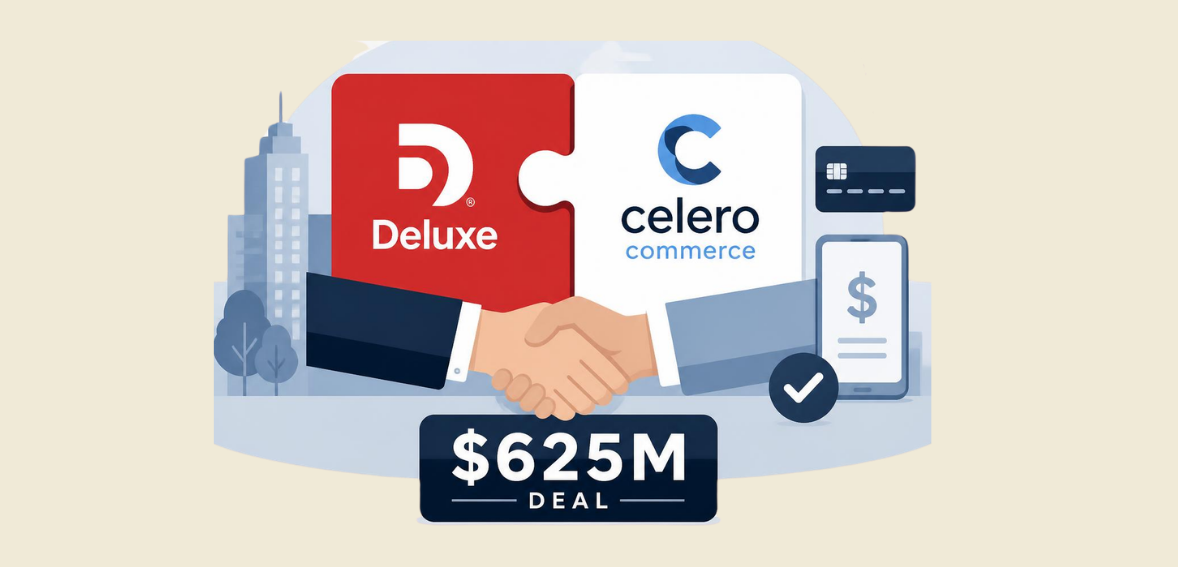
A 110-year-old check printer is betting big on the future of digital payments with a multi-million dollar investment. Deluxe Corporation has planned a $625 million all-cash acquisition of Nashville payments processor Celero Commerce, as of June 18, 2026. Deluxe famously mailed physical checkbooks to half of the postal addresses in the United States. Now, Deluxe wants to help small and medium-sized businesses move money.
As Deluxe acquires Celero Commerce, it speaks volumes about the state of the merchant acquiring business and suggests Deluxe has prioritized the payments processing business. Deluxe is also a key player in the ongoing consolidation of merchant acquirers in an environment that has experienced unprecedented coupling and reshuffling in payments processing.
For the small business owner, this is not an abstract story from the world of finance. Deluxe acquiring a payment processing business means that the processing company in the small business owner’s local market may acquire a different name, different business model, and a different customer support system.
This report explains what Deluxe acquired, why the check company is making big moves in the payment space, and what the continued wave of acquisitions means to the small businesses that will be most affected.
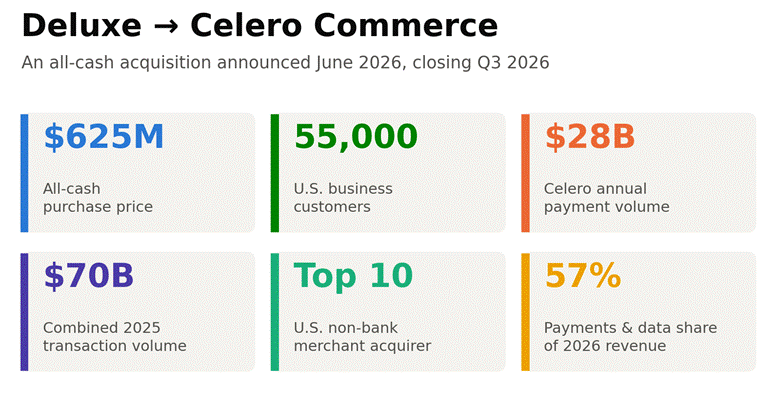
Figure 1. The Deluxe–Celero deal at a glance: a $625 million all-cash purchase that pushes the combined firm into the top ten U.S. non-bank merchant acquirers.
The all-cash purchase price is $625 million. Deluxe is purchasing a $375 million incremental term loan and a draw from its revolving credit facility. They announced the agreement on June 18, 2026, and anticipate closing the purchase in the 3rd quarter. Deluxe has plans to buy scale to a business they have been slowly growing for several years.
For most of Deluxe’s history, the company made money from checks, forms, and various paper supplies that financed their operations. Deluxe has been gradually changing its focus to payments and data. The Celero acquisition is their most significant commitment to that focus. After the acquisition, payments and data will comprise 57 percent of Deluxe’s 2026 projected revenue. In 2020, payments and data comprised 31 percent of Deluxe’s revenue. Deluxe is a payments company now.
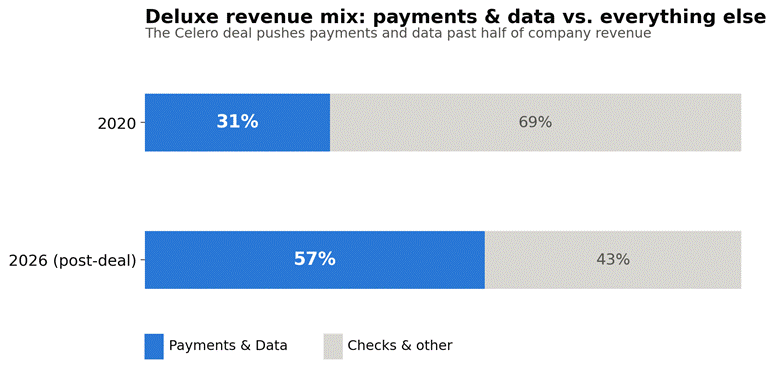
Figure 2. Deluxe’s revenue mix has flipped toward payments and data, projected to reach 57 percent in 2026 after the Celero deal, up from 31 percent in 2020.
Image Source
Deluxe was founded in 1915 and is one of the oldest business services companies in America. Deluxe gave us the paper check and printed checkbooks for banks and consumers. Though check printing provided steady cash flow, this business model was headed for permanent decline. Under Barry McCarthy, Deluxe repositioned the company with an emphasis on merchant services, data, and digital payments. The Celero acquisition is evidence of this strategy. McCarthy said the acquisition was a good way to quickly change the company’s focus and the money they make to the payments and data services that Deluxe offers. From this acquisition, it is clear that Deluxe is all in in this line of services.

Image Source
Celero was founded in 2018 as the fast, newer half of the partnership. They are based in Nashville and provide integrated payment processing and business management software and services with data services to small and mid-sized businesses. Celero has about 55,000 business customers and processes about $28 billion in payments a year. In 2025, Celero reported revenues of $200 million at a healthy 28 percent adjusted EBITDA margin.
Celero services businesses through 375 active partners, including banks and vendors of business software, and added about 60 partners in 2025. Founder Kevin Jones said this combination is “an exciting next chapter” for Celero, as it will allow them to further pursue their mission through Deluxe’s resources and extensive reach.
These two companies combined become a large entity. In 2025, the two companies combined processed about $70 billion in gross transaction volume. This volume allows the combined partnership to be classified as one of the top 10 non-bank merchant acquirers in the USA. Deluxe also stated that this deal should positively affect adjusted earnings per share within the year and provide over $15 million in cost synergies over the next 24 months. For a company still transitioning out of its paper-focused past, this deal provides justifiable numbers for the expected cost.
Deluxe’s decision stems from a larger context. Merchant acquiring is a consolidating industry, and Deluxe’s acquisition of Celero represents a smaller undertaking in a larger massive undertaking. The industry has been filled primarily with smaller to medium processors. Within the context of industry consolidation, that crowd is rapidly disappearing.
The largest example dwarfs the Deluxe deal. In January 2026, Global Payments acquired Worldpay for $24.25 billion, one of the largest deals in the history of the payments industry. In the same three-party deal, FIS acquired the Global Payments issuer solutions business. The reconfiguration of the payments processors has been characterized as a simplification of portfolio offerings and a pivot towards software-centric merchant services. Relatively, the Deluxe-Celero acquisition reflects the same trend.
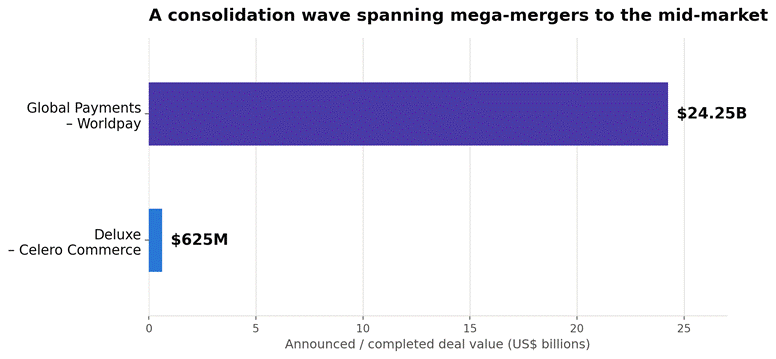
Figure 3. Recent deals show the scale of merchant acquiring consolidation, from Global Payments’ $24.25 billion Worldpay purchase down to mid-market moves like Deluxe–Celero.
The driving forces behind the wave are easy to see. Payments is an industry of tight margins and high tech costs, so the business is all about scale. The bigger processor shares the burden of compliance and fraud and platform investments among a greater number of customers. The point of sale and invoicing software is where the processors have control of the customer relationship, and that is really the game. And private equity keeps financing the wave; the Worldpay sale was one of the largest deals in the history of its private equity owner, GTCR. The processors are getting larger, and there are fewer independent names in the game. For the small merchant, the shock is when processors in the merchant’s ecosystem get acquired, and there are fewer familiar names left.
For most owners, the practical question cuts through all the deal math: what happens to my account when my processor gets bought? The honest answer is usually very little, at least in the short term. Card payments continue to clear, deposits continue to show up, and the terminal on the counter continues to work. Acquirers pay a great deal of money to purchase a merchant portfolio because they want to keep the merchants. Disruption is bad for business for both sides.
The changes, however, are more likely to show up later and more quietly. After a deal goes through, merchants may notice the company on their statements is different, the support phone number is different, and/or they are moved to a different terminal or platform. Pricing is likely to change, and in some cases, the acquirer may improve pricing as they absorb the account. In some cases, pricing may get worse, and a new fee may appear after the introductory offer is over. Most contracts are transferred as is, so any early termination provisions and long commitments are transferred to the new owner.
The real risk is more likely to be a slow decline in service rather than outright chaos. The promised rates may not survive the transition, and the account manager may also disappear and be replaced by a general support queue. A well-run acquisition is also likely to have a positive outcome for the merchant, so none of these changes is guaranteed.
Keep an eye on changes in ownership. Read the statements that follow a sale carefully and verify that the contract you signed is still valid. A processor changing ownership is a good reason to check if the contract is still valid.
Deluxe’s decision to spend $625 million to remove itself from its past makes sense only when you consider the death spiral of the paper check. The decline is no longer slow and steady. It’s practically vertical. Only 2.5 percent of all consumer payment transactions in the United States are settled by a paper check. The payment method that was once the primary means by which Americans settled their bills and conducted their financial transactions has all but disappeared.
The decline of the paper check can be documented by what can be described as the slow death of the transactional paper check in the business world. The paper check held on far longer in the business world as a means of sending payments. A recent study observed that in 2004, 81 percent of outgoing business transactions were conducted by a paper check. By 2025, that number fell to 26 percent. Incoming payments will follow a similar trend, decreasing from 75 percent to 25 percent of total business transactions. Even the government has implemented measures to increase the shift away from paper checks to electronic transactions.
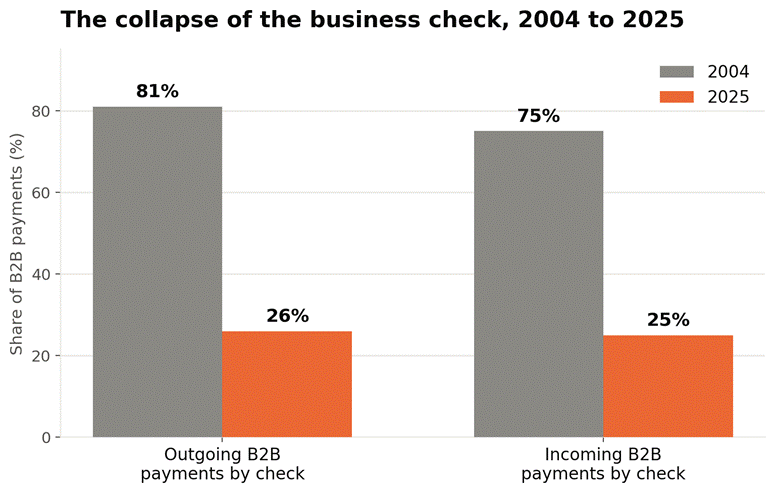
Figure 4. B2B check use has collapsed since 2004, with both outgoing and incoming payments falling by roughly 50 percentage points as businesses move to digital rails.
Digital rails didn’t make money disappear, and checks are becoming digital. In the same time frame, payments made through the ACH network more than doubled, going from 2.9 billion to 7.4 billion, and the dollar amount practically doubled, going from $28.3 trillion to $58.2 trillion. There are a few reasons why businesses are going paperless. Digital payments are cheaper, more secure, and more convenient. This is bad news for Deluxe, and the check business will continue to decline. The only way to grow now is to have part of the digital payments. Part of that is Celero.
There is a lesson hidden in the countless deals for merchants. In a marketplace dominated by constant mergers, what your prospective processor is sold for isn’t what you need to worry about. You want to ask what you can expect for today’s payment processing fee and what the deal’s long-term implications are. A little detail hunting will help you avoid a lot of future heartburn.
Instead of asking what the payment processing fee is, first ask for the total cost of acceptance. You can ask about the payment processing pricing model; is it interchange-plus, tiered, flat, or otherwise? In addition to the payment processing fee, what are the payment processing monthly minimums, statement fees, PCI compliance fees, gateway fees, and chargeback fees? In reality, what are the contract’s early termination and length provisions? Long contracts with large early termination fees will potentially be the long-term deal that will protect a bad relationship and get you stuck if the company is sold. What is the payment processing fund withdrawal and clearance policy? Is a rolling reserve held against your account?
Consolidation creates some urgent questions. Is your payment processing rate guaranteed, or is it an introductory rate? What is the advance notice when your pricing is changing? You need to ask what happens to your payment processing terms when the company is sold or if the company has the right to assign your contract without your consent. When a company is sold, who keeps your payment processing data and your customer data?
You should ask how support is structured. Do you get a direct support contact or do you just have access to a support line? How fast do they expect to solve your issues? These answers will help you determine if you are signing on with a stable partner or if you are just maintaining a contract for a rate that may not last the year.
There are warning signs in any market and signs in a consolidating market should make merchants even more cautious. The most obvious example is a contract with a hidden exit. If a contract has a multi-year term and a large early-termination fee, or an agreement that renews automatically each year, trapping you unless you physically remove it during an extremely brief time frame, then it is designed to make you pay for the slip even if you don’t use the service. In a market where anything can happen overnight, being locked in a contract is the opposite position you want to be in.
The main focuses of rate red flag concerns center around what is absent. Be very cautious of a quote that is significantly less than the market average. The difference is usually made up through fees that were not disclosed to you. The same can be said with tiered pricing that places transactions in large “non-qualified” buckets that are vague, teaser rates that are made to expire, and extremely curt statements that make you unable to figure out what you actually paid. These are all signs of a processor that is competing on obscurity. If a salesperson cannot straightforwardly explain your effective rate, that is a warning.
Service red flags are disclosed through a company’s lack of service even before an actual contract is signed. Vague answers about who your support is, the lack of an escalation path, the failure to put promises in writing, and pressure to sign quickly all show a lack of service. In markets full of mergers, even the stability of the provider is something to take into consideration.
A processor that is transparent with its support and terms is more likely to be a partner you can trust throughout any future ownership changes.
Merchants know that rate is the most important factor when selecting a processor. But as the market consolidates, factors like service and stability are increasingly important as well. If you’re losing deposits because of a failed system migration, or if no one is working on your account and chargebacks are dragging on, a little savings on your rate means nothing. The cheap processor ends up being your most expensive choice because of lost sales and time.
Something like stability is hard to quantify but is important. A processor that has a good service record, consistent stability, and stable ownership is less likely to surprise you. In a consolidating market, a company that honors its terms, maintains its support, and communicates clearly regarding its changes and mergers is a valuable partner. Although stability is hard to quantify, it determines whether you have to solve payment issues every time you sell something.
The bottom line is to consider the value of the service, not just the rate. A good, fair, and transparent rate, stability, and value of service will always be a better deal than a rigid contract and a cheap call center. The Deluxe-Celero deal is a good example of how the name on your statement changes, but service and stability should be valued even then.
The deal-making is not likely to slow down any time soon, but there are a few trends to keep an eye on. The first trend would be more of the same: the large processors acquiring software-led companies that have strong merchant relationships to acquire the customer. Expect the mid- market to be a busy place as larger companies acquire other companies to strengthen their market positions. This is also true for Celero. Larger companies are more likely to acquire companies to build their business as opposed to building their business from the ground up.
The true test of the consolidation will show how well the integrated companies are able to provide better technology and pricing for small to mid-sized businesses (SMBs). The elimination of competition will likely result in price increases, as is the case for other large mergers. After an acquisition, the price of any offered service may increase, and the service quality may improve. If it doesn’t, it’s likely the company is reneging on the promises that were made during the merger. Watch the continued shift from paper. For each check that is converted from a paper check to a digital payment, it gives legacy companies such as Deluxe a reason to forcefully acquire companies to keep up with the digital payment revolution.
Small to mid-sized businesses will benefit from remaining flexible and having the ability to adjust. Pay attention to contracts that allow you to move or change if there are new terms. After a change in ownership, always watch your statements. Concentration of market power will dictate which financial institution/processors will be providing merchant services to your business.
Deluxe spending $625 million buying Celero Commerce is a big deal. Deluxe is a company largely operating in the paper check space that is now diversifying and buying its way into digital payments. Check payments are in steep decline. This deal pushes payments and data to 57% of Deluxe revenues and makes the resulting company one of the top ten non-bank U.S. merchant acquirers. This deal is evidence of a legacy company choosing to reinvent itself over continuing its downward trajectory.
For small merchants, this deal is one small piece of a much bigger story. This is further evidence of consolidation in the acquirer marketplace, from the $24.25 billion Global Payments – Worldpay deal down to more mid-market deals such as this one. The first-order effects of a processing company being acquired are sometimes benign, but the second-order effects, such as new fees, new names, and service that is now much less customer-oriented, can be profound. The same defense is more important now than it was before. You must ask the hard questions much more than before, watch out for red flags for contracts and rates, and consider stability and the quality of your service well above the costs. A processor that was chosen for its transparency and reliability is one that you can trust to retain that reliability when ownership changes.
In an agreement announced in June 2026, Deluxe has planned to buy payments processor Celero Commerce for $625 million in an all-cash transaction. This purchase is expected to close in Q3 2026.
A merchant acquirer is a company that processes card payments for businesses and transfers money from the customer’s account to the merchant’s account. It manages the behind-the-scenes work for every card payment a business accepts.
Initially, only minor changes happen, and payments continue to go through as before. However, you should check your bank statements after every acquisition, as there may be a new company name, fee changes, or a platform migration.
Look beyond the headline rate and consider the total cost of acceptance. Review contract duration and penalties for early contract termination. Examine the quality of the service and the stability of the provider when placing your order, alongside or in preference to the price.
Yes, but it has decreased significantly. In 2004, B2B check payments made up approximately 80% of total business payments. By 2025, this number dropped to around 25% as businesses continue to make the transition to ACH and other digital payments.