Posted: September 30, 2026 | Updated: October 01, 2026 at 3:16 PM
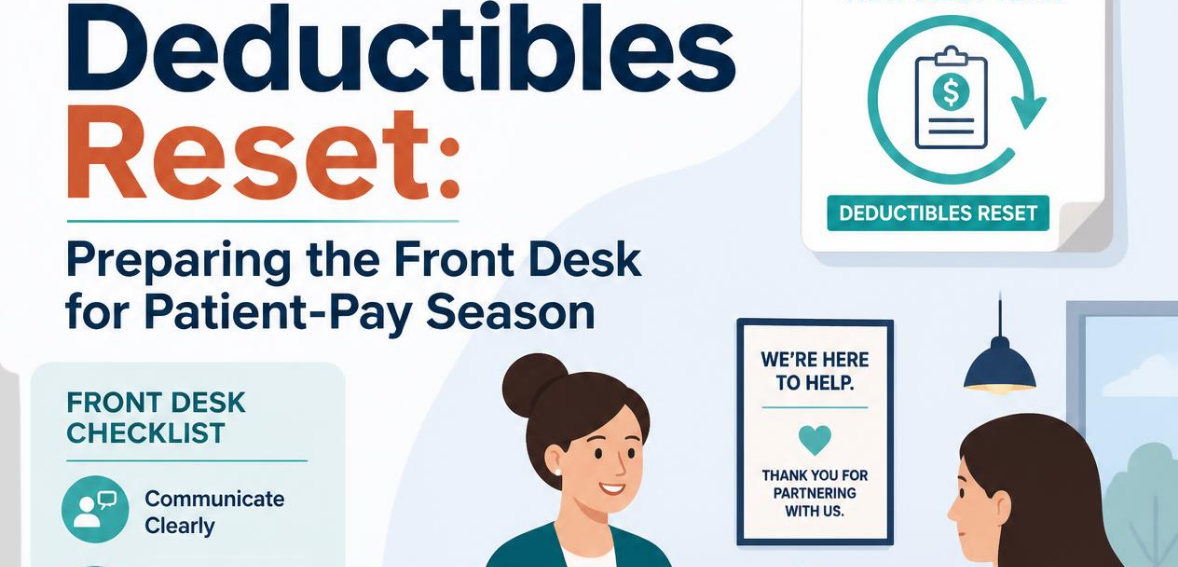
January can turn a medical practice’s entire revenue cycle on its head overnight. One moment, a patient pays a small balance for a December visit; the next, they’re asked to pay much more for the same service because their health plan’s deductible reset.
This can leave front-desk teams dealing with more patient queries, higher balances, and difficult payment discussions, making deductible-reset collections a Q4 planning item, not just a January problem.
A simple preparation plan for Q4 can make the transition easier at the beginning of the year. The staff can take the time to recheck the insurance benefits, go over patient balances, prepare estimates, confirm that patients have given permission to keep cards on file, and go over the necessary information regarding payment plans. This way, when January rolls in, a simple course of action will be available for the front desk instead of a complicated one.
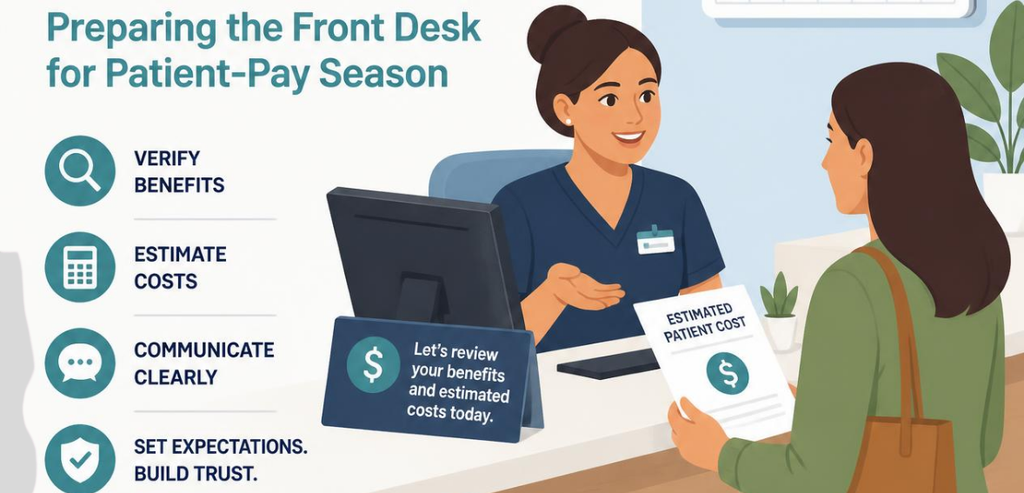
A deductible is the amount a patient must pay out of pocket for covered services before the plan begins paying its share. The deductible applies once the plan year begins.
Therefore, for most patients, this is an amount they are required to meet before the plan pays. For instance, a patient who has met a large deductible by December would have to pay higher amounts when seeking similar services in January because their insurance plan renews the deductible every year.
The amount your patient pays for services depends on their plan, what’s left to pay as deductible, copay, and coinsurance, and what service they’re receiving. So, the front desk can’t assume that what the patient paid in December will be the same in January. This is why January deductible season can create a noticeable increase in patient-pay activity.
The last few months of this year are a great time to start preparing for next year’s deductible cycle. Waiting until the first week in January to make any changes leaves your front office staff scrambling to handle both insurance issues and patient balances at the same time.
Review your usual insurance benefits verification and estimated patient payment procedures. Make certain everyone knows what information to gather and where to document it.
It is also a good idea to review your practice’s payment policies before the new year. If your practice offers payment plans to patients, your staff should be familiar with the plans and be able to describe them to patients.
Insurance information changes from year to year. Your patients could have a new card, a different deductible, a new employer plan, or changes in coverage. The front desk can no longer rely on last year’s information.
As you approach the new year, take some time to review your verification process and look for patients with upcoming appointments. When possible, verify their current coverage and confirm the details that will affect what they are responsible for.
This may include their deductible, copay, coinsurance, and other patient responsibility information.
The purpose is to avoid misrepresenting the patient’s final bill. The actual bill could be higher or lower than what is estimated, so present the figure as an estimate based on the information available to you prior to the visit.
Clear communication is especially important during the first few weeks of the year when many patients are experiencing the reset at the same time.
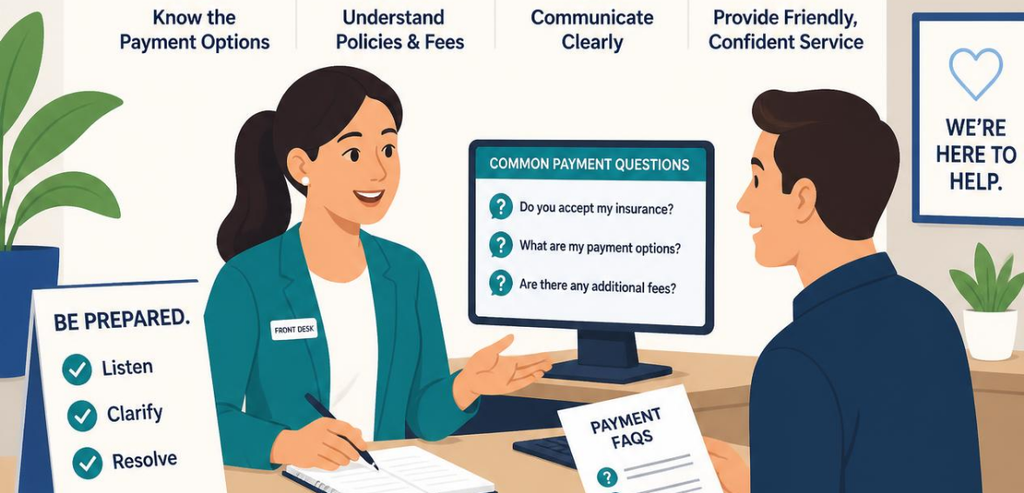
January brings more queries about billing statements and questions about why a patient owes money. Staff should be prepared to describe the difference between a copay, deductible, and coinsurance to patients in understandable language.
In addition, an employee should know when to advise a patient to contact the insurance company and what to tell them. The front desk can inform the patient of what the office is requesting based on the available information, but the insurer is the one who knows the details about a person’s plan benefits.
A consistent response should be used to address a patient’s concerns.
For example, staff members could tell people that their plan has a deductible and remind them of the information the office used when sending the bill. If a patient indicates that the information is wrong, the staff member can explain that the office will contact the insurer to clarify the benefits, and explain how the patient can do the same.
The conversation does not need to become complicated. The key is to give patients clear information without making promises about a claim the practice cannot control.
If your practice uses cards on file, Q4 is also a good time to review the process.
Make sure the practice has the required patient authorization before charging a stored payment method. Patients should clearly understand what they agreed to and how their card may be used.
A deductible reset can result in higher patient balances. Therefore, old card-on-file arrangements should not automatically be treated as permission for every type of charge. Review your practice policies and any applicable requirements before processing payments.
Staff should also have a procedure for when a stored card is denied or declined. By providing staff with a procedure, you can ensure they act consistently. The whole point is to make collecting payments as simple for the patient, and as reliable for the practice, as possible.
Not every patient can pay a larger balance in one payment. Patient payment plans give the practice another option.
If your practice offers payment plans, make sure front-desk staff understand who may qualify, how payments are scheduled, and what information patients need to enroll.
Staff should not make promises that go beyond the practice’s payment policy. Instead, they can explain the available options and help patients understand what to do next.
For example, staff members could say,
“Based on your insurance information, it appears that you have a higher patient balance this year. If paying the entire amount due today is difficult for you, we can go over the payment options that are available through our practice.”
The script doesn’t have to be worded this way. It just needs to be worded in a way that seems comfortable to the staff member saying it.
January gives practices a useful number to watch: the time-of-service collection rate.
This indicates the percentage of estimated patient responsibility collected at or near the time of service. This measure can help the practice assess how effective its front-desk revenue cycle is.
If the rate drops significantly in January, investigate factors contributing to the change. Verify that benefit checks are completed promptly, estimates are delivered to patients on time, staff aren’t struggling to explain higher balances, and payment plans are recommended.
The number does not explain the problem. It only provides a starting point for identifying where things need improvement.
Comparing the January numbers to previous years might help with that, too.
One way to make patient payments difficult is to introduce the amount when the patient arrives. They might not have anticipated it, may not have brought the required payment method, and may have questions that can’t be answered immediately. Whenever possible, communicate expected costs ahead of the visit.
You can use a phone call, text message, patient portal message, or other approved communication method to notify patients ahead of time of the amount they’re likely to be charged. The communication method will vary by practice and policy; the goal is no payment surprise when it can reasonably be avoided.

A patient who cannot pay the full bill is not necessarily a difficult collection case.
First, staff need to remind the patient of the practice’s standard payment policy. If a payment plan is an option, they should discuss the details and provide the necessary information. Moreover, patients who cannot pay their balance in full may be eligible for financial assistance. Staff should inform them of the eligibility criteria.
However, in all cases, employees must treat patients according to the same standard. If one employee offers arrangements that another cannot, the practice will look inconsistent.
A brief training session before the new year can prevent many issues.
Brush up on processes for verifying benefits, patient estimates, payment collection, failed cards, and explaining payment plans. This is a good time to let staff practice answering questions about deductibles and patient balances.
It is also a good time to review any updated internal guidelines. If your practice made any changes to the payment policy, payment plan procedures, or communication methods, make sure all employees are up to speed.
Before the new year begins, revisit your insurance verification process and ensure that your staff knows what to do if a new plan comes up. Also identify any upcoming appointments where benefit verification may help. Review your patient payment policies to ensure you’re estimating costs accurately, getting your patients’ permission to put their cards on file when appropriate, and offering payment arrangements.
Your front desk should also be well-versed in frequently asked questions about deductibles and know when to send a patient to their insurance company. Finally, decide what numbers you want to track in January, such as your time-of-service collections and outstanding patient balances. These updates shouldn’t feel overwhelming. They have to happen before the end of the year.
A deductible reset can make January a lot harder for patients and your medical practice. But the good news is: your front desk can prepare ahead of time to make the transition as smooth as possible.
Here are five things you may want to do: check the benefits, discuss expectations, collect payments consistently, review card-on-file permissions, and keep payment-plan information handy. But most importantly, don’t procrastinate until January. Q4 is when you set the tone for the following year, so bring your team together, review the payment policy, and learn about the pain points your practice experienced last year.