Posted: July 24, 2026
Every salon and spa experiences similar quiet times, like the Tuesday afternoons that never book up, the lulls that follow the holidays when the phone goes quiet, or the mid-summer slow spells when the clients are on vacation instead of in your chair. The empty hours feel like a problem that has to be solved, and the usual solution is a twenty percent off special posted on a sign in the window. It works only temporarily. Then the deal-seekers come, the regulars wonder why they paid the full price, and the valley comes back the next month, only deeper.
The slow season time of the year doesn’t always have to be viewed that way. The goal of the business is to fill the gaps and bring the income that is expected in the future closer to the present and convert the single-time visits into booked appointments. If executed properly, the slow times for a business can become the time of the most potential income for a business instead of the time of most planned markdowns.
The goal of this guide is to share the ways that salon marketing will fill your slow days while avoiding the situation of training your clients to wait for a sale. It will illustrate the cost of unnecessary discounts to your business, the value of time-sensitive offers and prepaid packages, and the most effective, highest value habit your business could implement during checkout. By the end, you will have a promotional calendar that fills your valleys while protecting your rates.
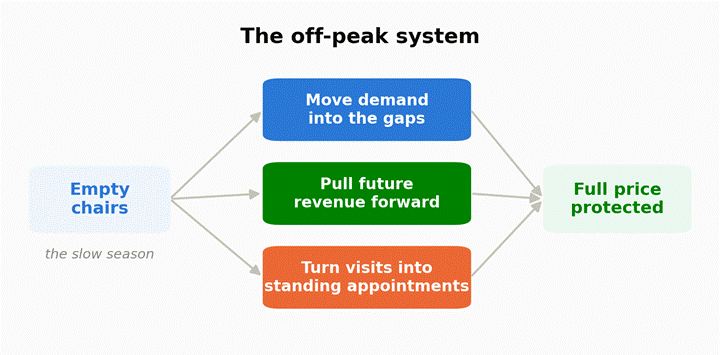
Figure 1. The off-peak system moves demand into the gaps instead of cutting price across the board.
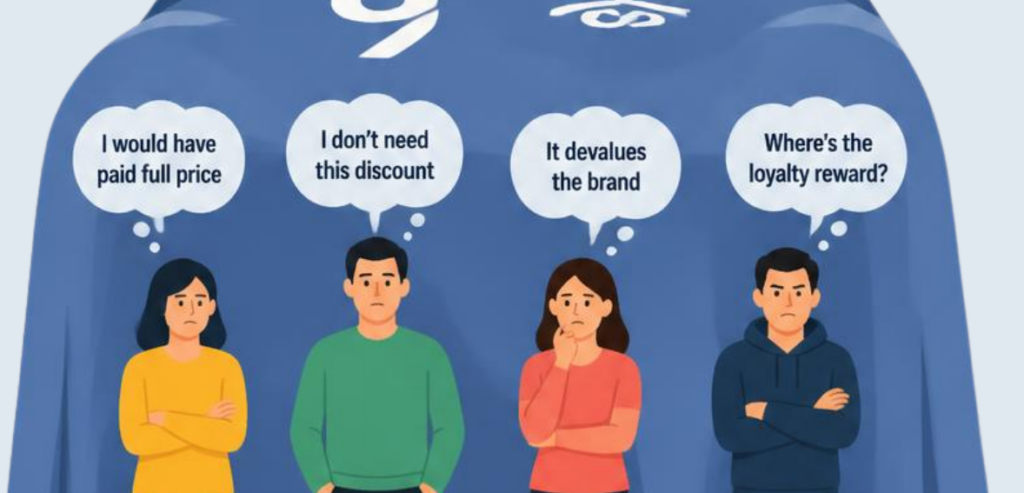
The general discount is what most owners will default to first. It is also the most damaging. A general discount teaches the clients you want to keep and continue doing business with to wait, attracts clients you do not want to have, and eats into your profit margins, which you cannot afford to lose. The why behind this is the basis for the next smarter business decisions you will make.
Discounted services may attract new customers, but look at who those discounts actually attract. Your new customers become bargain hunters and are gone until your next discount. It doesn’t help your business, because they will not make your services a regular habit, nor will they pay full price. To make things worse, your new bargain customers will be more demanding than your typical clientele. Your time is precious, and your chair time is gone on the least likely customers to return.
Discounts are easily noticed by your existing customers. Your regulars who pay full price will be the first to notice your discount, and your regulars will feel like they have been betrayed and punished for their loyalty. Your discounts will erode the trust of your most faithful customers and damage your business in the long run, because your services will seem like they are always up for negotiation. Frequent markdowns devalue your services, and customers will be unwilling to pay full price when the discount is no longer available.
The actual expense is in the numbers that most owners never run. Discounting a service is not a small reduction. It cuts into your profits. It also requires more volume than a slow season can provide. With typical salon gross margins of around thirty percent, a twenty percent discount means you have to fill two hundred percent more appointments to make the same money as before the discount. The challenge is, during your slowest weeks, you definitely cannot fill that many appointments.
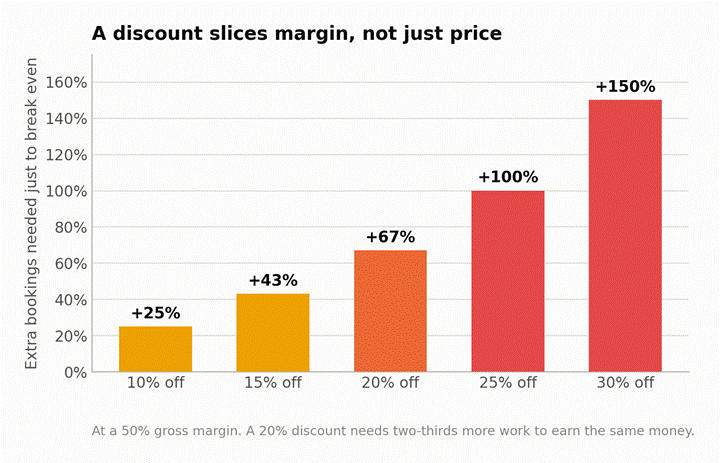
Figure 2. The extra volume needed just to break even climbs fast as the discount deepens.
The facts show that caution is warranted. Just about fourteen percent of clients abandon a salon to find lower prices. The greatest percentage (almost sixty-eight percent) of clients drift away due to feeling neglected. That one statistic completely reframes the slow-season dilemma. Clients do not want a cheaper service. They want to feel appreciated and have a reason to return. The answer is client retention, and not markdowns. The retention of clients, just by five percent, can yield profits of twenty-five to ninety-five percent. That is a return that no markdown will achieve.
Some discounting is an important strategy. The trick is executing discounting with precision. The biggest flaw with a blanket sale is that it discounts for every potential customer buying your services. This includes customers that would have happily paid full price for a Saturday booking. The opposite effect is created with time-sensitive offers. Time-sensitive offers direct the discount at the hours you are unable to sell.
The idea is that your Saturday is booked and your Tuesday at two is up for grabs, so they should not be offered the same deal. A small incentive to clients midweek will fill those otherwise empty midweek slots. Flexible clients, retirees, remote workers, and parents with school-aged children will take those slots. Your weekend slots remain booked because the weekend clients, who want those slots, pay for them. It is not a discount. It is pricing your calendar the same way an airline prices a midweek flight.
This is effective because the deal is offered for a time and not for the service. A midweek “happy hour” blowout deal prices the hour, not the service. It is a nice perk, and it does not impact your busiest windows. It fills the hour you most want to fill and offers a specific reason for a specific group of clients to use it. The discount is small, the focus is clear, and your brand is priced at full value where it matters most.
The other “dead hour” is the mysterious one — the one that doesn’t appear until a cancellation happens. A chair that suddenly frees up an hour ahead is an hour of work that would otherwise earn nothing. The challenge is to keep the offers unpredictable and rare, so people can’t strategize to take advantage of the offers when they become available.
Booksy
Last-minute bookings are now easier with the help of marketplace apps. Booksy is a booking application for salons and barbers that reveals same-day appointment openings to nearby customers. With this application, filling your time slots to gain new clients is easier than promoting a discount to your loyal clients. By using this feature, the marketplace acts as a way for your business to gain new clients.
The same warning that applies to everything is present here as well. Do not push last-minute deals to your loyal clients; use the marketplace to reach new people instead, or your loyal clients will learn to search for discounts.
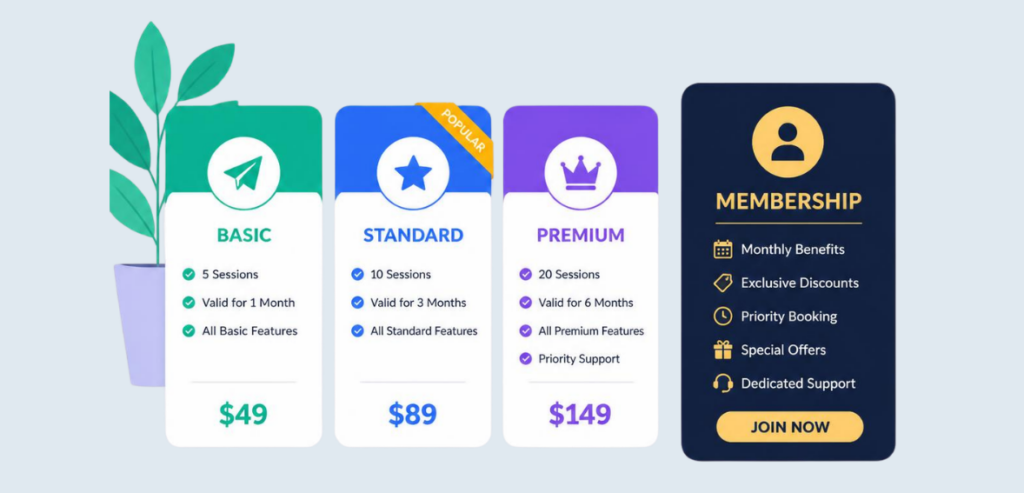
Discounts push money from your business, but prepaid plans pull payments forward. Memberships and packages pull funds forward and create cash flow for your business. The change from paying in advance instead of per visit smooths the impact of the slow season on your business more than any discount ever could. Prepaid plans and memberships help you create customer loyalty, which helps end the slow season.
Every month is a gamble with one-time clients. They might choose to come back, or they might not, and your revenue is unpredictable. A member has already paid and has committed to a routine. Members are gold because they visit much more regularly than one-time clients. There is a notable difference. A one-time or casual client without a loyalty plan visits on average about four times a year. A member visits on average about seven times a year. More visits equal less idle time on your most dreaded weeks.
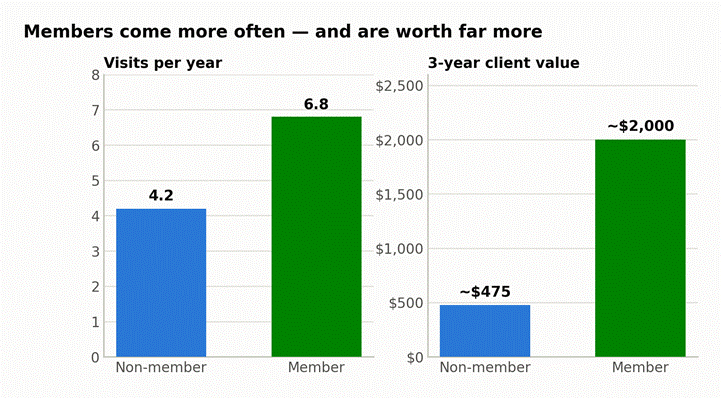
Figure 3. Members visit more often and are worth several times more over three years than one-off clients.
The difference in value over time is greater than the difference in visitation. In three years, a non-member is worth about $350 to $600. During the same period, a loyalty member is worth an estimated $1,200 to $2,800. Retention reinforces the picture. Loyalty members have an approximate retention rate of 78 to 85 percent, while the rest have a rate of 55 to 65 percent. A membership doesn’t just help with a slow Tuesday. It significantly helps to rebuild your entire revenue floor.
Small businesses think memberships are a strategy used by large businesses. That is not the case. A small studio or salon feels the financial impact of an empty chair more. Memberships provide a predictable form of income. They benefit small businesses more. To offer memberships, you do not need a complicated app or thousands of clients. You need one honest offer that your clients want.
Memberships offer a lot of flexibility. A salon can offer a monthly membership for a blowout, a prepaid membership for six color appointments, or a spa club that has one facial a month and a member discount on all services. The prepaid per-visit price should sit just below your walk-in price, low enough to reward commitment while still protecting your margin. Once that number is set, anything beyond it is a benefit for the client. With prepaid memberships, the business is protected. With clear membership terms and real perks, even a small salon can count on its loyal clients to provide steady income.
Each tactic in this guide is a standalone success strategy. This one is particularly phenomenal. It is cost-free, takes 10 seconds to implement, and grows to bring in tens of thousands of dollars yearly. It is simply booking the clients’ next appointment prior to them leaving the salon. Most salons don’t have this in their processes. Salons that have mastered this process have little to no slow seasons.
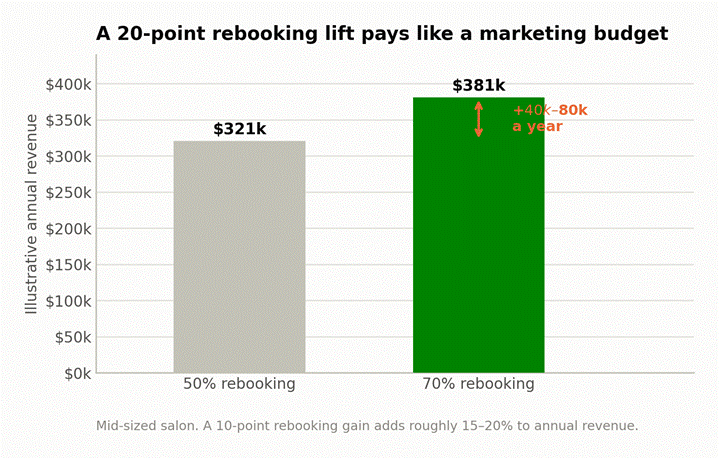
Figure 4. Lifting the rebooking rate from 50 to 70 percent can add tens of thousands in annual revenue.
The best time to book a client for their next appointment is right after their service. They leave the salon looking and feeling great. Their beautiful look helps them to envision their next appointment! If you let them leave without booking their next appointment, that feeling will fade and their calendar will get increasingly busy. Ask the client to book their appointment before they leave the salon to turn a feeling into an appointment.
It is easy to see the positive effects booking a client for their next appointment has for a salon’s revenue. An increase of rebooking rate by 10% has the potential to increase a salon’s revenue by 15 to 20% annually. For a salon of average size, increasing the rebooking rate from 50% to 70% could potentially increase revenue $40,000 to $80,000 annually.
Salons that have a rebooking rate of 70% or higher spend 30% less on client acquisition, meaning they have much lower costs to attract new clients. Booking an appointment at checkout hovers around an industry standard of 30% to 35%. The top salons reach 70% or higher. The difference is all in the habit!
Success hinges on your approach. “Let us know when you’d like to come back” puts the work on the client, and they’re likely to leave it unfinished. You’re better off saying, “You’re due in six weeks. Should I book you in for the same time on Thursday?” An offer with a time frame makes the decision easy, and active requests beat passive requests three to one because they eliminate the work that the client would otherwise have to do.
Resistance is not a stopping point; it is the prompt for your next line. When a client says “I’ll call later,” you cannot accept that and let them drift. Offer a hold they can confirm later, or send a reminder and follow up with a text. This is especially true because the follow-up channel is not equal. A follow-up by text is much more likely to be seen than one sent by email. If you’re going to remind a client to come in, do it by text.
Gift cards are the unsung heroes of offseason cash flow. Gift cards are sold to bring in cash to address slow seasons. The cards are redeemed later, when the recipients book their service. With gift cards, business can be done even in the offseason, and cash can be collected before the services are rendered. Gift cards even have a bonus that many business owners are unaware of.
The mechanics provide a huge advantage to a seasonal business. You collect the total payment when a client purchases a card. The service and its cost, however, happen at a later time. You can run a gift-card push to collect the revenue early and provide the service later during a busier time when you have the capacity to do so. Many salons used this strategy to sell gift cards during pandemic closures. They were able to sell gift cards to keep cash flowing while the salons were closed. The same strategy can be used during any predictable business lull.
An automatic upsell is also a part of this system. When a client comes to redeem their gift card, they usually spend an additional 20 to 30% beyond the card’s value. This also adds a new client to the business. This is not a discount for you; you have actually received the payment to introduce yourself to this new client.
Finally, there’s breakage, which is the industry term for value that gets sold, but never gets redeemed. Significant portions of gift card balances get neglected. Some researchers have even argued that gift card values that go unspent can even reach twenty percent on average, and that half the consumers have gift cards that were never fully redeemed at any point. In the United States, Americans are holding approximately twenty-one billion dollars in gift card value that has never been redeemed.
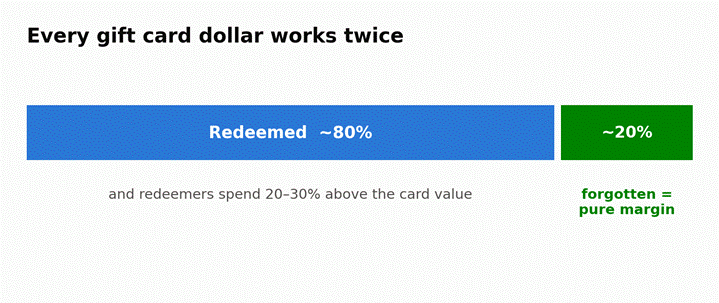
Figure 5. A large share of gift card value is redeemed and lifts spend, while forgotten balances become pure margin.
Breakage occurs when customers forget to redeem the gift cards they purchased. Breakage leads to real profit, as there is no chair to staff and no service to deliver. Even though breakage is a great bonus, it shouldn’t be part of a business strategy. A business model that counts on customers forgetting what they paid for is a model built on sand. Breakage will happen on its own, so consider it a gift, and keep your expiration terms fair and legal. Try to design your gift card program so that most gift card customers are repeat customers and spend more money.
Acquiring new clients is costly, and we all know how costly that can be. There is one exception: clients who come through referral. When you have a happy client, and they send their friend to your business, you, more often than not, receive an advance introduction, have some credibility, and can be sure the referred client will be of the same caliber as the client who referred them. That is the secret. The best clients you have in your business usually know people who will be equally good clients for your business as well.
A referral gets around the hardest part of marketing, which is building trust. While clients are still getting to know you, a referral comes to you with an advantage. Statistically, referred clients are worth more than double what an advertising client is worth, and they stay with you longer. In the first year, almost three-quarters of referred clients still visit the salon compared to only four out of ten clients gained through advertising.
Now take that into account with the costs of gaining a client’s attention through advertising. To gain a new client through paid advertisement, it costs between forty-five and one hundred twenty dollars, and in most cases, those clients are one-off visits. A referral is worth a small thank-you gift to you, and provides a loyal client who spends more, and refers again. During a slow business season, to fill more chairs, it is better to prompt for referrals than to advertise.
The most effective referral programs reward both the referrer and the new client. Without a mutual reward system, it can feel as though you are using your client to advertise. The system with a reward credit for the referring client and a bonus for the new client makes the referral feel generous instead of a business transaction. The client looks good, and the new client is not coming into the business with the feeling of being sold to.
Keep the reward tied to something that pulls the new client in more, like a credit that goes toward a future visit instead of a discount on the first visit. This solves the deal-seeker problem with the added benefit that the reward only takes effect if the new client decides to come in again, and the loyal client is not left with the feeling of having planted a business transaction. Instead, the loyal client is rewarded for the relationship that they helped to establish.
Every salon has clients that stop coming for no reason. Most of the time, they’re not even unhappy with the service. Clients sometimes just get busy with the things going on in their lives and start coming in less and less often. Drifted clients are the most overlooked asset for any business. This is because clients that have drifted know the business and the people that work there well, and they’re the easiest clientele to get back. A single, good, well-timed text to a drifted client can get them coming back like they used to.
You want to identify silence before it turns into a habit. If a client has been coming every six weeks, then starts drifting and comes back ten weeks later without booking, it signals that they are still coming, but drifting away. That is the time to give the client a gentle nudge. If you wait a year to give them a nudge, then you are competing with many other salons that they have gone to. To prevent them from forming other habits, it is best to reach out after the first cycle is missed.
Most clients leave because they feel like they have been forgotten, not because of the price. If you reach out to them, you show them that you noticed, and this can help with the recovery process. The recovery process has been showing good results. A good win-back offer recovers twenty-two to twenty-eight percent of clients that have been lost, and this benefit is much greater than the cost of a few automated texts. The texts will be read because they are opened almost 100 percent of the time.
An effective win-back note has an inviting tone and sells softly. It is a reminder to the client that it has been a while since you have interacted, and it makes the return convenient by including a time-based booking prompt. Including a small incentive works to your advantage when it is a value-adding surprise, like a complimentary add-on, and not a discount. It is better for the client to feel missed than that they are being marketed to.
Vagaro
Reaching out to all clients to win them back is where most people fall short. Tools like Vagaro automate win-back messaging by identifying clients who’ve missed their usual rebooking and allowing you to send a custom message. Rather than thinking about win-back, you can focus on other high-impact tasks. Scheduling and messaging are critical, but the real value is when the messaging maintains the human touch. Consistency in messaging that is targeted to clients at risk of leaving is worth far more than a one-time, elaborate campaign.
Tactics serve a purpose, but a calendar protects those tactics. Without a calendar, your clients learn that a sale is always just around the corner. Work your tactics against your actual valleys, rotate them to avoid permanence, and you fill the gaps while your full price is maintained the rest of the year.
You cannot fill a valley you have not measured. Step back and review a year’s worth of bookings and identify the real demand lags. Which weeks, days, and hours have bookings consistently low or nonexistent? Most salons notice their dips become predictable from the post-holiday stretch in January, low summer bookings due to vacation travel, and the absence of business during the middle of weekdays. Getting specific about your low demand intervals allows you to create targeted offers to fill those gaps. Discounts to fill time slots that would sell anyway become unnecessary.
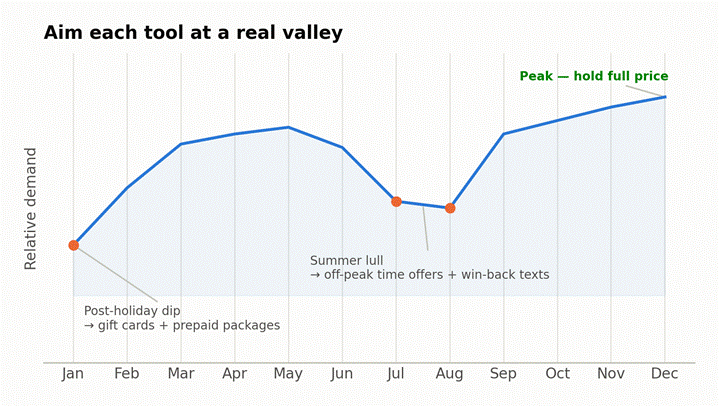
Figure 6. Match each tool to the valley it fills so no single offer ever becomes the everyday price.
Having the map means each tool can find its right place. Prepaid packages and gift card pushes work well during the long post-holiday slump when customers have less cash, but you still need revenue coming in. Off-peak deals help you during the year-round slow midweek and midday periods. Referral campaigns and win-back texts are the best forms of promotions to do just before a slow period to help fill the calendar before it becomes empty. It’s all about the placement, so every promotion is targeted to a weakness instead of covering the entire business.
The problem with any promotion that recurs is that clients come to expect it. A referral bonus that is offered all year long is no longer special. A standing midweek deal eventually is what your clients now view as your regular price. The way to defend against this is through rotation. If you run a gift card push followed by a membership drive, no single promotion will be in place long enough for clients to reset their expectations.
With rotation, each promotion feels fresh. Clients are excited to see a new offer instead of tuning out a banner they have seen for months. Your rack rate stays fixed and visible, and every promotion is designed to lead clients back to full price.
This is the goal with the slow season calendar. The promotions pull revenue and demand into the gaps, and through all of it the rack price never changes.
The slow season is not a discount problem. Thinking of it this way is why salons have a hard time selling services. Blanket markdowns lead to selling discounted services to clients you would not earn repeat business from, while the real lost revenue comes from the 68% of clients who leave because they feel forgotten. Solve the 68% problem, and clients will start filling your appointment calendar without you having to do anything else. The ideas in this guide are simple concepts that address your gaps in appointment demand and make a future time appointment easier to sell to a client, all while maintaining your current pricing.
The key to solving the problem is the order of operations. Move away from the across-the-board markdowns and instead make time-sensitive offers to fill gaps for specific time slots. Bring future cash into your salon with prepaid services and sell them at a discount to increase business loyalty. The rebooking ask at checkout is the most important habit; no other solution returns so much for so little time. Focus referrals on bringing in your ideal, most profitable clientele, and use win-back texts to recover the clients you have lost and want back in the salon.
Use scheduling to set boundaries on discounts that focus on appointment gaps, and keep rotating to stop stagnation and increase business bookings. The slow season is not a discount problem. It is lost potential time that the business could be earning income. You can easily fill appointment gaps and increase your business bookings without discounting your services.
Instead of discounting everything, aim the value at the gap. Focus on midweek time slots. A time-limited offer that fills genuinely empty slots during midweek can move flexible clients to your valleys, while keeping your busy weekend slots at full rate. Rather than a standing sale, fill unpredictable last-minute cancellations with same-day openings. Prepaid packages, rebooking, and win-back texts raise demand on top of that. Get the sale rather than training your clients to wait for a discount.
The empty chair becomes a much larger revenue loss for small businesses, since they have fewer customers. In this case, the small business is the salon. Hair salons do not have complex business structures with many employees, so they can operate most efficiently with steady prepaid revenue. It will actually make your business simpler. Just one reasonable offer can help your salon thrive! Consider creating a “single blow-dry” offer or a planned “visits per month” prepaid color packet. A membership makes your customers much more loyal. Set the per-visit price of a prepaid color plan just below your walk-in color price, and require enough visits, three or more, for the commitment to pay off for both sides.
When you’re at the chair, ask to book them for the same day and time in the next booking period. A question like, “You’ll be due in six weeks. Shall I book you for the same Thursday?” is better than a “call us when you’re ready” response. If there is hesitation, don’t allow them to leave without booking. Hold the date and send a reminder text. You can expect a revenue increase of fifteen to twenty percent for a ten-point increase in rebooking. Making the ask a habit for all stylists is one of the highest revenue-impacting asks.
Both your client and their friend deserve a benefit that enables the introduction to be perceived as a generous act instead of a business transaction. The current client will receive a credit for their next appointment, while the friend will receive a welcome bonus, which is an incentive given at the business’ discretion to the friend that will be received during their second appointment. This is a clever way of ensuring a return client, instead of a one-time bonus-seeking client. This is further incentive to create a referral program, as compared to other methods of acquiring clients; clients obtained through referrals are typically more valuable, as approximately seventy-four percent of referred clients remain active with the business at least a year after their first appointment.
Bring in cash sooner and add value to your current clientele. You can sell gift cards to create instant revenue for services that you will provide in the future when your business is busy. When customers redeem a gift card, they tend to spend more than the redeemable amount, and any remaining value on the card is profit. Gift cards and prepaid memberships help improve cash flow and guarantee revenue, while automated texts to former clients help bring back clients that you’ve lost. Identify the weeks your business is slow, create a specific offer to bring clients in, and rotate your offers to help keep your prices intact throughout the year.