Posted: July 30, 2026
Visa, Mastercard, and Coinbase have made a very public bet as they’ve joined over 140 other companies to launch Open USD, the latest venture to create a dollar-backed stablecoin for business payments, placing the card networks in the midst of a decade-long war with crypto. The news came out in July of 2026. The stablecoin is designed for all business owners and merges payments with the crypto space innovatively, and for the business owner watching from the sidelines, this means stablecoin payments have moved to the next phase. The infrastructure for stablecoin payments is now here.
This is a significant leap forward, and with participants like Visa, Mastercard, and major technology firms, this consortium is a who’s who of global finance and technology. The innovation is even enough to disturb the current market leaders. The announcement and implications will be discussed, as well as the reasons this venture still has significant drawbacks.

There are two components to the launch. One is the organization, and the other is the coin to be issued. Knowing the split is important because without the split, the governance model would not make sense.
Open Standard is the independent organization responsible for the release and management of the new token. They aim for neutral governance. Instead of one company monopolizing the token and profiting from it, Open Standard is managed by a board of directors comprised of member partners. The goal, as stated, is to make decisions for the benefit of the collective rather than for individual token issuers. Zach Abrams is the founding CEO and also the CEO of Bridge, Stripe’s stablecoin subsidiary. This means Open Standard is directly related to one of the largest developers of digital payments.
The organization is attempting to create a particular perception of itself. They want to appear as a public utility service rather than a startup. They want people to think of them like the early stages of card networks, which were created as banking cooperatives. Open Standard is presenting the same ideology for the era of stablecoins.
Open USD is OUSD for short. It aims for a value pegged to the US dollar. Designed to operate continuously, including weekends, OUSD aims to settle cross-border transactions with minimal delay. The coin is anticipated to go live in 2026, with the consortium and its rules being formally introduced in the summer of that year. Some reports claim that OUSD will be issued directly on the Tempo blockchain on its launch, which will be the first blockchain to support OUSD, unlike other general-purpose crypto networks.
Abrams stated his position on what OUSD brings to the market. Current stablecoins have their merits. However, to bring the technology to the mainstream and allow businesses to operate at scale with the technology, a token that is open and aligned with the businesses’ interests is needed.
The project’s partner list gives it real value. In the payments space, we find Visa, Mastercard, American Express, and Discover, while in the banking and asset management space, we find BlackRock, BNY Mellon, Standard Chartered, U.S. Bank, BBVA, Huntington, and Citizens Bank, with BNY Mellon announced as the custody partner for the reserves. In the fintech and digital asset space, we find Stripe, Coinbase, Chime, Adyen, Ripple, Galaxy, Bybit, OKX, and MetaMask. Finally, we find Google, Shopify, and IBM in the technology space.
The combination of traditional finance, payments, and crypto in a single project is very uncommon and is the primary reason for the significant interest in the launch.
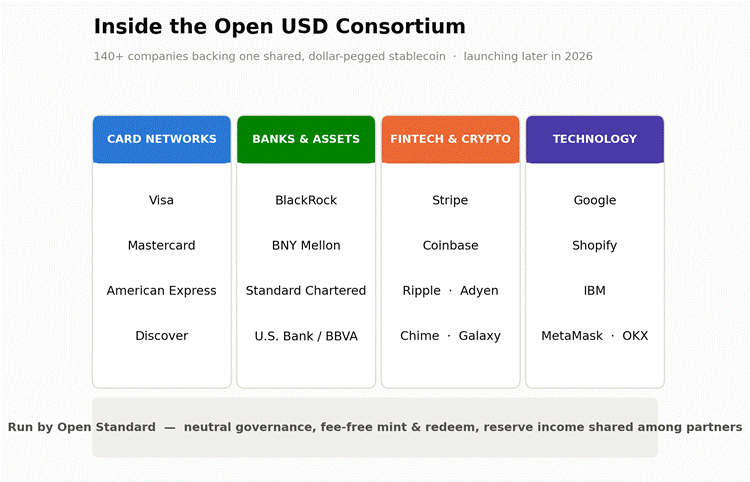
Figure 1: The Open USD consortium spans card networks, banks, fintech, crypto and technology.

Strip away the jargon and a stablecoin is a simple idea. It is a digital token that aims to keep a consistent value. The most common model is to the US dollar, where one token should equal one dollar. The only thing a stablecoin has to do is keep its value.
This is where stablecoins and Bitcoin diverge. The high volatility of Bitcoin prices makes it impractical for use as a standard to compare the value of goods and services, like a cup of coffee. Stablecoins, theoretically, do not have price volatility due to their reserves, where real dollars are held for each token in circulation. Therefore, if one stablecoin is sent, the recipient knows they are receiving one dollar and not a risk of losing value due to price fluctuations.
The peg is essential because payments cannot have volatility. When a payment is completed, the recipient knows the amount paid is the amount that was received, and if the price fluctuates, the payment system would be rendered useless. Therefore, the confidence in the reserves and the peg are the foundations of stablecoins. The peg is lost, and the reason for the token is lost. Therefore, the regulations regarding reserves described below are the most important feature.
Timing is certainly the most apparent issue here. Stablecoins have been around for some time, so why are Visa and Mastercard jumping into this space in 2026 and not 2021? The short answer is regulation.
The GENIUS Act, or the Guiding and Establishing National Innovation for U.S. Stablecoins Act, was signed into law in the United States in July 2025. It provides the first federal framework for payment stablecoins. It provides guidelines for previously grey regulations. All payment stablecoins must hold reserves of one to one, with high-quality, liquid assets.
Stablecoin issuers must be chartered or licensed (either federally or by the states), and any bank wishing to issue a stablecoin must do so through a regulated subsidiary. There are monthly attestations, and the reserves must be certified by the Chief Executive and Chief Financial Officers. Stablecoin issuers must comply with anti-money laundering regulations, and issuers must not offer any interest or yields to the holders.
For large institutions, these regulations are a significant change. There is no longer a stablecoin compliance risk. Rather, there is a defined product that institutions and banks can build. With the new regulations, large payment institutions are now able to issue payment stablecoins.
Regarding the networks themselves, this is defense. Their business is moving money and collecting fees. If someone else uses a faster, cheaper settlement token that cuts across their rails, that is a risk to them. By building the Open USD, they get to design the product instead of watching from a distance. Mastercard’s approximately $1.8 billion acquisition of the stablecoin company BVNK showed the same impulse. “Speed used to be the main differentiator, but the focus has to be on reliability, governance and interoperability,” said Visa executive Jack Forestell. The incumbents want to control the standard now that the railroads are in place.
Two phrases in the announcement do the heavy lifting. Both phrases indirectly criticize the methods employed to profit by the current stablecoin market leaders. Minting refers to the process of creating new tokens by depositing dollars, while redeeming means the conversion of tokens back to dollars. Open USD claims it will allow businesses to perform both processes without any costs or limits. For businesses transferring a large amount of money, there is currently a fee for both processes. Thus, eliminating these fees is a marketing strategy targeting treasurers and payment businesses.
However, the biggest disruption in the announcement comes from the phrase Shared reserves. When a stablecoin issuer is in the market with billions of dollars in reserve, the funds remain in short-term instruments and the stablecoin issuer profits from the reserves. Open USD claims that after the management fee, the profits from the reserves will no longer be the issuer’s profits, but profits will be distributed to partners.
That design focuses on the incumbent’s vulnerable point. Circle, the creator of USDC, generates the majority of its business from exactly this reserve interest. A competitor returning that revenue to partners undermines the core business. The market took notice right away, as Circle stock plummeted on the first day of the announcement, in part due to major backers such as BlackRock and BNY supporting the new competitor. Ark Invest Analysts are less confident Circle will lose its position. They feel Circle has a lot of benefits in distribution that may be difficult for new competitors to achieve. Tether, the issuer of the largest dollar stablecoin, also holds the largest market share and will be difficult to remove from that position.
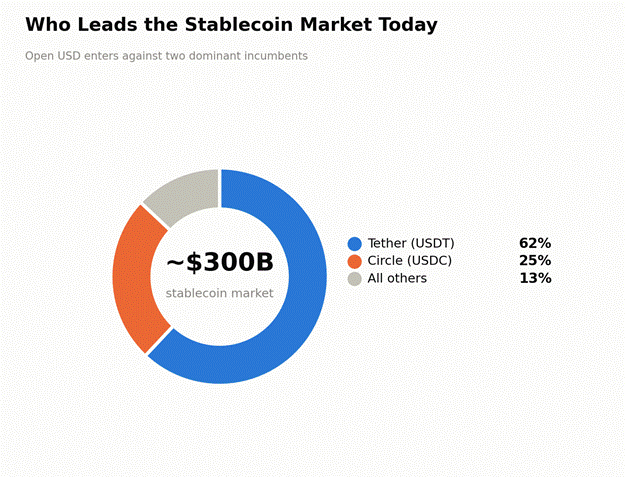
Figure 2: Tether and Circle dominate today’s stablecoin market. Open USD is the new challenger.
When business owners encounter stablecoins, it won’t be when a customer pays in stablecoin at the point of sale. They’ll likely already have stablecoins in their business long before that. Historically, cross-border payments have been the first major business use case for stablecoins. The existing systems are slow and expensive.
Let’s consider a supplier. A traditional payment (e.g., a wire) will take several days and pass through several banks along the way, resulting in several fees. A dollar stablecoin can be sent across the world in a matter of minutes for minimal cost, at any time, with no intermediary banks. For a business that pays overseas vendors or receives international revenue, that system is a major operational improvement. This is the main use case for Open USD, and is why banks and payment processors are involved.
The second major use case is for settlement. If a business accepts a card payment, the money can take several days to be credited to their account. Stablecoin settlement can reduce that wait time to near-instant. Stripe has indicated that Open USD has the potential to become the default settlement token for the businesses on its platform.
This would allow stablecoin settlement to be implemented in the background for regular transactions, with the business not interacting with the token at all. Back-office settlement is most likely to be the first use case for stablecoins.
Here is the part the press releases gloss over. Even with the wins in the stablecoins space, stablecoins are currently barely used for payments. There is a massive gap between promise and reality.
Research from the Federal Reserve Bank of Kansas City, published in late 2025, quantified stablecoins. With a total market cap of about 300 billion dollars, 48.8 percent of stablecoins were used for crypto trading, 29.3 percent were for transfers, and 21.2 percent were idle in wallets.
Only 0.7 percent were used for payments. That translates to less than 1 cent for every dollar of stablecoin activity that made a payment for goods or services. Monthly payment volume, although it has been growing, was in the range of low tens of billions of dollars, while the stablecoin market cap was in the hundreds of billions of dollars.
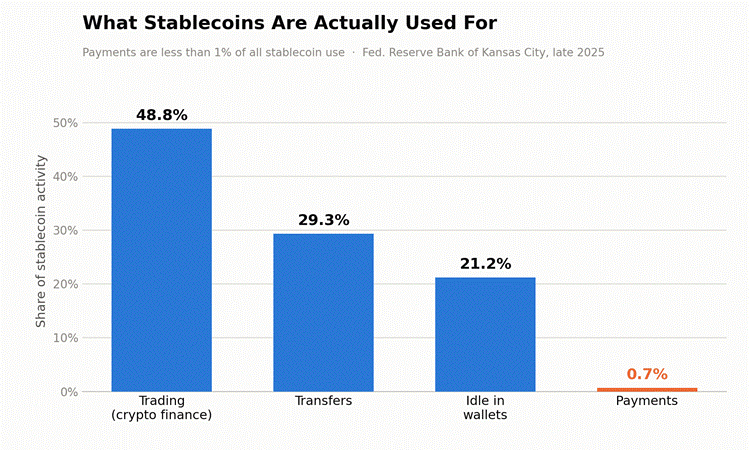
Figure 3: Payments remain under 1% of all stablecoin activity, despite the hype.
That number should set expectations. The infrastructure is coming, the law is enacted, and the biggest players are involved. However, user habits have not evolved. Currently, most stablecoins are traded within the confines of the crypto economy; they circulate between various exchanges and protocols and rarely leave the crypto economy to be used for settling payments.
Open USD is marketed as an improvement on stablecoins by the mainstream players. The issuance of Open USD is not proof of the change that is being anticipated. A headline should inform a merchant and not pressure them.

What questions should business owners ask themselves to look at this without being sold on the hype? For faster and cheaper settlements to improve your cash flow, do you frequently move money across borders? How about your customers and suppliers? Do they prefer to transact this way?
Or is this a solution searching for a problem within your business? Is your existing payment processor going to support Open USD, and therefore, you might benefit from this without making any changes? Finally, are you still willing to accept the digital cash token along with the remaining tax, accounting, and compliance issues that require you to still hold a digital token?
Most small businesses that service the domestic market (and have had their same-day banking needs satisfied) will find that the acceptance of stablecoins has no relevance at this point. There are important differences for exporters, importers, global freelancers, and platforms that pay creators around the world. It is wise to keep a patient approach and avoid adopting technologies too early, since it is clear that not all technologies operate in the same manner.
The real test will happen during the official launch in late 2026. There are a few ways to assess if this will be infrastructure or remain a headline. See if Open USD is released on time. If it is, then see if it maintains its dollar peg during its first real use. Also, see if it maintains its shared reserve model during the stated launch.
The true test of that model will be if it erodes due to pressure from regulators or profit. Finally, see if Stripe and the card networks, among many others, direct substantial settlement through the system. The true test of demand will be the settlement, not the partnerships.
Don’t forget about the current players in the market. Open USD will not define the whole market, as Circle and Tether will respond, and how they respond (cutting fees, sharing revenue, etc.) will be as important as Open USD.
If in the next year the payments share starts to increase as Open USD launches, then this will prove that they are not just redesigning the market for stablecoins. If the payments market share continues to stay below 1% then Stablecoins don’t really serve a payment function and are just a tool for trading.
Open USD’s introduction into the market is exciting, not because a new token is available, but because of the companies involved and how Open USD has been organized. When trade giants such as Visa, Mastercard, and BlackRock, in addition to over a hundred other companies, agree to share governance and reserves, it is safe to say that regulated stablecoins will be a core building block of payment infrastructure.
The GENIUS Act cleared the legal hurdles, and the consortium is going through with it. For now, the most identifiable change for merchants will be faster cross-border payment transactions and faster payment transaction settlement.
These will most likely be done by payment processors. The hype is kept in check, however, by data. Trading, not payments, will continue to be the main stablecoin activity for now. The most prudent approach is to acknowledge the shift and adapt if it makes sense for your business. Open USD could be the first stablecoin to bring payment services to merchants, but it is not the first to provide stablecoin services.
A stablecoin is a digital token that has a value that is usually equal to one US dollar and is backed by reserves. The purpose of stablecoins is to combine the best of both worlds by having the speed of crypto and the stability of regular money.
Open USD will be a business payments-focused dollar-pegged stablecoin designed by the Open Standard consortium, which is a group of 140 companies that includes Visa and Mastercard. It is expected to launch the business payments-focused stablecoin in 2026.
The newly passed legislation in the US makes regulated stablecoins possible. As for the legislation, if a competing entity owns the cheap settlement token, it could pose a threat. Supporting Open USD means that the networks will set the standard and not get circumvented.
Some merchants can. But adoption is still early. And payments currently represent a small fraction of stablecoin use. Faster settlement, which their payment processor will likely automate, will probably be the first noticeable benefit for most merchants.
Signed into law in July 2025, the GENIUS Act created the first framework for structuring payment stablecoins at the federal level in the U.S. Inclusive of payment stablecoins, it mandates full one-to-one reserves, charters for issuers and monthly reporting of reserves.