Posted: July 23, 2026
At 9 PM, a homeowner’s kitchen sink begins to leak. This homeowner doesn’t open ten tabs like everyone else. Instead, they search for “emergency plumber near me.” Often, they don’t even bother to click a result when an AI Overview supplies them with three local plumbers from the map pack. If you aren’t one of the three businesses, then you don’t exist to this homeowner.
This is local SEO in the age of AI. The first answer to a large percentage of local queries is now being written by AI. Local SEO AI Overviews are now dominating local queries. The businesses appearing in AI Overviews are exclusively the businesses that rank in the traditional map pack. In fact, practically nothing has changed regarding what drives local visibility. Being local is more cutthroat than ever. Businesses that implement the basics of local SEO are gaining prominence, while the majority of businesses are becoming less visible as the query is answered without them, completely out of their control.
This guide shows service businesses from trades to professional services where and how to begin to implement local SEO in the area where they work to gain the competitive advantage over other local services that do the same.
When watching Google Search Results change, one key thing to note is that AI summaries have taken the prime real estate on listings. Google’s AI Summaries are already showing up on most searches, and data from most affected industries are showing drastically reduced click rates to listings as AI Summaries are providing the information.
This is understandably a problem for Local SEOs, but at the same time, Google AI Summaries create the outputs from the same inputs as a Google Business Profile: a good amount of customer reviews, a good amount of local citations, and a good amount of on-page content.
AI Overviews do not create a separate ranking system with its own rules. They have created a new interface that is layered on the same trust signals that local searches have always been reliant on. The businesses that have AI Overviews created for them are the businesses that dominate the local searches map pack.
One study that has been widely referenced on restaurant searches has found that businesses that ranked in the top three of the local searches were referenced in AI answers 25.9% of the time. It is worth noting that the other local businesses did not receive any references at all. This completely changes the conversation. The reward for excellent local SEO is AI visibility, and not having to learn a new skill.
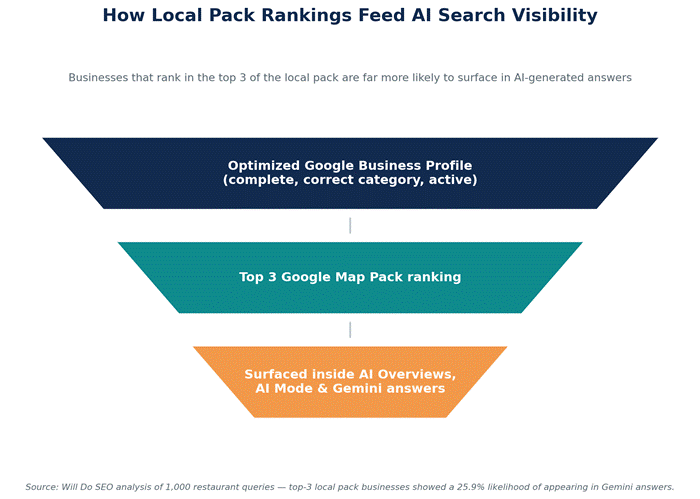
Figure 1: Local pack rankings feed directly into AI Overview and AI Mode visibility.
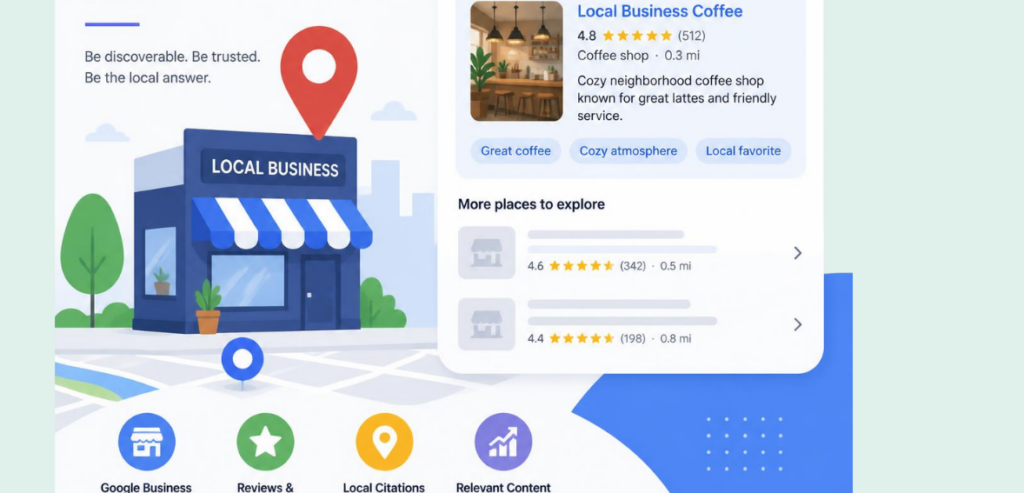
Google Business Profile (GBP), previously called Google My Business, powers the map pack, the knowledge panel, and a lot more when AI Overviews suggest a local business. It is the most powerful tool for local SEO, especially for small businesses in the AI era. As of now, recent industry surveys estimate that GBP signals account for 32% of local pack ranking factors, compared to on-site SEO, local reviews, citations, and behavioral signals. In other words, GBP signals are more important than any other single factor.
There is no more denying the importance of GBP for local businesses. It is the core of local SEO, and businesses must complete every field of the profile to achieve the best performance in the local SEO sphere. This means businesses must choose the most appropriate business category, complete every field of service and product listings, add and update business hours, add real photos (not stock photos) of the business, and update the profile regularly. AI pulls structured data to answer queries. If GBP is incomplete, AI will overlook the profile and the business will lose traffic to other businesses with complete profiles.
For a long time, Google has explained map pack rankings in terms of three areas: relevance, distance, and prominence. Of these three, distance, aka proximity to the searcher, is the most important and is also something that cannot be adjusted with any amount of SEO. This is because distance (or proximity) relies entirely on the location of the customer at the time of the search.
Relevance is determined by the Google Business Profile search query match, hence the importance of the correct Google Business Profile category selection. A general contractor (who has the Google Business Profile category of ‘contractor’) will lose visibility to the contractor (who has the Google Business Profile category of ‘plumber’) when someone searches for plumbing-related services. Rounding out the three is prominence: the combination of review volume and quality, consistency of citations, on-page website authority, and behavioral engagement (clicks, calls, requests for directions, etc.).
Since proximity is not something you can optimize, a smart small business local SEO strategy focuses on what a business owner can actually control: profile completeness, category accuracy, review velocity, citation consistency, and website content that is relevant to the area. Whitespark, a local search data and software company, conducts an annual survey of a few dozen top local SEO professionals to see how much impact each of these factors has. Below is a chart that shows some relevant data from their 2026 report.
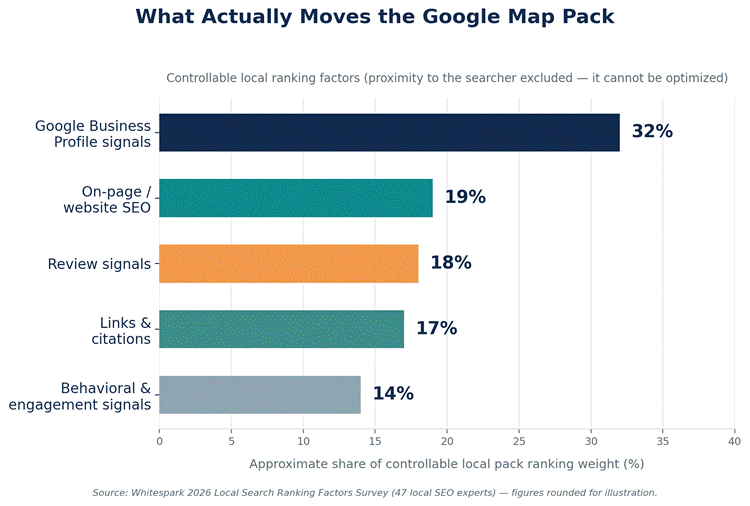
Figure 2: Approximate weighting of controllable local pack ranking factors, based on Whitespark’s 2026 survey of local SEO experts.
Two outdated tactics to be discarded in local SEO are geotagging photo files and Google Post keyword stuffing. There are no measurable ranking advantages of either in controlled tests. One study that tracked 441 keywords over nine weeks found no ranking movement related to Google Business Profile Posts. Focus on the SEO fundamentals instead of wasting time on these tactics.
You can’t really pinpoint the magic number of reviews needed to enter a map pack, and the data reflects that as well. Take review signals; they account for approximately 16 to 20 percent of local pack ranking weight, and that number is expected to grow. What affects the ranking the quickest is review velocity, which is the steady influx of reviews as opposed to a singular focus.
Google can’t tell that a business is popular now if all of its reviews are from the past; a business that is popular in the present will be consistently active. Response rate is included in this as well. Businesses that respond to at least 80 percent of their reviews are likely to experience a boost in ranking, and the responses shape the AI Overview for the business as well.
Each review has its merits as well, but a review that mentions a specific service in the area and a detail about the experience itself is way more helpful than a standard five-star review. Google’s algorithms will definitely lack information if you are only relying on five-star reviews. The sweet spot for most service businesses is a review every few days; anything more is unnecessary. Most consumers consider reviews that are older than three months to be stale, and that notion only adds to the review generation urgency. Review generation should definitely be a long-term business goal.
A local citation refers to an instance where a business’s name, address, and phone number (NAP) are published on a third-party website (for example, a directory or an industry website). There are many examples of local citations, and some include: Yelp, Bing Places, industry-specific directories, and listings for chambers of commerce. Agencies have included hundreds of citations as part of their local SEO strategies, and the volume-first approach used to be the most common. Recent evidence suggests that around ten authoritative, industry-relevant citations outperform fifty scattered, low-quality citations.
The importance of local citations has not diminished; however, they do not carry as much weight as before, and now the consistency of local citations is more important than the number of local citations. Inconsistent NAP information can confuse Google and AI in determining if a business truly exists.
Citational importance has been updated due to AI search innovations. When tools like ChatGPT are asked to recommend a business to fulfill a user request, they first compile the answer from multiple citations. This creates a need for local businesses to be listed on industry “Best of …” lists, reputable industry directories, and Bing Places, to name a few. Optimizing local citations for AI search now has more value than before. The process of fixing and improving local citations is simple. Focus on one or two high-value, industry-specific directories, and eliminate duplicates and inconsistencies.
In terms of local intent, “near me” searches may be the most lucrative behavior pattern for small businesses to tap into. The great thing about “near me” searches is that they indicate the searcher is only hours away from making a decision and taking action, as opposed to weeks. When a person searches “near me,” the goal is to make sure every signal you can control confirms your location. This starts with an accurate and verified business address on your Google Business Profile (GBP), consistent NAP (name, address, phone) details within each citation, and location-specific pages on your website instead of a generic service area page.
Although service-area businesses may not have a public storefront, they should follow Google’s direction on concealing their address while providing their service area. Controlled experiments have shown that service areas do not impact Maps rankings for businesses with an actual address. What is most important is the verified address that the profile is centered around.
Moving beyond the profile, the best visibility for “near me” searches comes from hyper-local content. This can include city and neighborhood landing pages, a Google Map (embedded), testimonials that are related to the area, and organic mentions throughout the page of the landmarks and service zones. The speed of the webpages on mobile can also impact visibility, considering that the vast majority of “near me” searches take place on mobile devices, and often from the person standing right outside your business.
An overwhelming number of consumers search for businesses on their mobile devices and then visit the business within the next 24 hours. A page that doesn’t load fast or an outdated address doesn’t just lose a click; it loses a customer.
AI Mode, Gemini, and ChatGPT are clearly different from other search tools in that they summarize web content and extract information from structured data to answer questions rather than linking to web pages. AI crawlers will find answered questions much more easily than marketing copy. This is because clear, concise answers are much more helpful than brand voice marketing copy that requires interpretation. Plain language content that directly answers customer concerns is much more effective than vague marketing copy because systems that summarize web pages are clearly designed to distill text down to the most specific and concise answer.
The latest studies examining the local business recommendations of tools like ChatGPT indicate that first-party testimonials on a business’s website now carry more influence. Unlike past AI tools, ChatGPT and the AI tools that will be developed in the next few years will probably rely on business homepages and not service pages as primary source texts.
As a result, business homepages will need to be an engaging and high-quality way to communicate business information. This will also not negate efforts towards local SEO. This will be an addition to local SEO. Because of this, businesses that have been generating legitimate trust signals will be rewarded, rather than businesses that have been manipulating a ranking algorithm.
Filling in every section of a Google Business Profile and correcting the primary category is an example of the highest-leverage activity for a business in its infancy. The next highest-leverage activity is creating a system to request a customer review in the first 48 hours post-purchase. Additional activity that follows this level of leverage is resolving inconsistent NAP listings in local citations and either improving or tightening 2-3 high-authority directory listings. This also means making a dedicated landing page for the city or neighborhood that the business serves, and placing LocalBusiness schema markup on those pages.
This makes it much easier for an AI to parse and understand the business information for a local search. Each of these steps can be completed in under a day and doesn’t require a redesign or major investment. Most can be done in an afternoon.
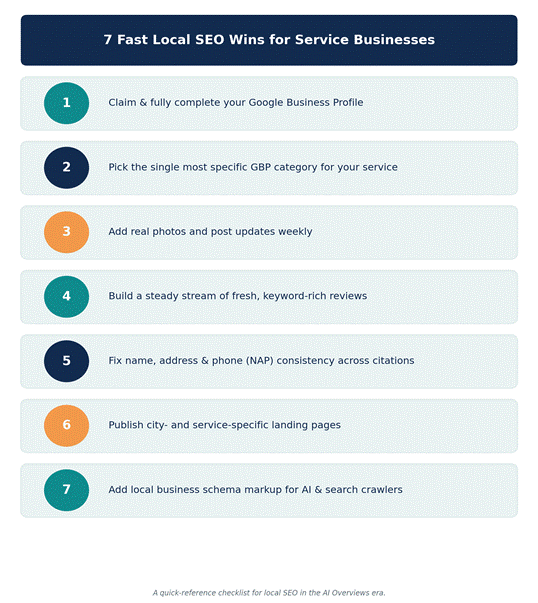
Figure 3: A quick-reference sequence of fast local SEO wins for service businesses.
Local search isn’t more complicated to understand. It’s just more punishing to those who cheat the system. AI Overviews are a good local SEO report card. They reward businesses that have good local SEO, such as a complete Google Business Profile, consistent targeted reviews, and steady citations and content that are focused on local customers.
Those businesses will land in the map pack and get cited in AI answers. The fundamentals take time to implement, but they pay back over time. The Google Business Profile and steady reviews are the most important things to focus on. Once those things are done, the rest of the local SEO for small businesses becomes a lot easier.
Map pack rankings are determined by relevance, distance, and prominence. Of these three factors, distance is the only factor you can’t control. You can influence the other two, relevance and prominence, through four areas of focus. Ensure your Google Business Profile is optimized and includes a detailed business category. Additionally, obtain thorough reviews regularly, and maintain consistent citations and focused content on your website. Businesses that focus on all four areas will see the fastest and most sustainable results for gaining placement in the top three Map pack rankings.
Yes, probably now more than ever. Business profiles on Google have the potential to influence 32 percent of the local pack ranking. AI Overviews use business profiles to help them decide which businesses to showcase. A profile that is complete, accurate, and actively maintained offers traditional search and AI-generated answers something dependable to cite. An incomplete or outdated profile offers them nothing; thus, the business is overlooked in preference to a competitor with more extensive information.
A definite number of reviews does not exist that will secure a boost in rankings. What is most important is review velocity. This means a steady flow of reviews over time with little to no gaps as opposed to a large number of reviews all at once. Coupled with a consistent answering of reviews, this is most favorable for rankings. Reviews that provide detail and are specific to a location and service are preferred over vague, generic five-star reviews. For most service businesses, the goal should be to secure a review every few days with no end in sight.
Local citations are listings of a business’s name, address, and phone number on online directories and external sites (such as Yelp and Bing Places). Local citations now reflect the quality of the listings and have become less effective with the proliferation of third-party sites. About ten citations from authoritative and relevant industry sources will outperform fifty citations from low-quality directories. Maintaining details of your NAP (name, address, and phone number) is still essential everywhere they are published, since various search engines and AI tools will be confused if there’s a lack of consistency in what is perceived to be a legitimate business.
Optimizing for “near me” searches needs a correct and verified Google Business Profile address and consistent NAP info across the web and separate landing pages for every city or neighborhood served, rather than a single service-area page. Dedicated pages will help you rank better. Mobile page speed needs to be swift as well, since most “near me” searches are made from mobile devices by customers who are ready to buy. All of these signals work together to assist Google and AI search tools in correctly associating a business with a searcher’s location and intent.