Posted: July 29, 2026
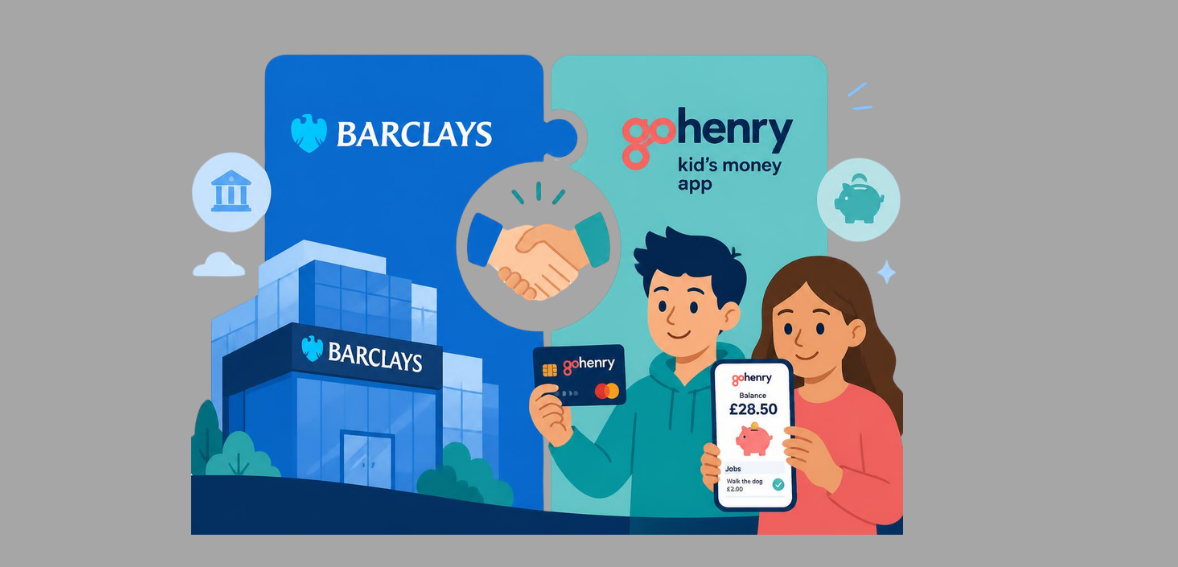
A large retail bank has just acquired the first children’s debit card. In June 2026, Barclays reportedly agreed to purchase the UK arm of GoHenry, the money app for 6-to-18-year-olds, for approximately £180 million. The company’s US parent, Acorns, has sold GoHenry to Barclays as part of a corporate realignment. Acorns will keep GoHenry’s US branch as Acorns Early, thus dividing the brand. Barclays gets the UK branch while Acorns gets the US.
Compared to Barclays’ literal and figurative financial muscle, this purchase is small. The acquisition is meaningful for a different reason. This is the first clear example of the embedded finance trend extending the furthest to date, down to the crafting of financial products for kids. This deal will signal to any company that has a family-centric business focus how and where customer loyalty efforts should ideally start. This shows why GoHenry is attractive to Barclays and what implications this deal has for banks and merchants outside of the banking sphere.
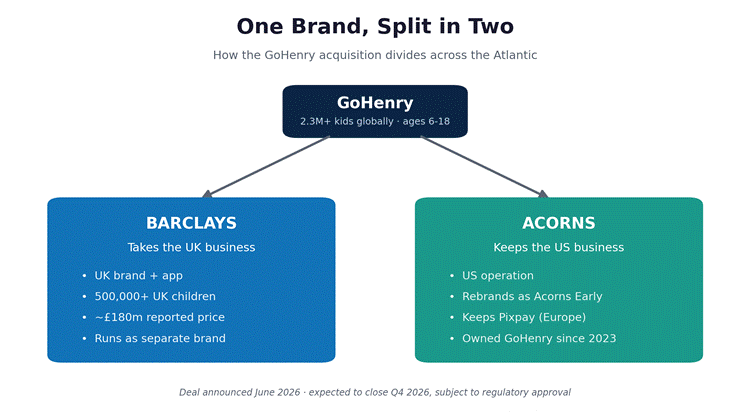
Figure 1. The deal splits GoHenry by geography: Barclays takes the UK business, Acorns keeps the US operation and its European arm.
Simply divide the elements to see the structure. Barclays will purchase GoHenry’s U.K. business, GoHenry’s U.K. brand, and the GoHenry app, while Acorns will retain the balance. The transaction is expected to be completed in the fourth quarter of 2026, pending regulatory approval. GoHenry will continue to operate as its own brand and app, under Barclays, and will not be integrated into the main bank overnight.
Barclays presented the acquisition as a family play instead of a fintech play. The bank’s logic is lifecycle banking. Winning the parent customer means they will probably win the child as a customer. The bank is attempting to hold the relationship from the first child’s debit card all the way to the family mortgage and pension. The financial cost of the acquisition is minor.
In April 2023, Acorns purchased GoHenry to extend its reach beyond the US. Acorns sold GoHenry’s UK division, enabling the firm to focus on the US and allowing Acorns to maintain its youth finance division in the US. Acorns’ Chief Executive, Noah Kerner, stated that the sale enables GoHenry to serve many more kids in the UK. Acorns also retains PixPay, the European teen money sub-company, continuing its family-centered fintech in the region.
To understand the GoHenry app, it’s best to look at the functionality. GoHenry is a money management app for children that is far more than a beginner bank app. GoHenry allows parents to set parameters and load funds to a child’s actual debit card, which children can use to make purchases both online and in-store.
Louise Hill’s mission “to make every kid smart with money” started with the founding of her company in 2012. Now, Hill’s company has developed an app that serves users as young as 6. The app gives users a card, chores, and allowance tools, savings goal tracking, money lessons, and has parental controls (for transaction monitoring and category spending blocks) built in. GoHenry is currently serving more than 500,000 children in the UK and an estimated 2.3 million children globally. GoHenry is a subscription-based company, allowing it to operate without money management conflict (as many of its competitors do). As such, GoHenry is a suitable acquisition for banks.
Barclays understands this – so it paid the price GoHenry wanted. Barclays now has instant access to a trusted and established user base and an app designed to engage families and children, cultivating habits and securing brand loyalty in their future adult customers.
To understand why this deal matters, consider it a sign of something much larger. Embedded finance is integrating financial services like payments, cards, savings, or lending into non-bank platforms. It is the “pay in four” option at checkout and the payment wallet in a ride-hailing app. Now, it is a debit card in a children’s chore tracking app.
This deal is just one of many that is aimed at the lucrative embedded finance market. The market for embedded finance was worth an estimated $145 billion in 2025 and is expected to reach $2 trillion by 2034, at a compound annual growth rate of over 30%. Banking for the youth and their families is simply the latest embedded finance market to be captured. When Barclays invests in a kids money app, it is saying this market is no longer fringe. It is actually a competitive market.
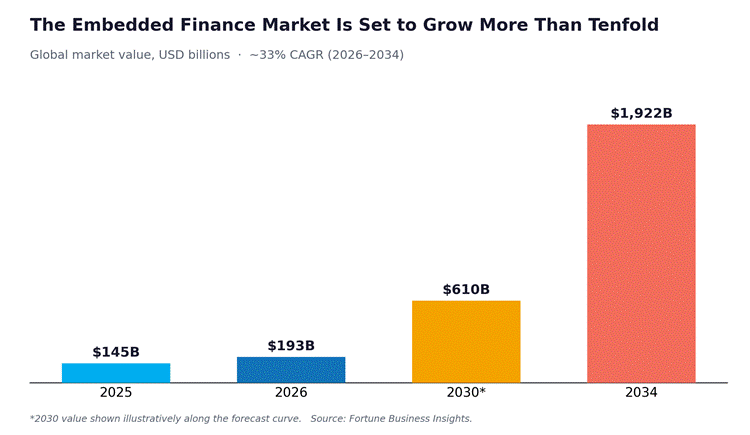
Figure 2. The embedded finance market is projected to grow more than tenfold between 2025 and 2034, with youth and family among its newest segments.
You don’t need to be a financial genius to understand the main driver behind the strategy being discussed here. Banks have discovered how sticky financial relationships are. Once customers open a main account, they are unlikely to open a new one elsewhere for the remainder of their lives. This makes it most cost-effective for banks to target children to secure these customers for life.
Investing in a ten-year-old is not financially beneficial with a GoHenry card for today, but that is not the point. The point is to be part of the child’s money life early on. This is why many banks target children. By offering a GoHenry card to children, Barclays is first in line to provide financial services to the next adult generation with a credit card before their competitors even get to pitch their services.
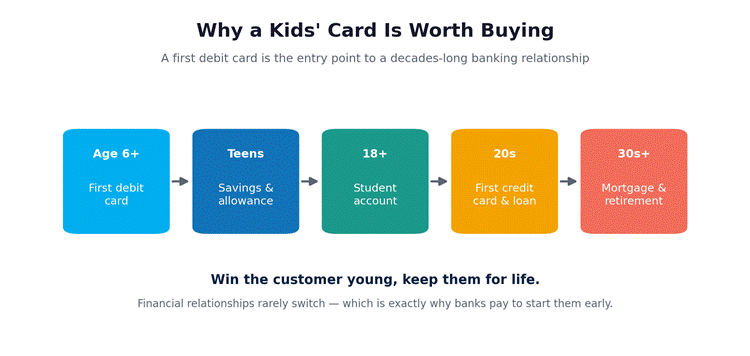
Figure 3. A kids’ card is the entry point to a decades-long banking relationship, from first allowance to mortgages and retirement.
You are not required to be a bank to take these lessons. Any business that works with families has the same opportunity Barclays just bought – to build an early, trusted relationship with both the parent and the child. The early and useful relationships are the ones that are rewarded the most.
Think about the businesses that have great regular contact with families. These are gyms, tutoring centers, kids’ activity clubs, and family subscription services. All these businesses interact with the same families repeatedly. All these contact points can be enhanced with a financial or loyalty component. The point of contact can be a stored-value card or a loyalty card integrated with the academy’s concession. The insight is not to provide financial technology, but to see that families are increasingly looking for and expecting financial technology within the services that they already use. These solutions make the businesses that provide financial technology integrated services the most sticky.

This matters outside of the plumbing. GoHenry did not win over parents by providing a card. They earned the trust of parents by saying they would help parents teach their kids about money. Framing teaching kids about money as a service and not a product creates a loyal customer base, as it helps parents become more financially well-off.
Parents worry about kids growing up with the same guilt about money and no financial advice. A brand that offers a solution to that worry, by providing a lesson, setting a goal to save, or by providing a simple financial dashboard, will earn loyalty and goodwill, which in turn becomes retention. Parents will appreciate the tool and thus become loyal customers. The lesson any family-oriented business will learn is to provide the solution first. That solution is a financially confident and capable child, and the transaction can be out of sight. The wellness of the parent is the means, the engagement is the end, and the loyalty is the outcome.
For merchants, understanding this concept can be a little abstract until it reaches the point of sale. In reality, the trend of embedded finance touches most businesses via the applications that they currently use. Most of the time, this does not involve custom development.
It appears as “pay-over-time” options at checkout, branded gift and stored-value cards, instant refunds to a stored-value wallet, and flexible financing for larger purchases. These capabilities are bundled by payment and point of sale providers, making the activation of any of these capabilities as simple as flipping a switch in a settings menu. The most applicable element of the GoHenry story is that finance is an embedded feature in other products and services. A merchant that recognizes this trend is able to reach customers, including the younger customer segment, in the places that they already are.
The GoHenry deal is a milestone, not a finish line. Expect more competition and more players in this space. Rivals like Greenlight, Step, and Current focus on the same families, and a bank-formed GoHenry will force them to enhance their offerings.
There are three main things to keep an eye on. First, other major banks are likely to create their own youth banking offerings or make purchases similar to Barclays. Second, more advancements and integrations in the space are expected. The offerings will likely move from prepaid cards to banking, investing, and credit services as the child gets older. Third, there will be scrutiny and more regulations around these offerings. Banking services for kids create scrutiny for data, marketing, and service fees. Family and youth-centered financial technology services are likely to become the main services offered, and the Barclays acquisition is likely the first of many large purchases made for this space.
This is a story about timing and trust, with branding stripped away. Barclays reportedly wanted to pay £180 million for a children’s app to strengthen the connections they expect to maintain for the next fifty years, while Acorns maintained the US business to protect this turf outside the US. The specifics of the deal will fade, but this deal structure will not. Banking is being integrated into the most common activities of a large segment of the US population, and the connections are getting started at the youngest age ever.
For business owners, the useful response to a bank’s children’s money app is not pain from seeing the bank’s big deal. It is the recognition that the factors that made the children’s money app a bankable deal—including formative loyalty, integration, and a financial wellness connection—are also within the reach of almost any service that is directed at families. You don’t have to be a bank to do this. You have to know that the tools of financial management are moving into the services people already trust, and position your service among them. Start your relational connection with a great service, and they will stick with you.
Barclays is said to have purchased GoHenry’s UK business for about £180 million. The acquisition allows Barclays to build a relationship with current customers and families that may yield future clients.
Children and teens from ages six to eighteen can use GoHenry to learn about money practically. With GoHenry, children and teens can have their very own prepaid debit card, and parents can have peace of mind knowing that they have parental control over the card. GoHenry users can also set savings goals.
This refers to financial instruments, such as bank and payment cards, incorporated conveniently into non-bank products, payment systems, or savings. A common example is the pay-over-time option during the checkout process.
Once the financial relationships are established, it becomes challenging to change them. Hence, the financial institution captures the customer for life if they capture them during childhood. From this perspective, offering a kids’ card is a low-cost customer acquisition strategy.
Families seem to expect that the services they use will provide them with some type of financial products or money tools. Businesses that provide tools with loyalty programs, stored value, or pay-over-time will have deeper customer retention.