
Posted: September 29, 2026 | Updated: October 01, 2026 at 12:54 PM
Most leases start on the first of the month because it keeps the math simple. But plenty of tenants move in on the 10th, the 15th, or the 20th, and the first question is always the same: how much rent is owed for that partial month?
The answer is prorated rent, sometimes called partial rent. The tenant pays only for the days they actually occupy the unit. The complication is that there are two accepted ways to calculate it, and they do not always give the same number.
This guide walks through both methods for prorated rents with worked examples, then covers move-outs, February, 31-day months, and the fees that should not be prorated at all.
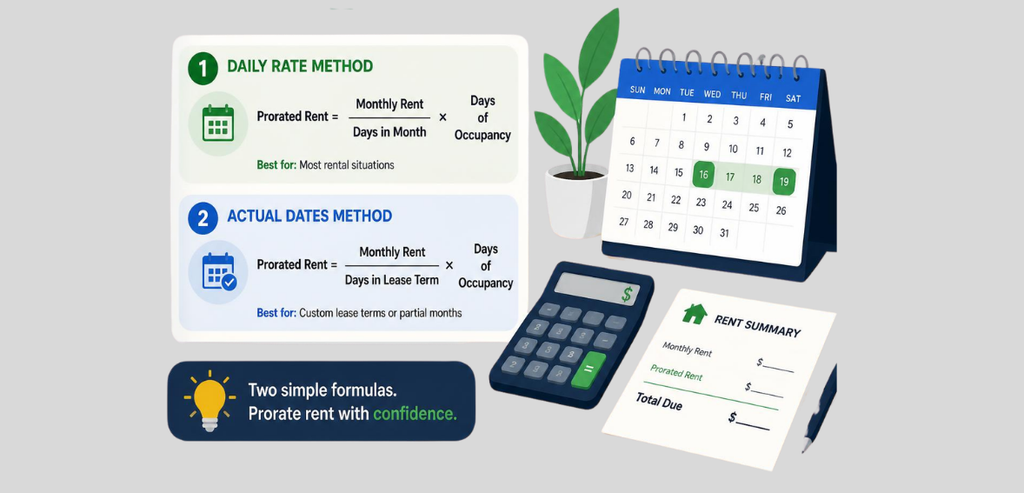
Prorated rent is the portion of a month’s rent owed when a tenancy starts or ends partway through the month. If the monthly rent is $1,200 and the lease begins on June 15, the tenant owes rent for June 15 through June 30, not for the whole of June. How that partial amount is calculated depends on which method the lease specifies, which is why the lease should say.
The actual-days method divides the monthly rent by the number of days in that particular month, then multiplies by the number of days the tenant is responsible for. The 30-day method, sometimes called a banker’s month, treats every month as 30 days regardless of the calendar, then multiplies by the days of occupancy. The lease should state which one applies, and some local landlord-tenant rules require a particular method.
Formula: monthly rent ÷ days in the month × days occupied = prorated rent.
Example: rent is $1,500, and the tenant moves in on June 15. June has 30 days, and the tenant is responsible for 16 days (June 15 through June 30). $1,500 ÷ 30 = $50 per day. $50 × 16 = $800.
Formula: monthly rent ÷ 30 × days occupied = prorated rent.
Same example: $1,500 ÷ 30 = $50 per day, and $50 × 16 = $800. In a 30-day month, the two methods agree. They only diverge when the month has 28, 29, or 31 days.
Take July. Rent is $1,500, and the tenant moves in on July 15, so they owe 17 days (July 15 through July 31).
Actual-days method
$1,500 ÷ 31 = $48.39 per day. $48.39 × 17 = $822.58.
30-day method
$1,500 ÷ 30 = $50 per day. $50 × 17 = $850.
The difference is $27.42, and it lands on the tenant. With enough units and enough mid-month moves, that gap is why landlords and tenants argue about the method.
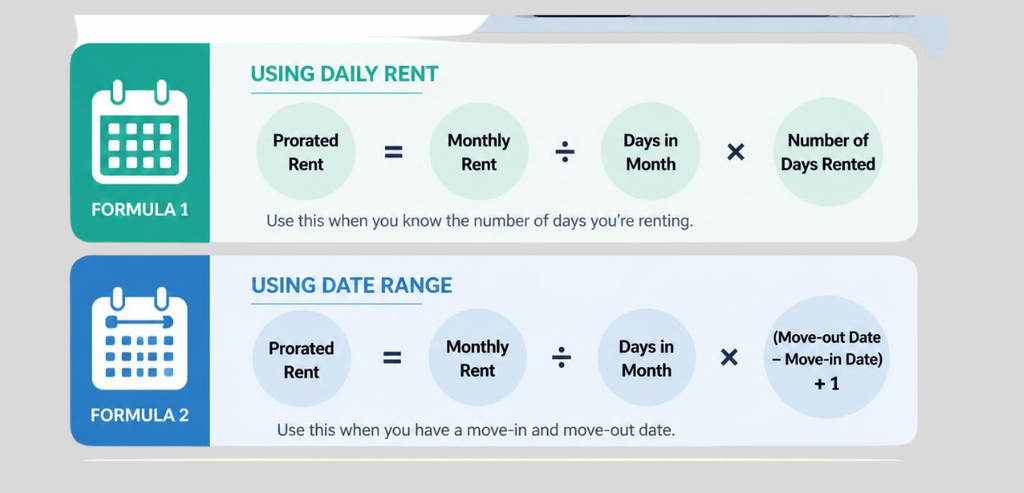
A lease should say which formula applies before anyone moves in. If both parties know it is actual days, or know it is a 30-day month, the calculation is a two-minute job. Without that line, each side reaches for the method that favors them and a small dispute is built in from day one.
Before running the numbers, read the rest of the lease as well. Requirements about first and last month’s rent, the official start and end dates, and any additional fees can change what is due. If the lease is silent on proration, the landlord-tenant rules of the state where the property sits may decide.
Start from the day the tenant takes responsibility for the unit. Confirm the monthly rent and check which method the lease names. Divide the rent by the days in that month (actual-days) or by 30 (30-day), then multiply by the days the tenant is responsible for.
Example: rent is $2,000, and the tenant moves in on August 20, so they owe 12 days (August 20 through August 31).
Actual-days: $2,000 ÷ 31 × 12 = $774.19.
30-day: $2,000 ÷ 30 × 12 = $800.
The amounts differ because August has 31 days.
A move-out before the end of the month works the same way in reverse: pick the method the lease names and count the days from the first of the month through the move-out date.
Example: rent is $1,500, and the tenant moves out on July 10, owing 10 days (July 1 through July 10).
Actual-days: $1,500 ÷ 31 × 10 = $483.87.
30-day: $1,500 ÷ 30 × 10 = $500.
February has 28 days, or 29 in a leap year, so the actual-days method produces a higher daily rate than it does in any other month. If rent is $1,400 and a tenant owes 14 days in a 28-day February: $1,400 ÷ 28 = $50 per day, and $50 × 14 = $700. Under the 30-day method, the same tenant would owe $1,400 ÷ 30 × 14 = $653.33. February is the one month where the 30-day method favors the tenant.
In a 31-day month, the actual-days method divides by 31, and the 30-day method divides by 30, so the actual-days daily rate is always a little lower. At $1,500 rent, that is $48.39 per day versus $50. The same number of days of occupancy produces a lower bill under actual days, which is why tenants moving in during a long month tend to prefer it.
Not necessarily. Rent is charged for the days the tenant holds the unit, but parking, pet, utility, and amenity fees may be billed on their own schedule, monthly, weekly, or as a one-time charge, and a lease can reasonably say that a flat monthly pet fee is due in full regardless of move-in date. Do not assume every line item prorates because the rent does. Check the lease, and if it is silent, check local rules.
Prorated rent is simple arithmetic once you know which formula applies. The actual-days method uses the real length of the month; the 30-day method treats every month as 30 days. With $1,500 rent and 17 days in a 31-day month, that is $822.58 versus $850. Put the method in the lease, count the days carefully, and show the calculation to the other party. Fees and early move-outs may follow their own rules.