Posted: July 27, 2026 | Updated: July 28, 2026 at 9:56 AM
Your customers aren’t mad about card fees. It’s about the lack of communication. A customer taps the card they have tapped hundreds of times before and is met with an unexpected fee. This customer is now instantly thinking about all the times they have been taken advantage of by a business they considered trustworthy. Your customer thinks they have been given a fee to use your business, but the fee was negligible. The surcharge backlash impact was not.
Most owners don’t understand that the customer is not upset about having to pay card processing fees. The fees are expected and commonplace. Most customers have paid a processing fee before. The customers who do stop using your service are no longer considering the percentage of the fee. They are upset about the lack of communication. This guide is to help your business achieve better communication.
You will learn how to talk to customers and explain a processing fee in a manner that your customer is more inclined to accept, how to reframe a fee as a payment choice, how to convey the message through signage and staff scripts, how to handle the very rare upset customer, how to confirm your fee and communication are compliant, and a plan to implement this new communication strategy within a week. Communicating the fee correctly will save you sales.
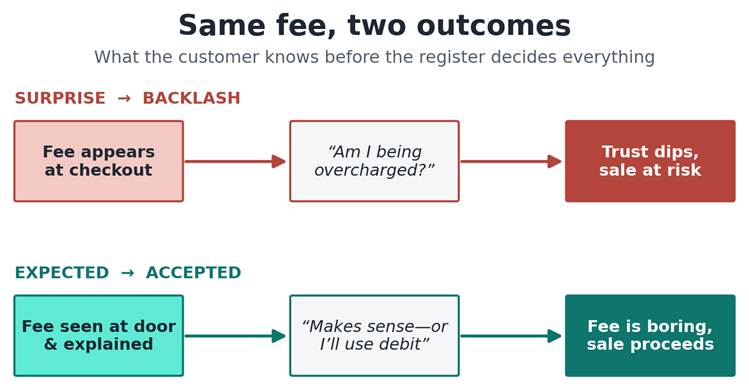
Figure 1. The same fee lands very differently depending on whether the customer heard about it first.
Customers think nothing extra comes out of your pocket when their credit card or debit card goes “swipe.” Because of this, when customers notice sudden added fees on their statements, they don’t understand that every card swipe costs money and therefore think you are charging extra money for your products. Because of this, your customers will perceive you as stealing from them, and begin to look for alternative solutions, quoting the “stealth charges” as the reason. The problem is not the amount of the fee; the problem is that the fee surprises them.
Considering the additional costs, nearly 60% of cardholders don’t consider a surcharge by itself a reason to complain. What’s worse, many of those same customers say they would switch to another vendor over a surprise surcharge. The reason for this contradiction is that the surcharge itself is not the issue; it’s the unexpected fee, discovered at the moment customers are about to pay, when they are most vulnerable.
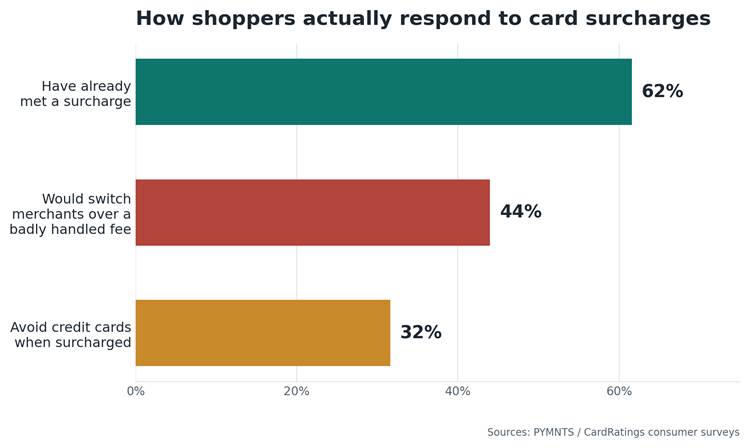
Figure 2. Most shoppers have already met a surcharge, yet many would still walk over a badly handled one.
This development should benefit you. Communication issues are the easiest to resolve. You cannot influence the costs on card networks, and there are times you cannot eat those costs. However, you have full control over the information provided to the customer before they get to the register. Essentially, every point in this guide aims to move the moment of discovery earlier. Instead of the unpleasant surprise at checkout, you can provide the customer with a notification well in advance. An expected fee is just background noise, and that is the ideal situation.
To explain a fee to a customer, you first need to understand what fee you have. The industry has four words for this, and they are not synonymous. Each term has its own fee rules and its own feel at the counter. Choosing the wrong term will confuse the customer and may also put you on the wrong side of the card networks.
A surcharge means a percentage is added to the price when a customer pays with a credit card. The price as seen by the customer remains as is, but the fee is displayed on a separate line at the checkout. On the other hand, a cash discount means the posted price is increased to cover the cost of card acceptance, and the price is then reduced for customers who pay by cash or debit. The cash discount and credit card surcharge may result in the same price, but the perception of the price will be different. A surcharge is perceived as an additional cost, whereas a cash discount is perceived as a payment received for a service.
The cash discount vs credit card surcharge mechanics balance in pricing, but they do not in the perception of the price, and that is what is most important to a business. Consumers will always perceive a deal favorably over a price increase. However, in pricing, the surcharge or cash discount must be kept honest. Discounts can be claimed only if a surcharge is legitimately in place. If a surcharge is dressed up as a discount, customers and card networks will treat it as a surcharge.
The other two terms are more specific, and most small businesses shouldn’t go for them. Convenience fees are charges for people who choose to pay with one of the other payment methods, like paying online instead of in person, and are restricted to certain scenarios by the card networks. Service fees are even more specific, and are reserved for card acceptance by government and educational institutions. Using either term in a loose manner invites confusion for the customer and compliance issues for the business. For the average shop, salon or clinic, the real choice is between a clear surcharge and a cash discount framing.
Two companies can charge the same price and receive completely different responses. This is primarily due to relative framing. Framing a price as a penalty for using a credit card versus framing it as a price that is a few cents less for cash or debit is the same effective price for both. Framing is not spin. It is narrating the true price and value in a customer-acceptable manner.
A cost that is explained generates customer forgiveness. Therefore, you should tell them the reason for the fee first. If a customer pays with credit, card networks charge you. If you choose the option of not absorbing the fee, it is fair that you charge customers who choose to pay with credit. Passing the cost along means customers who pay cash are not subsidizing those who pay by card. This sentence explains everything. You are being fair to everyone.
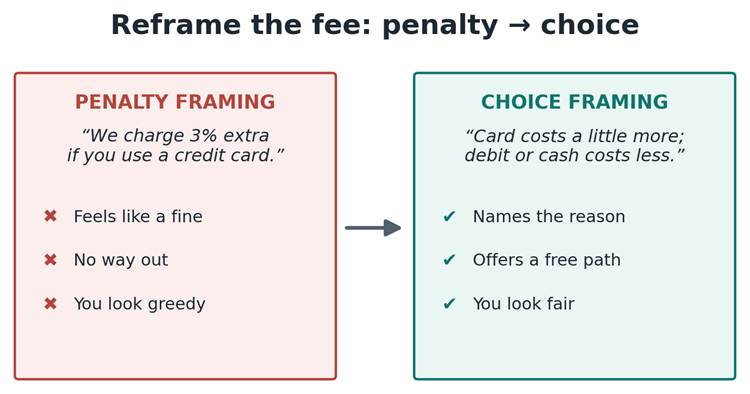
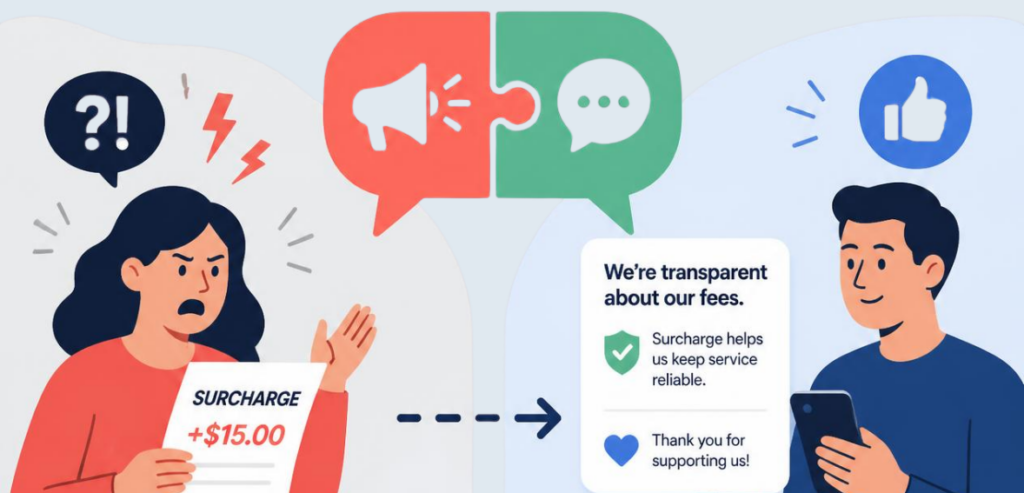
Figure 3. The same fee, reframed from a penalty into a choice, changes how customers respond.
A choice is only a choice if there is another door. This is the most important habit in successful communication. Whenever you mention a card fee, also mention how to avoid it. Fees are completely waived by payments made by debit, cash, or check. That simple addition changes the entire communication. The message no longer communicates that the customer is being trapped into a fee. Rather, it provides the customer a choice, which most people will still decline, shrugging and paying with the card anyway. However, the trapped feeling is completely avoided, and a customer with a way to avoid a fee is rarely dissatisfied.
You have already had the best surcharge conversation before anyone spoke. Good signage does this. It shifts the moment of discovery from the register to the doorway and the menu, where the information is presented in an “I’m just telling you” way rather than a “surprise, gotcha” and is, therefore, not a problem. Additionally, signs that are clear and unambiguous assist in meeting a compliance requirement, so doing them right is a win.
Card network rules and common sense agree on where to place surcharge notices. A notice should be placed at the point of entry, which is the front door of a physical store or the landing page of an online store. A second notice belongs at the point of sale. The reasoning is that no customer should get to the point of sale without knowing the fee that they are about to pay. The surcharge is to be displayed on the receipt as a separate line and should not be included (merged) in the total amount paid.
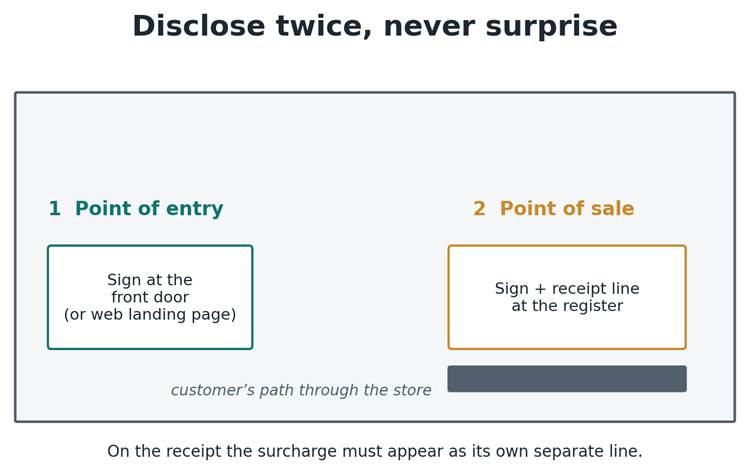
Figure 4. Disclosure belongs at two points: the entrance and the register, so the fee is never a checkout surprise.
The wording and placement of signs is valuable. A friendly, law-abiding sign describes the fee, explains how it relates to your cost, and identifies the cost-free option. A clear template is: “We add a small surcharge of X% on credit card purchases, which is not greater than our cost of acceptance, and we never surcharge cash or debit.” This one sentence is designed to accomplish each of the three tasks.
It describes the fee, explains the fee is not a benefit to the company, and illustrates the way to avoid the fee. Use large font, a friendly tone, and plain language. A sign that has the appearance of a legal warning will create the same anxiety that you are trying to avoid.
Signage introduces, but your team finishes. The response your team gives in that critical moment when a customer asks you about the fee in those few seconds defines whether that moment will be calm or turn sour. That is why the script has to be short, warm, and consistent from each and every employee. A confident one-liner is reassuring. Providing a fumbling, apologetic response will invite an argument.
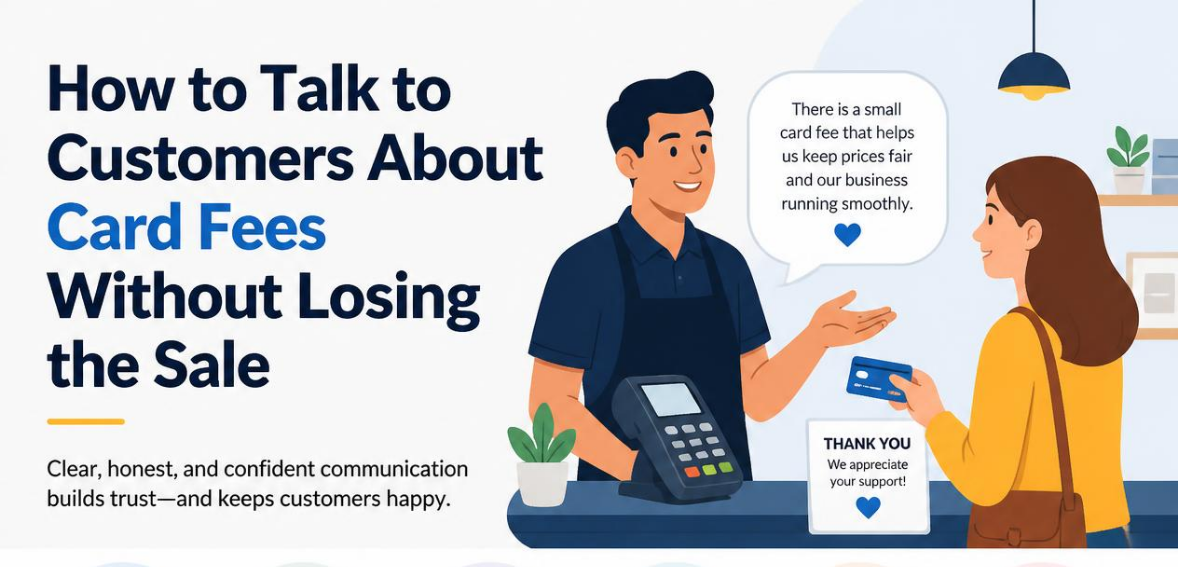
Post the wording below on the wall near the cash register and teach your staff how to answer complaints about card transaction fees with it: “To use the credit card payment option, a processing fee will be applied, and this is noted on the signage that’s placed by the entrance. If you want to avoid the fee, you can use cash or a debit card.”
Then tell your staff to smile and give the response without dragging it out or wasting any more of the customer’s time while the line forms behind them. With the wording posted, the staff has the option of instantly handing the customer the answer. There is no need for an apology or a long explanation, since neither of those serves the customer.
What your team should never do is just as significant. Never criticize the customer’s card, argue over who pays what, or become defensive when someone complains. Responses like “that’s just our policy” or “everyone does it now” are combative and dismissive. Lines staff must also avoid including: “let me do the math for you” or “the fee is temporary, I promise”. The goal is to move the customer, briefly and politely, to the next stage in the process. A customer is likely to be calm and composed when the staff behind the counter exhibits the same attitude and treats the fee as a normal, no-big-deal occurrence.
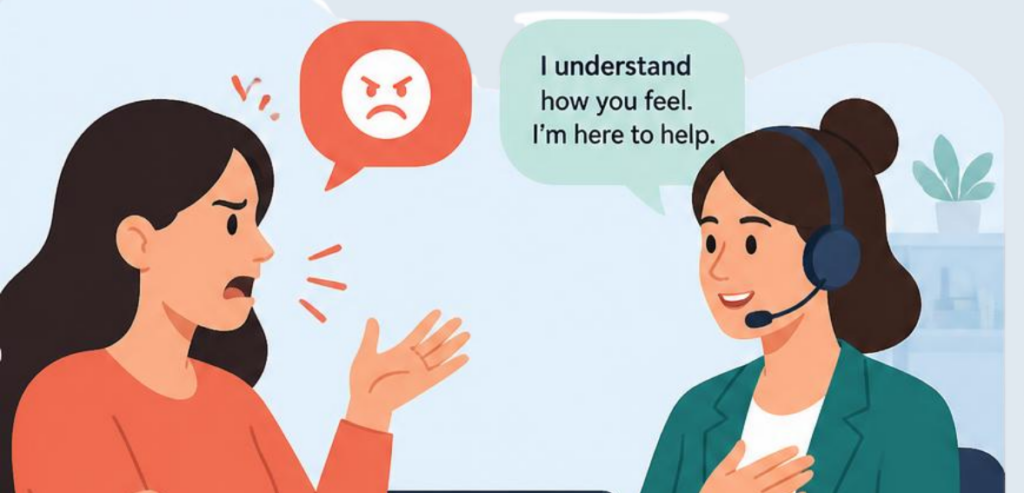
Most customers won’t care enough to complain. A select few might. When this happens, and there’s pushback, the instinct is to get defensive. That’s the wrong move. The upset customer isn’t really unhappy with the three percent fee. They are feeling surprised or disrespected or are feeling that they are being financially squeezed, and that fee is where it all came to the surface. Most of the time, if you address the feeling, the fee stops mattering.
This approach is straight to the point and works almost every time. It helps to acknowledge the customer’s frustration. A customer who feels heard quickly calms down. Then provide the reason, in as few words as possible, that due to the increased costs of accepting cards, we decided to add a fee rather than increase all prices.
Then provide the offer: cash or debit avoids the fee, and you are happy to process the sale that way. Most people just need to feel heard and be given a clear direction. The fee to accept card payments was never the real concern; it was the feeling that they had no other options.
Limits exist, and successful businesses adhere to those limits. It is almost always correct to forgo a minor fee for a customer of true value. The economics of the situation support waiving the fee. A single charge is negligible compared to the value of a customer who is likely to return for the long term. In those few situations, give your customer service staff the authority to remove the fee without having to call in a supervisor.
This also provides the opportunity for a little customer service magic where that staff member can say something like “no problem, I’ve taken that off for you” and then the customer has a positive experience that they talk about. If you are being inflexible about charging a few cents, then those few cents are probably the most expensive fee you will ever collect.
For the communication to land, the fee program behind it must be legitimate, and the conditions here are particular. This is more of a ‘sense check’; however, this is not comprehensive, and you should definitely give the full compliance brief a read before implementing this. That said, a few requirements tend to snag the majority of businesses, and if you address those, you will mitigate the greatest risks.
First, consider where you do business. Only a handful of states completely ban credit card surcharging, so where you do business largely determines whether you can implement a credit surcharging program. The next consideration is cost. While you can surcharge for the cost of accepting the payment, the cap on surcharges is generally three percent. Next is the debit rule. This is an absolute Federal rule, and you can never surcharge debit or prepaid cards, even if the customer runs the card as a credit transaction.
Lastly, your processor (acquirer) must be notified 30 days in advance of the surcharging program, since the card networks no longer take that notice directly, and every surcharge must be listed as a separate line item on the receipt.
Visa and Mastercard
Because the card networks set the caps for everyone, their rules should be acknowledged. Visa limits credit card surcharges to three percent of the transaction. Mastercard permits four percent, but to stay compliant, most processors impose the three percent cap. The disclosure requirements that both networks have are already covered here and include a separate line on the receipt and signage at the entry and checkout.
Since these rules are dictated by the networks and not by a state, they are applicable wherever the cards are accepted. The network requirements should be considered the minimum in comparison to your state’s law. Thus, your program should satisfy the greater of the two.
A lengthy project plan isn’t necessary for you to launch this successfully. You need a week along with the correct order of operations. Launching too quickly causes the checkout surprises you’re trying to avoid. A short rollout saves you the trouble of losing goodwill. Below is a sequence that is effective for a small business.
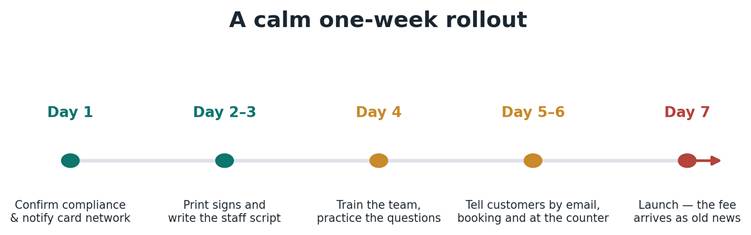
Figure 5. A calm one-week rollout moves the fee from surprise to expectation before it ever hits a receipt.
Confirming compliance and providing the required notice to your processor at the start of the week means the legal groundwork is done before any customer hears a word. During the next few days, prepare and print the signs for the door and the counter, and write a short staff script. By midweek, inform your team of the new updates and walk them through the staff script, and have staff practice asking and answering the questions until the answers become natural.
Two or three days before activation, give your customers notice through email, booking confirmations, and a note at the counter. This way, your regular customers will hear the information from you and won’t have to discover it on the activation day. During the activation day, the staff fluently knows the answers to all questions, and the customers are already expecting the fee, which is the whole point.
Card fees don’t lose sales. Withholding information does. Every adverse response to a fee occurs because a customer was blindsided by a charge. Fix the communication, and the charge is a non-issue.
The strategy itself is simple. Choose the right label so you can describe the fee honestly, and frame it as a choice rather than a trap. Let your signage do the talking early; discovery happens at the door, not at the counter. Give your employees a simple script, warm empathy, and the no-argue discipline, and your customers will feel acknowledged and move on.
Waive the fee when your regular customer is upset. Meet the basic legal and regulatory requirements first, and then roll out the strategy in one calm week of no surprises. This doesn’t require you to absorb costs; it requires you to tell your customers the truth, kindly and early, and show them how to avoid the charge. This preserves your margin and your sale.
Tell them in advance. Tell them the reason. Announce the new policy and issue a price change notice a few days in advance via email, booking confirmations, and a note at the counter. Leave no customer shocked at the register. Lead with the reason. Card networks charge a fee on every credit transaction, and you’re not raising prices across the board to cut margin, so this fee is being passed to the customer. In the same communication, suggest the free alternative. Pay by debit, cash, or check to avoid the fee. The goal is to make the price change expected and perceived as fair when the customer first sees the fee on a receipt.
A credit card surcharge raises the price by a percentage and is displayed as a separate charge line at checkout. A cash discount is the opposite. You raise your listed prices to cover card fees, then minimize them for cash and debit payments. The end price may be the same; however, psychologically and emotionally, customers are more inclined to appreciate a discount than an added charge. Whatever you decide to implement, it’s vital that your business practices are consistent with the label you select because your customers will very quickly recognize any time you disguise a surcharge as a discount.
An excellent, warm, and confident response should take no longer than 15 seconds to communicate that a small card fee for processing is posted on the sign by the door. Debit and cash transactions avoid the fee. It is a fact and policy posted for all to see, with a free alternative right there should they wish to take it. Lengthy apologies, explanations of who pays what, or saying, “that’s just our policy,” invite arguments and fights. When your team treats the fee as routine, almost all customers do the same. Treat the fee as an exception, and customers will treat it as one too.
If done correctly, the communication around surcharges can help retain customers, rather than losing them. Surcharging has become commonplace. In fact, most cardholders have encountered surcharges, so the concept is no longer novel. Most customers leaving and taking their business do not leave due to the fee, but because of the surprise when they see it, for example, when it is not communicated clearly and/or ahead of time. People will not be upset with the fee, and in most cases, will move on. Framing a surcharge, or any communication around it, as a choice and clearly offering a fee-free option as a way to pay ensures that most customers accept the charge and move on. A lost sale is bad, but the far more common outcome is customers switching to fee-free debit or cash, which is exactly the tradeoff you want, rather than walking away.
You have to post two notices – one at the point of entry (the front door or the landing page of your website) and one at the point of sale (the checkout page). These notices have to state what the fee is, relate it to the cost of acceptance, and mention the free alternative. An example is to say that you add a small percentage to credit purchases, which is equal to the cost of acceptance, and you never surcharge cash or debit. In addition to the notices, you are required to provide a receipt that shows the surcharge as a separate line item (i.e., you are not allowed to hide the surcharge in the total). Visible, friendly, clear signage will help you remain compliant and help maintain your trust.