Posted: August 03, 2026
A payment processor should, by design, be the most boring vendor in your company. They move money in the background and never grab a press headline. So, it’s fair for small business owners to briefly step away from their sales when one of their largest processors starts making frequent swaps for their Chief Executive, in a year losing almost 70% of their stock. Call it the Fiserv effect.
Fiserv’s largest payment processing competitor, Square (now called Block) made huge strides in the payment processing world, most likely due to the turbulent changes in management at Fiserv. In 2026, Fiserv’s new CEO, Takis Georgakopoulos, appointed as its 3rd CEO in 18 months, led the company after its stock took a massive hit and several lawsuits continued to plague the company.
This article will briefly explain the leadership changes at Fiserv and why you should be aware of this massive payment processing competitor and its effect on the stability of payment processing in your business. Additionally, you will get a glimpse at the daily impact a processor like Fiserv has on your payments and how to discern true stability beyond charts.
What you will receive are the questions you should ask your own provider. Information will also be included here for the case for choosing service over sheer size and the signals you should watch as Fiserv attempts to climb back. Your response should be attention, not alarm. The intention here is to help you evaluate, in a calm manner, if your payment processor is a partner or simply a connection.
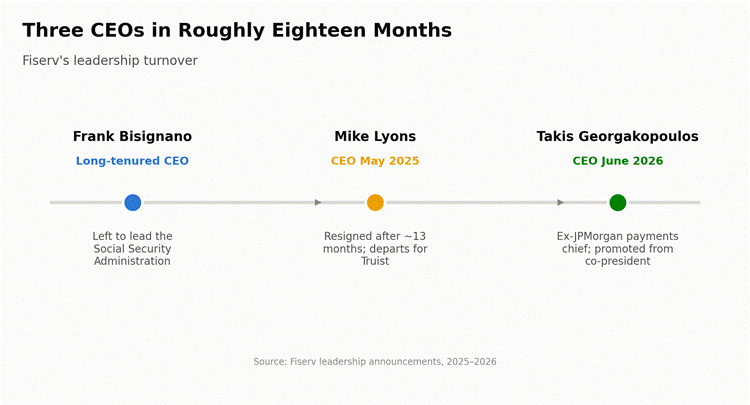
Figure 1. Three chief executives in roughly eighteen months. A closer look at Fiserv’s leadership turnover.
Frank Bisignano is the latest focus of the story. He was in charge of Fiserv for quite a long time. He was the person who oversaw Fiserv’s integration of First Data. He also had a brief stint overseeing the Social Security Administration after a federal appointment. His departure from Fiserv was problematic for the company since they lost one of their top executives at a pivotal point. The board was subsequently forced to look for a candidate beyond the company.
Mike Lyons was the candidate beyond the company. He was hired from PNC Financial Services Group (his former employer) for the role of company president and chief executive and officially became the chief executive in May 2025. He had a rough start with the firm and, after just five months on the ground, called for a necessary and critical company reset.
He said that the firm had been working under grossly misplaced expectations for the firm’s future growth regarding sales and operational efficiencies. Essentially, the expectations from the stock market were unrealistic. The stock price fell sharply. About a year after his appointment, he left for the dual role of president and chief executive at a bank, faithful to his previous employment. He joined Truist shortly thereafter.
Lyons will start his role at Truist Financial in September 2026. This is relevant to us as a chronological note. This hire is interesting because the executive who joined a troubled processor and was meant to be there for the long haul left for a bank in less than a year and a half. This is not the nature of a well-managed processor. This is the nature of an executive looking for stability.
Takis Georgakopoulos has been placed in that position as of June 2026. He is not a stranger to the company. He joined Fiserv in 2024 and progressed rather quickly from being a senior advisor to the COO to co-president of the Technology and Merchant Solutions group. Before joining Fiserv, he spent 17 years at J.P. Morgan Chase, where he was in charge of Global Payments.
Gordon Nixon, the board chairman, praised Georgakopoulos for his efforts to modernize the firm’s merchant services platform and for incorporating AI within the platform. To reinforce the bench, Fiserv promoted Dhivya Suryadevara to president and CFO; they issued a multi-million dollar retention award. The message was stability; the reality is that this is the third leadership change in 18 months.
You might wonder why any of this should be relevant to your business. You don’t participate in Fiserv board meetings, nor do the consumers of your services attend earnings calls. Although there are connections, they are indirect and infrequent. It is understanding the connections that distinguishes useful concern from pointless anxiety.
New executives change focus. Each new chief executive plans a new central focus for the organization, which in turn plans a new focus on the allocation and usage of a company’s resources. Fiserv has designated 2026 as a “reset” year for them. While “reset” years are generally a time for cost discipline, this can manifest as smaller support teams and slower updates for product enhancements, as well as quiet and subtle cost increases for services.
While cost discipline is not inherently a poor practice, the consequences of these actions are generally felt by customers as longer wait times for services and renewal letters requesting the new costs. It is these actions that are felt by customers of the organization months after a new chief executive has taken up their post.
Clover serves as the best example of how strategy from the top impacts the bottom. Clover is Fiserv’s point-of-sale system, which they acquired with First Data in 2019. Clover powers numerous small business cash registers. When the executives developed aggressive growth goals for Clover, disappointment translated to lawsuits and rage from investors.
For a merchant, the lesson is not about the stock. But rather, the cash register system in your business is connected to a corporate growth story. When the growth story is not strong, they will be forced to generate more revenue from account to account. The difference between a growth-focused partner and a service-focused partner is clear.
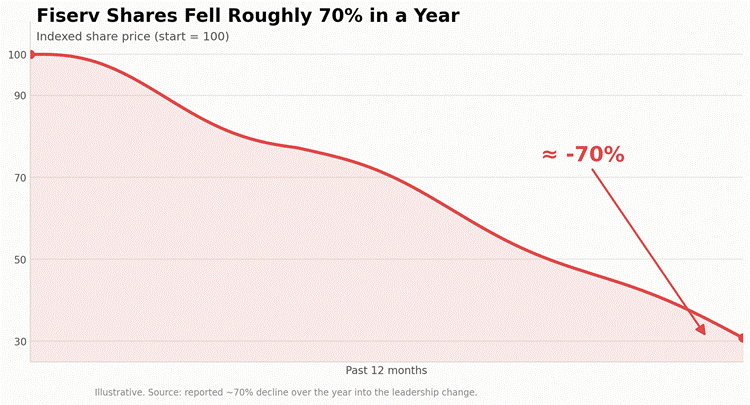
Figure 2. Fiserv shares lost roughly 70% of their value over the year leading into the leadership change.
Most merchants never lay eyes on their processors. They encounter terminals, card readers, or online checkout pages. Behind the scenes, there’s a long chain of companies, many of which are bundled together (not always conveniently). Understanding the chain helps you understand what you are actually purchasing, and who you can call to fix the link (if you can call them).
When a purchase is made, the transaction leaves the merchant’s terminal and travels to a payment processor. The payment processor’s job is to route the transaction to one of the card networks, and then to the issuing bank for approval, and then route the transaction back to the terminal. The payment processor is also responsible for the settlement of the transaction, as well as the statements you receive detailing the fees, and also the support line you call when something goes wrong.
Fiserv does this at a massive scale. According to the Nilson Report, Fiserv is the largest merchant acquirer in the U.S., number one in both total purchase volume and total transactions. Through Clover, its own sales teams, and its bank and software partnerships, Fiserv serves merchants of all sizes.
Fiserv isn’t one product, and your bank likely uses Fiserv without their name being on the door. Your point-of-sale could be Clover. Your bank statements could be from a reseller who buys Fiserv processing and marks it up. This is why two merchants can be Fiserv clients and yet have a completely different experience. This is also why looking at the size of a company offers very little information about the service you will actually receive. A company can be the largest acquirer in the country while a small merchant feels like a rounding error.
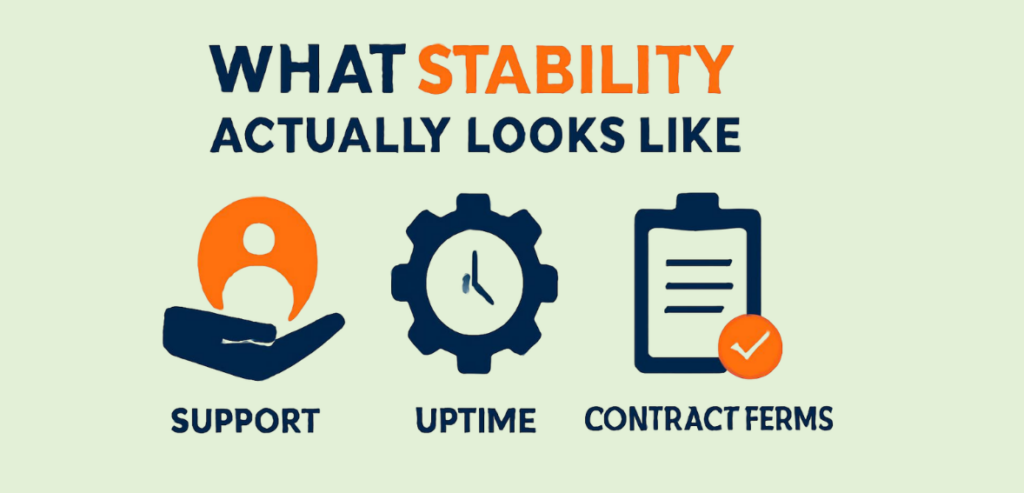
Steady stock prices are nice, but they are not what runs your business. The true stability, the kind you can touch and feel, comes from three things that you can actually measure: the quality of support, the reliability of the system, and the fairness of the contract. A processor can look volatile and unhealthy on Wall Street while still treating you with great service, and vice versa. When it comes to service, judge it, not the stock price.
Support is the first pillar. True stability means a human actually answers the call when your terminal dies during a Saturday rush as opposed to a menu that you just loop back into. It means the support agent resolves your call and you don’t get passed around to different support teams while customers are left waiting. Uptime is the second pillar. Your processor should be keeping your payments flowing during busy times, holidays, and outages, because any time that is downtime is a time you can’t make a sale. Inquire about the contract.
Contract terms determine the kind of relationship you will have with a provider. Good contracts outline your rates, include full transparency, and allow you to leave with no penalty. Bad contracts have hidden pricing structures, unexplained monthly fees, and multi-year contracts with very high exit fees. Read contracts and statements. The processors with understandable contracts are the ones with the longest relationships. When a provider’s finances take a hit, surprise fees will be the first place you will notice the pressure.
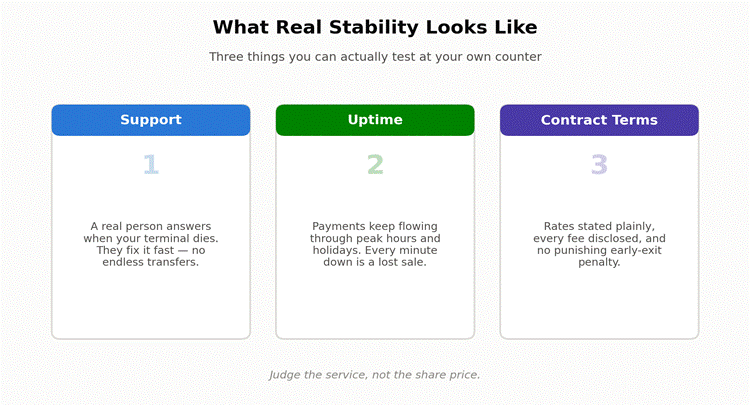
Figure 3. Real stability rests on three testable pillars: responsive support, dependable uptime, and honest contract terms.
Poor service is an insidious problem. A vendor that used to answer your calls. Now sends you to a portal. A statement with understandable line items can become nonsensical. An owner neglected by their vendor is often the last person to recognize vendor neglect. The ability to recognize neglect earlier helps you solve the problem before you experience the impact of the neglect during your peak season.
The most obvious and early sign of neglect is cold support once you call for help and are forced to endure multiple transfers. If issues are closed without follow-up, you have been ticketed. A second sign of neglect is the slow and gradual increase of fees. Look out for unexplained charges, above-quoted rates, and uncommunicated annual rate increases. The third sign of neglect is a sudden change of terms, support equipment, or pricing with no prior notice.
The last two signs also help to define a neglectful vendor relationship. The first is the strong push to buy equipment or support that you do not need. The second is the feeling that your interests no longer matter to the vendor. These feelings and pushes you get when your vendor is servicing billions of transactions a year is a good reason to find a new vendor.
You deserve a provider that treats your business as a priority, not as just a number.

You don’t need deep knowledge of payments to test your processor. Have your questions ready. Then observe how they respond. Good processor partners respond clearly and quickly. Poor processor partners are vague, lose focus, or respond slowly. The responses are important, but the response style is often the most important part.
Start with support and stability. Ask who you call if something breaks, if that support is staffed during your business operating hours, and how long you should expect to wait on support to solve the problem. Ask what happens to your account and your rates if the company is acquired, restructures, or if there is a leadership change, since you have most likely seen a large company do exactly that.
Then ask your money questions. Ask for a plain-language explanation of each fee. Ask if your rates can change and what conditions would allow for that to happen. Finally, ask the future questions. Ask what happens to your equipment and your pricing when the current contract ends. Then ask if you are on a month-to-month, or if you are locked in.
Merchant services refer to all the components tied to the processing of transactions, and it is the part of the system that addresses these concerns. The most competent merchant services companies address the tough questions. A confident, service-centric merchant services company answers these tough questions and documents the answers. Those who avoid, postpone, or obscure the answers to the tough questions with fine print have shown what kind of partner they will be when things are tough. It is most prudent to ask the tough questions before needing the answers.
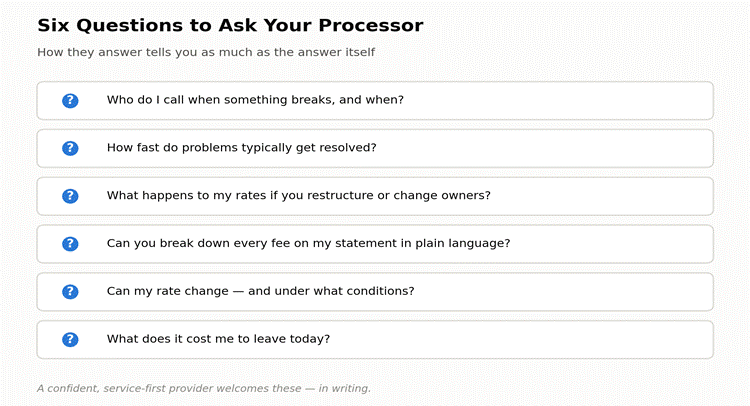
Figure 4. Six direct questions that reveal whether your processor is a partner or just a pipe.
There is a general assumption that larger payment processors are somehow safer. The Fiserv example disputes that assumption. While larger payment processors tend to be more efficient and have a greater network, that does not prevent payment processors from losing their clients, cutting their guidance, or being treated as just one of their millions of clients. For a lot of small businesses, a service-oriented provider is a better choice, since their focus is solely on the client’s needs.
A service-oriented provider competes on the strength of the relationship, not on the size of the client base. This leads to distinct positive changes a business owner can appreciate. Support is usually local or at least dedicated, so the support staff knows their clients. Pricing is clear because a service-oriented provider stays in business by keeping their clients happy.
Their contracts are fair, and their communication is proactive. Keeping the client informed is the service-oriented provider’s greatest communication strength. When the leadership at a large payment processor changes, it is the service-oriented provider’s commitment to service that keeps their client’s business thriving.
The core of this argument is about alignment. A large payment processor is primarily concerned with their stockholders, growth goals, and the pressures of their publicly traded company. A service-oriented merchant services partner is primarily concerned with the merchants they serve, because losing a client is an immediate loss. Neither model is perfect, and a lot of small clients are served well by large firms.
The last year has taught small business owners a lot. If you have real stability, your business could survive better than something you could value by looking at the stock market. Pick the business partner who will succeed if you do.
Fiserv isn’t going anywhere. Having the largest merchant acquiring business in the nation has its advantages, especially with the new chief executive who has familiarity with the business. The company has labeled 2026 a transition year and has communicated to investors to expect a dip before a recovery. The upcoming quarters will be important for merchants and observers to indicate if the turnaround will be legitimate. There are a few things to pay attention to.
The first thing to look for is stability within the leadership. Georgakopoulos kept his executive team, and along with the board, has shown a preference for retention. If that team stays and the plan holds, this will show stability and be a mark of improvement. If more senior members depart, the chaos will continue. The next thing to look for is guidance. Fiserv has reaffirmed a target of 1-3% organic revenue growth, with adjusted earnings per share in the range of $8 to $8.30. Meeting or exceeding this goal will be indicative of improvement.
With respect to Clover and the lawsuits, the small business segment of the company is best represented by Clover. Healthy incremental growth is positive for the small business merchants that rely on the small business segment of the company. The investor and cybersecurity lawsuits are in court and are a distraction to the company as they drain resources. For your business, the most important thing to watch is your service.
For the next year, monitor your hold times, fee assessments, and account statements. The turnaround you care about most isn’t the one reported in the earnings call. It’s the one you measure at your counter.
There’s nothing to panic about when a processor has a new chief executive officer (CEO). It happens that the largest companies often swap out their higher-level management. Especially when looking at the swipe card industry. However, there are signs that indicate a lot more is going on than just a reshuffle. An admitted reset with unrealistic assumptions, lawsuits, a 70% dip in share price, and 3 different CEOs in 18 months are not signs of a healthy company. Things that you can expect to see with a company that quietly handles a large share of the payment processing in the US are thinner support, higher fees, and a growing disinterest in helping smaller clients.
At this point, the reaction doesn’t need to be panicked. It just means paying more attention. The feeling of loss of support that most clients see happens to a lot of companies. You have the ability to judge Fiserv with more control than you think. You can test the level of support that you believe is the right fit for you, the uptime of the system, and most importantly, the terms of the agreement. If you have to start asking hard questions to Fiserv, you should be looking for a new provider that believes that their success is related to yours. Service is what you feel. Look to Fiserv for a recovery, but look to yourself first.
In June 2026, Takis Georgakopoulos became the company’s CEO. He also worked at Fiserv starting in 2024 and previously led global payments at JPMorgan Chase.
New management changes priorities and can pass the effects of cost-cutting down to you as reduced support or increased prices. Disturbance at the upper levels of management can, months later, affect your counter as well.
Assess three things you can evaluate: responsive human support, consistent uptime during your busiest hours, and a straightforward contract with no concealed charges, harsh exit penalties, or anything of that nature.
You get in touch with a real human being in a timely manner. They resolve the issue. You don’t get charged fees without explanation. Unexplained fees and bad service are red flags.
Yes. First, check if your contract has any early termination fees. Then, you should switch to a provider that has better customer support and pricing. It would be better if the new provider worked on a month-to-month basis, too.