

Tip pools are a way for a business to have its staff split tips with each other. Tip pools fall under law and regulations. Starting March 23, 2018, employers were prohibited from retaining employees’ tips by the main federal wage law, the FLSA. This prohibition applies no matter if a business claims tip credits. As stated in the DOL’s Fact Sheet #15, if an employer lets a manager or shift boss retain tips that are part of a shared pool, then the employer may have to give those tips back to employees and pay them at least $7.25 an hour in cash wages.
This guide will discuss three tip splitting methods: splitting tips based on hours worked, splitting tips based on a point system, and splitting tips based on a predetermined percentage. This guide will create a tip-splitting example for each method, provide the corresponding Excel function, and describe the role of card transactions and payroll records.
This guide will solely discuss and incorporate tips rules and regulations from the DOL and IRS. Implementation of these rules and regulations may vary from state to state. Therefore, this guide should be used to gain basic tips and splitting methods and systems, and state-specific tips and splitting methods should be researched and verified by an employment and/or payroll attorney.

Our tip pooling calculator uses four factors. The first is the total tip pool amount for a given pay period. The second is the portion of pooled tips paid by card for the pay period, plus the fee rate the processor charges. The third is the number of hours worked by each employee. Lastly, you must input a value to weight each employee’s tip share. This weighting can be expressed in points or as a percentage.
You must decide on a tip share allocation method before entering any data. The calculator will then assign tip shares and round them to the cent. The last line on the results page shows whether the total tips equal the pool total. A total less than the tip pool amount indicates tips are missing. A total greater than the pool total indicates tips are too generously rewarded.
It is only necessary to use the calculator once per pay period if tips are paid out with normal wages. Tips an employer collects for a pool must be paid out on the usual payday for that work week, or as soon as practically possible after it if the final total is not known before payroll closes (DOL regulations).
The calculator allows you to enter names to show how you would divide your tips among specific people. The names you enter are limited by federal law.
Whether or not a business claims tip credits is the deciding factor in the base pay and minimum tip amount. Without tip credits, base pay must equal at least $7.25 an hour. For tipped employees, base pay can drop as low as $2.13 an hour, but no lower. Employers may count up to $5.12 an hour in tips which, along with a $2.13 cash wage, brings pay up to the $7.25 federal floor.
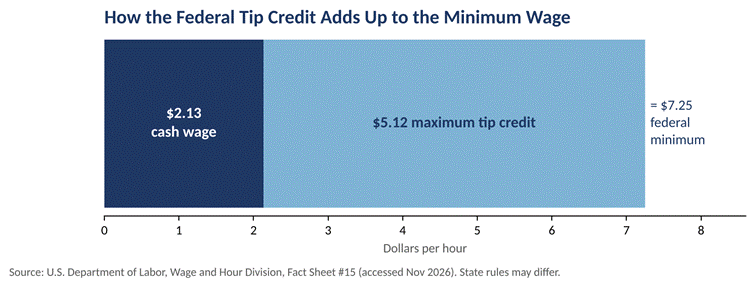
With tip credits, only staff who usually get tips from guests may be in the pool. Staff who bartend or wait tables are workers who usually get tips. According to the DOL, staff who don’t usually get tips (e.g. kitchen cooks or dishwashers) may share in the pool if the employer claims no tip credits. Tip pools may not include managers or owners. Managers may, however, keep a tip a guest hands them directly for service only they provided.
Notices must be provided to employees by any business that claims tip credits and makes employees join a pool. The notice must state how much each worker is required to contribute, and it is best shared before the first pay period starts. It should also explain the method the employer will use to split the pool (e.g. the split, or point or percentage method) and the schedule of tip pool payments.
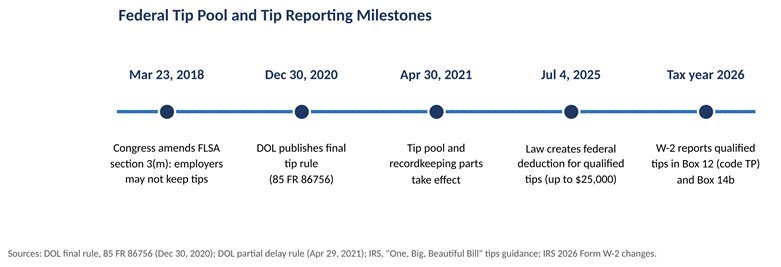
These rules were implemented in several stages. In March 2018, Congress enacted legislation that made changes to the FLSA. The DOL implemented similar changes to its regulations in December 2020. These changes were stayed and ultimately implemented in April 2021. As Tip credit regulations vary by state, it is recommended that tip credit regulations be analyzed at the state level.

How does each method answer the same question? Each method finds what fraction of the pool a person earns, but finds it using a different drive.
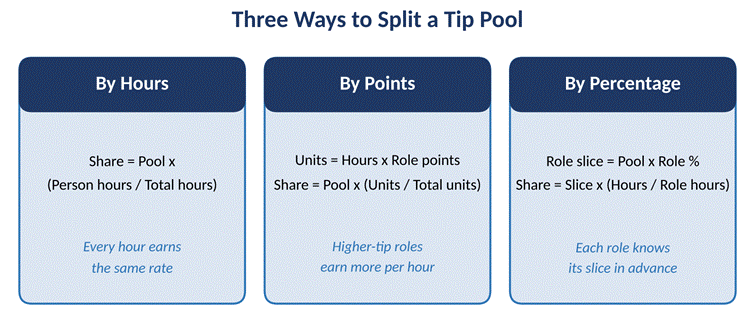
An hours split means each person in line gets paid for the number of hours they worked. First, find the total number of hours worked by all the people in the pool. Split the pool across that total to find the rate per hour. Finally, pay each person that rate times their own hours.
It’s fairly simple to teach this method and check its accuracy. It provides equal treatment for all hours worked and, therefore, all jobs. Some feel this is reasonable. Others think it unreasonably favors the tables bussers and/or other lower-tier staff.
Each role is assigned a specific number of points. Servers may be worth 10 points, and bussers may only be worth 5. Once points have been assigned, each employee’s hours are multiplied by the points to determine units. The pool is divided by the total units to determine what one unit is worth. Each employee is paid that unit value times the units they have earned.
Points are a way for businesses to give higher-tip roles a bigger share while still tying pay to hours. No federal regulation dictates point values, which means businesses have the freedom to determine point values themselves. Point values should be published and shared with employees. Point values should remain constant over a given period of time. Point values should only change with advance notice. Point values help explain and justify a given payout to an employee.
A percentage split determines how much each job role gets paid before the hours worked are totaled. A bar can give 60% to servers, 20% to a bartender, and the rest to other employees. If a role is filled by more than one employee, that slice is further divided. This is usually done by how many hours each person puts in.
Knowing how much each role is paid is attractive to some employees. This system becomes unattractive because of inequitable work weeks. An employee can work a double shift, a busser for example, and another employee, let’s say a server, can take off. In this scenario, the busser would still get paid the same amount as if they only worked a single shift.
The figures that follow illustrate the division of a $2,400 weekly pooled amount among five employees who are paid at least $7.25 an hour in cash. The amounts shown are representative, not actual amounts paid to employees.
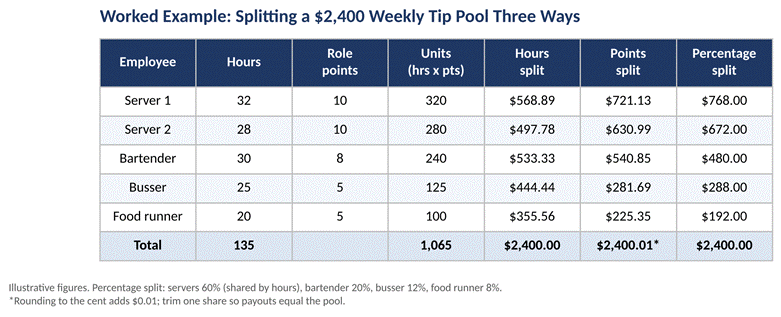
The team has logged 135 hours. Therefore, Server 1’s earnings are $568.89 based on an hourly rate of $17.78, which is calculated by dividing $2,400 by 135 hours. Based on the points split, each unit is worth approximately $2.2535. Therefore, 320 units earned by Server 1 are worth $721.13. Based on the percentage split, the servers’ 60% slice is $1,440. Server 1’s 32 hours out of the servers’ 60 hours gives $768.00.
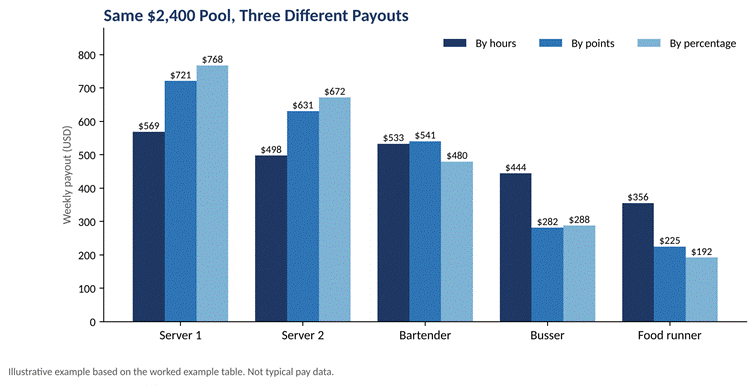
Depending on the method employed, Server 1 is paid $568.89, $721.13, or $768.00. The busser receives $444.44, $281.69, or $288.00. Each time, the pool is $2,400.00. The only thing that changes is the rule. The bartender’s payout changes the least, ranging from $480.00 to $540.85, depending on the method.
Final checks on rounding. In a points split of the tip-out, rounding to the cent results in a tip-out of $2,400.01. To ensure management tips out the exact amount in the pool, one share will have to be reduced by $0.01. In this example, the hours split results in an exact tip-out of $2,400.00, but that will not happen every week.

Like the calculator, the tip pooling spreadsheet automatically totals the pool. Unlike the calculator, it keeps an electronic record of each tip-out. One sheet is provided for each pay period and suits small teams.
Put the total pool amount in a cell, say H1. In cell A2, list the first employee; next to it enter the hours worked (column B), and next to that, enter the role point value (column C). The next column (D) is for units and uses the formula =B2*C2. Column E is for hours split and uses the formula
=ROUND($H$1*B2/SUM($B$2:$B$6),2).
Column F is for points split and uses the formula
=ROUND($H$1*D2/SUM($D$2:$D$6),2).
Copy the formulas down for all employees. The dollar signs fix the pool amount ($H$1) and total range ($B$2:$B$6) to allow for easy formula copying.
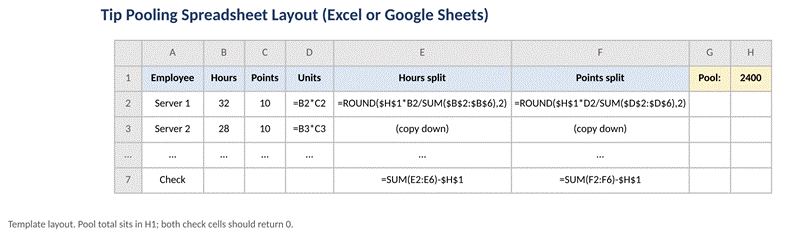
Add a check cell under each share column. The formula is as follows: =SUM(E2:E6)-$H$1.
This should result in 0. Values other than 0 signify rounding or inputting errors. Protect the formula cells to restrict shift leads or other users from altering the cells.
ROUND and SUM function similarly across Excel and Google Sheets, and therefore the same function layouts apply to both programs.
Businesses pay fees to accept card tips. Some of this cost can be recovered under the federal rules.
According to the DOL Fact Sheet #15, a business that pays a card company a percentage fee can take that same percentage from the tip. The employer can not take more than that processing fee and doing so can result in tip credit violation. Card tips must reach the worker by the usual payday and can not be withheld until the card processing company settles with the employer.
California has different rules. The Division of Labor Standards Enforcement states that under Section 351 of the Labor Code, card tips must be given to employees in full and can not be withheld to cover processing costs. Card tips also must be given to employees at the next pay day following the guest’s authorization to charge.
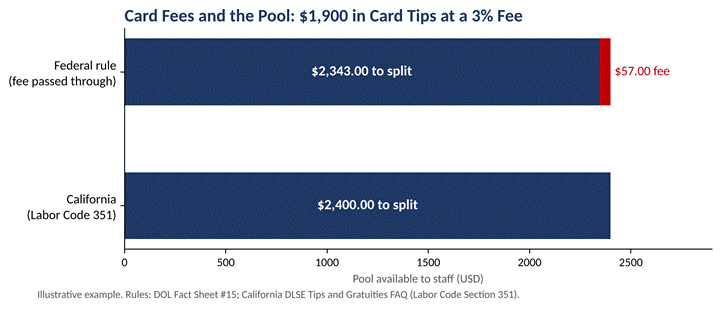
Using the example given, $1,900 of the $2,400 pool was loaded on cards, and the processor charges 3%. The federal limitation on the deduction is $57, making the balance available for distribution $2,343. In California, the pool is $2,400. To accurately reflect the distribution, a fee should be charged before the pool is distributed, and the fee should match the actual rate on the processor statement. Additionally, the distribution record should indicate the reason for the charge; in this case, the fee was charged to cover the processor fee.
Two federal agencies oversee tip income. The DOL assesses whether employees receive their tips and wages. The IRS assesses whether employees report and pay tax on tips.
29 CFR 516.28 outlines the records employers are required to keep. These records vary based on tip credit.
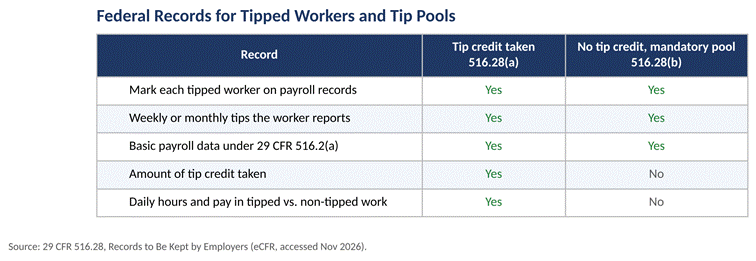
Both types of employer are required to keep records on tipped staff, including the tip totals they report each week or month. Employers claiming tip credits must keep a record of the credit taken and the number of hours the employee worked for which the credit was taken, split between tipped and non-tipped work. Records of wage payments must be kept for at least 3 years. Time cards and wage rate tables must be kept for 2 years. (29 CFR Part 516)
Employers must also take into consideration rules issued by the IRS. According to IRS Publication 531, if an employee receives $20 or more in tips in a month at one job, the tips must be reported to the employer by the 10th of the following month. Tips pooled among employees of the business must be reported. Large food or beverage businesses where tipping is customary and more than 10 employees work on a typical business day must also complete and file IRS Form 8027.
With respect to records pertaining to tip employees, the One Big Beautiful Bill Act added a new provision, allowing tip employees to take a federal income tax deduction for tip income up to $25,000. Tip sharing among employees is permitted, and tips distributed through a tip sharing arrangement are qualified tip income for purposes of the tax deduction.
The tax deduction is phased out for tipped employees with modified adjusted gross income exceeding $150,000 or $300,000 for a joint return. Beginning with tax year 2026, employers must report tips to employees through Form W-2, and must also report qualified tip income of employees on Form W-2 in a manner prescribed by the IRS.
Pooled tipping is a payroll distribution system subject to legal restrictions. An hours split is the simplest system to implement and to verify through an audit. A points system also works; however, its success depends on point values that are written down and kept stable. Predictability is the advantage of a percent tip split; however, it can drift away from the work actually done in a busy week.
Regardless of the system implemented, managers and owners must be kept out of the pool, all tips should be distributed by the regularly scheduled payday, and a record of each tip distribution should be retained. Other considerations, including the tip-out and tip-credit systems, should also be implemented under state laws and rules. Legal advice may be needed to understand state law tip credit and other related systems.
Take the full pool and divide it by the total number of hours worked by all employees to find the hourly tip rate. To determine how much tip money each employee made, multiply the hourly tip rate by that employee’s working hours.
Each role is assigned a point value, and hours times points gives each employee’s units. The pool is divided by total units, and employees are paid for their units.
The feds say that if pay is at or above minimum wage, then pooled tips may be reduced by the card company’s fee percentage, and no more. CA says no.
Keep the name of every tipped worker, the tip totals they report, and payroll records, plus tip credit and hour records if tip credits are claimed. You have to keep the records for a period of not less than three years.
Reduce Your Fees, Upgrade Your Service.
Your information will not be distributed
We received your request. A payments specialist will reach out shortly.
