
Posted: September 16, 2026 | Updated: October 06, 2026 at 6:04 PM
The federal government restructured the economics of a tipped shift. Final rules published by the Treasury Department and the IRS on April 10, 2026, confirm that over 70 occupations are now allowed to deduct qualified tips up to $25,000 from their taxable income for each tax year. At the end of the year, each server, bartender, or stylist will see that number on their pay stub, Form 4137 or W-2, and know it represents their take-home income.
Point of sale (POS) software, for the first time in history, is now intertwined with tax law. Only the tips that get reported are legally qualified for tip deduction. For the tipped employee, unreported cash tips, service charges coded as tips, and tips that are pooled and assigned to the wrong tipped employee are all non-deductible tips. Employees are left to bear the burden of tips that were not properly recorded. It is now a benefit for the employees to have a POS system that captures tips.
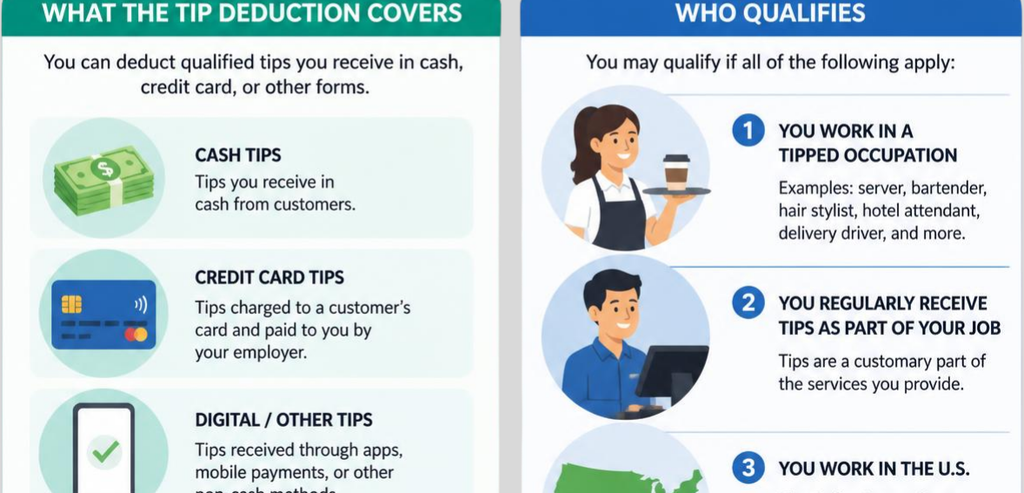
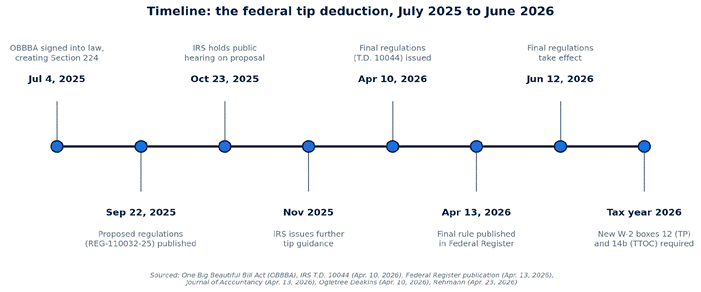
President Trump signed the One Big Beautiful Bill on the Fourth of July, 2025. RSM US says that is when Section 224 of the tax code was made. It outlines a new tax deduction that will run for 2025 through 2028 to help cover the cost of certain tips that are considered qualifying. The deduction applies to staff in occupations that routinely received tips before the end of 2024.
According to the Journal of Accountancy, over the course of the next year after Trump signed the OBBBA, the IRS published an initial list of occupations in September, proposed regulations later that month and additional guidance in November, then published the final rules on April 10, 2026, adding three additional occupations of qualified tipped workers (floral designers, visual artists, and gas pump attendants) to the list that already included 68 qualified occupations.
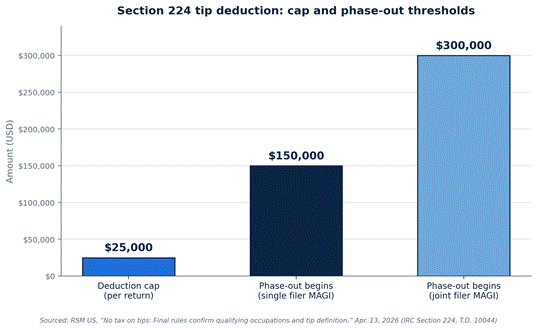
The deduction for qualifying tipped workers ends at the end of 2028. The cap, as RSM US notes, is $25,000 on each return. The benefit is less and less for higher earners. The deductible tips will be reduced by $100 for every $1,000 of modified AGI above $150,000 (single filers) or $300,000 (joint filers). Rehmann says that the final rules took effect June 12, 2026, so payroll and point-of-sale staff had a two-month grace period after publication to prepare for the new regulations.
The IRS has introduced a new system called the Treasury Tipped Occupation Code, or TTOC, under which they classified the 71 occupations into 8 broad categories, summarized by TaxAct. Each occupation has a designated 3-digit code, which is the code the employer reports in box 14b of the W-2. According to Frank J. Bisignano, the IRS Chief Executive Officer, the IRS has already started to issue refunds related to the deduction.
The IRS announced this in its April 2026 final rule publication. This becomes relevant for point-of-sale teams because it signifies the IRS is already cross-referencing tip amounts with returns under their continued active review of returns, as opposed to publishing a rule and waiting for the subsequent filing season.
The final rules specify that determining whether a service charge is involuntary is what decides if the amount is deductible. A tip is voluntary; a charge is involuntary. Ogletree Deakins states that the example of the restaurant adding an 18% charge to the bill for parties of 6 or more is charging a service charge and not collecting a tip. The money collected that way would never be deductible, even if the restaurant later distributed that money to the employees as if it was a tip.
The final rules also increased the standard for voluntary tips. If a customer can’t tip zero, the charge is not voluntary. RSM US and Doeren Mayhew agree that a POS system is coercive if it offers only preset amounts, such as 16 percent or 18 percent, and tips cannot be set at zero. This also applies to checkout signature screens and tip-enabled touch screen tablets if customers do not have the option to opt out of the tipping system. In that case, the tipping amount does not meet the requirements of Section 224.
The IRS states that the ability to control the tip decreases the voluntary nature of a tip. Doeren Mayhew and the IRS state that service charges must be allocated to the wages of the employees. Employers that have their workers include banquet tips, large party surcharges, and delivery fees in the tip pool run the risk of employees claiming a deduction that the IRS will not honor. The decision of whether an amount is a tip or a service charge is made at the point of sale, at the item or charge level. Of course, payroll is not in a position to make a workaround.
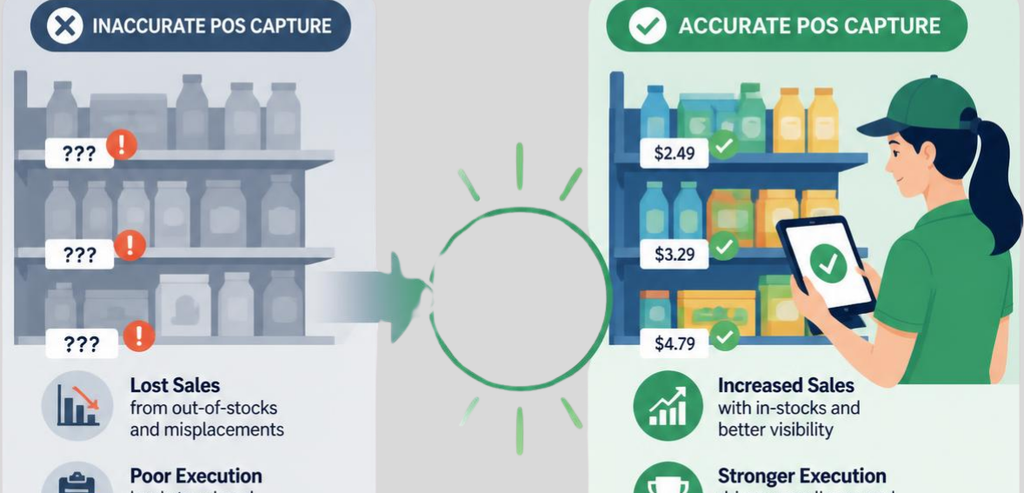
Before this rule, an unreported tip was more of a compliance hassle for the restaurant than anything. An unreported cash tip from a server or a sloppy batching of tips by a manager impacted math for the tip pool and payroll taxes. Now, each dollar unreported is a dollar the employee cannot deduct.
Let’s take a single day and see what happens. Let’s say a server has cash tips totaling $150. However, the server only reports $100 to the POS. That server has lost the ability to deduct $50 at the end of the year. Think of what this does over the course of an entire year. The difference in the value of lost deductions between a restaurant that maintains good tip report habits and a restaurant that has poor tip report habits can easily amount to several hundred dollars per employee.
This changes the way employees interact with the POS tip reporting systems. Employees now have more incentive to report tips than before. This new structure makes employees report card tips and cash tips and make sure that pooled tips adhere to the terms of the tip pool. A restaurant that trains its employees to report tips accurately and a restaurant that configures its systems to make tip reporting easy provides a real benefit to its employees at no cost to the business.
Even with tip pooling, there are reporting risks. The final rules state directly that tips going to tip pool managers or supervisors for tip-sharing, either mandatory or voluntary, are not considered qualified tips. As stated by Ogletree Deakins, this is true no matter the tip pool arrangement structure. Thus, a shift lead who receives a share of a tip pool by a title that is effectively supervisory cannot consider that share of the tip pool a deductible tip, even if the source of the tip money is the customer.
Tip pools that are distributed automatically by a point-of-sale system rely on classification of employees. If the tip pool system automatically distributes the tips to a working manager who is classified as a manager for tip distribution, but who is a non-supervisory employee for most of the shift, the classification would be wrong. The final rules treat ownership interests and abusive situations on a case-by-case basis, in place of the previous broad prohibition, as described by RSM US. This means that classification decisions carry more gray area, and more incorrect decisions will go unnoticed.
Restaurants with shared tip pools for servers, bussers, and bartenders should treat the attribution report for a tip pool the same as reviewing payroll. An incorrectly attributed dollar in a tip pool report is not just an internal equity issue. It is a dollar that would show up or fail to show up on the W-2 of the wrong employee.
Because of the tip deduction, the design of W-2s for 2026 will be the first to focus on the tip reporting change. As the instructions state, cash tips must be reported separately and should be reported in box 12 with code TP indicating the total tips in cash. Box 14 has now been subdivided into box 14a (Other info) and box 14b (the employee’s TTOC). Here, employers can report up to two codes. Employers can enter code 000 for the portion of the tips that came from a non-qualifying position.
| W-2 field | What it now shows | Source |
| Code TP, Box 12 | Total tips in cash that were reported to employer | IRS 2026 W-2/W-3 instructions |
| Box 14a | Other information (unchanged category) | IRS 2026 W-2/W-3 instructions |
| Box 14b | TTOC code(s), up to two | IRS 2026 W-2/W-3 instructions |
| Boxes 3 and 7 | Social Security wages and tips; FICA still applies | IRS; MP HR (Jun. 30, 2026) |
Analysis of the 2026 W-2 Design regarding separating qualified cash tips as a discrete wage type.
There are no changes to the withholding for Social Security or Medicare. As MP HR states, FICA taxes apply to tips reported to the IRS, even if those tips are not eligible to be claimed back as a federal tax deduction. Employers who think the new W-2 boxes mean a change in payroll tax withholding are gambling on under-withholding each payroll and will be in for a shock at the end of the year when they have to reconcile all the payroll.
In 2025, the IRS had not finalized the new W-2 format, so the earlier reporting method had to be used. The method used in 2026 will really matter to the configuration of the point-of-sale equipment, as the total tips in cash reported must be the same as the information stored in the equipment at the end of the year.
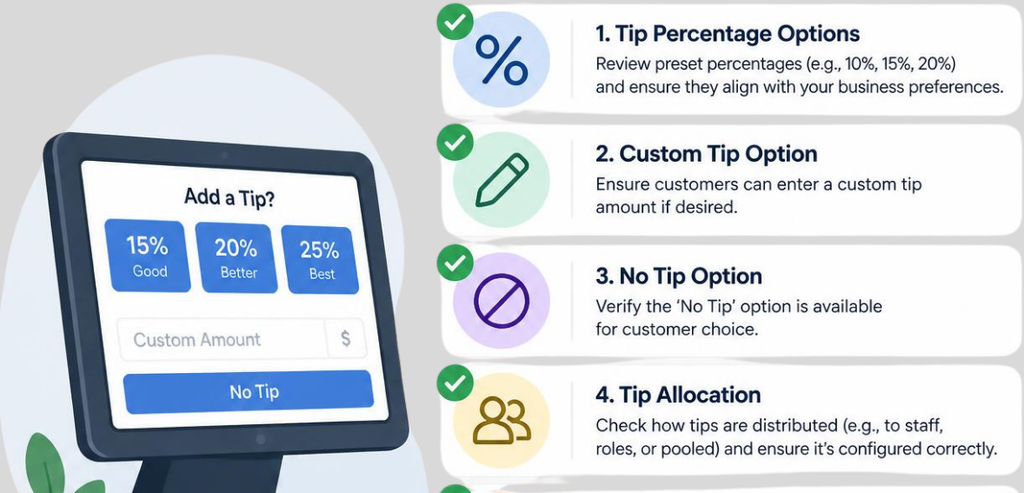
Three criteria will determine if a restaurant’s tip records will satisfy the IRS’s deduction rules. None of the three are uncommon POS settings. The first criterion is the flag for ‘tip vs. service charge’ that is associated with each menu item or party-size rule. An automated system that favors automatic large-party tips falling under the ‘tip vs. service charge’ category is misclassifying money prior to seating the party, and will lose the deduction for every dollar of tip the employee purports to claim.
The second criterion is whether a ‘zero-tip’ amount can be keyed in on the payment screen. If the tip screen only provides a series of tip amounts, and if a ‘zero-tip’ amount cannot be keyed in on the screen, then under the final rules the amount collected is not a voluntary tip and the deduction will be denied, no matter if the screen is a handheld, a countertop terminal, or an ordering kiosk. Cash tips are the last criterion and, during a busy shift, will likely be the one criterion that is overlooked. A cash tip entry at closing is what puts the server’s cash tips on the record.
Another audit-worthy section is attribution logic related to tips in the context of determining whether the system separates supervisory tips from other tips, as the final rules state that, irrespective of the structure of the tips pool, income earned from manager/supervisor tips is not deductible. Restaurants should perform this as a due diligence audit rather than a voluntary cleanup, because the regulations went into effect on June 12, 2026, and apply to the full 2026 tax year.
Restaurants face the tightest labor markets in the service sector when it comes to staffing. In 2018, the National Restaurant Association reported an average employee turnover rate of 75%. Additionally, Cornell University’s Center for Hospitality Research states that replacing one hourly employee costs an average of $5,864 due to the costs associated with recruiting, hiring, and training. Given these factors, a tax deduction of up to $25,000 is a substantial part of a restaurant employee’s total compensation, at least at restaurants where staff can validate their tip record.
A restaurant that accurately records cash tips, occupational codes, and pool assignments provides full benefit value to employees. An employer who has messy entries loses some benefit to employees, and the employer potentially never sees this money. Tipped employees talk to one another about which restaurants keep clean records. A manager who can say that employees’ tip entries are correct and employees receive their recorded wages is a strong retention tool with very little cost.
Restroworks industry turnover data indicates front-of-house turnover is 41 percent per year. This may not be as bad as the average of all positions within an organization, but most restaurants spend a significant amount of time and resources training a large portion of their staff every year. When a new employee is added to the staff mid-year, that employee must be trained to do tip entries the correct way so that the POS is configured for turnover, not the work of one trained server. A setting that works for one server is not a long-term solution.
A POS configuration decision results in an additional line item for tip deduction in the tax return. For cash to qualify as a tip, the amount must be separated from service charges at the point of sale, making tip reporting the responsibility of the employer before the preparation of a W-2. The Treasury’s tip-eligible occupation list and the $25,000 cap, in addition to the $150,000 and $300,000 phase-out limits, will only reach an employee whose employer records tips correctly.
In restaurants where tip entry, pool allocations, and job coding are done right, the tip deduction will appear on 2026 W-2 forms. Not addressing the tip entry system results in a loss of the benefit to employees at no cost to the employer, which is not what Congress intended.
RSM US states that for the years 2025 through 2028, eligible workers can deduct qualified cash tips of up to $25,000 from their federal taxable income.
No, automatic service and gratuities charges are not considered tips by the IRS and therefore do not qualify for a deduction.
The final rules state that the 71 occupations defined by the IRS include the addition of floral designers, visual artists, and gas pump attendants, made in April 2026.
No, tips that reach a supervisor or manager through any tip-sharing are not included, regardless of how the pool is structured.
No, this deduction is only for a reduction of federal tax liability. Medicare taxes and Social Security will still apply to all reported tips.
For 2026, cash tips must be reported separately in box 12 with Code TP and the employee’s TTOC must be reported in box 14b.
POS tip records and the tip deduction: one piece of running payments in a restaurant. The rest of our restaurant payment guides are in Restaurant Payment Resources.