

Posted: November 16, 2026 | Updated: November 19, 2026 at 9:21 AM
Spending on personal fitness falls into a gray area of the tax code. Gyms provide a service related to overall health. The tax code defines two categories related to expenses: costs related to health and costs tied to running a business. The tax code has no separate category for fitness spending and, therefore, membership costs must fit within one of these two categories.
The vast majority of individuals may not deduct fitness costs. The federal tax agency, the IRS, treats gym fees as personal spending that does not reduce taxable income. Also, gym fees fall outside the reimbursable expenses for an HSA (health savings account) or a health FSA (flexible spending account).
This guide describes the gym membership tax deduction limitations based on the individual, the employer, and the fitness provider. This guide analyzes relevant IRS code, regulations, rulings, and related publications.

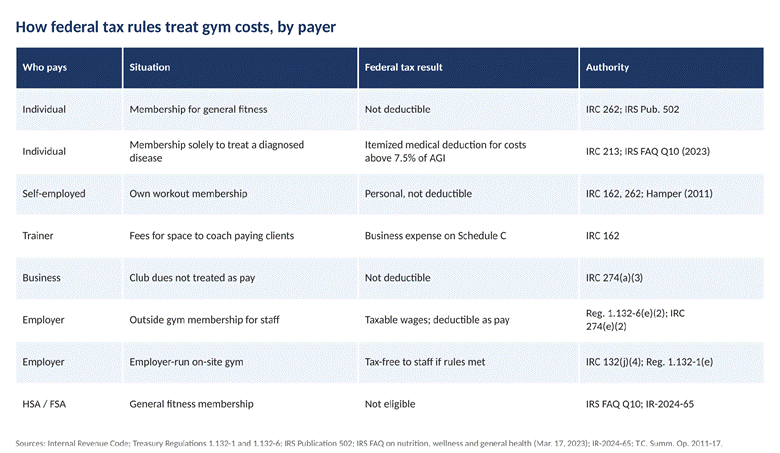
Personal, living, or family expenses, like gym memberships, are not deductible under IRC Section 262. According to the IRS, fitness costs are not deductible because being in shape helps you function in your day-to-day activities and is not associated with your employment or a medical condition.
It is unlikely that gym expenses will be medical expenses for the average taxpayer. The IRS has already determined that fees paid to health clubs are not medical expenses. The IRS will not allow medical expense deductions for membership fees at health clubs even if the member joins in order to alleviate mental or physical stress that is not attributable to any medical condition.
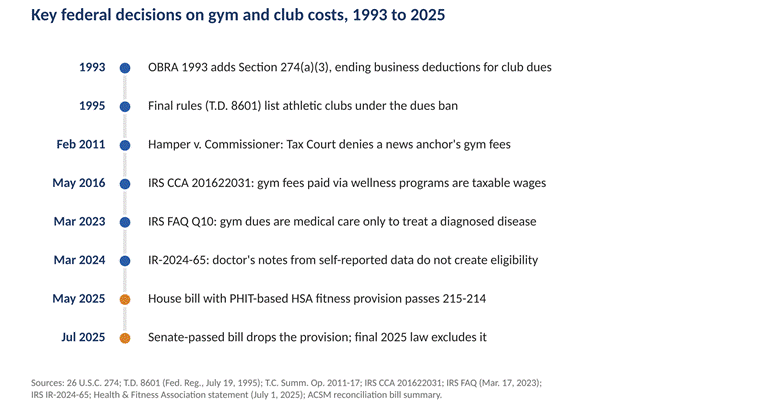
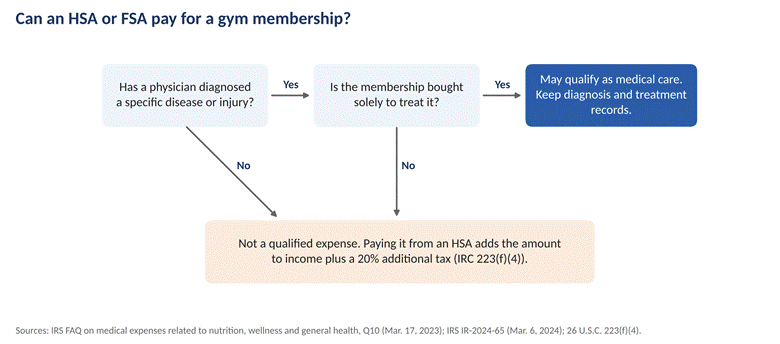
On March 17, 2023, the IRS released questions and answers covering diet, wellness, and overall health (IR-2023-47). Of relevance to gyms is Q&A 10. In this case, the IRS stated that, in order for a membership to a gym or similar facility to count as an eligible medical cost, the membership’s only purpose has to be to alleviate symptoms of a disease a doctor has identified, for example, obesity or cardiovascular disease. In all other cases, the IRS said, the membership counts as spending on overall wellness, and therefore, not an eligible medical cost.
Publication 502 states that even if the purpose of the membership is to alleviate symptoms of a confirmed illness, such as obesity, by losing weight, the membership dues still count as spending on overall wellness.
An eligible medical cost, here a gym fee, lowers the individual’s taxable income only when the individual itemizes deductions using the Schedule A form. Additionally, the year’s combined medical bills must top 7.5 percent of the individual’s AGI, the income figure on Form 1040 after certain adjustments. Therefore, for an individual whose AGI is $80,000, in order to see any tax savings, the year’s eligible medical bills must pass $6,000.

Under IRC Section 162, taxpayers may write off costs that are both ordinary and necessary for the work they do for profit. Costs counted as ordinary in a given line of work are common and accepted there. A cost is necessary if it is helpful and appropriate for the business.
Expenses related to personal health or fitness are not ordinary or necessary costs of earning business income and, therefore, are not deductible. This has been confirmed by case law. In Hamper v. Commissioner, T.C. Summ. Op. 2011-17 (2011), a television news anchor petitioned the Court to deduct gym membership fees and other costs related to her appearance on the news. The Court disallowed the gym membership fees and held that costs of staying fit and well are personal expenses and are not related to the person’s line of work, even if that work requires the person to appear before the public.
Similar results would be reached if a consultant, a real estate agent or a freelance graphic designer joined a gym.
Personal Trainers and Fitness Instructors
Trainers do have deductible business expenses, including what they pay to work out of a gym. A floor fee, rent, access fee, etc., is a cost trainers incur to work. It is a cost of doing business and belongs on the Schedule C form.
A trainer’s own workout membership is generally not deductible for the business, even when it helps the trainer stay fit for work. Personal use of the membership makes it a nondeductible expense.
Business Owners and Club Dues
The membership expense is also disallowed because of Section 274(a)(3), added by the Omnibus Budget Reconciliation Act of 1993. This section prohibits the deduction of dues paid to any club whose purpose is social, recreational, leisure or business networking. Final Treasury regulations issued in 1995 listed athletic clubs among others and prohibited a deduction for dues paid to such clubs.
This prohibition applies to all businesses, including sole proprietorships and partnerships. One exception to this prohibition is to treat the dues as compensation to an employee.
There is more flexibility when it comes to employers. It depends on where the facility sits and who runs it.
Off-Site Memberships and Reimbursements
When a company purchases an employee’s membership at an outside club, that payment counts as the worker’s taxable pay. Treasury Regulation 1.132-6(e)(2) states that memberships to private country clubs or athletic facilities, regardless of how frequently the employee uses the facility, can never be excluded as a de minimis fringe benefit.
The IRS has stated the same for wellness programs. In CCA 201622031, released May 27, 2016, the IRS stated that expenses an employer pays or reimburses to an employee for gym dues through a wellness program are considered taxable income and are subject to federal unemployment tax, Medicare and Social Security taxes and income tax withholding.
Under Section 274(e)(2), for the employer to take a deduction for the memberships, the employer must report the expense on the employee’s W-2 as wages. Final regulations published by the Treasury on May 30, 1996 (T.D. 8666) stated the IRS would allow the employer to take this position.
A workplace gym is considered a tax-free benefit under Section 132(j)(4) if the requirements in Treasury Regulation 1.132-1(e) are met. The employer must own or lease the property where the facility stands and must operate the gym or cause it to be operated by an independent contractor. Substantially all use of the gym must be by the employer’s staff, their spouses and their dependent children.
The gym need not be located on the employer’s main business premises. It need only be located on business premises of the employer that the employer owns or leases. A Regulation provides the example of a resort that has a gym, a pool and tennis courts, to indicate that the resort would not qualify for the exclusion.
Staff use of a workplace gym can be excluded from pay if the rules set forth above are met. A gym at a residential facility would also not qualify for the exclusion. Paying club dues for employees, by contrast, is taxable income to them.
Medical expenditures eligible for reimbursement through an HSA, a health FSA, or an employer reimbursement plan known as an HRA are defined in IRC Section 213(d). Gym dues will need to satisfy this definition to be eligible for reimbursement.
On March 6, 2024, the IRS released a statement in IR-2024-65, indicating that certain companies sold documents purporting to be medical documents that allowed the purchaser to deduct food purchases, as well as expenses associated with physical fitness and nutrition. The IRS stated that such documents do not enable taxpayers to treat such expenses as eligible medical costs. The IRS also stated that a plan that provides reimbursements for non-medical items would disqualify the entire plan, and reimbursements for real medical care would be considered taxable to the employee.
An impermissible withdrawal from an HSA is added to the owner’s income and is subject to a 20% additional tax unless the account holder has reached age 65, has a disability, or has died.
A physician’s treatment letter must document that gym use belongs to a treatment plan and is necessary to treat the condition. The FAQ states the test is satisfied when the facility is used only to treat the condition. A membership is unlikely to satisfy this test if the condition arose after the membership was purchased.
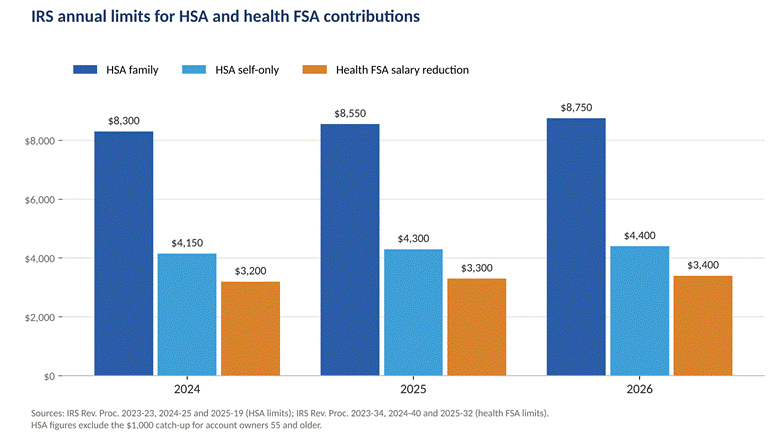
Limits on the accounts typically increase each year. Below are the annual limits published by the IRS for the years 2024 to 2026.
The 2025 version of the PHIT bill was reintroduced in the Senate and House in March by bipartisan groups of Representatives and Senators. The bill, if passed, amends FSAs and HSAs to permit payment for gym memberships, fitness classes, and equipment as well as youth sports and activities.
An iteration of this bill was included in the recent House reconciliation bill. The bill would have permitted HSA spending limits of $500 per year to be spent on physical activity. Backed by members of both parties, this bill passed the House in May by a vote of 215 to 214. The provision was dropped in the Senate in July, and the final law, signed July 4, 2025, as Public Law 119-21, did not contain this provision.
Some online sources wrongly reported that the 2025 law made gym memberships HSA-eligible in 2026.
H.R. 2369 remains pending in the current Congress.

Gyms get a flurry of questions about taxes in the new year. Staff often answer questions informally, placing the gym and member’s interests at risk.
Gyms are allowed to educate members about Publication 502 and the 2023 IRS FAQs. From this information, members learn that, for purposes of taxability, they should not treat their gym membership in the same way as other medical expenses. While gyms can educate members about this information and direct them to the sources, gyms cannot coach members about the application of this information to their particular situation. Only a member’s tax advisor or plan administrator can do this.
Gyms can help members by providing detailed receipts for qualifying expenses. If a member uses the gym’s services within a medically supervised weight loss program, the gym can help by charging the supervised portion of the program separately from gym membership. In this way, the member can apply the treatment rules in Publication 502.
Gyms should not lead members to believe that their memberships qualify them to take a medical deduction or make contributions to an HSA. Gyms should also avoid selling, or helping members buy, the questionable medical documents the IRS warned about.
When gyms partner with employers, gyms can explain the rules to the employers in general terms. Each employer should consult a payroll or employment tax professional. State tax laws may vary from Federal laws. Therefore, a practitioner licensed in that state should provide an opinion on a given situation.
Taxpayers must provide proof when taking deductions or making payments from a tax-free account.
The IRS website “How Long Should I Keep Records?” says records supporting items included on tax returns must be kept for three years from the date the return was filed. This period increases to six years if the tax return understates gross income by more than 25 percent. Claims regarding worthless securities must be supported by records retained for at least seven years. The same period applies to claims concerning bad debts. Employment tax records must be retained for at least four years.
The records that matter differ by situation:
Electronic copies are fine. Store them where you can find them by tax year, and keep the plan or account paperwork with them.
In most cases, gym fees are personal expenses. Publication 502 does not allow for a medical expense deduction for gym memberships. Additionally, I.R.C. §262 bars a deduction for them as personal spending. The 2023 IRS FAQ permits a medical expense deduction when the membership exists solely as treatment for a diagnosed disease.
Although being physically fit may help an individual’s business, the Hamper case bars a gym expense deduction for the self-employed. In the case of trainers, fees paid for a place of business may be deductible.
An employer may provide a fitness center for its employees, tax-free, if it meets the requirements of I.R.C. §132. Payment for an employee to use a fitness center off the employer’s premises counts as taxable pay for the worker.
Standard fitness center memberships may not be paid for with HSA or health FSA money. The PHIT proposal, which would have allowed such payments, was not included in the 2025 Tax Act.
Generally, no. Personal fitness spending cannot be written off, though a trainer’s fees for space to coach paying clients can be deducted as a work cost.
Yes. If an employer pays for an employee’s gym membership, that is taxable income and reportable on the employee’s W-2. Providing a workplace gym for employees is not taxable to the employee.
Yes, if the membership serves solely as treatment for a disease a doctor has confirmed. Standard memberships fall outside that rule, and using HSA money for one adds income tax plus a 20% additional tax.
Reduce Your Fees, Upgrade Your Service.
Your information will not be distributed
We received your request. A payments specialist will reach out shortly.
