
Posted: November 19, 2026 | Updated: November 20, 2026 at 12:40 PM
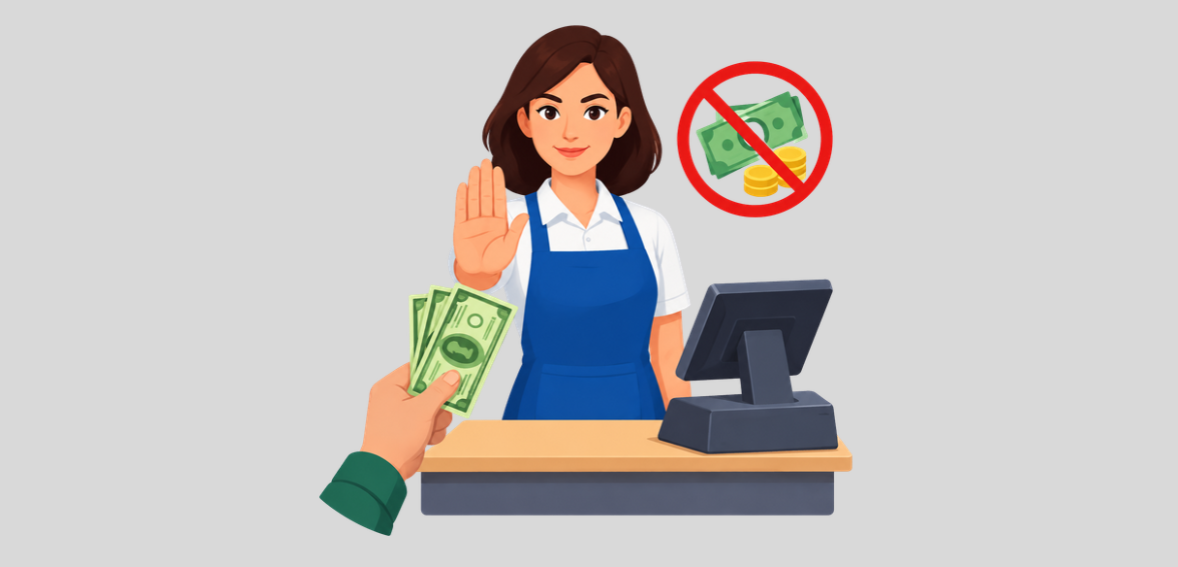
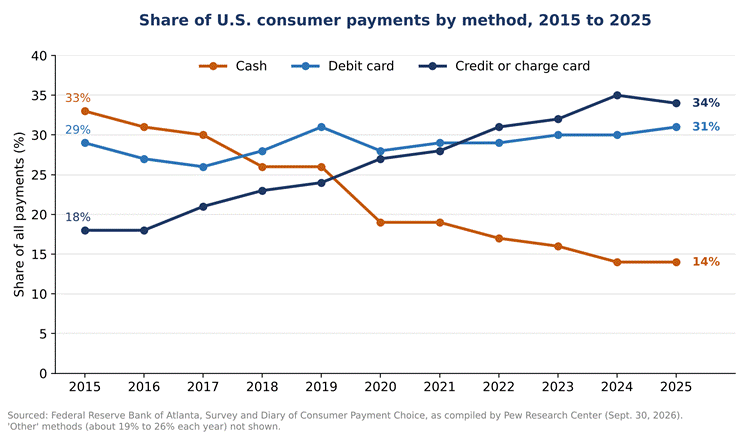
Cash still settles a significant percentage of transactions in the U.S. Results of the Federal Reserve’s 2026 consumer payment diary show cash was used to complete 14% of all payments made in 2025. Only 5 years earlier, cash was used to complete 33% of payments, according to Atlanta Fed figures that Pew compiled. During this same time period, laws and ordinances restricting cash transactions were passed by states and cities to counter the increase in businesses refusing cash transactions.
As of November 17, 2026, ten states and an equal number of localities had passed legislation making merchants take cash. Effective October 1, 2026, merchants in Maryland were once again obliged to take bills and coins. Other state legislation with similar requirements will begin in Illinois in January 2028. Therefore, at this time the response to the question “can a business refuse cash payments” is yes, depending on the location of the business.
Below you will find general information about Cash Acceptance on each of the major pieces of each side of this issue. What to consider before refusing cash payments. This is not legal advice.
Shoppers have long questioned the legal force of the statement printed on each U.S. bill, which calls the note legal tender usable to settle any public or private debt. The statement traces back to Section 5103 of Title 31 of the U.S. Code, which permits debts to be satisfied by payment in coins or currency.
At the time of a sale the debt owed by the customer doesn’t come into existence until the customer takes possession of the good sold. Before payment, the seller determines the terms of the sale. According to the Federal Reserve, it is the seller who has the final say in how a debt owed to them should be settled. Therefore, a given business or person is free to create and implement their own cash policies, unless restricted from doing so by the state.
Previously, the U.S. Treasury also explained this situation using the example that a private bus company has the right to refuse to accept dollar bills or to accept no pennies, for example, on a particular bus route.
Federal law places no mandate on a private person or business to take cash. Lawmakers filed a Payment Choice bill in each of the last four sessions of Congress to allow customers the right to pay with cash for a given transaction, up to a limit of $500. Currently, it is legal to turn down cash in a private transaction. Exceptions to this come from states and cities.
Massachusetts enacted the first law in 1978, which is codified at Section 10A of Chapter 255D in its general statutes. This law prohibits merchants from treating cash-paying shoppers unfairly and offering incentives to purchase goods on credit. There have been very few laws like Massachusetts’ for approximately the last 40 years.
In 2019, Rhode Island and New Jersey also enacted similar laws. In 2021, Connecticut and Colorado also passed such laws. The law became active in Oregon in June 2022 and in Delaware in April 2023. Montana’s law became active in May 2023.
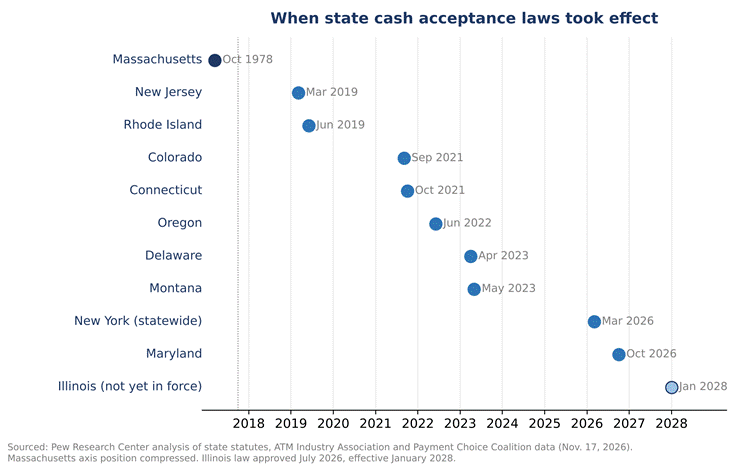
New York expanded its rule in 2026. General Business Law § 396-ii was enacted statewide on March 21, 2026. Prior to this date rules implemented by the NY Attorney General’s office applied only to NYC. Between 2020 and 2026 At the time of the expansion of the NY rules in 2026, Maryland had not implemented any similar rules. According to Pew, Illinois passed a similar rule in 2026 that starts in 2028.
Other local rules and regulations may exist. Pew’s list of local rules includes Philadelphia, San Francisco, West Hollywood, Berkeley, NYC, Washington, D.C., Miami-Dade County, Detroit, and King and Snohomish Counties in Washington. Rules in San Francisco and Philadelphia went into effect in 2019. The rule in Washington, D.C., started in October 2023 and was temporarily stayed in March 2024 before being reinstated in January 2025.
Hence, there is considerable variability in the effective dates and the actual text of the rules across different jurisdictions.
The result is a mosaic of laws and policies. A company may legally operate a card-only store in one state and face a fine in another for operating the same store in a different state. In California, Pennsylvania, and Washington, the same restriction may be imposed by one city or county but not by another. Pew’s study doesn’t include Tennessee, as that state’s law only prohibits stores from accepting payments for tolls and fines issued by that state.
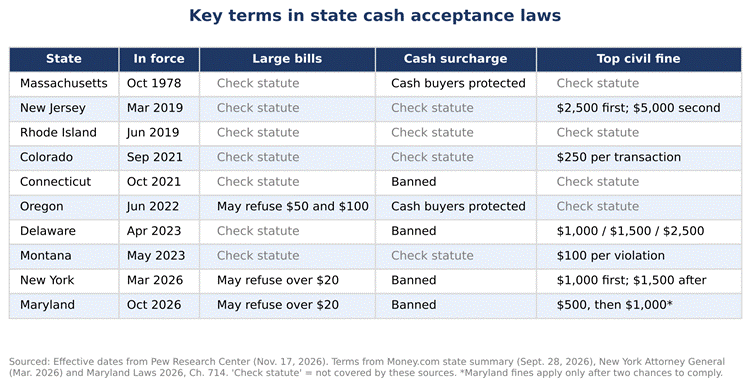
The amount of the fines also varies. New Jersey can fine a first offense as much as $2,500, and a second offense as much as $5,000. In Delaware, the first fine may reach $1,000, the second $1,500, and the third $2,500. In Colorado, the fine for each violation may not exceed $250.
The cap on fines in New York is $100 for each violation. The first violation of a similar law in New York may result in a fine of $1,000 and $1,500 for each subsequent violation. Maryland gave merchants two warnings to come into compliance with the law before a first fine capped at $500 may be imposed, with any later fines capped at $1,000.
These varying laws create a great deal of confusion for businesses operating across state lines.
The majority of these laws cover face-to-face sales. Transactions done over the phone, through the post or on the internet will not be covered by these laws. This is explicitly true in New York, Connecticut, and Maryland’s laws. In New Jersey’s law, transactions done without any face-to-face interaction are also excluded.
The most common way to circumvent a mandate to accept payment is to use a cash-to-card machine. Stores are allowed to eliminate the acceptance of cash from the cash register by implementing one of these machines in their location, according to laws in New York, Colorado and Delaware. New York also limits and caps machine fees. Maryland and Connecticut also require stores to take cash while the machine is being repaired.
Carve-outs vary from state to state. In New Jersey, airports are exempt from the law as long as each of their terminals has at least two vending machines taking cash. Exemptions also apply to public parking lots and facilities, and to car rental locations and arenas that hold 10,000 or more people. As for Delaware, it exempts nothing. Oregon exempts vending machines, sales made on board aircraft, and EV chargers. Connecticut exempts banking and rental facilities requiring a cash deposit, as well as facilities in the fields of medicine and law.
Colorado exempts automobile rental facilities and banks. Montana and Colorado both allow a single cash register to be used in a large volume store.
Maryland’s carve-out law is the most restricted of those mentioned here. It permits cash sales only of food, drink, and other personal items, including medicine and hygiene products. The value of each transaction must be at least $5 and less than $300. The transactions must occur between the hours of 6 am and 10 pm.
Exempted from the requirement of Maryland’s law are restaurants, other stores selling food meant to be eaten on site, fuel stations, parking facilities, and members-only fuel stations.
Regarding large denomination bills, by federal law, sellers of goods and services are allowed to set their own limit on the size of the bill they will accept. Previously, the Treasury Department answered this question by stating that some merchants will refuse to take any bill larger than a $20 bill. Some states have followed suit and enacted similar laws. In New York and Maryland, sellers have the right to refuse to accept any bill larger than a $20 bill. Oregon allows sellers to refuse both $100 bills and $50 notes and to refuse any transaction if they so choose.
There is greater consensus among the states on small density fees. New York, Delaware, Connecticut, and Maryland prohibit merchants from charging cash customers a higher price than non-cash customers. Discounts for cash payments are common. In the 2025 survey conducted by the Federal Reserve, 3.0% of debit card transactions and 3.0% of credit card transactions were conducted with a surcharge, and 5.0% of cash transactions were conducted with a discount.
The main argument for card payments is to reduce the cost of handling cash. A 2018 study conducted by the IHL Group on 13 different retail sectors estimated the cost to be between 4.7% and 15.3%. Quick service restaurants, according to QSR Magazine’s report of the study, showed a cash handling cost of 11.4%. That study encompassed costs associated with drawing cash from the bank, making change runs, picking up cash from the safe, and cash theft.
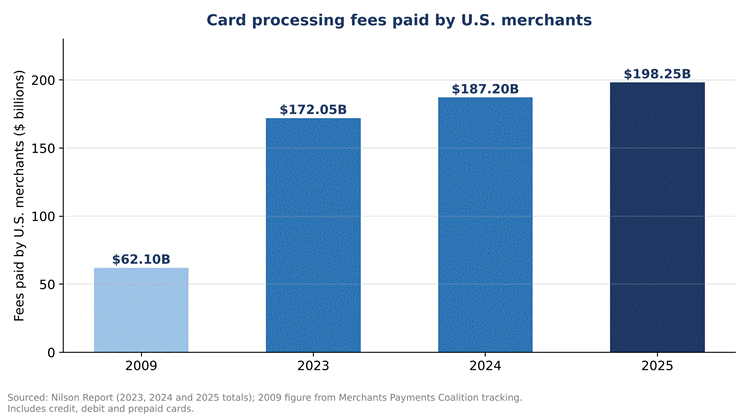
The argument against cashless policies pertains to the fees associated with card transactions. In 2025, U.S. merchants charged a total of $198.25 billion in card transaction fees, up from $172.05 billion in 2023, according to the Nilson Report. Of that total in 2025, $157.8 billion was from transactions using credit cards. Merchants on average paid 1.57 cents in fees for every $100 of transaction value, reports the Nilson Report.
In 2009, the Merchants Payment Coalition first estimated that credit and debit card transactions cost merchants a total of $62.1 billion.
Customer access is also important. The FDIC’s 2023 household banking survey estimated that 4.2% of households, or about 5.6 million households, did not have an account at a bank or credit union. Of those, 66.2% transact only with cash. The Fed’s 2026 Diary Study reported that 80% of participants used cash within the last 30 days and 90% of participants anticipated using cash in the next 30 days. The 2026 Pew Survey showed that 12% of participants use cash to pay for purchases alternatively. Forty-two percent of participants reported they did not use cash at all to make any payments during the week.
The rate of unbanked consumers has decreased since 2011 when it was measured at 8.2%, but larger differences in use of financial institutions persist. The 2023 survey showed the unbanked rate for black households to be 10.6% compared to 9.5% for Hispanic households, 1.9% for white households, and 11.2% for households having a member with a disability of working age.
Among consumers using the Fed’s 2026 Diary to make a payment in person, 16% preferred using cash as the method of payment.
The size of tickets also alters how math is done. According to Pew’s analysis of 2025 Fed data, the average cash purchase was $58 compared to $74 and $80 for debit and credit purchases, respectively. Retailers who carry products with larger ticket prices will have fewer customers paying with cash.
Begin with location. Check city and state laws, in that order. An example of this is seen with Philadelphia and San Francisco. Once locations are identified, match the business to the law. Some rules are broader and may apply to many businesses. An example of a more specific rule can be found in Maryland.
If a cash-to-card kiosk is part of the business plan, read the rule closely. Look into provisions for card expiry dates, fees, deposits, and what happens to stored balances if the kiosk malfunctions. Plan to have employees take cash out if the kiosk malfunctions.
Next, look at signs and pricing. It is illegal to charge a cash surcharge in some mandated states. Also, in some states, including Connecticut, signs stating cash will not be accepted are prohibited. Set large bill limits in line with each state’s restriction. Compare how much it costs to process cash against the opportunity cost of not having cash to accept all customers. Count the cash both ways to be certain cash is not taken as a surcharge. Because of inflation, and the need to plan for cash-only customers, some businesses may choose to take cash only in order to avoid the costs of banking, transporting and securing cash on the premises.
Keep in mind that recently enacted laws may change again. As of this writing, the Illinois law does not go into effect until January 2028, and the Payment Choice bill in Congress was not enacted last session. Train employees who will have the most contact with customers on the new policy. Other mandate laws have also recently been amended. In 2025, Connecticut expanded its law, and New Jersey in 2021 enacted an exception for professional sporting events.
No federal laws stop private businesses from turning away cash payments. That legal tender rule applies to debts and does not reach sales transactions. Exceptions to this come from states and cities. As of November 2026, Pew reports ten states and ten local governments have cash mandates. Illinois will have cash mandates starting in 2028.
Depending on the location, each mandate determines scope, exemptions, limits on bills allowed, and fines. Generally speaking, businesses are free to operate cashless throughout the majority of the country; however, they should verify the rules for each location where they do business.
Under federal law, yes. The Federal Reserve says businesses can set their own policies regarding cash transactions, except where specified by state or local laws.
According to Pew, these include Oregon, Maryland, New Jersey, Colorado, Rhode Island, Massachusetts, Delaware, New York, Montana, and Connecticut. Illinois will follow suit in January 2028.
In general, yes. In New York and Maryland, stores can refuse $20 bills, and in Oregon $100 or $50 notes.
Yes, there are no federal restrictions. Delaware, Connecticut, and Maryland prohibit setting higher prices for cash payments. Oregon also prohibits cash payment discrimination.
Reduce Your Fees, Upgrade Your Service.
Your information will not be distributed
We received your request. A payments specialist will reach out shortly.
