

Posted: November 17, 2026 | Updated: November 19, 2026 at 11:57 AM
Independent contractors are taxed on their profit, not what clients pay them. Expenses reduce the amount subject to both income tax and SE tax. For a sole proprietor, expenses reduce the taxable amount the same as income increases it.
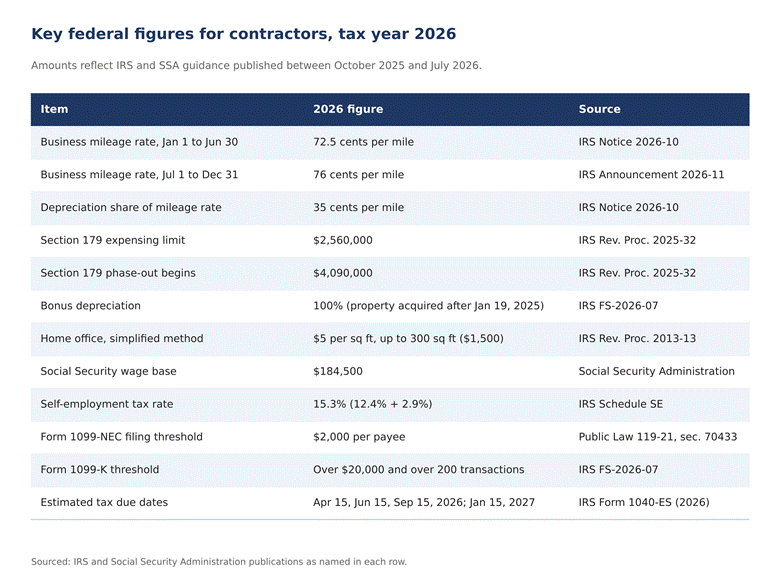
Various tax laws and provisions changed in 2026. The 2025 federal tax law (Public Law 119-21), for example, reinstated and increased bonus depreciation and increased the Section 179 expense limitation. Additionally, the Act increased the 1099 reporting threshold. The IRS increased the standard business mileage rate, and raised it again in July.
The following information is a summary of certain federal income tax deductions available to independent contractors for 2026. This summary includes descriptions of the requirements to claim each deduction, examples illustrating computation of each deduction, and descriptions of the types of evidence that may satisfy the IRS. State tax laws differ from the federal rules in this summary, so independent contractors may wish to consult a tax practitioner licensed in the state where the business is located.

Worker status is determined by the IRS based on the common law standards. Those standards consist of the degree of control the business can assert over the worker; whether the worker has any investment or risk of loss in the activity; and the permanency of the relationship.
Anyone in business as a sole proprietor is required to report that activity on Schedule C of Form 1040. That person also owes SE tax (Social Security and Medicare for the self-employed) if they have at least $400 of net income from that business activity in the year.
Client paperwork changed as well. There is a new rule about when clients file a 1099-NEC form. Effective for reporting after December 31, 2025, a person or entity issues the NEC form to a contractor when payments for the year total $2,000 or more. Previously, this form was required to be issued to a contractor when payments for the year were $600 or more.
According to IRS Fact Sheet FS-2026-07 (March 2026), for card and app payments, a Form 1099-K will be issued when the annual total of payments exceeds $20,000 and the number of payments exceeds 200. A Form 1099-K reports payments to the payee for a year and does not necessarily indicate that the payment is income to the payee.
Federal rules permit a deduction for expenses that pass two tests: each one has to be “ordinary,” and each one has to be “necessary.” The term “ordinary” means that the expense is common and relevant to the trade or business. The term “necessary” means that the expense is helpful and appropriate for the business. An expense does not need to be indispensable to be “necessary.”
Each contracting expense is shown on a specific line on Schedule C. Knowing the location of this line allows a bookkeeper to categorize expenses appropriately. It also allows a tax preparer to easily locate total expenses. The table below shows how expenses documented in this guide will be reported.
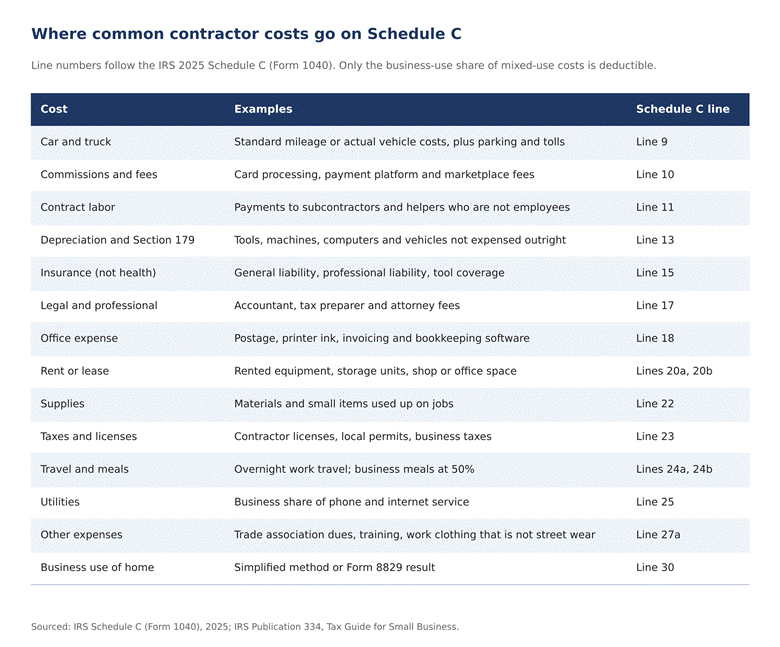
Some clarifications are needed with regard to the expense category for meals. Business meals with clients or prospects may be deducted by the company up to 50% as stipulated by the IRS in Publication 463. Personal meals are not deductible.
Small Expenses and the $2,500 Safe Harbor
In the case of materials that comprise a contract, such as lumber or wire, the cost is deducted as the job progresses and, thus, is a cost of the job. Hand tools and other small items, on the other hand, present a different situation. Treasury Regulation 1.263(a)-1(f) provides a “de minimis” safe harbor, allowing a contractor to treat items of $2,500 or less per invoice or item as expenses. The IRS increased the safe harbor from $500 to $2,500 through Notice 2015-82, effective for tax years beginning in 2016. The effect is that the contractor may deduct the item in the year it is bought.
Big Ticket Items: Section 179 and Bonus Depreciation
Purchases that exceed the safe harbor, such as a work truck or a work-related laptop computer, are deducted over several years (known as the recovery period). Two provisions, however, permit the contractor to take a greater up-front deduction.
Per Revenue Procedure 2025-32, Section 179 provides for first-year expensing of up to $2,560,000 in 2026. The limit on expensing is reduced on a dollar-for-dollar basis once qualifying purchases for the year pass $4.09 million. The annual deduction is also capped at business taxable income for the year. The 179 write-off is allowed in the year the asset is placed in service, and any amount above business income carries over to subsequent years.
The other alternative is to take bonus depreciation. The fact sheet IRS FS-2026-07 states that 100% bonus depreciation will be allowed on certain qualified assets bought from January 20, 2025 onward. Unlike Section 179, bonus depreciation is not limited by the amount of business income. The fact sheet states that the requisite business use must be in excess of 50% to qualify listed property to take bonus depreciation. Listed property includes motor vehicles and computers. Both sections 179 and bonus depreciation are reported on Form 4562.
If an item serves more than one purpose, a portion of the cost may be expensed if the item is used predominantly (e.g., 70%) in the line of business. A business usage log can serve as evidence of the business use.
Driving is the largest business expense for many tradespeople and field contractors. Federal rules permit two methods for claiming driving expenses, and the method chosen in the first year usually determines what is available in later years.
The 2026 Mileage Rate
On December 29, 2025, the IRS announced the 2026 IRS per-mile rate would be 72.5 cents. Gas prices then increased. On July 1, 2026, the IRS increased the rate to 76 cents. Therefore, the rate for driving in the second half of 2026 was 76 cents, while the rate for the first half was 72.5 cents. A contractor driving 12,000 business miles in 2026, split evenly between the two halves of the year, would report business driving expenses of $8,910.
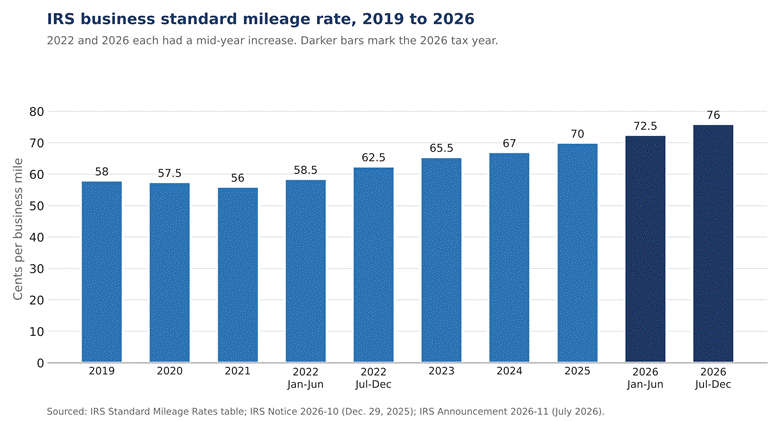
The IRS per-mile rate takes into account costs of operation, maintenance, and other costs associated with operating a business vehicle. Parking fees and tolls may be deducted in addition to the rate. According to IRS Publication 463, 35 cents of the 2026 rate is for depreciation and is subtracted from the cost basis of the vehicle.
The Actual Expense Method
This method allows a taxpayer to deduct the actual cost of operating a business vehicle. Costs including gas, oil, repairs, and maintenance, and depreciation are added and multiplied by the vehicle’s work-use share. A truck with 20,000 miles driven in a year, of which 15,000 miles were for the business, has a 75% work-use share.
Switching Between Methods
As outlined in the IRS release dated December 29, 2025, to use the per-mile rate for a vehicle you own, you must choose it in the first year the vehicle is used for business. A vehicle leased for business use and for which the per-mile rate is used in the first year cannot switch to the other method for the remaining term of the lease. Publication 463 outlines an exception to the per-mile method, which states that a vehicle expensed under Section 179 cannot switch to the per-mile method in later years.
Commuting to and from work is never deductible. Publication 463 states that travel from a taxpayer’s regular place of work to other work locations is business travel.
Home Office Tests
IRS Publication 587 outlines the main guidelines for the home office test. Generally speaking, a space must serve the business regularly and exclusively to qualify. Furthermore, the space must be the contractor’s principal place of business or where the contractor meets clients. A space that is used for other purposes (e.g. guest room) does not qualify. A contractor who spends the workday at client locations may qualify if the contractor does billing, estimates, and scheduling from a home office and works from job sites.
Two Different Approaches
The simplified approach, outlined in Revenue Procedure 2013-13, states that the deduction is $5 for each square foot, up to 300 square feet. The maximum allowed is $1,500. The contractor need not track depreciation.
The regular approach is found on Form 8829. The contractor calculates the office’s square footage in relation to the entire dwelling unit and applies that percentage to expenses incurred for the dwelling unit. For depreciation, the contractor may utilize IRS guidelines. The contractor may use either approach in a given year.
Telephone and Internet
Mobile phone and mobile internet bills are deductible if used for business. Publication 587 states that the basic charge for the first landline into a home is not deductible. A second telephone line, which is used exclusively for business, is fully deductible.
Business Insurance
Business insurance coverage premiums are reported on Schedule C, line 15. Some common small business insurance policies for contractors include general liability insurance, professional liability insurance, and insurance policies to cover contractors’ tools and equipment. Insurance policies to cover vehicles used in a business should be reported under the costs of the vehicle when the actual expense method of accounting is utilized. Insurance costs related to driving a vehicle are absorbed in the IRS per-mile rate.
Health Insurance Premiums
Health coverage a contractor buys is not reported on Schedule C. This insurance premium is reported on Form 7206 and is transferred to Schedule 1. According to the instructions for Form 7206, this insurance premium is allowable only if the contractor does not have the opportunity to obtain health insurance through any employer or the employer of the contractor’s spouse. This health insurance premium reduces the contractor’s federal income taxes; however, it does not reduce the contractor’s Self-employment Tax.
Licenses and Permits
Licenses and permits required of contractors to do business are reported on line 23 of Schedule C (taxes and licenses). It is generally permitted for a contractor to write off continuing education and training to maintain and improve his or her professional and business licenses. Education and training that would qualify the contractor to practice a new trade or business are not allowable as a business expense.
Card and Processing Fees
Contractors should deduct fees charged by credit card processors and other organizations that provide payment and invoicing services on Schedule C as fees and commissions. Contractors who receive Forms 1099-K should report the gross amount shown on the Form 1099-K. The contractor is entitled to take a deduction for the fees charged by the credit card processor. Failing to take a deduction for credit card fees overstates income, because the processor kept those fees.

Contractors Pay Both Halves
When you work for yourself, you are required to pay the full 15.3% of the Social Security and Medicare tax. The Social Security tax is 12.4%, which is capped at the Social Security wage base, set at $184,500 in 2026. Medicare takes 2.9% of every dollar of self-employment income, with no cap. Single filers who earn more than $200,000, and joint filers who earn more than $250,000, also owe an extra 0.9% Medicare charge.
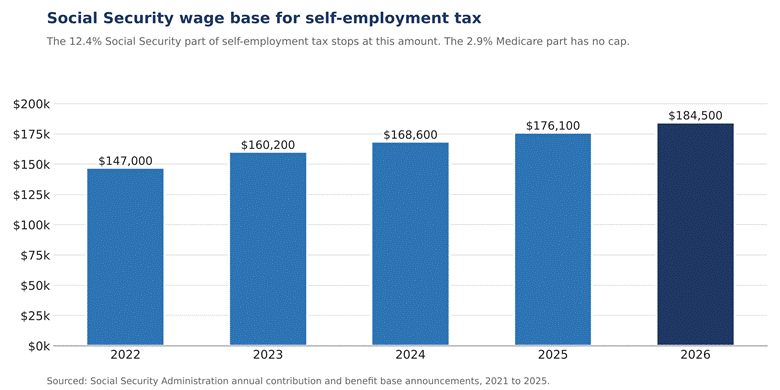
Schedule SE applies a tax to 92.35% of your net profits. With $60,000 of net profits, you would have a taxable base of $55,410, and you would owe $8,477.73. You would then deduct $4,238.87 on Schedule 1. This deduction lowers income tax only, not SE tax.
Schedule C expenses reduce both of these taxes. Many contractors are also eligible for the QBI write-off of up to 20%, which was made permanent by the recent tax law, as mentioned in IRS FS-2026-07.
Employers will not withhold taxes from contractors. Contractors are required to make quarterly payments if they expect their taxes, less withholdings and credits, to be $1,000 or more. Payments for 2026 will be due on April 15, June 15, and September 15, and then January 15, 2027.
The underpayment penalty is avoided if the lesser amount of 90% of the expected 2026 tax or 100% of the 2025 tax is paid. If 2025 AGI topped $150,000, then the prior-year safe harbor rises to 110% of the 2025 tax. Payments may be made using IRS Direct Pay or the Electronic Federal Tax Payment System. Payments should be made for the quarterly income tax and the tax on self-employment earnings.
Proving your deductions is important. IRS Publication 583 states that businesses must retain documentation that supports every income and expense amount reported on their tax return. For contractors, the working file may contain:
Publication 463 contains an exception to the receipt rule for certain expenses. Expenses less than $75 do not require a receipt if the business records contain the amount, date, place and business reason for the expense. Lodging always requires a receipt. Expenses for tools, office supplies and other equipment do not fall under the $75 rule. These expenses require proof of the expense.
Electronic copies of receipts are acceptable provided they contain the required information. The IRS permits the electronic storage of receipts. The period of time these receipts are retained depends upon the situation and is outlined below.
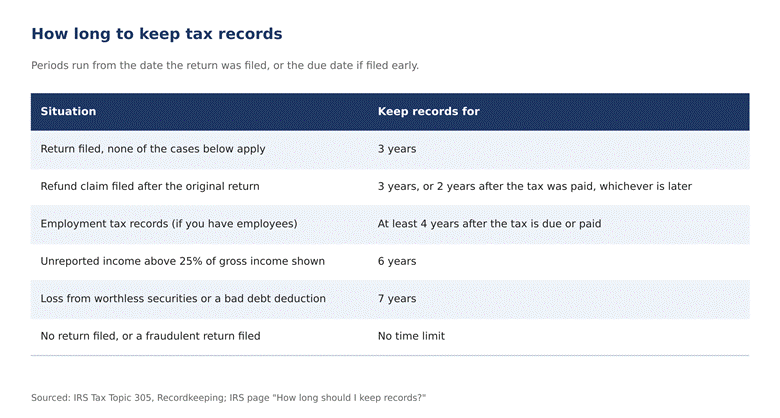
Records of an asset’s cost and depreciation must be kept for as long as the asset is held, and for the limitations period after it is sold or disposed of.
Contractors can deduct ordinary business expenses for 2026. Mileage rates are 72.5 cents (pre-July 1) and 76 cents (post-June 30) per mile driven for business. The Home Office Simplified Rate is $5 for each square foot. Tools generally qualify for the $2,500 expense safe harbor. Equipment would likely qualify for either the Section 179 expensing or Bonus Depreciation. Card processing fees reduce net self-employment income.
Card processing fees are deducted separately from 1099-K gross income, not netted against it. Self-Employment taxes are 15.3% of Net Profit; however, the Social Security tax is capped at $184,500. Each expense is deductible only if there is sufficient evidence to show the amount, the date of the expense, and the business purpose. The IRS suggests taxpayers retain this information for at least 3 years from the date the information was submitted.
Yes. A de minimis election lets items or invoices costing $2,500 or less be fully expensed. Tools costing more than that can be recovered through a section 179 election or bonus depreciation.
The IRS per-mile rate (72.5 and 76 cents in 2026) can be more than actual expenses for more fuel-efficient vehicles. For larger vehicles with less fuel economy, it can be beneficial to use actual expenses.
Card processing fees are expenses of doing business and are reported on Schedule C, line 10. Because Form 1099-K reports total proceeds of a transaction (before fees), processing fees must be deducted separately.
Not always. Travel expenses are deductible without a receipt if expenses are $75 or less. Lodging always requires a receipt, and so do expenses of $75 or more.
Reduce Your Fees, Upgrade Your Service.
Your information will not be distributed
We received your request. A payments specialist will reach out shortly.
