

Posted: November 18, 2026 | Updated: November 20, 2026 at 10:22 AM
Nearly every business in the U.S. issues gift cards. These cards represent a promise by the business to provide goods or services in the future in exchange for money that the business cashes on now. The laws that regulate these gifts and their terms are very limited. The feds mandate that the card’s money can’t expire before a certain amount of time has passed. State laws, on the other hand, can and do restrict terms of the gifts more stringently. A business is required to abide by the terms most restrictive of the locations where the cards are sold.
Below you’ll find information about the expiration dates of gift cards, the types and amounts of fees that can be charged on gift cards, and how merchants should account for gift cards given out as promotions. I am not providing legal advice with this information. To determine what the laws are in your state and to learn what your options are with regard to setting policy concerning gift card expiration, consult with a lawyer.

So, can gift card money run out? Not really. Cards bought in the US are not permitted to have expiration dates less than 5 years after purchase, as stated in the 2009 CARD Act. This act is enforced by the CFPB, the federal consumer finance regulator, and explained in Regulation E, 12 C.F.R. 1005.20.
Some states have amended this law to ban end dates outright. These states are Washington, Minnesota, Florida, Connecticut, and California. Elsewhere, the 5-year cutoff typically applies. In Massachusetts, gift cards must remain valid for a minimum of 7 years. So, in these states and areas, gift cards expire “never.”
Even with the 5-year minimum, the plastic gift card may itself deteriorate or expire before the card’s money does. In these cases, the buyer is permitted to request a free replacement from the retailer, under federal CARD Act requirements.

The Federal Reserve Board created this federal rule and published the final version in the Federal Register on April 1, 2010. Responsibility for this rule was later transferred to the CFPB and is now found in Part 1005. This rule applies to gift cards that consumers bought on or after August 22, 2010.
There are three products covered by this rule. Gift certificates include a card that represents a specific monetary value that is not redeemable until the card is presented for use. Single-store gift cards are redeemable at a particular merchant or chain of merchants and may be reloaded. A prepaid card for general use may also be used to make purchases at any merchant that accepts the card’s payment system.
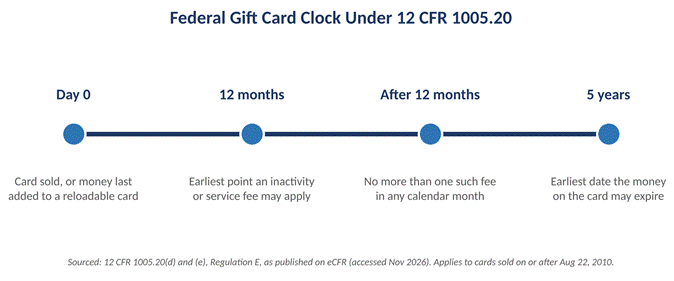
The end date for each of these cards provides a minimum of five years during which the card may not be redeemed. In the case of gift certificates, this date is assigned when the card is issued. For a reloadable card, this date is assigned each time money is loaded to the card. Therefore, money loaded to a single-store card in 2026 would not expire until 2031.
The federal rule requires sellers to keep their inventory stocked and fresh. Issuers must implement policies that allow customers to choose cards whose expiration date is no less than five years past the print date. See part (e)(1) of the rule.
Certain products are excluded from the requirements of the rule. As mentioned in part (b) of the rule, gift reloadable cards, cards used exclusively to store value for phone time, cards issued to the public which do not take physical form, and paper certificates, event and venue tickets are excluded from the rules. Likewise excluding loyalty and promotional cards which must be issued in compliance with less onerous requirements of the rule.
The federal CARD Act sets a minimum standard. Thus, state laws that further protect consumers remain in effect. This is the reason state-specific laws pertaining to gift cards are important to businesses with multi-state locations or with online operations.
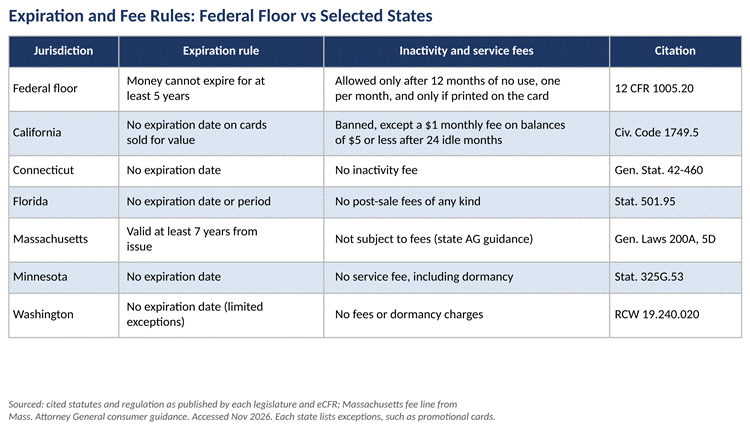
Florida Statutes 501.95 prohibits expiration dates and periods on gift certificates sold in Florida, as well as post-sale fees. Minnesota Statute 325G.53, effective August 1, 2007, prohibits charging service fees or setting end dates for gift cards. Exceptions to the ban on setting fees and dates in Washington’s RCW 19.240.020 are for awards and gift cards used to raise funds for a charitable organization.
Cards issued by banks located outside of the U.S. cannot carry an end date or inactivity fee to be sold in Connecticut, according to the Connecticut Department of Consumer Protection. Also, according to the entry for Maine on the website unclaimed.org, expiration of gift obligations in Maine is prohibited.
Massachusetts takes a different approach. In accordance with Chapter 200A, Section 5D of their General Laws, gift certificates issued by Massachusetts businesses must be valid for a minimum of 7 years after purchase. The face of the certificate must also state the date of purchase. If the certificate shows no printed expiration date, it may be redeemed at any time.
Do gift cards expire in California? No, gift cards bought for a specific value cannot carry an end date. Section 1749.5 of California’s Civil Code prohibits the sale of expiring gift cards. Any end date, in this case, would effectively set a limit to the card’s value and would therefore be misleading to the consumer. Once used or replaced, the card has no expiration date.
California has a cash-out rule, which means that if the consumer requests it, the business must give them the card’s cash value for any balance under $15. Before 2025, the cash-out value was under $10.
According to the Connecticut Office of Legislative Research’s report dated August 15, 2023, there are 14 states with a cash-back rule. Of those 14, Connecticut, Rhode Island and Vermont set the line at $0.99, $4.99, and $2.49, respectively.
California prosecutors use what’s known as the cash-out rule. On October 23, 2025, the Ventura County District Attorney’s Office obtained a judgment against the Chipotle restaurant chain with prosecutors from Shasta, Sonoma, Los Angeles, and Ventura Counties. Chipotle, according to the complaint, refused cash refunds on customer balances under $10. At that time, Chipotle’s minimum cash out amount was $10.
Chipotle agreed to pay $246,000, which consisted of a $145,467 civil penalty, $88,533 to cover the cost of the investigation, and a $12,000 restitution payment. As part of the settlement, Chipotle also agreed to create an online webpage to allow customers to request a refund of their small account balances. Chipotle admitted no wrongdoing.

Are fees on gift cards legal? Yes, but only under certain circumstances. The federal government has placed some restrictions on gift card fees in part (d) of that regulation. According to this section, an issuer may charge an idle-card fee once a full year passes without use. The issuer is required to disclose the amount of the fee on its face. Further, the issuer may charge this fee only once per month.
To determine gift card ‘activity’ for this section, a transaction that increases or decreases the card balance is considered ‘activity.’ Fee charges do not qualify as ‘activity.’ Likewise, a credit to correct an erroneous transaction is also not counted as ‘activity.’ Therefore, a fee cannot initiate the 12 month waiting period to assess if a card has been ‘inactive.’
The protection of these regulations also extends to covered gift cards when they expire. Part (e)(4) of the rule provides that the issuer may not bill the holder to replace the card or to liquidate its face amount. An exception is made for a card which was previously reported to be lost or stolen.
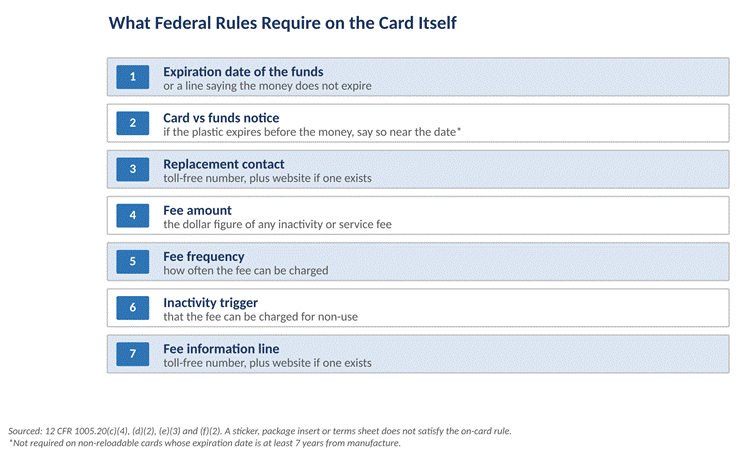
Fees not associated with idle time, specifically activation and purchase fees, are permissible under federal law. Part (f)(1) of the rule requires the card issuer to disclose the amount of the fee on or with the card.
California law further restricts fees permitted under federal law. In particular, California’s Civil Code, in section 1749.5, prohibits gift card service fees, except a single dormancy fee that may be charged after 24 idle months and which may be imposed only on the amount represented by the card rather than the amount of the fee, not to exceed one dollar per month.
Pursuant to the terms of the card, the fee may be assessed against the card before each transaction. Florida has also enacted similar statutes prohibiting various fees on prepaid cards purchased in that state. Washington, Minnesota, and Connecticut have also prohibited inactivity fees. As such, it would be prudent for a merchant to prohibit idle fees on cards used at its stores to transact purchases, in states having stores operated by the merchant.
A card given out for free is subject to less restrictive rules. A card given as part of a reward, loyalty or marketing program is listed in part (a)(4) of the rule. Therefore, a card given out with a purchase to be redeemed for a rebate would also fall into this category.
These cards expire before 5 years pass and may also carry a fee. The card issuer has some leeway to set the terms of the fee, and must disclose these terms on or with the card. The card’s face must show the reward’s expiry date, and the telephone number of the issuer must also be included. The issuer may also set up a free phone line to be used to inquire about the fee. The issuer must also establish a website and show the website address on its card.
States have their own rules for promotional cards. In California, free award and promotional cards are exempt from the no-expiration rule. However, the date must be printed in all capital letters, with a minimum type size of 10 points, on the face of the card. In Florida, if a customer did not have to pay for a loyalty card, the issuer is allowed to print a date on its card. Minnesota exempts loyalty, promotional, award, and incentive rebate cards from its expiration policy if the customer did not have to pay anything for the card.
Generally speaking, in these types of laws if a customer had to pay for the card, it counts as a true gift card.
Discounting a card does not make it a promotional card. A company should consult an attorney first before putting a date on a ‘bonus’ card that it sells to customers.
Disclosure rules affect the card itself. Part (c)(4) of the rule requires that disclosures appear on the physical card itself. Stickers or terms inserted in the package are of no effect. Terms of the card may be embedded in an electronic version of the card, but they must also be included in the version transmitted to the consumer.
Timing is important. Subsection (c)(3) of the regulation states that fee and expiration date terms must be disclosed to customers prior to the sale of a card. Once a card is sold, the issuer is not allowed to change these terms. Therefore, to increase a card issuer’s fees, only cards sold after the change would be subject to the new terms.
State regulations, in addition to the federal regulations, also apply to card issuers. California’s dormancy fee statute is only valid when the card’s face discloses the fee in 10-point type, prior to purchase. In Massachusetts, to be valid, a card must display its issue date and its expiry date. The absence of a printed date signifies the card will not expire.
Some states have requirements pertaining to receipts. Effective October 1, 2016, the law in Connecticut required sellers to provide a receipt, either electronically or in paper form, to customers prior to sale of the card. As part of the judgment against Chipotle, card issuers were required to disclose on cards issued to customers in California that customers have the right to request redemption of the balance if it is less than ten dollars.
Gift cards create a financial liability for a business. Finance has to track the amount of unspent gift cards, the age of those gift cards, and the location of the liability.
As stated in ASC 606, also known as the revenue recognition standard, when a card is sold, a liability is recognized and revenue is recognized upon use of the card. Paragraphs 606-10-55-46 to 55-49 of ASC 606 cover ‘breakage’. Breakage is the portion of card value that goes uncashed by the customer.
If a business is able to estimate breakage with reasonable certainty, revenue is recognized corresponding to the estimate of breakage. Other businesses estimate breakage only when usage is extremely unlikely. An example of the first method is shown in The Cheesecake Factory’s 2019 annual report, where they recognize breakage of gift cards over three years since that is the approximate duration of time it takes customers to use the cards.
In conformity with state law, some businesses are required to turn over the proceeds of gift cards which have not been redeemed to the state. A business is also prevented from recognizing breakage for the amount turned over to the state. Thus, in such a situation, the amount would be considered a liability of the business until turned over to the state.
States vary widely in their laws governing gift cards. According to unclaimed.org, gift cards issued in Delaware, Georgia, and the District of Columbia must be abandoned after 5 years. Those in Alaska, Iowa, and Kentucky must be abandoned after 3 years. Gift cards issued in Arizona, Kansas and Louisiana do not expire.
Section 717.1045 of the Florida Statutes states that gift cards covered in section 501.95 do not need to be escheated to the state of Florida as unclaimed property.
To locate and report unclaimed property, you should begin when the sale happens. With each subsequent load, the card’s face amount resets for federal and some state laws. Write the state where the card sale took place. If a customer provides a mailing address, use it to identify the customer and address in accordance with the 1965 Texas v. New Jersey Supreme Court ruling. At the end of each month, run an aging report to see if there are any gift cards that remain unclaimed for an extended period of time.
Money loaded onto gift cards is shielded under the 2009 federal statute from expiring before 5 years have passed. Most states do not allow gift cards to carry end dates. Idle fees on gift cards are restricted by the federal CARD Act. Some states, like California, Florida, and Washington, have banned idle fees altogether. Free cards given as promotions must show their expiry date on their face.
California has mandated that merchants issue cash to customers with gift card balances less than fifteen dollars. Chipotle recently paid out $246,000 to customers for failing to do the same with the previous ten-dollar limit. To remain compliant with the various state laws, merchants should record the sale and reload date of each card and track the balance by state.
According to federal law, card money can’t expire for 5 years after it was purchased or previously loaded. Some states, such as California and Florida, don’t allow gift cards to carry end dates at all.
Once a full year of inactivity has passed, and no more than once a year, the business may keep a fee charged to the card to cover administrative costs. States like Washington and Minnesota don’t allow fees to be charged to gift cards.
Yes. Gift cards offered by a business to promote their product may carry a set expiry date. The card must show that date in print.
The business must honor the card for a minimum of 5 years after the date of purchase. Once the card has expired, the money may no longer be used, but the owner of the card is legally entitled to the face value of the card.
Reduce Your Fees, Upgrade Your Service.
Your information will not be distributed
We received your request. A payments specialist will reach out shortly.
