







SaaS & ISV Partner FAQ

Host Merchant Services is a software and payment services company. We process payments and build software products that integrate with our payment services. We also provide our partners with our payment APIs. This FAQ focuses on the types of questions software companies ask before they integrate payment services with HMS.
This SaaS partner FAQ explores the business, technical, and operational questions associated with payment partnerships. For more information about the five paths to collaborate with HMS, please visit SaaS & ISV Partner Program.
Business professionals shaking hands during a SaaS and ISV payment integration partnership meeting.
Business professionals reviewing information on a tablet during a SaaS and ISV payment partnership discussion.

Commercial

Do you impose a minimum threshold for the number of merchants or volume of processing transactions for participation in your program?
There is no merchant or volume threshold to partner with HMS. Partnership options include a referral partnership, software partnership, and HMS supporting the end-to-end merchant journey. Regardless of the partnership model, HMS will design and implement payments solutions with our partners.
HMS provides a variety of partnership models including: a referral partnership model, integrated payments and revenue share partnership models, as well as HMS-led payments sales partnership model, white-glove partnership model and white label and private label partnership models.
ISV partners earn a monthly residual for each merchant under contract, paid around the 25th for the prior month. ISV partner residuals are tracked and reported via the HMS partner portal. Chargebacks on volume already paid out are reconciled against future residuals.
Revenue share is determined by HMS based on the individual partner and is determined during the integration call.
No. This is a flexible program based on your business. We want to help you add HMS where it fits and keep your existing relationships. Your team will work with us to develop the relationship based on your needs. Relationships may be developed through referrals, integration into your application, or completely managed by HMS. Discuss the HMS business model with us to learn more. We will also address the commercial aspects of the partnership with you.
Yes. You can keep your existing relationships and integrate HMS where it is beneficial. The program is completely flexible and allows you to pursue new business opportunities. Whether you are launching your first payment integration or seek to integrate payment processing for an existing customer base, we want to help. Informed of your existing integration requirements, we can discuss the HMS partnership and integration models and assist you in developing a payment solution to meet your customers’ needs.

Merchant of Record and Risk

Do I or my software company become the merchant of record?
No. Your software company doesn’t become the merchant of record or hold merchant funds. Your customers sign their own merchant agreements with HMS and have their own merchant accounts. HMS provides the merchant account relationships, and your software company provides the software. Because of this, your software company doesn’t assume the underwriting or funding risk when you add payments through this partner program.
No. HMS is not a PayFac. Your customers sign their own merchant agreements with HMS and have their own merchant accounts. Your software company doesn’t become the merchant of record, hold merchant funds, or assume underwriting or funding risk. From a software company perspective, in the context of a PayFac or an ISO (independent sales organization) partner relationship, this is the account structure that HMS uses in its program.
HMS sets merchant pricing. Your business can integrate payment processing through a white label or private label solution, but cannot present itself as the processor or bank. Your customers enter into a merchant agreement with HMS, and HMS sets up a merchant account for each customer. We can discuss the areas of integration for payments based on your partnership model and if HMS sells payments to your customers, or if your customers are referred by your team.
In a referral model, payments sales, boarding and support are handled by HMS. For the white glove model, HMS integrates and boards customers and provides merchant support. Other integration models cover the extent of integration, and define the support and sales responsibilities for HMS and your team. HMS takes over support and sales from your team based on the integration model.
Business professional using a laptop displaying a security shield symbol representing secure payment processing and merchant risk management.
Software developer working on a laptop to integrate payment APIs and payment processing solutions into applications.

Integration

What is PaymentCore, HMS PayAPI?
PaymentCore, also known as HMS PayAPI, is our payment processing layer. It is used in HMS Cloud Manager products and can be used by our partners in their applications. PaymentCore is a pre-certified payment application. Other options include payment pages, payment links, and payment invoices. Your developers will get path-specific documentation and a complete sandbox during the onboarding process. HMS Pay offers multiple ways to integrate payment processing.
HMS Pay provides multiple path options, including HMS PayAPI, payment pages, payment links, invoices, payment terminal integrations, payment gateway integrations, and direct processor arrangements. Payment terminal options include Dejavoo, Clover, PAX, and Valor. Direct processing arrangements are offered by TSYS and CardConnect. HMS provides path-specific documentation and can perform integration work white-glove for our partners.
Yes, if it is one of the gateway integrations supported by HMS, which include NMI, Authorize.Net, TSYS TransIT, CardPointe, and FluidPay. The payment processing integrations offered by HMS are documented and available in the Payment Integrations directory.
HMS supports payment processing integrations with terminals from Dejavoo, Clover, PAX, and Valor. Provide the details for both your software and the hardware. HMS provides necessary documents based on the choice you provide. HMS also offers test environments and development sandboxes. You can request a build by our professional services team through our ‘white-glove integration’ offering.
Yes. Both low- and high-risk merchants are supported via the HMS integration offerings. As part of the due diligence process to onboard a high-risk merchant, we require an assessment of each merchant’s payment workflow, in addition to other payments-related software, gateways or hardware.

Developer Access

Is API documentation public, and what languages/SDKs are supported?
Our documentation is shared during the partner onboarding process and is proprietary. Therefore, we request that you direct your integration and technical discussions to the path you have chosen, which may include HMS PayAPI. Once you have decided on your path, we provide the relevant documentation to your developers and integration support. Refer to the Developer Resources for the support provided to our partners.
HMS provides a UAT and sandbox environment. Our development and integration support teams provide your development team with a complete environment, integration and documentation support for your chosen path. We encourage you to engage in a scoping discussion to identify the end points you want to integrate.
Yes, HMS can do the integration for a partner through the “White-Glove” integration support model. In this case, HMS does the integration and boarding support for the merchant. If your developers will do the integration, we provide support, integration documentation and a complete environment for integration.
Software development team collaborating at computers to review payment API documentation and SaaS integration solutions.
Digital security shield with checkmark and compliance icons representing PCI DSS standards and secure payment processing.

PCI Scope

Could embedding payments bring us within PCI scope?
We design integrations so that card data won’t be captured in your systems wherever possible. This reduces your PCI scope. The design depends on your integration method. It may include a payment page that is hosted by us. It may include an iframe tokenizer with embedded input fields. We support you in defining the design during the integration process. Payment processing may be done using PaymentCore. Alternatively, we support your efforts for TSYS and CardConnect certifications.
Payment processing may be done using the pre-certified HMS PayAPI. Alternatively, we support your efforts in getting TSYS and/or CardConnect certifications. PaymentCore supports processing for these, as well as other processors, thus using PaymentCore may negate your need for processor certifications. We scope the various routes with your team, and support integrating HMS with your software.

Workflows

What payment types and workflows are supported?
Card-present and card-not-present transactions, including recurring transactions and payments, are supported. So are pay links, ACH payments, and Apple and Google Pay. HMS also offers Level 2/Level 3 and GSA payments. All transactions can be settled via the API, including refunds and voids, as well as surcharges, if permitted by the card brands and the applicable state laws. Bring the payment workflows required by your end customers to the table to help scope the payment integration required by your product.
Payment adjustments and split funding are supported via the API. So are recurring payments and card-on-file transactions. HMS also supports card-present and card-not-present transactions, including ACH payments. Developers can integrate payment transactions via the HMS API. If you prefer HMS to build the payment integration for you, we also provide that service.
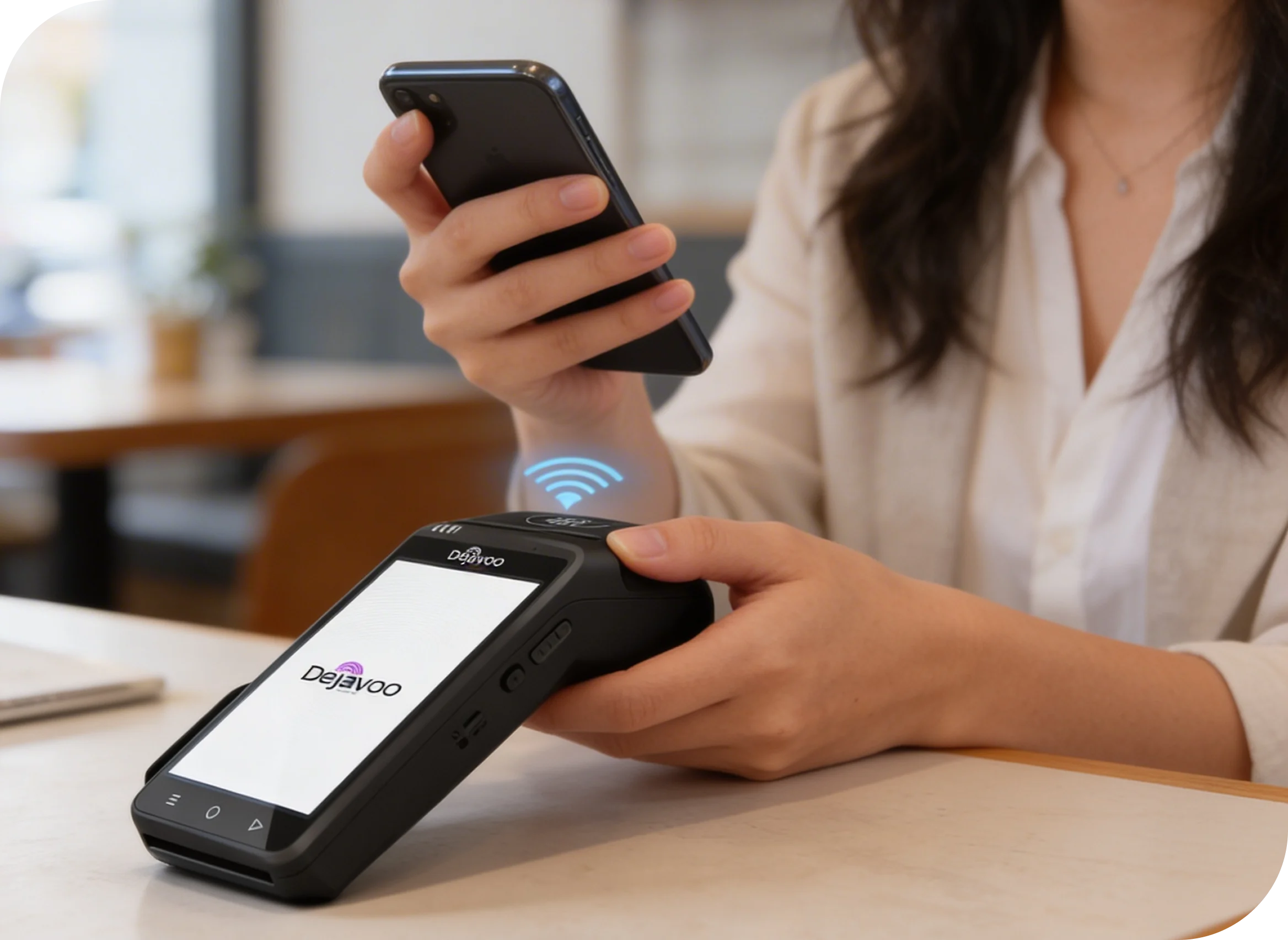
Customer using a smartphone for contactless payment on a Dejavoo terminal, demonstrating digital payment processing workflows.
Business professional using a tablet to manage merchant account applications, onboarding, and payment processing services.

Onboarding and Funding

How do your customers open merchant accounts?
Customers can apply for a merchant account via a referral link, an application within the software, or HMS’s boarding API. Decide during pre-integration scoping how your customers will apply. Each customer enters into a merchant agreement with HMS and has a merchant account opened for it. As a software company, you will not have any merchant funds and will not be a merchant of record, regardless of the application method chosen by you.
Merchant application approval can be as fast as the same day, depending on the risk profile. Potential merchants can apply via a referral link, an application within the software, or the boarding API. HMS supports both low and high-risk merchants, and each of them has a separate merchant account and a merchant agreement with HMS.
HMS will fund a merchant account the next business day when a merchant batches a transaction by the set deadline. Your software company will never be a merchant of record or take any funding risk. The partner portal gives you the ability to review batches and merchant transactions, as well as your regular residual reports.

Reporting, Branding, Launch

What kind of reporting do partners get?
You receive full partner reporting like HMS agent reporting, with information on boarding partners’ merchants, monthly residuals, batch activity, and chargebacks. You can view all the merchants you work with, and your batch and residual information, with reporting available via the Agent & ISO Portal. Residual payments are made around the 25th of the month, and reporting is posted to the Portal with the payment. View the Residual Reporting section of the Agent & ISO Portal for more information.
Yes, payments can be white-labeled and/or private-labeled or with the use of “Powered by Host Merchant Services.” Your business cannot be the processor or bank. The right to use a partner’s logos is granted by that partner. Scope your branding, including the type and extent of your integration with the merchant account, so your brand is clearly identified.
You can have your first merchant account set up and funded in as little as one week. Launching your first merchant account involves four steps. The first step is to contact us and scope your integration path and the partnership model. Next, you will complete UAT and sandbox testing. After that step is completed, you are ready to launch your first merchant account. UAT testing can be completed in less than a day. Custom integration may take longer on your part, so we will scope the activities to be completed and integrate as quickly as possible.
Business professionals reviewing financial reports and performance charts during a SaaS and ISV partnership planning meeting.

Talk Through Your Integration

Bring any questions you may have regarding integration with HMS on the call. We’d like to learn more about the payment workflows you need to support, the type of work HMS should perform, and the scope of your integration needs. You may hear more about our Partner Program first, or you can choose to jump right into the partner discussion.