
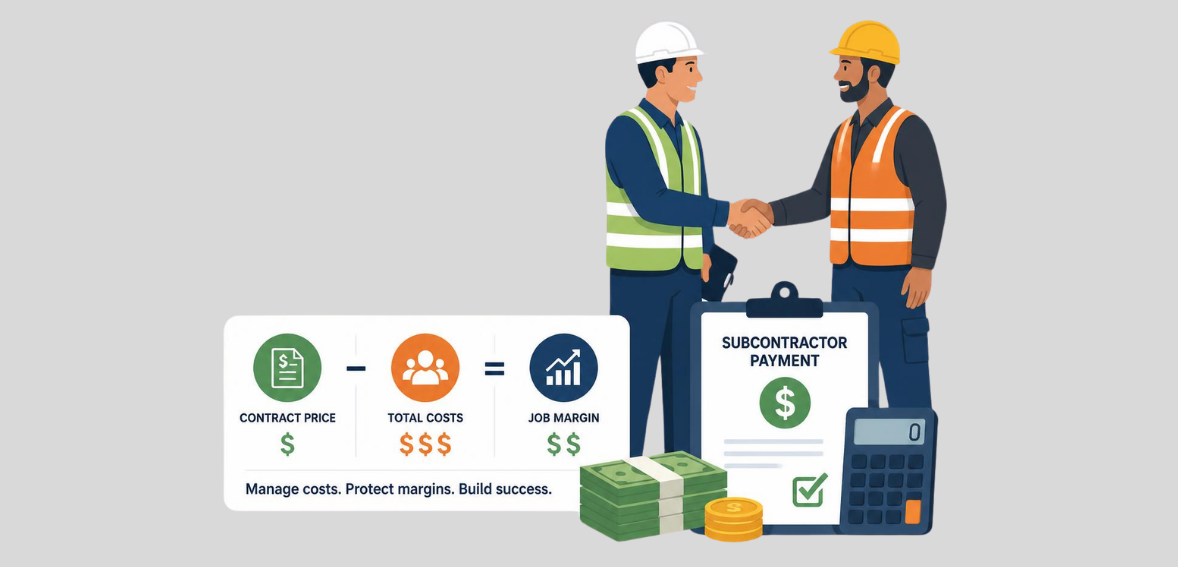
The commercial construction industry runs on cash, and contractors deal with tight cash flow stretches for many reasons. Rarely is the reason for running dry caused by an oversight in accounting. It is normal for there to be a lag between paying a subcontractor and receiving payment from the customer. If cash flow is effectively managed, contractors can maintain a healthy margin.
If cash flow is neglected, a contractor is very likely to fail on the same job when the schedule slips and three subcontractors bill in the same week. This article explains subcontractor payments and how successful contractors manage cash flow.

There are two calendars that every job must follow. The first indicates when the subcontractor finishes work and when they expect to be paid. The second indicates when the lender or customer releases a draw. These two calendars rarely overlap. An example would be a remodeling contractor notifying a subcontractor that the customer’s construction loan draw is waiting to be underwritten, and the subcontractor then submits an invoice.
The contractor is responsible for the labor and the cost of the delivered materials before the customer pays for the work. This scenario is a cash flow issue. It becomes a much bigger problem because the contractor’s cash flow is then impacted, which causes a larger margin compression on the job. Cash-strapped contractors pay suppliers at a loss and use credit cards or lines of credit to finance the job even further, resulting in late payments, interest, and fees.
This cash flow problem then shows up months later as a job in hand that appears profitable for the contractor’s business, but has less cash inflow than expected.
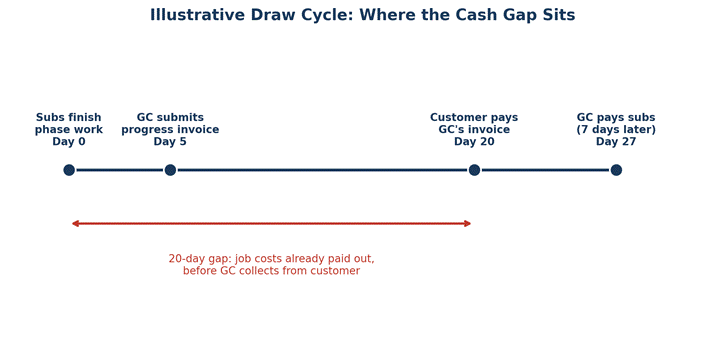
Illustrative example. A 30-day draw cycle example showing the window between job costs paid and funds collected from the customer.
The timing gap can be seen as planning information rather than as a surprise. Clients who pay on the 20th and contractors with the 27th as an ideal payment receipt date have a 7-day working margin. Both clients and contractors without documentation on payments do blind planning.
Prior to starting a single day of work, a subcontract should have the answers to three questions. First, when will the subcontracted labor be paid? Second, what will trigger payment? Third, what supporting documents will the payment invoice include? Ambiguity in contract language can allow for ambiguous payment behavior, and this becomes costly, especially when retainage and change orders are taken into consideration.
A well-specified payment schedule will link payment to a contracted milestone or payment will be made a given number of days after the subcontracted invoice is submitted. Subcontracted payment invoices must be considered “compliant.” A compliant payment invoice must include: a signed time (or material) log, a lien waiver for the previous payment, and the insurance certificate as it was when submitted. Contractors who specify this save a tremendous amount of time in the process of submitting payment invoices during the construction project.
These two clauses mean different things. A pay-when-paid clause is the right to delay payment. It doesn’t mean the obligation to pay doesn’t exist. A pay-if-paid clause is more extreme. It makes the owner’s payment a true and real condition, and therefore, if the owner fails to pay, the general contractor may have no payment obligation to the subcontractor.
The fact that these clauses are not treated the same by courts of different jurisdictions is evident. Some states enforce pay-if-paid language only if the language is clear, and some states have a total ban on pay-if-paid language. Since the enforceability of these clauses is contract- and state-specific, any contractor using either of these clauses should seek the advice of construction counsel rather than using a generic language clause from another contract.
The most efficient way to safeguard margin is to correlate subcontractor draws with the same customer invoice milestones. Each customer draw occurs for foundation work, framing, rough-in, and finish. In contrast, subcontractor draws should not occur on an arbitrary weekly or monthly schedule. Related draws should occur with the same customer work.
This concurrent movement of money in and money out protects the margin instead of allowing it to erode on two independent work schedules. It also simplifies job costing, since each customer draw is closed with a trade draw to compensate for the work. Subcontractor draws are already correlated with customer draws, so this can be done with no additional cost or work.
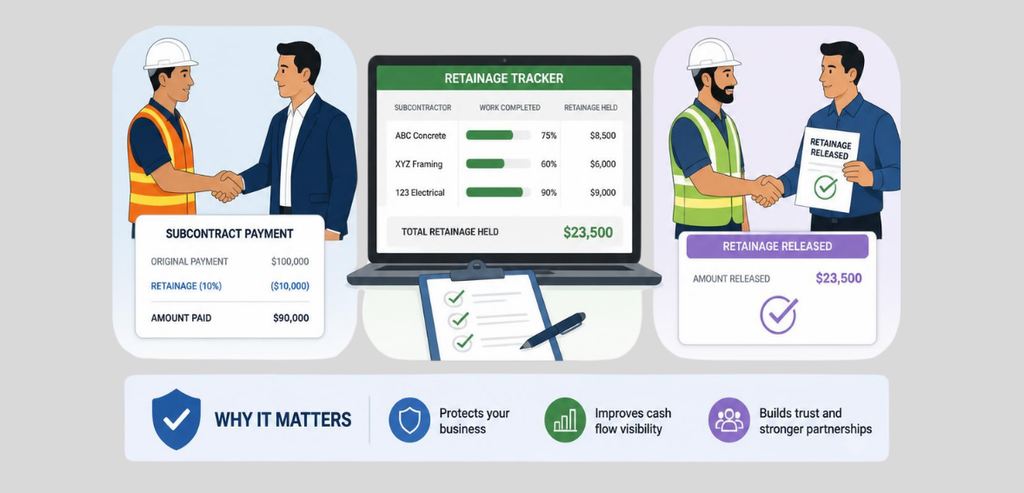
Retainage is the withholding of some percentage of each progress payment until a project reaches substantial completion or the work is completed. Common progress payment retainage in private, commercial contracts is approximately 5 to 10 percent. This withholding provides leverage to the paying party to ensure the completion of punch-list items and the submission of final project documentation. In federal contracts, FAR 52.232-5 limits retainage to 10 percent.
Additionally, more and more states are limiting retainage to 5 percent of contract payments. For these states, once the statute is applicable, retainage is limited to 5 percent of contract payments regardless of the terms and conditions of the contract.
| Project Type | Typical Retainage | Notes |
| Private commercial | 5%–10% | Often steps down to 5% after 50% completion |
| Federal projects | Capped at 10% | FAR 52.232-5 sets the ceiling |
| Select states (e.g., CA, NY) | Capped at 5% | State statute overrides a higher contract rate |
Sourced. Ranges cite FAR 52.232-5 and standard private-contract, as well as state-statute retainage practices, and state limits differ. Before preparing the contract, the author of the contract should confirm the state retainage practice.
Many contractors fail to think of the ledger. The retainage held for each sub should be a specific sub and contract liability. It should not be a part of general accounts payable. When the time comes to release, a contractor must have a clear audit trail for every invoice, what punch-list items remain, and what lien waivers have yet to be submitted. The retainage release is governed by its own retention and lien waivers, which are explained in detail in the companion article devoted to progress payments and lien waivers.
Compliance work required before a subcontractor submits an invoice is often the least expensive. For example, before paying a subcontractor, a contractor should request and file a W-9, not send a request for it in December when the appropriate tax documents are due. A contractor should not wait until a claim is made mid-project to check if they have a subcontractor’s current certificate of insurance on file.
Contractors should incorporate this certification in their new subcontractor forms to ensure that subcontractors stay in compliance. For the most part, contractors who do not request the proper compliance documentation at the beginning of the relationship end up chasing documents that should take just a few minutes to obtain.
As per the “One Big Beautiful Bill Act,” businesses no longer need to send a 1099-NEC to a subcontractor until a subcontractor reaches $2,000 in payments over the course of a calendar year (in comparison to the prior threshold of $600 per calendar year). This threshold is also subject to inflation adjustments for payment years after 2026, and this threshold will apply to payments made after 2025.
It should be noted that as of this writing, there are no bipartisan bills in the current Congress that set a new payment threshold for the 2026 tax year. Since changes in the laws can and will happen, contractors should ensure that they follow the IRS instructions for the current tax year to resolve any issues and treat the information provided as a preliminary framework.
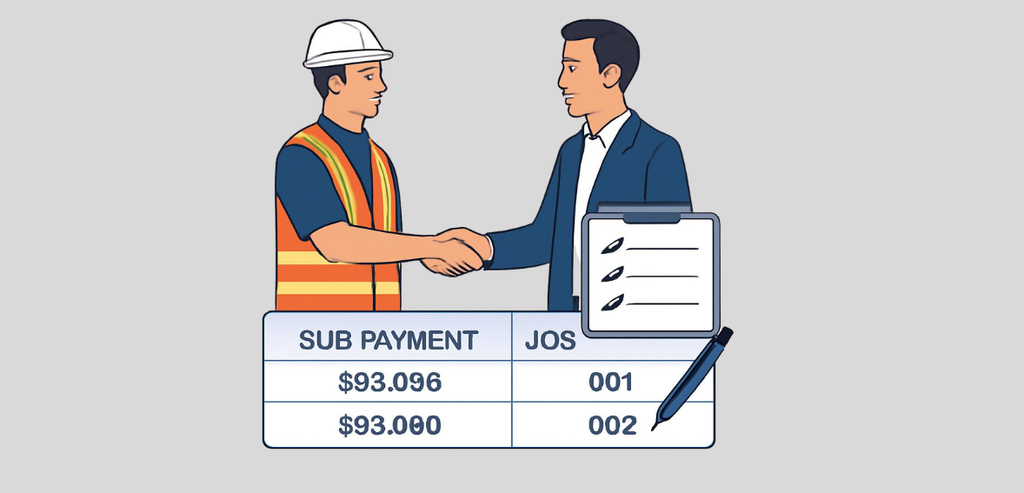
Payment transactions not associated with job or cost codes are effectively invisible to job costing. For job costing, payments leave the contractor’s bank account, but the contractor will not see payments if they check to see if a given job actually makes money. Payment lines must have three associated tags: job, cost code, and draw or phase.
Contractors who run multiple jobs will notice this error in a few payment cycles. Job-level margin starts to move significantly as expenses end up in the wrong job or no job cost code at all. The only defense against this is a very strict coding discipline when payments are made. A resource on job costing provides a structure for cost coding that can be implemented across many jobs.
A backcharge is an amount a contractor withholds from a payment to a subcontractor to offset the amount spent to correct or complete work assigned to the sub. From the perspective of construction accounting, backcharges are normal. Poor practice, on the other hand, results in good subs refusing to work with a contractor. The difference is documentation. A backcharge that can be defended includes photos of the defective work, a written communication to the subcontractor prior to the adjustment, and the applicable contract language.
Backcharges are not meant to be surprises to the sub; therefore, verbal warnings and after-the-fact deductions are disputed, bringing all the other trades on the project to a standstill. Most contractors, treating each backcharge as a line item, document the backcharge themselves, thus keeping a good relationship with their subs.
Subcontractors aren’t the only cash recipients. Many suppliers provide trade credit for contractors through open accounts with a net-30 payment period, and many of these accounts offer an early payment discount. One of the more common structures is 2/10 net-30: take a 2% discount if you pay within 10 days, or pay within 30 days. It is up to the contractor whether the early payment discount is worth taking, and it depends on how the contractor currently operates its cash flow.
A 2% early payment discount on a payment 20 days prior to the due date has the potential to give a contractor a good annual return, but the return will only be realized if no negative consequences come from cash flow shifting to pay supplier accounts early, potentially affecting the payroll or subcontractor draws.
Contractors with multiple supplier accounts build a competitive advantage by understanding the discount offerings from suppliers and comparing them based on the gaps in the time they are required to pay.
How a contractor sends money has as much to do with cost and record-keeping as it does with who gets paid. In construction, checks have the advantage of being familiar and leaving a physical trail that can be audited. Unfortunately, checks are slow, easy to lose, and expensive to replace. ACH transfers make funds move directly from one bank to another. Funds are typically available within one to two business days.
Also, there is a clean audit trail that is easily linked to accounting software. Card-based payables allow a contractor to “push” a virtual card to a supplier or subcontractor; this could allow a contractor to take a float on the payment to the vendor while still paying the vendor on time. Different payment methods have different costs and different reconciliation processes, so it is important to understand payment volume, preference of vendors, and how closely the contractor wants payments to be tied to cost records for each job.
HMS Pay allows construction contractors to manage both their customer payment volumes and the payables they process on construction contracts. In this way, HMS Pay integrates construction payment flows and customer payment flows.
Most states and federal statutes set short deadlines for how long contractors can delay paying their subcontractors. These deadlines fall between 7 and 10 days, and interest penalties will be incurred when contractors fail to meet these deadlines. Because the deadlines and penalties for each state and type of public or private project are slightly different, it is safest to ensure each individual state’s deadline is researched before finalizing a payment schedule.
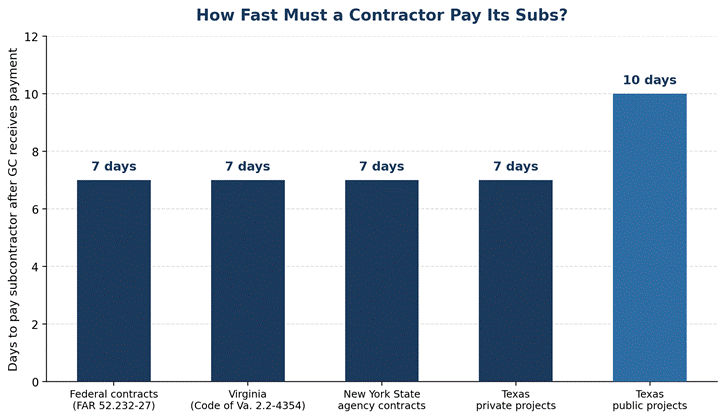
Sourced. FAR 52.232-27 (federal); Code of Virginia § 2.2-4354; New York State Finance Law prompt-payment guidance; Texas Property Code Ch. 28 (private) and Texas Government Code Ch. 2251 (public).
When contractors pay their subcontractors well, it’s much more about the timely management of payments than it is about generosity. Successful contractors build a system that intentionally matches money-out to money-in for every draw cycle. Along with clear language in the subcontract, a draw schedule aligned to customer invoice milestones, disciplined tracking of retainage, clean onboarding documentation, and job-cost coding with every payment, all of these goals culminate in the ability to understand the project margin at each step of the process, as opposed to merely at close-out.
Contractors who build this payment margin control system into their processes encounter less of a need to react to cash flow issues and gain a greater degree of control over running profitable jobs as planned.
This depends on the contract and the state, but most federal and state laws state that a contractor has 7 to 10 days to pay a subcontractor after the contractor has been paid.
Pay-when-paid means that the obligation to pay a subcontractor may be delayed until the general contractor is paid by the owner, but the obligation is not eliminated.
Retainage is a withholding of approximately 5% to 10% of each payment made to the subcontractor until all the work of the subcontractor has been accepted, all construction has been completed, and all of the subcontractor’s close-out obligations have been met.
Yes, before the first payment. This form ensures that the contractor has the subcontractor’s assigned tax ID number for reporting 1099-NEC Forms after the end of the year.
A backcharge is the general contractor’s withholding payment to the subcontractor for costs associated with the correction or completion of work that the subcontractor was obligated to perform.
We keep our contractor payment articles together in Contractor Payment Resources; see it for more on paying subcontractors.
Reduce Your Fees, Upgrade Your Service.
Your information will not be distributed
We received your request. A payments specialist will reach out shortly.