

Posted: November 24, 2026
HVAC is a steadily growing trade in the United States. According to the Bureau of Labor Statistics, jobs for heating, air conditioning, and refrigeration mechanics are expected to grow 11% from 2025 to 2035, creating about 48,200 new jobs. Because demand for these services is fairly consistent, contractors who employ these mechanics rely on a steady flow of HVAC leads to keep their schedules full each day.
A lead is a potential customer who has contacted a contractor to inquire about repair or tune-up work or to request an estimate on a new system. Many leads are generated for free when customers do online research or contact the contractor through word of mouth. Other leads are generated through paid ads. The eight strategies described below encompass both ways to get these HVAC leads as well as ways to convert those leads to paying customers.
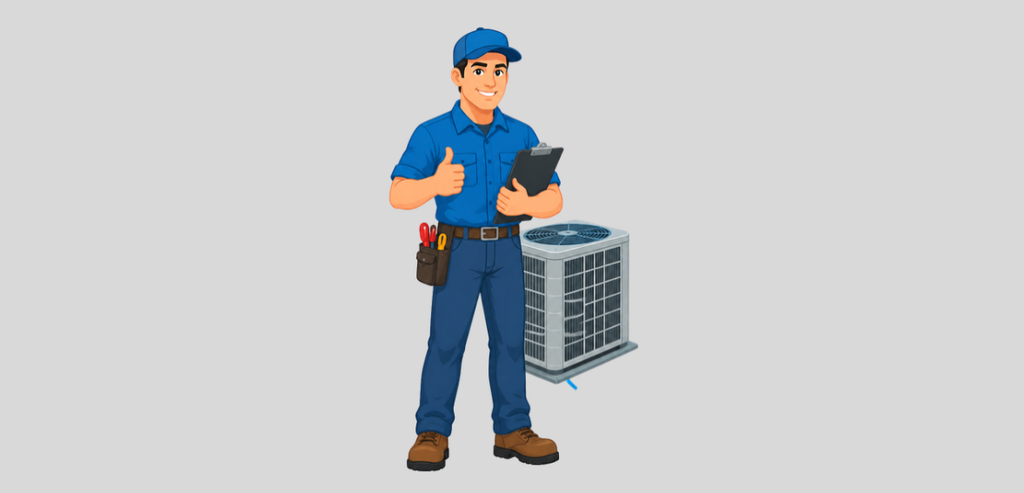
Most lead generation for HVAC focuses on two areas. Owned channels are free, but require up-front investment to build and maintain. These include your Google listing, website, customer database, and referral program. Paid channels include pay-per-click and pay-per-lead options.
Homeowners are generally in a rush. In the 2026 Consumer Search Behavior study by BrightLocal, 75% of consumers made a local business decision within 30 minutes, and 28% made that decision within 5 minutes. Similarly, 72% of consumers looked at three businesses or fewer before making their final decision.
The prevalence of mobile search is the most likely cause of these stats. Of all local searches in 2026, 73% were done on mobile devices, according to BrightLocal. In order to obtain free leads, you need to be in that final list of three businesses.

Your free Google Business Profile is often a homeowner’s first impression of your business. Factors determining local search results, according to Google, are relevance, distance, and prominence. The more positive reviews a business has, the higher it will rank, according to Google.
Complete your profile. Include as many of your business offerings as the allotted space allows. Describe the services you offer, from furnace repair to heat pump installation and duct cleaning. Add your service and operating hours, photos of your employees and service vehicles. Describe any ongoing specials or promotions.
Potential customers will see and be influenced by your Google reviews. According to the Local Consumer Review Survey by BrightLocal, published Feb. 11, 2026, 97% of consumers surveyed from the U.S. read reviews for local businesses. Recency is also important. 74% of consumers said they will only consider reviews written within the last three months.
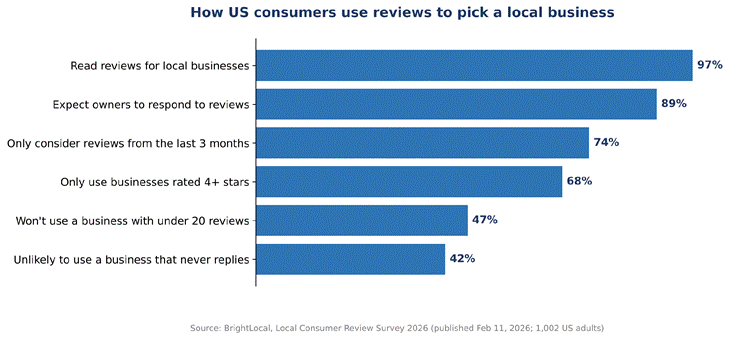
Ask for a review at the end of each job you do. The easiest way to do this is to send a text with a link to your review request. Good or bad, respond to each review. In the same survey, 89% of people said they would expect the business owner to respond to reviews. 42% of people said they’re less likely to use a business whose owner never responds to reviews.
Many people go to your website after reading a review. In BrightLocal’s 2026 survey, 54% of participants said they visit a business’s website after reading a good review. In 2019, just 32% of participants reported doing the same.
Have your phone number on every page of your site, and make it click-to-call where possible. Add an online booking form on your site. Create a page for each service you offer, and include the towns you serve. Include prices if you’re able to. Consumers have said in BrightLocal’s 2026 study that they will look for clear pricing when deciding which business to contact.
A good maintenance plan gets customers to renew their membership every year. Members pay either an annual or monthly fee. Decide the perks of the plan. Some examples could be discounts on repair services, priority booking, etc.
As part of ENERGY STAR, the US EPA suggests customers book pre-season checks every year. They recommend checking the A/C in the spring and the furnace in the fall. A plan modeled after this would give you two scheduled visits and booked appointments with a member each year.
Scheduled visits give you the opportunity to assess the condition of the equipment. Make any necessary repairs. Record the year, make, model, and condition of each unit you service. The US DOE’s 2021 Energy Saver guide states that by performing routine maintenance on your heating and cooling system, you could lower your energy costs by 10% to 25% each year. With the increase in energy costs and the expense of owning a home, customers are more inclined to pay for preventative maintenance to offset the costs of owning a home.
ENERGY STAR mentions that contractors get extremely busy during the summer and winter months, making the spring and fall months good times to schedule jobs.
ENERGY STAR suggests that the best time for homeowners to schedule checkups is around the time that clocks are adjusted for daylight saving time. In the US, daylight saving time starts on the second Sunday in March and ends on the first Sunday in November. Campaigns can be sent during those two weeks.
March through May would be a good time to run a campaign for air conditioning tune-ups, and again from September through November for heating system tune-ups. Target previous customers first, as you already have their information, and then expand your offer to neighboring homes. Keep the message short and include the price and a way to schedule the service.

People have the most trust in personal recommendations. About 88% of participants in Nielsen’s 2021 Trust in Advertising study said they trust personal recommendations the most, compared to other advertising methods.
Customers are likely to make recommendations if you reward them with a gift card or credit for each new customer they refer.
Closely related to this is neighbor marketing. Leave door hangers on the neighbors of the houses you recently completed work on. Also ask customers if you can place a yard sign to let the neighbors know you are working in the area.
These marketing techniques also help build trust and keep your name in front of the client for repeat business.
Contractors who buy HVAC leads get calls quickly. The price depends on the platform, the city and the type of job.
Google Local Services Ads
These ads are placed at the very top of the search results page. You’ll pay Google based on each lead. Housecall Pro has estimated the cost of Google Local Services Ads to be between $50 and $80 per lead for HVAC services. According to Google, the cost per lead for these ads will increase if service providers do not respond to customer queries in a timely manner or do not have an adequate number of positive reviews.
Missing a phone call from a potential customer may lower your responsiveness score. Google prefers and promotes businesses with Google Screened or Google Guaranteed badges.
Angi and HomeAdvisor
Angi and HomeAdvisor sell names of homeowners looking for contractors to complete a project. Housecall Pro reports that HomeAdvisor leads cost providers between $15 and $100 each, with an additional $350 annual listing fee. FieldPulse reports that leads are sold to multiple providers, leaving little room to compete on anything but price and response time, and that leads can cost between $20 and $150 or more depending on the trade. Emergency HVAC leads in large metropolitan areas may cost between $80 and $150.
Cost Per Booked Job
The cost per booked job is what you should focus on. This is calculated by dividing the cost per lead by the closing rate. Therefore, a lead costing $60 with a closing rate of 15% means a job cost $400 to book.
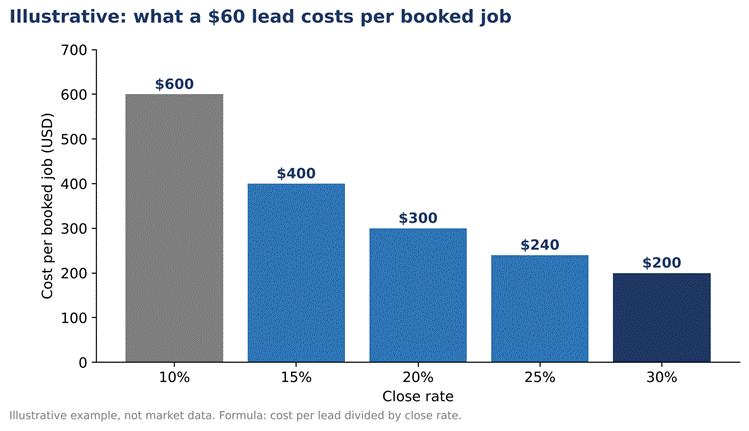
Track this figure for every source each month. Move budget toward the sources where it is lowest.
In an HBR article from March 2011, lead author James Oldroyd and two co-authors shared research on lead response. They analyzed 1.25 million leads and found that companies that attempted to contact a lead within an hour were 6.9 times more likely to qualify the lead than those who waited an hour. Companies who waited a day or more were 60 times less likely to qualify the lead than those who contacted the lead within an hour.
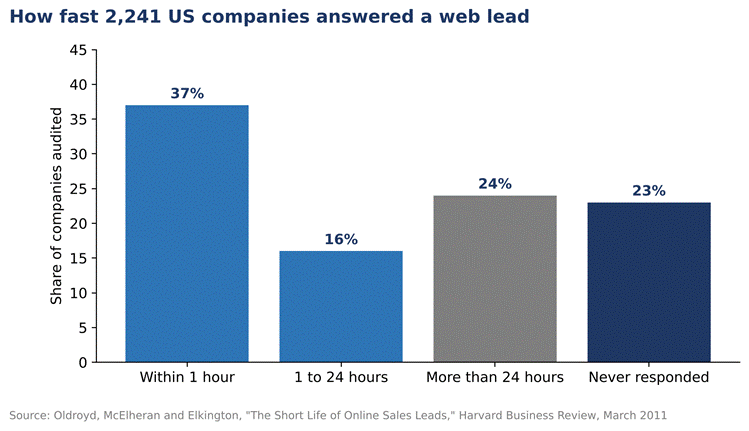
The report also cited a check on 2,241 American firms who received a test web lead. Only 37% of the companies responded to the lead within the hour. Another 23% never responded to the lead.
For an HVAC shop, that means a live person answers the phone during business hours. After hours, an answering service or on-call tech will pick up the phone. All calls will be returned within minutes. Web forms and LSA messages will also be answered immediately. Appointments will be scheduled for the first available time, and a window will be given for the tech to arrive.
The May 2026 report, Economic Well-Being of U.S. Households, showed that 63% of adults believed they could come up with $400 to pay for a surprise expense. Another 12% of adults surveyed believed they would not be able to come up with the money to pay the expense at all.
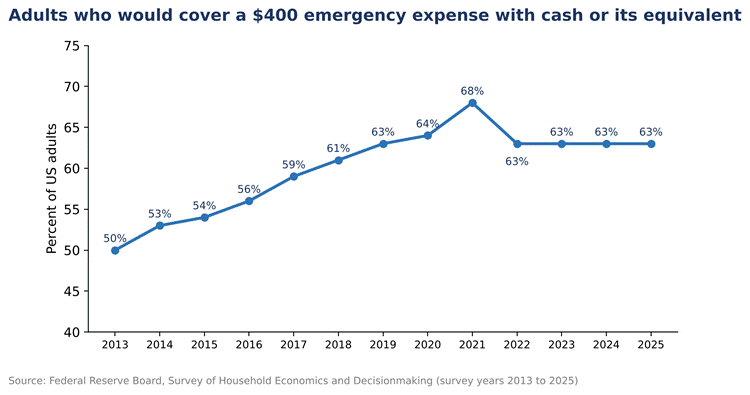
Almost every equipment replacement quote is over $400. A financing partner lets you give these homeowners the option to make payments on the equipment. Add the monthly price to each quote and show it next to the full price. In the field, collect payment by card or bank transfer when the job is complete. If there is an outstanding balance after the job, text the homeowner a payment link to close it out.
Leads for HVAC are generated by both organic and paid means. Some methods, like your Google profile, reviews, website, maintenance plans, and referral programs, don’t cost much to implement, if anything. Others, like Angi and Google’s Local Services ads, cost a set price per lead.
Results from each method depend on how quickly you respond to leads and how easy you make it for leads to become customers. Keep track of your cost per booked job to see which method is the most effective and to allocate your advertising dollars accordingly.
Owned leads come from sources like their website, Google Business Profile, reviews, and maintenance plans. Increase the number of leads with paid sources like Angi and Google Local Services Ads.
Housecall Pro lists Google Local Services Ad leads between $50 to $80. FieldPulse reports that emergency HVAC leads in large metro areas can cost between $80 to $150.
Paid leads can be beneficial if you are able to answer the lead and close the sale quickly enough. Your true cost per job booked is the lead cost divided by your close rate.
Marketing HVAC services in the spring and fall can be beneficial since ENERGY STAR recommends consumers have their home’s heating and cooling systems checked prior to the start of each new season.
Reduce Your Fees, Upgrade Your Service.
Your information will not be distributed
We received your request. A payments specialist will reach out shortly.