

Posted: November 06, 2026
Every U.S. company that pays contractors, landlords, or vendors needs a valid taxpayer identification number to file a Form 1099. Payers use Form W-9 to collect that number. It is a one-page form, followed by multiple pages of instructions. Small errors have large consequences. If the payee provides no number or an incorrect number, the payer is obligated to withhold 24% of each payment and send it to the government according to the Form 1099 instructions.
As of now, the form in use is Form W-9 (Rev. March 2024). EY’s Tax News Update of March 12, 2024 reported that the last revision was in October 2018. The IRS recently posted a draft of the form for the years 2026, and all pages of that draft carry a do-not-file watermark. In a June 3, 2026, notice, the University of North Dakota Finance Office stated that they will only accept the March 2024 form until further notice. This guide will go over the March 2024 form and provide guidance for different entities, i.e. individuals, sole proprietors, LLCs, corporations, and nonprofits to fill out a W-9.

Businesses are required to report payments to you to the IRS. To do this, they need your legal name, tax classification, and TIN. The payer keeps a copy of this form. You do not send this form to the IRS.
The form’s instructions name many of the reports where the payer includes this information. They include 1099-NEC for payments to non-employees, 1099-MISC for rents and prizes, 1099-K for payments via card and payment apps, 1099-INT, 1099-DIV, 1099-B, 1099-S, and the 1098 series.
Only U.S. persons fill out this form. U.S. persons include citizens, resident aliens, domestic partnerships, corporations, LLCs, estates, and trusts.
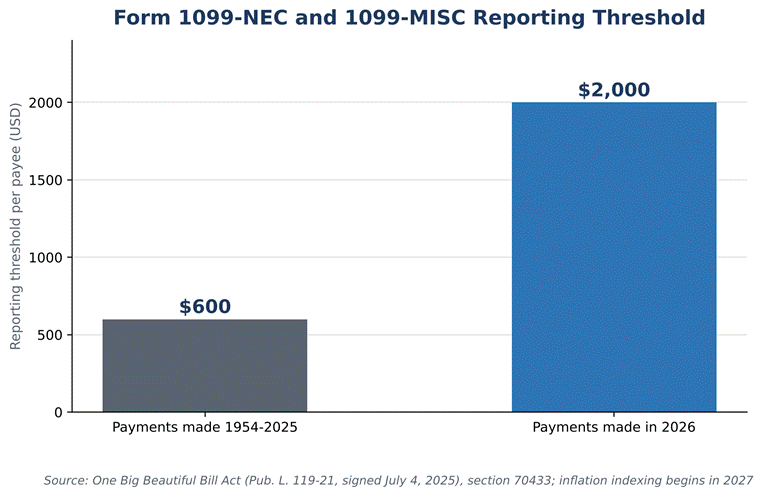
The threshold for reporting contractor payments changed in 2026. The One Big Beautiful Bill Act signed on July 4, 2025 raised the $600 threshold for 1099-NEC and 1099-MISC to $2,000 for payments made in 2026 and after. Patriot Software reports that the $600 threshold had not changed since 1954 and would be indexed for inflation starting in 2027. The same act moved the threshold for 1099-K back to over $20,000 and over 200 transactions.
A higher threshold doesn’t stop payers from requesting the form. According to Thomson Reuters’ 2026 guidance on W-8 and W-9 practices, businesses should collect the form before sending the first payment.
The top of the form is where most mismatches occur. The name you write here must match the taxpayer identification number you give in Part I.
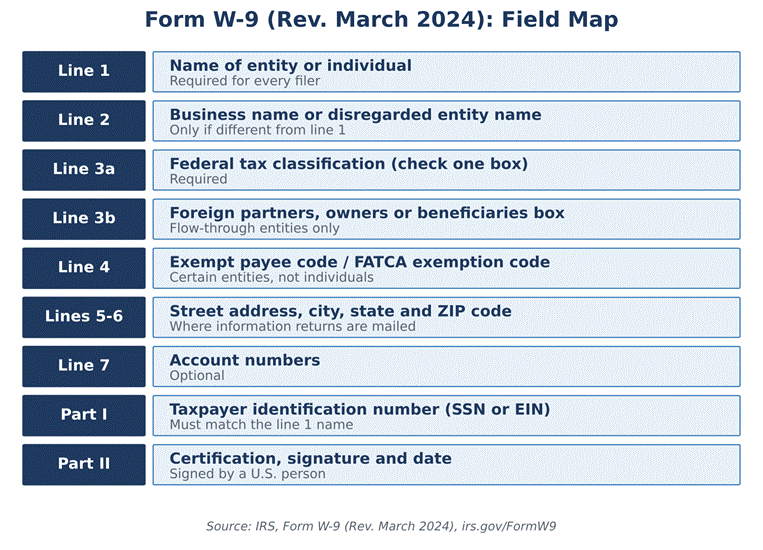
Line 1 must never be blank. Individuals are required to write their name exactly as it appears on their income tax return. If your name changed and you have not notified the Social Security Administration, the IRS will ask for your first name, the last name on your Social Security card, and your new last name.
A sole proprietor writes their name as it appears on their Form 1040. A shop name is not written on Line 1. A corporation, a partnership, or an LLC that is not disregarded writes the name of their entity on Line 1 as it appears on their entity’s tax return.
Most filers know the rules for Line 1, but the single-member LLC is an exception. In cases where the IRS disregards the LLC, the owner’s name is written on Line 1. The instructions state that the name written on Line 1 should never be a disregarded entity’s name.

Line 2 is for any trade name, DBA, or disregarded LLC name that is different from Line 1. Freelancers who do not have a business name leave it blank. A sole proprietor who does business as a brand fills in the business name on this line. A single-member LLC owner fills in the legal business name on this line.
Line 3 explains the way the IRS taxes you and is divided into two parts: 3a and 3b in the March 2024 revision.
There are seven boxes in 3a: individual/sole proprietor, C corporation, S corporation, partnership, trust/estate, LLC, and other. You pick only one box.
The LLC box requires a letter entry. An LLC that files as a partnership writes ‘P’. One that is taxed as a C corporation writes ‘C’. One that elected S corporation status writes ‘S’. The form adds a rule in its note under 3a. A disregarded LLC does not pick the LLC box. It picks the box that reflects its owner.
The default classification at the federal level determines the letter that is picked. If an LLC has more than one member, then it is taxed as a partnership. If an LLC has only one member, it is disregarded unless it files to be taxed as a corporation. Form 8832 is the election to be taxed as a corporation, and Form 2553 is the election to be taxed as an S corporation.
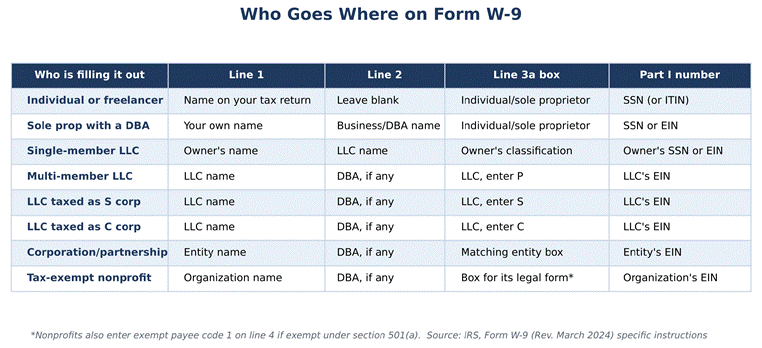
Filling Out a W-9 as an Individual
An individual or freelancer has the simplest version. Write your name on line 1, leave line 2 blank, and check individual/sole proprietor on line 3a. Skip line 4. Enter your address, write your Social Security number in Part I, sign and date the form.
Filling Out a W-9 for an LLC
A single-member LLC with no tax election puts the owner on line 1 and the LLC on line 2. If the owner is a person, then 3a gets the individual/sole proprietor box. If the owner is a corporation, then 3a gets the corporation box.
A multi-member LLC writes its own name on line 1, ticks LLC and enters P. An LLC of any size that elected corporate tax treatment ticks LLC and C or S.
Filling Out a W-9 for a Business
A partnership or corporation that is not an LLC checks the matching entity box. A corporation checks C corporation or S corporation based on its tax filing. Any DBAs are on line 2.
Completing a W-9 for a Nonprofit
The form has no box labeled nonprofit. An exempt group ticks the box that best describes its legal structure, or uses other and provides a brief description. An example of this can be seen in the W-9 posted by the University of Alabama at Birmingham, where they utilize the other box and provide their 501(c)(3) status. A group exempt under section 501(a) also writes exempt payee code 1 on line 4.
Line 3b: Flow-Through Entities With Foreign Owners
This line was added in March 2024.
According to the Internal Revenue Service, this line is for a partnership, trust, estate, or an LLC that wrote P, that is providing this W-9 to a partnership, trust or estate in which it has an ownership interest, and that has foreign partners, owners or beneficiaries.
Many freelancers and small businesses can ignore this line.
Line 4 contains a pair of codes that pertain to businesses or entities, not to individuals. So a sole proprietor would not enter anything here.
Entering the exempt payee code means the payer will not withhold backup withholding. The codes begin at 1 and end at 13, with code 1 pertaining to organizations and IRAs that are exempt from federal income taxes. Code 2 pertains to the United States. Code 3 pertains to state governments and political subdivisions. Code 5 pertains to domestic corporations. The remaining codes pertain to foreign governments, securities dealers and futures commission merchants, real estate investment trusts and other investment companies, banks, and other financial institutions.
Exemption of a corporation from backup withholding does not exempt the corporation from other provisions of the income tax laws and regulations. For example, payments made to a corporation for legal, medical or health care services must still be reported by the payer.
Codes in the FATCA area pertain only to accounts maintained outside the United States by certain foreign financial institutions. If you have only U.S. accounts, then you need not complete this area.
Line 5 is your full street address including apartment/suite number (if applicable). The payer uses this address to send you information returns. If different from the address the payer has on file, write “NEW” on the form. Line 6 is your city, state, and zip code.
Line 7 is where you can list account numbers the payer has for you. The box beside it is for the requester’s name and address. Both are optional.
Part I provides a space for a Taxpayer Identification Number (TIN). Per the instructions for the IRS form, if the TIN does not match the name on line 1, backup withholding may be applied. Here is how each entity completes Part I.
An individual will report their SSN. A resident alien who does not have an SSN will report their Individual Taxpayer Identification Number (ITIN). Sole proprietors will report either an SSN or an Employer Identification Number (EIN). A single-member LLC which is disregarded for tax purposes will report the SSN or EIN of the owner. An LLC which is taxed as a partnership or corporation will report the LLC’s EIN. A partnership, estate, trust, or tax-exempt organization will report the EIN.
A draft issued in January 2026 removed the option for a sole proprietor to report an EIN; an updated draft issued in June 2026 reinstated it. Watch the final 2026 revision for the outcome.
Until you acquire a number, you can submit an application for it. An SSN is requested from the Social Security Administration on Form SS-5. To apply for an ITIN, taxpayers complete and forward Form W-7. An EIN can be obtained online through the IRS website or by completing SS-4. While the application is processed, write “Applied For” in Part I.
If the taxpayer has not applied for a number and is entitled to receive interest or dividends, the IRS will allow 60 days to provide the number. All other payers must withhold until the number is provided.

Part II is under penalty of perjury. To complete this part, you must affirm your TIN is correct, that you are not subject to backup withholding, and that you are a U.S. citizen or other U.S. person. You must also affirm that the FATCA Code (if applicable) is correct.
If the IRS has told you that you are subject to backup withholding due to underreporting of interest or dividends, you must cross out Item 2 before signing.
The IRS requires signatures in several situations. Signatures are also required by financial institutions for accounts that pay interest or dividends or for broker and barter exchange accounts. Signatures are required for real estate sales. It is permissible for a real estate seller to strike Item 2. Signatures are not required for most other payments, such as payments for services, rents, royalties or goods. The IRS also does not require signatures for accounts that pay mortgage interest, IRA contributions, and other accounts that pay interest or dividends that are opened prior to 1984. The IRS may require a TIN for other situations.
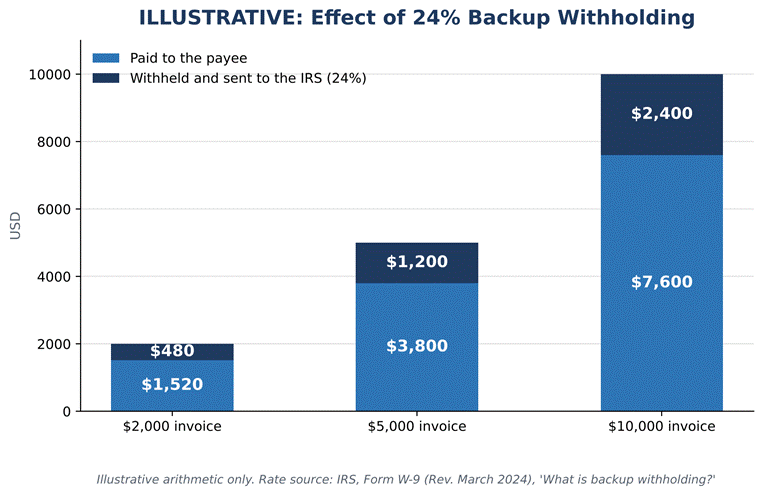
The IRS sets penalties for this section. Generally, if a payee fails to provide the correct TIN, they will be charged $50 per failure, unless they have a reasonable cause defense. If a payee, without reasonable basis, provides a statement to avoid withholding, they will be assessed a $500 penalty. Willful falsification of a statement to avoid withholding may result in a criminal penalty, imprisonment or both.
Mismatching names and numbers is the most common mistake. For example, the owner of a single-member LLC may list the name of the LLC on line 1 and provide the owner’s Social Security Number (SSN) in Part I. The IRS encourages certain payers to use the TIN Matching program. If a payer does not use TIN matching and lists the name of the LLC on line 1, and the SSN of the owner of the LLC, this would also be considered a name and number mismatch. Payers should be aware that a mismatch may result in a notification from the IRS and possible backup withholding.
Tick-box errors include selecting the LLC box to report a disregarded entity. The form states that the owner of a disregarded entity should select the box for the owner’s classification, not the LLC box. Another tick-box error is selecting more than one classification on line 3a.
Some individuals report they are exempt from tax because their earnings are less than the exemption threshold and report an exempt payee code on line 4. Exempt payee codes are only allowable for certain entities, and the form states that individual sole proprietors should leave line 4 blank.
The IRS publishes revised forms periodically. Some individuals may submit the June 2026 draft, which payers should not accept, since every page carries a do-not-file watermark. Use the current published revision (March 2024) until the IRS releases the final 2026 form.
Individuals should notify a payer of a change to their tax status. According to Eversheds Sutherland, a W-9 has no expiration date and should be provided to a payer upon request.
Submit the completed W-9 to the requester, not to the IRS.
The name and number on Form W-9 must match the individual’s federal tax return. Completion of the form requires an individual’s tax return name, Social Security Number, and potentially other information. Single-member LLCs provide their owner’s name and SSN, as well as the LLC name. With respect to multi-member LLCs and LLCs with a tax election, the entity provides its name and an EIN.
Line 4 is generally left blank; however, it may be completed by a corporation or an organization exempt from tax. Part II must be signed for interest, dividend, broker, and real estate transactions; for most other payments, the signature is optional. For payments made in 2026, the 1099-NEC and 1099-MISC reporting threshold is $2,000.
On line 1, the W-9 should provide the owner’s name, and on line 2, the LLC name. The W-9 should be checked as “Individual/sole proprietor,” and the owner’s SSN provided, not the LLC’s EIN.
Use your SSN if you are an individual or a sole proprietor. Use the entity’s EIN if you are a corporation, a partnership, or an LLC that is not disregarded.
A U.S. person should complete a W-9 if requested by a payer to provide a TIN to report on a US tax document. A foreign person should complete a W-8.
No. You complete a W-9 so the payer can report a payment to you on a Form 1099. The payer keeps the W-9; you keep a copy for your records.
