

Posted: November 25, 2026
Pricing paperwork decides who carries the risk when a job is more than estimated. The two words that bracket that risk are ‘estimate’ and ‘quote’. Some owners use the two words interchangeably. There is a legal distinction.
An estimate is a ballpark cost of a job. A quote is the cost of a job. When a customer is charged more than the quote, a deposit is at stake, or a change order is issued, the distinction becomes material. There are also state consumer laws that vary by trade that differentiate the two documents.
This guide will distinguish between Estimate vs Quote and provide definitions in layman’s terms. It will also explain the wording that clearly defines the price to the customer, how to choose the appropriate bid to submit, and what happens after the bid is awarded.

Estimates, quotes, and bids all predict prices. The difference is in the level of commitment. Think of an estimate as a rough figure. A quote commits to a price. Bids are formal prices offered when a buyer is comparing prices of various sellers.
The chart below illustrates this. It shows typical business use. The legal effect of a document varies depending on the language used and the governing law.
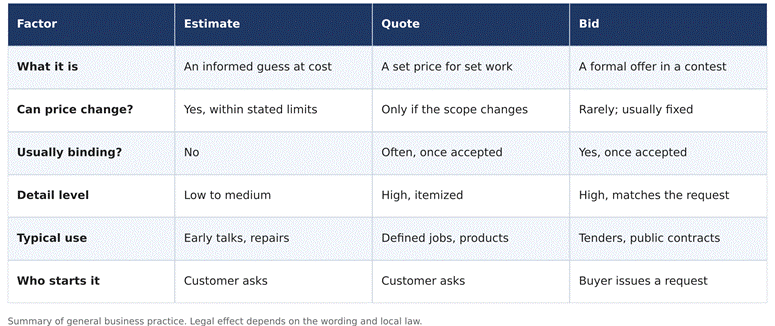
Table 1: How an estimate, a quote, and a bid usually compare
A business’s best reading of what a job will cost is called an estimate. Estimates are formed by the experience and knowledge of similar jobs by the business, the costs of the materials required, and a preliminary inspection of the job. Estimates are known to change.
Because of the uncertainty in many types of work, estimates are the best means to describe the cost of a job. A plumber may not know what is behind a particular wall. Mechanics do not always know which part of an engine failed. A developer may not know how many pages of a website a client will want.
A business is free to set an estimate at a price that limits its exposure to risk. However, most consumers view an estimate as the maximum the business will charge to do the job. An estimate does not guarantee the business the job at that price.
Some states also require a business to obtain the approval of a customer to charge more than an agreed estimate for a job.

California’s Automotive Repair Act, Business and Professions Code § 9884.9, states that repair shops may not charge more than the estimated cost to repair a customer’s vehicle without the customer’s express consent. This consent may be given either orally or in writing. Additionally, the California Bureau of Automotive Repair’s consumer guide states that before carrying out additional work, the repair shop is required to contact the customer to explain the additional cost and obtain consent to do so.
Florida statute § 559.909 states that a customer’s permission is required for a repair shop to charge more than $10 or 10% over the customer’s written estimate, whichever is greater, up to a maximum of $50. Florida’s estimate rule applies to any repairs that would cost the customer more than $100 (§ 559.905). The margin in the repair shop’s charge may never exceed $50.
The chart illustrates how Florida’s margin works. Up to $300, the shop can add a margin of $30 without requiring a new sign-off. Beyond $500, the margin remains at $50 regardless of the size of the job.
The laws only pertain to the repair of vehicles. Other professions in other states may have different laws, or no laws at all. A business that relies on estimates would be prudent to research or consult an attorney in each state where they do business to learn more about the laws that may apply to them.
A quote is the price provided for a specific job. It contains what will be included in the price, what will not be included, and how long the price will be valid. Once a customer accepts a quote, it is understood that the work will be done for that price.
A quote takes more effort to create than an estimate. The seller needs to have enough knowledge about the job to stake their reputation on a single number. This often means visiting the customer’s location to take measurements, make calculations, and determine costs of relevant supplies.
There is certainty for both the customer and seller about the cost of the work. If the customer requests additional work to be done, the seller can charge more for that work since it falls outside the quoted scope.
The seller also benefits from the certainty of a recorded agreement which serves as the basis for any change orders.
The outcome is dependent on the context and the words used. Generally speaking, in the private sector, a contract is formed when the customer signs off on a detailed quote. An expired or vague quote is significantly weaker.
Regulations pertaining to the buying process of the federal government differ from that of the private sector. As stated in section 13.004 of the Federal Acquisition Regulation, a quotation does not constitute an offer. Consequently, the government is not authorized to accept a quotation to create a contract. Effectively, in order to create a contract, the government must place an order which, in turn, becomes the offer. The contract is only created once the supplier accepts the order. In its decision B-405711.2, the US GAO also stated that vendor quotations are “information only” and do not constitute an offer.
From a legal standpoint, this exception to the rule means that just labeling a document a quote does not by itself bind the parties to a contract. Determining whether a contract exists depends on whether the document tendered constitutes an offer. Individuals in doubt about the status of their quoted documents should consult an attorney licensed in the state in which the other party is located.
A bid is a price offer in response to a buyer’s request. Schools, hospitals and large corporations issue requests for bids to secure the best price for a product or service. Bids allow government agencies and large organizations to establish competitive prices.
The U.S. Federal Government uses a sealed bid process as described in Part 14 of the Federal Acquisition Regulation. Bids are publicly opened, and the contract is awarded to the responsible bidder whose bid is most advantageous to the Government, considering only price and price-related factors. Sealed bidding normally contemplates the use of firm-fixed-price contracts; however, some exceptions are allowed to permit an adjustment for economic conditions.
Outside of the Federal Government, sealed bidding practices do not strictly adhere to the processes and formalities of the regulation, but in concept they are the same. In sealed bidding, the buyer specifies the goods or services to be purchased and leaves it up to the seller to determine a price for those goods and services. A bid, in essence, is a quote, but in this case the quote is issued in a competitive situation controlled by the buyer.
Small service firms usually compete against each other in bidding for commercial and public works and property management contracts. Price estimates requested by homeowners for the installation of a new roof are more accurate quotes and typically do not reflect an actual competition among roofing contractors.

Ultimately, it comes down to how well the scope is defined and how comfortable the business is with risk.
An estimate is appropriate when the full extent of the work is not readily apparent. Examples include repairs and renovations to older buildings, hourly consulting, and preliminary budget discussions. An estimate also works when the customer only wants a rough idea of cost to decide whether to proceed with the project. A seller who estimates too low may win the job at a losing price. Alternatively, a seller may inflate the quoted price to the point the customer decides not to do the project.
A quote is provided when the work can clearly be measured and priced. Examples include supplying and installing a specified number of fixtures, and cleaning a defined area of a floor. The quoted price is the customer’s final price.
A bid is normally submitted in response to an official request for a proposal. In this case, the format is usually prescribed by the customer and the seller has very little latitude in format and content. Failing to comply with the customer’s format and deadline may disqualify the proposal.
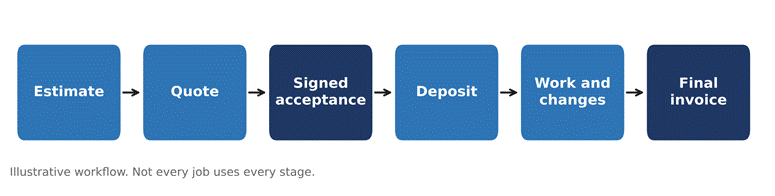
Some businesses default to an estimate to test the customer’s budget. After the budget has been confirmed, a quote is provided. An estimate is usually given first to initiate discussion and a quote is given to end the discussion and confirm a price.
Clear wording prevents most pricing disputes. The goal is to write something a customer can understand the first time they read it.
Start with the title. An estimate should be labeled as such, and a quote should also be identified as such. Do not call a guesstimate a quote. A customer will expect a firm price if they see the word quote.
A concrete description of the work to be done is essential. It should include the specific tasks and materials to be included in the price. In addition, the description should include what is not included in the price. Spell out the exclusions to avoid disagreements.
On an estimate, include what could cause the price to change and how the customer will be notified. This follows the consent rules in California and Florida. Include language that states the business will contact the customer to obtain approval to go over the stated price.
Set an expiration date on quotes. With fluctuating material and labor costs, what is fair to charge in the spring may not be fair to charge in the fall. Any duration will work as long as it is documented.
Outline procedures for changes. If a client requests additional work, clarify the additional cost with a change order and have them sign it before implementing the change. California requires written change orders on home improvement contracts, and the Contractors State License Board enforces this.
In addition, state your payment terms. Explain when payments are due and in what amounts, and state which payment methods you will accept. Vague payment terms encourage customers to delay payment.
The moment a customer agrees to the price is called acceptance. The best evidence is a signed copy of the quote. The quote must be signed, either on paper or electronically. The signed quote is the basis for all future payments.
Some service companies require a deposit to start work. The deposit is to defray the cost of materials and to show that the client is serious about the project. There are some state restrictions on the amount a company can charge up front. In California for example, the Business and Professions Code states that the down payment can’t be more than $1,000 or 10% of the contract price. The Contractors State License Board also states this restriction in its consumer and contractor guides. Besides the initial down payment, a contractor is not allowed to collect any payment for work or materials to be provided in the future.
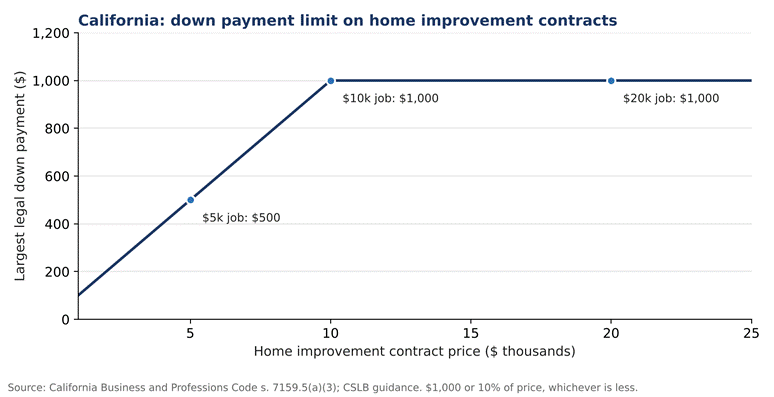
California state law places a limit of $1,000 on the amount of the deposit that can be charged for home improvements costing $10,000 or more. Below that amount, a 10% deposit is allowed. For a $5,000 job, the deposit is limited to $500. Other states’ laws vary and many have no laws regarding home improvement deposits, so check before writing a deposit into your bid.
Some sales include a cooling-off period. Under the FTC’s Cooling-Off Rule, buyers have three business days to change their mind about a purchase made during an in-person sales meeting conducted by the seller at the buyer’s workplace, home, or school. This does not apply to sales made to a buyer at a seller’s temporary location (hotel, fair, etc.), unless the sale is $130 or less. The Cooling-Off Rule does not cover sales made at a buyer’s workplace, home, or school worth less than $25. If a customer signs a quote at their kitchen table, the firm should be aware of this rule and provide the buyer with the required notice.
The final invoice should include the total amount on the accepted quote, change orders (if any), and the total of progress payments. Line items should be linked to approved changes. The totals should tie out so the customer has very little to question.
Estimate-based work should show the customer’s estimate and the final invoice. An explanation should also be included on the invoice for any costs that exceed the original estimate, and how and when the customer approved the increase. In California, when a repair shop uses a recorded phone authorization to get customer approval for increased costs, the shop should also document this on the invoice with the name of the person approving it, the phone number called, and the time and date of the authorization.
On the invoice, the number of the quote should be included to assist the customer in record-keeping. Also, offering payment options on the invoice increases the likelihood of prompt payment.
Estimates are approximations of costs, and therefore allow some level of flexibility. Quotes are tied to specific requests and formally bind the parties to that price. Bids are official offers made within a competitive process. The document chosen to convey the offer depends on the amount of the job that can initially be defined.
There are variations in each type of document. Regardless of the document name, using specific labels and terms clearly gives customers an understanding of the scope of work to be performed, exclusions, an expiration date, and change orders.
California regulates both auto repair estimates and home improvement deposits, and Florida regulates auto repair estimates. These limits, and any others established by law, should be included in the document. A short review by a local attorney will be less expensive than having to defend an offer against a customer claim.
Estimates are preliminary costs that may fluctuate during the completion of a job. Quotes are given for a defined scope of work, and once a quote is accepted, the price will not change.
Once a quote is accepted, it generally becomes a contractual price. In federal procurement, a quotation is not an offer; in private sales, state law governs.
Yes. In some states, for example, Florida, auto repair shops must obtain the customer’s approval before charges can be assessed above the estimate given.
It is at your discretion. If you decide to charge for estimates, you must inform the customer before preparing one. The California Bureau of Automotive Repair suggests customers ask about the cost of an estimate before authorizing it.
Reduce Your Fees, Upgrade Your Service.
Your information will not be distributed
We received your request. A payments specialist will reach out shortly.