
Posted: November 23, 2026
Card payments are moving away from using the raw card number. Visa reports that in the first half of 2026, about half of all online payments were tokenized. Mastercard reports tokenized payments comprised over 50% of their e-commerce transactions in 2025. Network tokenization is the technology that is driving this change.
Tokenization changes how a stored card appears when it is transmitted to a bank to be verified for payment. It changes the approval mechanism as well. This article explains what a network token is and how it is different from a merchant token. It also explains how network tokenization affects the way cards are reissued, and what the costs and setup would be for a merchant to implement it.
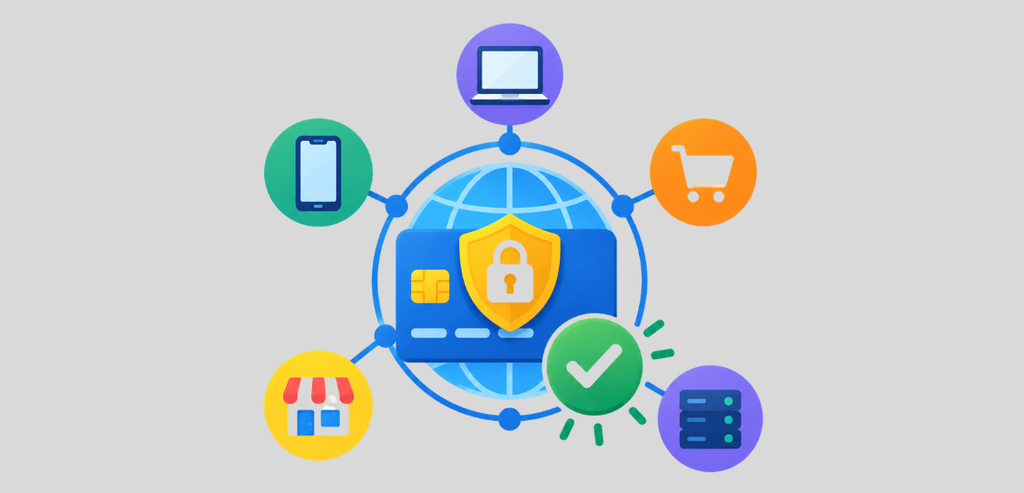
A network token is a stand-in card number created by the card network on behalf of the issuer. The real number, the primary account number (PAN), is kept by the network and the card’s bank. The merchant then stores the token and charges it.
Mastercard’s April 2026 document says each token is unique to a single merchant or wallet; thus, a single card can be associated with multiple tokens. A token stored in one merchant’s database has no use to another.
When a transaction is started by the shopper, it is also protected by a cryptogram. Mastercard states that this allows the card’s bank to authenticate the transaction and verify that it really comes from the shopper in real-time.
Visa VTS
Visa’s version of this is its token service, known as VTS. VTS assigns tokens to approved devices and applications for the card’s bank and allows the bank to revoke a token from the system. Visa mentions that using a card to load a wallet on a mobile device results in the card being replaced by a new, random number.
Mastercard MDES
Mastercard has also outlined a similar service, MDES. Mastercard has set a target of 100% of e-commerce payments in Europe to be tokenized by the year 2030. As of 2025, Mastercard has stated that about half of all e-commerce payments using their cards in Europe were already processed using tokens.

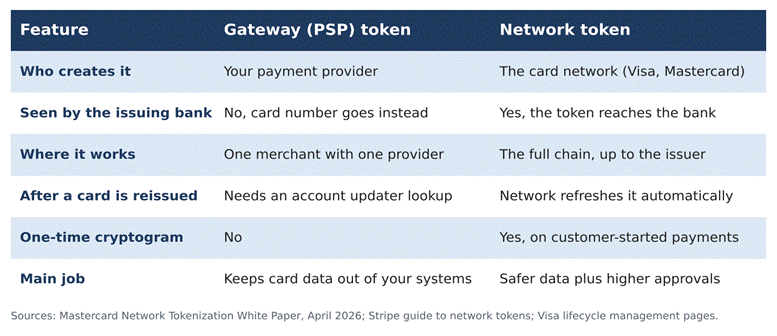
Many merchants already use a form of tokenization without realizing it is not network tokenization. Visa’s UK merchant guide mentions that some merchants tokenize cards as part of their compliance with PCI DSS or to secure the data they send to their payment gateway. These are known as gateway tokens or PSP tokens.
A gateway token has no meaning outside of the vendor’s vault. Mastercard explains that the vendor looks up the actual card number and sends it to the issuer for authorization. Hence, the card’s bank never sees the gateway token. A network token works the other way around and is recognized by both the card’s bank and the merchant’s bank.
Mastercard says merchants can keep using the provider’s token alongside the network token. A network token is created by the card network, and every party in the authorization chain understands it.
What is important is that the merchant’s checkout code doesn’t change. There is no conflict in using both provider and network tokens.
Banks turn down more online payments than in-store payments. A token, assigned by a card issuer to a specific merchant, provides stronger evidence of a payment. The token is maintained by the network, and each payment carries a cryptogram. Banks have less reason to suspect fraud and therefore are less likely to decline the transaction.
There are minor differences in the studies published by the networks. In 2025, Visa reported a 4.8% increase in authorization rate for tokenized online payments, using VisaNet data. Mastercard reported an increase of 3% to 6% based on 2025 data from a sample of its merchants. In a Mastercard case study, Checkout.com reported an increase of 10.3% for all regions for the same year.
These studies seem to differ slightly, likely due to differences in the way the figures were reported. In general, all networks agree there is an improvement in authorization rates for card-not-present transactions when tokenization is implemented.
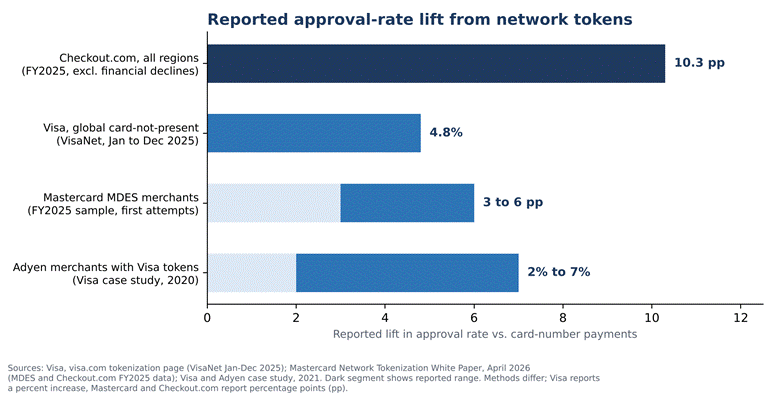
Measurement methods vary. Mastercard’s examples cover only first attempts. Checkout.com’s examples exclude financial declines, for example, insufficient funds. In a 2021 Visa case study on Adyen, Visa reported improvements of 2% to 7% for tokenized transactions in 2020. Visa also stated that the results varied by merchant.
There is also a reduction in fraud. Visa reports that in FY2025, fraud rates for non-tokenized transactions were 39.4% higher than for tokenized transactions. Mastercard states that in 2025, Checkout.com merchants experienced a 49% reduction in fraud-related chargebacks.
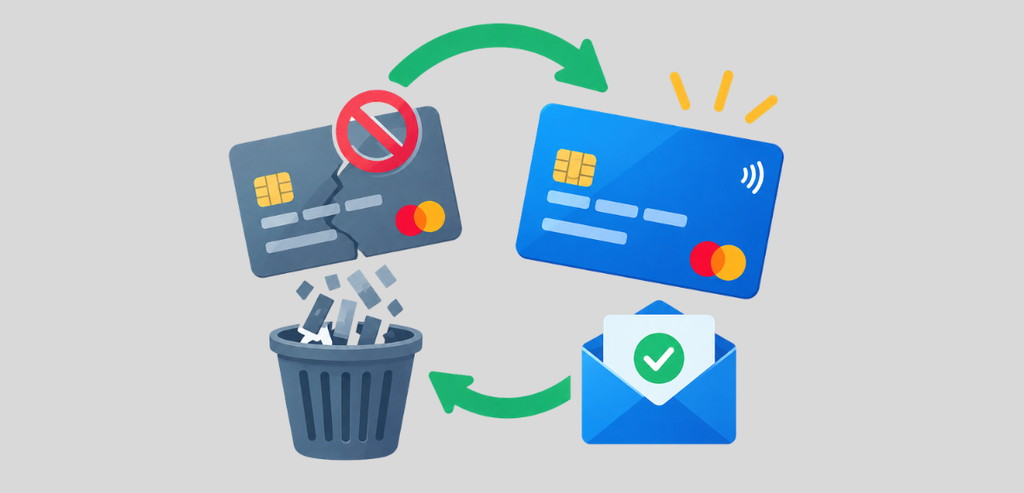
Cards get reissued. Merchants that store the raw card number will not be able to process future charges after a reissue and may require customers to enter their card details again.
A token bridges that gap because it represents the card, not the number. Mastercard states that card issuers utilize MDES and Automatic Billing Updater to transmit new card details to merchants and tokens are updated accordingly. Stripe likewise states that tokens are updated by the networks when a card is lost or reissued.
Visa has a similar service called Visa Account Updater, and states that participating issuers are required to notify them within two business days of a change. Braintree adds that merchants using their network token product are enrolled in Visa Digital Credential Updater.
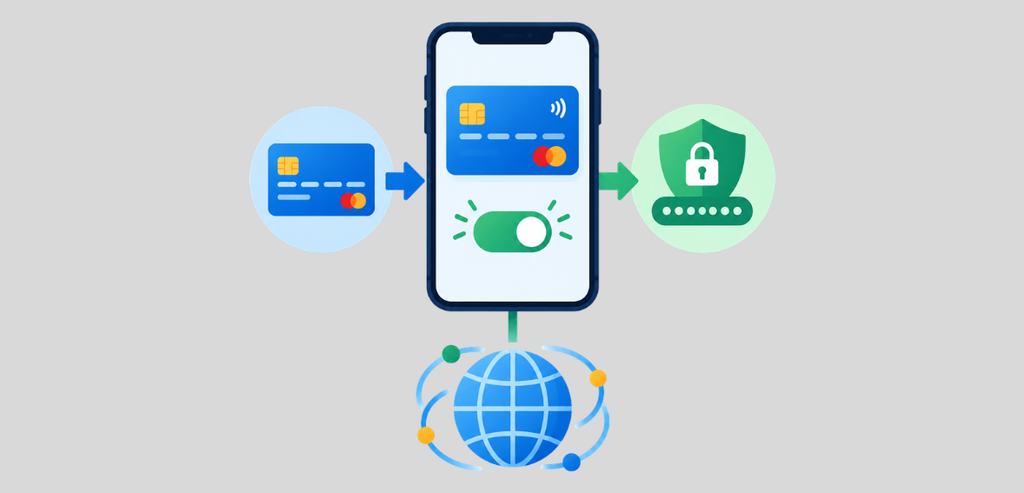
For standard processors, enabling network tokens is usually a configuration setting, not something done during the build process. The processor will reach out to Visa and Mastercard on your behalf to get tokens. Your responsibility is to check that the feature is enabled on your account.
Stripe
Stripe mentions that their network tokens are automatically enabled for all merchants using Stripe Payments. They currently support 16 countries and regions, including the U.S., Canada, U.K. and the E.U., India and Australia. Stripe will choose which one to use, a token or card number, for each transaction, based on which is likely to perform better. Tokens can be used to initiate payments, and if that fails, Stripe will attempt to process the payment using the card number.
Checkout.com
Tokens can also be obtained through Checkout.com’s API. Mastercard’s paper mentions provisioning time is usually less than two seconds. If it takes longer, the payment will be processed using the card number. Tokens are enabled for card-on-file payments by default on Checkout.com. Tokens are also enabled by default for card-on-file payments for many other processors. Check with your processor to confirm. Checkout.com’s June 2026 notice mentions that from October 2026, per Mastercard’s policy, all card-on-file payments within Europe must use network tokens. Exceptions to this rule would be if the issuer refused to accept the token or no valid token has been set.
There is usually no separate line on the bill. As of 2026, neither Stripe nor Mastercard mentioned token fees but described benefits of using tokens. There are some network charges. Adyen says Visa charges a flat EUR 0.02 VTS fee in the EU and UK for payments protected from fraud liability. If 3D Secure is used, only the 3D Secure fee would apply.
The largest charge is for transactions that do not use tokens. According to Braintree and Spreedly, from October 1, 2023, Visa has charged 2.5 basis points for e-commerce payments made in Europe without a network token or 3D Secure. Checkout.com says that from October 1, 2025, the fee will increase to 7.5 basis points.
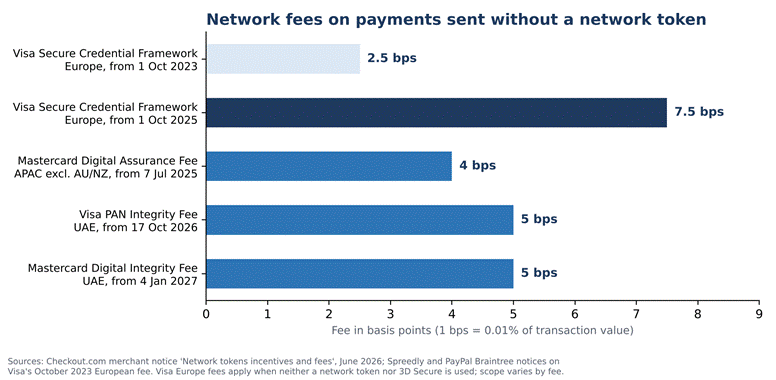
Other regions are following suit. From July 7, 2025, Mastercard has charged a 4 basis point surcharge on card-on-file payments without a token in the Asia Pacific region, excluding Australia and New Zealand. From October 17, 2026, Visa will charge 5 basis points, and from January 4, 2027, Mastercard will charge 5 basis points in the UAE. Stripe says businesses in custom interchange pricing plans can save money, as it is often less expensive for a payment processing company to obtain a token compared to processing a raw card number.
Network tokens swap the stored card number with a credential issued by the card brand. Visa reported a 4.8% higher approval rate and a 39.4% lower fraud rate in FY2025 for payments made with tokens versus payments made without them. Mastercard reported a 3- to 6-point increase in 2025. Unlike stored card numbers, tokens automatically update.
Therefore, recurring payments will continue to be charged. In Europe, Asia Pacific, and the UAE, Visa and Mastercard have charged merchants for most transactions made without tokens. Most merchants will need to contact their payment processor to enable tokens in order to implement this feature.
This replaces a card number with a token issued by the card network, such as Visa. The token is strictly associated with a single merchant and will also change when the card number changes.
No. Tokenization is a broader term. That merchant uses a token issued by a payment gateway only and stays within the merchant’s payment provider. A network token is issued by the card network and is recognized by both the issuer and the merchant’s bank.
They reduce it. Visa reported a 39.4% reduction in fraud with tokenized credentials in FY2025, and Mastercard reported a 49% reduction in fraud chargebacks with tokenized credentials for merchants using Checkout.com in 2025.
Not much. Providers like Stripe have network tokens enabled by default, so you would need to confirm with your processor that tokens are being stored with customer cards.
Reduce Your Fees, Upgrade Your Service.
Your information will not be distributed
We received your request. A payments specialist will reach out shortly.