

Legal concerns about inconspicuous fees charged to consumers have emerged in recent years as perhaps the most highly regulated area of pricing in the U.S. Often, the difference between the price advertised to the customer and the final amount charged raises legal questions. Regulations relating to this difference have proliferated in recent years. California’s price law took effect in July 2024. The Federal Trade Commission adopted its fee rule in December 2024. By April 2026, the law firm Troutman Pepper Locke counted all-in pricing laws in 7 states.
From a merchant’s perspective, the focus is practical. What fees can be charged on a separate line? When are fees required to be part of the first price shown to a customer? These questions typically do not result in a legal obligation. It is always advisable for a merchant to retain a lawyer licensed in the state where the obligation arises to confirm the merchant’s legal obligations.

“Junk fee” is not a legal term, but rather a term used by the media and the general public. A charge is a junk fee if it is presented to the buyer as part of the final bill, and the buyer has no choice but to pay it.
Of the problems defined by the California law, drip pricing is the main concern. The law requires a merchant to show the buyer an upfront figure no higher than the amount the buyer ends up owing. Additional charges are then presented to the buyer one at a time, usually the last of which is displayed prior to the payment step. A ticket that is shown at one price and then a higher price at the payment step is a common example.
The other problem is unclear naming. The FTC has stated that the terms “service fee” and “convenience fee” are misleading and vague and should not be used to describe charges to a buyer.
These additional fees are junk fees if a buyer has to pay the fee in order to complete the transaction.
The FTC posted its finalized regulation on Dec. 17, 2024, and it was published in the Federal Register on January 10, 2025, and became effective on May 12, 2025. Its citation is Title 16 of the CFR, Part 464.
The FTC’s 2023 proposal received criticism for its breadth and potential to impact virtually all industries. The final rule limits its scope to the ticketing and the short-term rental industries.
The ticketing industry is defined by the final rule as covering the sale of tickets to public events. The final rule defines short-term rentals as temporary lodging, and covers the sale of access to lodging where the lessor expects the lessee to occupy the property for fewer than 30 consecutive days. The definition is not limited to personal residence. The FTC is authorized to define terms, but has not defined any.
The rule does not distinguish between large and small businesses, and the FTC’s small entity compliance guide states that no businesses are exempt from the rule. The travel and ticket selling industries are included in the rule.
The rule gives two main requirements to businesses. First, a business is required to display all fees. Second, a business is prohibited from falsely representing a fee.
Fees are required to be displayed in the price. Initial or shipping fees may be excluded. Additional fees may also be excluded if the customer selects the good or service.
Charges must be displayed to consumers before a business is allowed to collect payment, and final bills must include charges.
The rule bans deceitful practices, not specific fees. In a 2025 analysis, Foley & Lardner wrote that the rule bans flexibility in pricing and requires businesses to charge prices that reflect costs. Should the FTC determine a business has violated the rule, the business must alter its practices to comply, refund consumers, and pay penalties. The FTC estimated the rule will help consumers save 53 million hours and 11 billion dollars over ten years by eliminating the need to search for the true cost of goods and services.
In most cases, Texas state law preempts federal law. More all-encompassing Texas state statutes apply to a wider range of products and services. The dates below reflect the effective dates of the associated statutes.
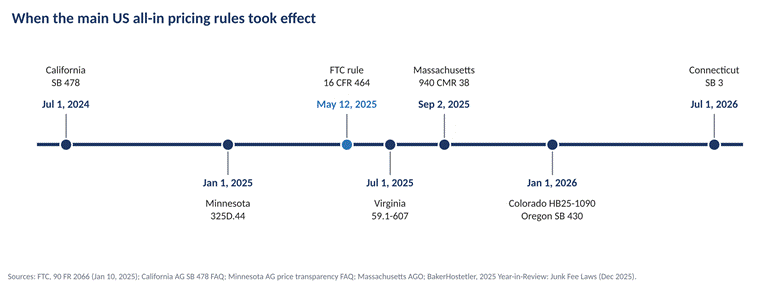
California’s Honest Pricing Law, which amended and superseded SB 478 and is codified at Civil Code 1770(a)(29), becomes effective on July 1, 2024. Honest Pricing generally requires sellers to include all fees a buyer must pay in the price quotations to buyers. Prices that do not include all fees a buyer must pay are misleading under the Honest Pricing Law. The Attorney General of California, Rob Bonta, described the Honest Pricing Law as a transparency law. The Honest Pricing Law does not cap prices. Consequently, sellers are free to list fees, charges, and/or surcharges on prices charged to buyers in any manner. However, the first price charged to a buyer must be the full amount charged to and payable by the buyer.
The Attorney General’s FAQs on the Honest Pricing Law indicates that prices charged to buyers may exclude government taxes and fees. Other fees that may be excluded include reasonable shipping charges for physical goods and fees charged to buyers for optional services. Handling charges may not be excluded. The Honest Pricing Law is only applicable to the purchase of goods for personal use.
The amendments effected by SB 1524 permit food sellers to disregard the Honest Pricing Law and charge fees in addition to the stated price. Fees charged by food sellers must be clearly and conspicuously disclosed.
Amendments to the Minnesota Deceptive Trade Practices Act will take effect on Jan. 1, 2025. Vendors who sell at airports controlled by the Metropolitan Airports Commission have until June 1, 2025, to comply. The Minnesota Attorney General’s response to Frequently Asked Questions states that transactions controlled by contracts executed before 2025 are exempt from the Act.
Minnesota has laws similar to California’s that mandate certain prices charged by restaurants. However, Minnesota’s laws go further and require the prices charged by restaurants to include any fees or charges that relate to “health and wellness.” Automatic gratuities charged to large parties may be added to prices charged by restaurants and do not need to be disclosed. Disclosure is required for all other fees and gratuities. The Minnesota Department of Agriculture may enforce this statute and impose a civil penalty of up to $25,000 per violation.
Virginia’s law, Va. Code section 59.1-607 and following, will be enacted on July 1, 2025. Under this law, a business will be required to disclose the full price of a product or service if that price is advertised. Like most states, Virginia will not require the advertised price to include all taxes and fees. However, the fees must not be unreasonable. Some fees associated with the sale or lease of a motor vehicle, utilities, and real estate settlements are excluded from this requirement. Fees associated with air transportation are also excluded.
Massachusetts chose the regulatory route. The rules of the Massachusetts Attorney General, 940 CMR 38.00, took effect on September 2, 2025. From that date, a seller was required to disclose the total price to a buyer before that seller charged the buyer any price. Wiley noted that Massachusetts uses the term total to describe the highest price a buyer is required to pay. The rule does not differentiate required fees from voluntary fees the way the FTC’s rule does. Wiley explained that, under the Massachusetts rule, a restaurant could charge a service fee and keep the service fee. The Attorney General’s Office could impose penalties of up to $5,000 for each service charge that is not disclosed, in accordance with the Office’s guidelines.
Colorado, Connecticut, and Oregon enacted new laws in 2026. Colorado HB25-1090 and Oregon SB430 took effect January 1. Connecticut SB3 took effect on July 1. Currently, Colorado does not require all advertisements to display prices. If a price is shown, the total amount must also be shown and must be more noticeable than other price information. Colorado permits restaurants to keep service charges, and like tips, outside the total, so long as the charge is disclosed to the customer. Oregon’s law, which applies to online sales, contains similar provisions to those of Colorado and Connecticut. BakerHostetler reported that Connecticut’s law also allows a disclosed required gratuity to be kept outside the total.
The absence of a state’s fee law does not make that state “no-fee” territory. Troutman Pepper Locke reported that prior to the recently adopted state laws, numerous state consumer protection laws were used to challenge deceptive practices involving hidden fees.
These laws don’t prohibit fees. They restrict the location and the name of the fees. As long as the first price a buyer sees remains the same, a business can require additional charges, like a delivery charge, booking charge, or a cleaning charge.
There is a similarity among the rules. If a charge is included in the first price a buyer sees, then it can not be separated from that price. Other charges, which are optional or depend on a buyer’s later choices, can be listed separately from the first price, as long as the charges are disclosed to the buyer before payment. The following table provides examples of each of these rules.
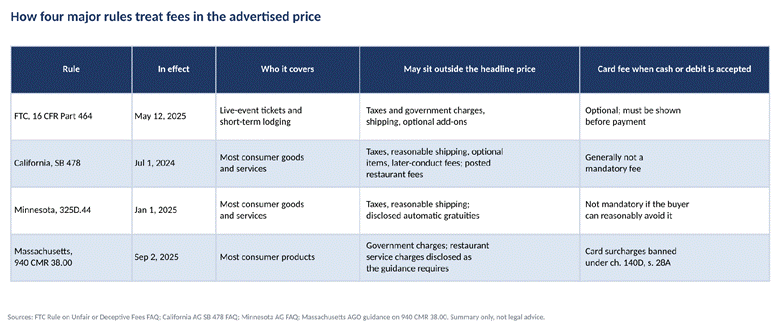
Changes from order to order require special consideration. Colorado, Virginia and Connecticut give sellers the option to omit certain fees if they remain unknown at the time the advertisement is published. BakerHostetler reports that advertisements in these states should disclose that the price may change and identify the variables that cause price changes. Wiley states that in Connecticut a shipping fee that is charged without variety may need to be disclosed in the total.
Of equal importance is the placement of a fee as opposed to its amount. In the eyes of the FTC, nondisclosure of a fee serves the same purpose as charging a fee without a clear rationale. Hence, the term “service fee” is inadequate to describe a given charge and “cleaning fee” or “venue facility charge” should be used in its stead. Furthermore, the FTC states that if a fee is nonrefundable, this should be disclosed to the consumer.
Card surcharges are determined by payment network rules and laws. The FTC, California, and Minnesota, for example, evaluate optional fees by determining if the customer has the option to pay by a method that does not incur a fee. Cash and check payments, as well as payments by a card that is not a credit card, are methods of payment that may give a customer the option to avoid the fee.
If a customer has the option to pay by a means that does not charge a fee, it may be considered optional and may be passed on to the customer by the merchant. If, however, a merchant only accepts card payments, the fee is considered pass-through and must be built into the merchant’s prices. The FTC also states that if a fee is optional, it must be disclosed to the customer.
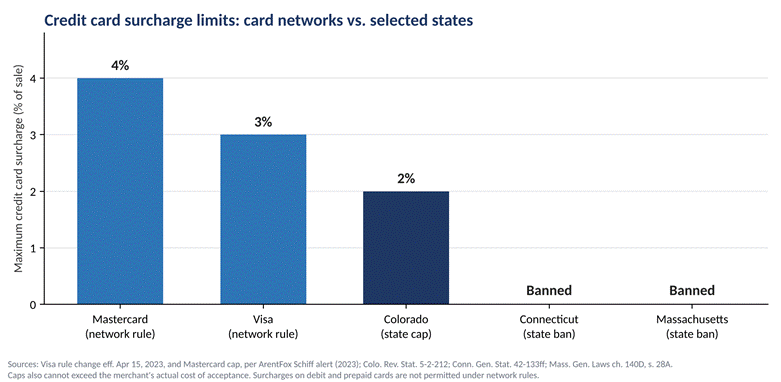
Card network rules may also require a fee. The following table shows a comparison of network rules and the rules of three states.
Visa
Effective April 15, 2023, Visa reduced the US surcharge limit to 3%. A surcharge cannot exceed the merchant’s card acceptance fee. Merchants must notify their acquirer 30 days in advance to remove surcharges. Visa does not permit surcharges for debit and prepaid cards.
Mastercard
Following Visa’s change, Mastercard left its 4% limit unchanged, according to the 2023 update by ArentFox Schiff. Like Visa, Mastercard does not permit surcharges for debit and prepaid cards.
State laws may provide additional provisions. Under Chapter 140D, Section 28A of the Massachusetts General Laws, card surcharges are prohibited. Other states may cap card surcharges. In states that cap card surcharges, some merchants may use cash discount pricing. This practice allows merchants to set the card price the same as the cash price.
The same logic applies to convenience fees charged for a card transaction for goods and services purchased via phone and the Internet. The convenience fees must be charged for all card transactions and should be included in the price. However, the convenience fees may be charged separately and should be disclosed to customers prior to payment.
State laws govern the treatment of service charges. In California and Colorado, service charges may be imposed by a business and retained by the business. The service charges may be in addition to the price of the good or service and need not be disclosed by the business. Massachusetts has enacted a similar law, but requires the business to disclose the service charge in a particular format. Minnesota allows an automatic service charge if the charge is included in the price of the good or service.
A fee audit is a good place to begin. Make a list of all fees. Determine whether each fee is required or avoidable. Next, analyze the list against laws and regulations in states where your business operates. Three areas deserving particular attention are:
A business operating in multiple states can simplify its operations by following the most stringent rule in the rules allocated to it. Most likely, this rule will be the Massachusetts rule, which requires the disclosure of the all-in price, including optional fees.
The payment settings also require attention. For example, settings that impose a flat percentage surcharge on card transactions may violate the card networks’ rules for debit card transactions and may be illegal in surcharge states.
From a defensive reactive perspective, it is prudent for the business to retain old copies of its price pages. Old copies of price pages may become valuable evidence in a court case to demonstrate what a consumer saw and paid on a particular date.
Junk fees rules just say where fees must be listed. They do not set prices. The FTC’s rule only applies to ticketing and lodging. The laws enacted in California, Minnesota, Virginia, Massachusetts, Colorado, Oregon, and Connecticut cover more merchants.
There is no unity among these laws in how they treat shipping, optional charges, and restaurant surcharges. Regarding credit card surcharges, there must be a surcharge-free payment option to avoid the card surcharge. Other restrictions apply as well, such as network restrictions and state restrictions. To ensure compliance with surcharge laws, merchants should consult legal professionals.
A junk fee is an additional charge beyond the original price. Junk fees are sometimes misleading by using vague or confusing names.
Yes, the rule affects all businesses and does not exclude small businesses. The FTC’s rule and the Minnesota Attorney General’s Office’s FAQ do not exclude small businesses.
A credit card surcharge would not be considered a junk fee. A surcharge is permissible if the business also accepts other payment methods and discloses the surcharge. A surcharge must be included in the price if a business only accepts credit cards.
From 1 July 2024 onward, any California price for a product or service must include all fees, except taxes, government fees, and shipping fees. A restaurant may post a separate delivery fee.
Reduce Your Fees, Upgrade Your Service.
Your information will not be distributed
We received your request. A payments specialist will reach out shortly.