Posted: June 30, 2026 | Updated: June 30, 2026 at 11:15 AM
You finish a $12,000 HVAC install. The customer pulls out a rewards credit card. You smile, run it, and quietly watch 3% of your profit vanish into processing fees. For a busy contractor, that adds up to thousands of dollars a year.
Surcharging and cash discounting are the two legal tools that let you stop eating that cost. But the rules are strict, they change often, and getting them wrong can mean fines from your card network and your state attorney general. This guide breaks down the credit card surcharge contractor rules that actually apply in 2026, including the surcharge laws by state 2026 you need to verify before you add a single fee.
These terms are often confused, but they are not legally equivalent.
Surcharging means charging an additional fee on top of the posted price when a customer pays by credit card. Your invoice shows $10,000; the credit card customer now pays $10,300. The reverse is true for a cash discount. In this case, the posted price is the higher amount, and the cash, check, or debit payer receives a price reduction. Your invoice shows $10,300, and the cash customer pays $10,000.
The cash flow and business implications are the same for surcharging and cash discounts. However, from a legal perspective, surcharging and cash discounts are not equivalent and are treated very differently. A surcharge is an additional fee to a base price. Therefore, it is scrutinized against the card network rules and state laws against surcharging. A cash discount, on the other hand, is a price reduction to a posted price. Cash discount programs are legal in all states. This is the most critical concept that trade businesses must grasp before considering passing on credit card fees.
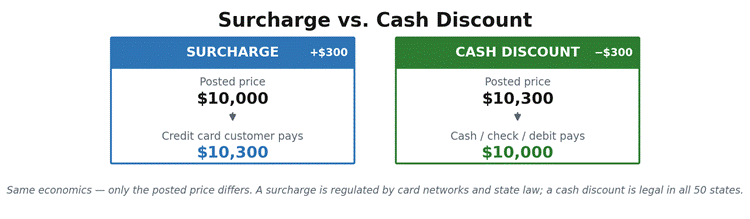
Surcharge vs. cash discount: the economics match; only the posted price differs.

Before state law, your card network establishes the minimum requirements. Each surcharging merchant in the U.S. must comply with these rules, and they must be followed independently of the law of any state. Violations of these rules can result in the loss of the right to do business with that card brand or financial penalties.
Visa has the reputation of being the strictest network of the bunch. In 2023, Visa’s new rules changed the entire landscape. Since April 15, 2023, Visa reduced the surcharge cap from 4% to 3% per transaction, or the cost of the merchant’s acceptance, whichever is lower. This last part is the most important to note. A surcharge can never exceed the processing cost. If your effective rate is 2.6%, Visa’s charge is capped at 2.6%, not 3%. Visa’s new rules also eliminated the requirement to register directly with Visa. Now, you only need to inform your acquirer at least 30 days before implementing surcharging.
Mastercard employs a similar system, but with one distinction. The maximum surcharge for Mastercard caps at 4%. However, it is uncommon for a merchant to benefit from that higher ceiling. When accepting both Visa and Mastercard, you will effectively max out at 3%, since you cannot surcharge one brand more than the other. The blended reality for just about every contractor is a 3% ceiling.
The expression “cost of acceptance” describes the legal basis of all surcharge programs. Surcharges are not meant to be profit centers for merchant activity, and the true cost of processing a consumer payment transaction is the ceiling for a surcharge. The ceiling is always the lower of the network maximum or the merchant’s true cost. Several state statutes support this, and some even lower the ceiling. The 2026 limits are presented below.
| Card or scenario | Maximum surcharge | Notes |
| Visa credit card | 3% | Or your actual cost of acceptance, whichever is lower |
| Mastercard credit card | 4% | Rarely usable alone if you also take Visa |
| Accept both Visa and Mastercard | 3% (blended) | The practical ceiling for most trades |
| Colorado / Oklahoma | 2% | State caps below the network maximum |
| Debit and prepaid cards | 0% (never allowed) | Prohibited nationwide, even if run as “credit” |
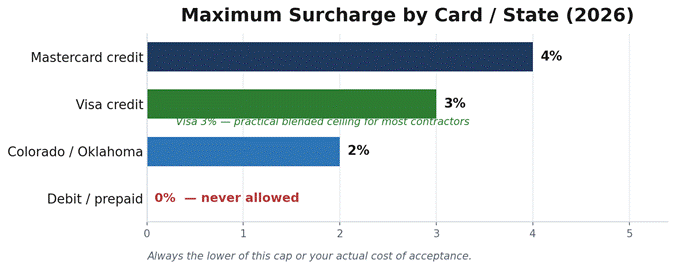
The blended practical ceiling for most contractors is 3%.
This is the main rule that contractors unintentionally break. Never surcharge debit or prepaid cards. This is the case even if the customer runs the transaction in a way that appears to be a credit card transaction. This rule is based on federal law and is supported by card network rules. This is applicable in all states, with no exceptions.
Why do people have a hard time understanding this? Many debit cards are processed through the credit network at the terminal. When a customer taps “credit,” your point-of-sale system may also treat the transaction as a credit transaction. If your software adds a surcharge, this is a violation.
Visa has even been known to audit businesses and catch surcharges applied to debit or prepaid cards. Your POS system needs to be able to differentiate a credit card from a debit card and apply a fee only to transactions that are truly credit. If your system cannot perform that function, surcharging is not the right solution for your business.
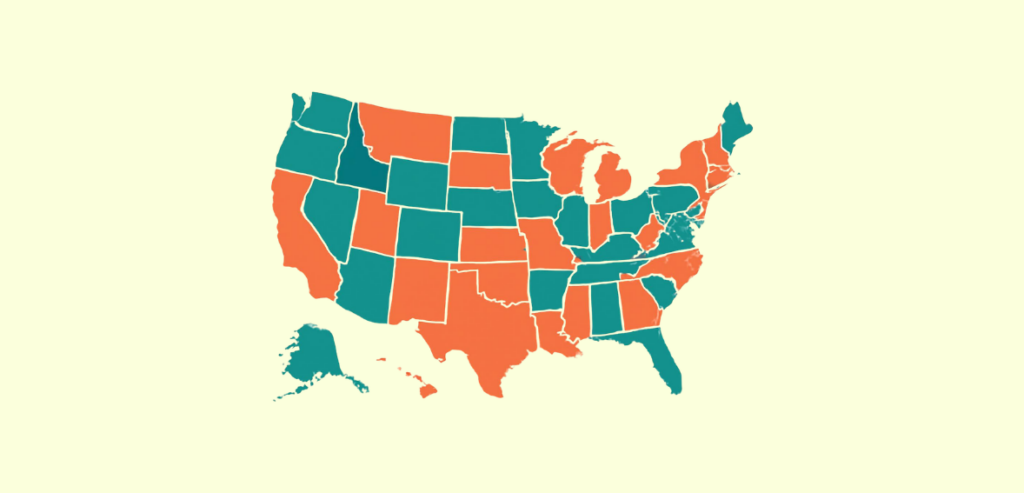
Contractors keep getting blindsided by state laws as the landscape continues to change. Most states do not have a problem with surcharging; however, a small handful do still restrict or condition it. Starting in 2026, Connecticut, Massachusetts, Maine, and Puerto Rico will have credit card surcharge bans in place. In the other remaining states, surcharging is only allowed under set restrictions.
Below is a table that contains the most relevant jurisdictions and their restrictions and conditions. This is not legal advice, and you should check the current restrictions before publication, as many states have changed their regulations since 2023.
| State or territory | Surcharge status in 2026 | What to know |
| Connecticut | Banned | Cash discounts allowed; fines around $500 per violation |
| Massachusetts | Banned | Cash discount programs are permitted instead |
| Maine | Banned | Cash discounts allowed; some government fees exempt |
| Puerto Rico | Banned | Cash discounts permitted |
| California | Restricted (SB 478) | “Honest Pricing Law” (eff. July 1, 2024) requires all-in posted prices; use cash discount / dual pricing |
| Colorado / Oklahoma | Allowed, capped at 2% | Lower than the network ceiling; Oklahoma’s repeal took effect in November 2025 |
| New York | Allowed with strict disclosure | Two-tier display required (see below) |
| New Jersey, Nevada, South Dakota | Allowed, conditional | Surcharge may not exceed your actual cost of acceptance |
| Texas, Florida, Kansas | Allowed in practice | Statutory bans struck down or unenforced; verify local guidance |
Two observations that are a little more practical. First, surcharges are generally only applicable to a state’s transactions. If you do work in both a banned state and a permitting state, you can still surcharge in the permitting state. Second, Texas’s statutory ban remains on the books but has been struck down by federal courts as unconstitutional under the First Amendment, so enforcement there is a gray area.
California is a different case: its older surcharge ban was enjoined on the same grounds, but the 2024 “Honest Pricing Law” (SB 478) now requires your posted price to include all mandatory fees — which makes a traditional add-on surcharge non-compliant, so in California use a cash-discount or all-in pricing model instead. (Minnesota’s similar price-transparency law took effect January 1, 2025.) Either way, get proper legal advice before instituting a program.
New York requires its own section since its policies are distinct from those of other states. Following the Expressions Hair Design v. Schneiderman case, the U.S. Supreme Court prompted New York to revise its surcharge statute. As of the 2024 update to General Business Law §518, businesses surcharging must conspicuously articulate the total price inclusive of the surcharge on the credit card.
Essentially, businesses cannot display a lower price for cash and then register a higher price for credit card transactions. New York law mandates that the higher price must be displayed in dollars and cents. Consumers should not be forced to calculate the final price. New York law explicitly preserves the two-tier pricing system, which allows posting two prices: the cash price and the price inclusive of the credit card surcharge.
There may be no surcharges in excess of the processing fee, and violations are subject to a civil penalty of up to $500 imposed by the Attorney General and local offices of consumer protection. For remote work and online estimates, the price must be shown before the final step of the transaction.
Although surcharging can give you nightmares about compliance, the road to cash discounting is infinitely smoother. Cash discounts are legal across the United States, and unlike surcharging, they can operate in states with outright bans on surcharging. Therefore, while you can’t implement surcharging in Maine, Connecticut, or Massachusetts, you can offer cash discounts to provide your customers with a reduced price off the posted price.
The actual implementation of cash discounts is quite simple, but the framing is everything. You integrate your processing costs into your standard rate, and then you offer a discount to every customer paying in cash, by check, or by debit. The discount must be presented to the customer before payment is taken. You cannot list a cash price and then charge a higher credit price at payment; that turns the discount into a surcharge, which would be a violation.
For contractors and trade businesses, the answer usually lies in where you work and how you quote. For businesses operating in more surcharge-friendly states and that usually post surcharges on estimates and invoices, a surcharge program is the most straightforward option. For businesses that operate in more debit-friendly states, operate across state lines, or operate in a more restrictive state, a cash discount program would suit them best and be more compliant.
No matter which option you choose, the obligations for disclosure are the same in all the areas where surcharging is permitted. You must clearly post a notice at the point of entry and at the point of sale, and the fee must appear as a separate line item on the sales receipt. For estimates and payments made online, the surcharge must be disclosed before the customer completes the transaction on the checkout page. Incorporate the notice into your quotes, signage, invoices, and correspondence so the customer does not see the fee for the first time after the transaction is complete.
Neither surcharging nor cash discounting schemes are ideal, as both require perfectly executed techniques to achieve the desired effect, but both can be used to prevent processing fees from eroding your cash margins. To be safe when setting your surcharges, keep them at or below your true cost of acceptance, and never above 3% for Visa card charges. Also, never surcharge debit or prepaid cards. Before you start surcharging, be sure to check whether your state allows it and, if you have business in New York, follow the two-tier display rule.
If surcharges are banned in the state you’re doing business in, switch to a cash discount that is clearly disclosed to the customer. Consistently doing the above will allow you to keep your legitimately earned revenue without incurring fines. Be sure to check your cash margins and profits, as well as the rules and regulations, which change frequently, before you initiate any of the techniques mentioned.
Yes, in most states. Most states allow surcharging in accordance with the appropriate card network rules and state law. Your surcharging must comply with the following: the fee must be capped at the actual cost of acceptance, remain at or below 3% for Visa transactions, clearly disclose the surcharge, and exclude Connecticut, Massachusetts, Maine, and Puerto Rico. Always check the most up-to-date rules for your specific state.
The cap will always be the lower of your actual processing cost or the network maximum. In April of 2023, Visa reduced their ceiling to 3%. Mastercard sits at 4%. However, accepting both effectively caps your ceiling at 3%. A few states cap lower, including Colorado and Oklahoma at 2%. You can never surcharge more than what your processor actually charges.
When a customer pays via credit card, a surcharge (which adds an extra cost to the posted price) is incurred. In contrast, payment via cash, check, or debit results in a cash-determined price, which is a discount from the posted higher price. Although the two systems are modeled the same way economically, cash discounts are generally preferable for contractors, as they are legal throughout all fifty states and carry lower compliance risk. That said, surcharges can be easier to manage where they are permitted, and pricing is posted in front of customers.
No, debit and prepaid cards are never allowed to be surcharged, regardless of how the customer uses them at the terminal. This prohibition is in effect under federal law and card network rules in every state with no exceptions. Your POS system must apply fees only to transactions made with real credit cards.