

Posted: November 12, 2026 | Updated: November 13, 2026 at 11:43 AM
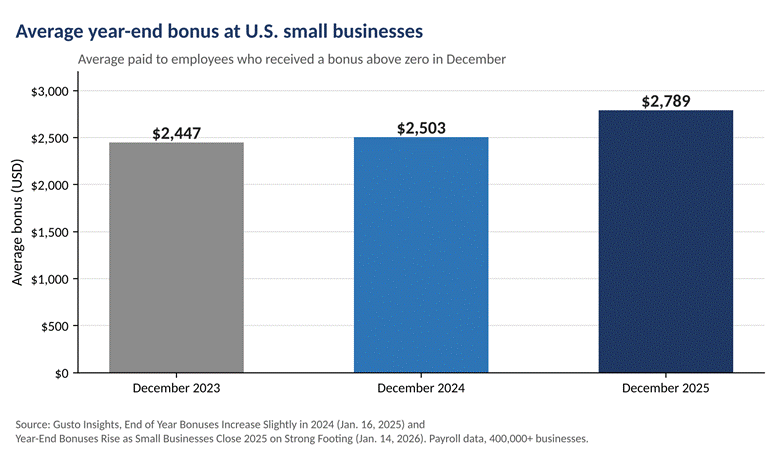
Small businesses raised the amount of year-end bonuses given to employees in 2025. Gusto, a payroll service with over 400,000 client businesses, found the average year-end bonus in 2025 was $2,789, a 11.5% increase from 2024. Bonuses were given to 18% of Gusto’s client businesses’ employees in December 2025.
Christmas bonuses are traditional in the U.S. and other countries, and present similar challenges to businesses as other payroll events. The benefits and draws of Christmas bonuses are outlined in this chapter, including the amount employees receive, how the amounts are determined, tax effects, the means of payment, planning and anticipation.
Christmas bonus data are from the Internal Revenue Service (IRS), the Bureau of Labor Statistics (BLS), the U.S. Department of Labor (DOL), and Gusto.

Minimum or maximum federal rules regarding holiday bonuses do not exist. The ownership team sets the rules. Two pieces of information provide context for that decision.
The first is payroll data. Gusto’s January 2025 report listed the average December 2023 bonus at $2,447 and the average December 2024 bonus at $2,503. Gusto’s January 2026 report listed the average December 2025 bonus at $2,789. Gusto’s reports only include bonuses greater than $0. Hence, the averages only represent employees who received bonuses.
Results vary by sector. According to Gusto’s 2026 report, the average bonus in Tourism and Accommodations increased by 52% in 2025. Bonuses in the Entertainment and Recreation sector increased by 45%. Across all sectors, the proportion of employees receiving bonuses increased.
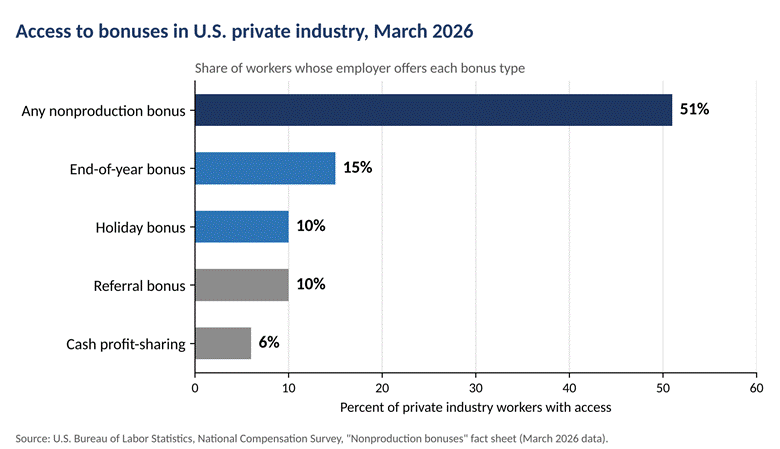
The other set of figures comes from the BLS’s National Compensation Survey. In March 2026, 51% of employees in the private sector were eligible to receive a nonproduction bonus. The BLS defines nonproduction bonuses as cash payments that are not given for production or services rendered. End-of-year bonuses were eligible to only 15% of employees, and holiday bonuses were eligible to 10%.
The BLS tracks cost as well. In March 2026, private employers spent $1.37 per hour worked on nonproduction bonuses. That came to 2.9% of total compensation.
Generally speaking, cash on hand and staff members’ expectations will determine the answer to the question at hand. There is a DOL regulation (29 CFR 778.212) that covers many small business cases. The example provided states that a business owner pays their staff two weeks’ worth of salary as a Christmas bonus, and an additional two weeks’ salary for every five years of service. According to the regulation, this bonus would not be considered in overtime calculations. As such, an owner may opt to follow this regulation and pay staff members one week’s worth of salary, or a cash bonus worth less than one week’s pay.
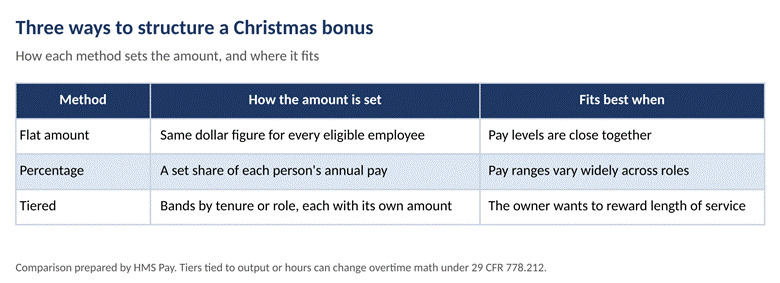
Most small business bonus plans use one of three formulas to determine the distributions. Each of these formulas divide the same pool of money in a particular way.
In the formula called “flat amount,” the pool of money is divided such that an equal amount is given to all eligible employees. A potential disadvantage of this formula is that, in addition to the cost of the bonuses, payroll taxes also need to be considered. For example, when the bonus pool is $6,000 and 12 employees are to receive equal bonuses, then each employee would receive $500 and the company would incur an after tax cost of $5,760. A potential equity issue with this formula is that a part-time employee would receive the same bonus as a full-time, senior manager.
A formula ties each employee’s bonus to a certain percentage of their salary. An employee making $40,000 receives a bonus of $800. A bonus for an employee making $70,000 is $1,400. Bonuses are relative to the position.
Employees are divided into groups by a tiered system. Employees in the same group may differ by years of service. Employees in the second group (two to five years of service) may receive a larger bonus than employees in the first group (less than two years of service) and a smaller bonus than employees in the third group (more than five years of service).
How a bonus gets structured determines whether it is included in overtime calculations. According to 29 CFR 778.212, overtime “regular rates” of non-exempt staff cannot include gift-type bonuses. To qualify, the amount of the bonus cannot be based on the employee’s hours worked, units produced, or the employee’s overall workplace usage or efficiency. An example provided by the Labor Department states that a tenure-based bonus passes this test. Bonuses based on personal productivity or sales do not pass this test.

Yes. The Internal Revenue Service (IRS) defines a cash bonus as a form of wages. Cash bonuses fall in the IRS’s Publication 15 Supplemental Wages category.
The withholding of income taxes on bonuses depends on the method chosen by the employer. When bonus money goes out as a separate amount from other wages, the employer is allowed to withhold 22% as income taxes. That withholding percentage is increased to 37% for bonus payments, in excess of $1,000,000 for the year, to the same employee. The other method allows the employer to add the bonus payment to the worker’s usual wages for the pay period, and withholding is computed using the employee’s withholding allowances and Publication 15-T.
Withholding is for the employee’s information only. An employee may be required to pay additional taxes if their income is above the exemption threshold for the year. Alternatively, an employee may qualify for a refund if they did not owe any taxes for the year.
The Same rates used to determine withholding on wages also apply to bonuses. For 2026, the first $184,500 of an employee’s wages is subject to a 2.4% (employer’s and employee’s) Social Security tax. The Medicare tax is 1.45% on all wages with no limit. The Additional Medicare Tax of 0.9% is also imposed if the employee’s wages for the year exceed $200,000.
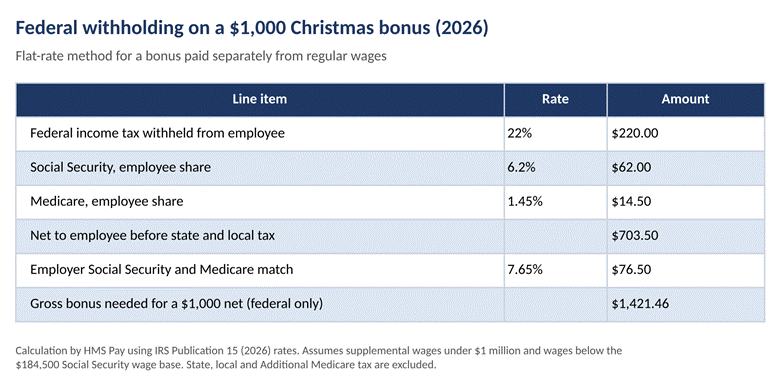
Bonuses are often grossed up by management. This means the worker gets a larger payout than what remains after taxes. When management pays an employee $1,000, and that is the full amount after federal withholding, $1,421.46 had to be paid out by management. State income tax means this number is even higher for some employees.
Bonuses are a business expense. Exactly when the expense is deductible depends on the method of accounting. A business using the cash method of accounting deduces bonuses in the year the cash is paid out. A business using the accrual method of accounting deduces bonuses when the expense is incurred. Generally, a 2026 bonus is deducted on the 2026 return if the cash is paid out by March 15, 2027. Bonuses to shareholders are considered expenses when the cash is paid out. A CPA can clarify the rules regarding bonuses.
The method of payment doesn’t affect the amount of taxes owed. It affects the complexity of taxes.
Wages paid in cash still must be reported, and taxes must be withheld. Because cash can’t have taxes withheld, the withholding must happen from a different wage payment, or an adjustment to the payment must be made by the employer, which is easier said than done.
It’s easier to withhold taxes from bonuses paid by a separate wage payment, since that payment is then considered a bonus for withholding purposes. That payment can then be used to figure out the 22% flat rate of withholding. A record of that payment may also be needed for reporting.
Withholding taxes from a regular wage payment may also be used to figure the 22% flat rate of withholding when bonus pay goes out along with that regular wage payment. However, the payroll software may use the aggregate rate to determine the amount of taxes to withhold. That means more federal taxes may be withheld from the regular wage payment.
Gift cards count as cash equivalents, so they are always fully taxable and reported. The IRS fringe benefit guide (Pub. 15-B) allows a holiday gift that isn’t cash to qualify as a de minimis perk.
Because cash and cash-like items stay fully taxable and reported, a food basket may also count as a de minimis perk.
Christmas Day 2026 falls on a Friday. The Federal Reserve has declared it to be a bank holiday. As of now, FedACH processing on that day will stop at 11:30 p.m. on December 24 and restart at 5:30 p.m. on December 27. Transactions processed via ACH on December 24 will not be settled until December 27. Payroll companies determine their own cut-off times, and in this case, their deadlines will also be the ACH transaction cut-off times.

Although the final quarter is typically a slow quarter, that does not mean the bonus pool should not be distributed. Amendments to the bonus plan should be considered.
Bonus plans always include an expense. Each cash bonus of $10,000 increases the employer’s FICA taxes (Social Security plus Medicare) by $76.50, if the employee is under the yearly cap on wages taxed for Social Security. Federal unemployment tax (FUTA) is only assessed on an employee’s first $7,000 in wages each year. Therefore, a December bonus to an employee would not result in FUTA tax. State unemployment tax rules may differ.
Gusto’s 2024 data report indicated that the average bonus amount increased by about 2%, and the number of employees receiving a bonus decreased by about 2%.
Decreasing the pool for cash gifts is preferable to no gifts; cash gifts are more tax favorable to the employer if paid before January 1. Cash gifts may also be expended in early 2027, and may be excluded from the employer’s payroll taxes if the gifts are of a low, de minimis value. Accrual-basis employers may use extra cash on hand to give employees taxable bonuses, paid time off, or reimburse employees for qualified expenses. Paid time off may be given before December 31, to be used at a later date.
Finally, if the pool is not distributed by year-end, bonuses may no longer be paid until next January.
The way an announcement is worded can determine how bonus pay is perceived under the Fair Labor Standards Act (FLSA).
Discretionary bonuses are defined in 29 CFR 778.211 as bonuses where the employer still hasn’t finalized its decision regarding the amount or the recipients of the bonuses. This final decision must occur as the bonus determination period draws to a close. Bonuses that are promised ahead of time through a contract or agreement, an offer letter, or an announcement are considered non-discretionary. For non-exempt staff, these promised payments get added into the hourly figure that overtime is based on.
Christmas bonuses are excluded from overtime calculations and may be anticipated by employees. The exclusion applies even when that payment was promised for more than one year. The amount of the bonus cannot be determined based on the employee’s work or service for a given period.
To ensure excludability and to provide employees the maximum amount allowed under the Christmas bonus exclusion, management should announce the bonus close to the payment date. The amount should not be based on employees’ performance relative to a standard. The standard may be expressed as a goal, target or objective. A goal, target or objective that is not expressed in measurement terms is referred to as a “wild” goal, target or objective.
Management should limit the payment to the goal, target or objective in order to exclude the bonus from overtime calculations. A wild goal, target or objective should not be expressed in monetary terms. Management should ensure that employees understand that a wild goal, target or objective has been established and expressly communicated to employees.
From an administrative and financial consideration, payments to employees should occur no later than December 24. Payments made to employees on or before December 24 will be processed in 2026.
Payments to independent contractors for holidays or similar occasions are not wages. The payment is considered nonemployee compensation and no payroll taxes are withheld or paid by the business.
The One Big Beautiful Bill Act increased the reporting threshold for the Form 1099-NEC from $600 to $2,000 for 2026 and subsequent years. If a contractor receives 2 or more payments totaling $2,000 during a year, including a holiday bonus, the business is required to issue a 1099-NEC to the contractor. Adjustment of the threshold for inflation will begin in 2027.
To avoid questions about employee status for a contractor who is paid a bonus like an employee, the contractor should be paid a thank-you or appreciation bonus. Employee status questions may also arise if the contractor is paid a holiday bonus. These questions may be addressed by a CPA or employment attorney.
Each year, small businesses grapple with setting Christmas bonuses. Gusto reported an average of $2,789 per owner for 2025. According to the BLS, bonuses remain rare, especially for employees in the private sector. As a result, any type of end-of-year bonus is typically appreciated. The structure of a Christmas bonus (e.g., flat, percentage, or tiered) determines who gets what. The IRS lays out the rules for 22% flat-rate withholding.
Payroll taxes also play a role. The IRS decides whether bonus pay counts as taxable income, and the DOL plays a role in determining whether that payment is connected to overtime pay. The Fed determines what day of the year is the last acceptable business day for bonus payments. A business owner can avoid surprises by paying the Christmas bonus before the new year. Because this is not legal advice, an attorney or CPA should be consulted.
According to Gusto’s payroll data for December 2025, the average small business bonus was $2,789, up 11.5% from December 2024.
No. The federal government does not impose a separate income tax on bonuses. However, thanks to Publication 15 from the IRS, many employers will withhold a 22% tax from bonus payments.
Yes. Bonuses in any form are taxable. Gift cards are considered cash equivalents and, therefore, reportable as wages on Form W-2.
Yes. Bonuses paid to non-employees are still reportable on Form 1099-NEC, and a new form must be issued if the total annual payments reach $2,000.
Reduce Your Fees, Upgrade Your Service.
Your information will not be distributed
We received your request. A payments specialist will reach out shortly.
