
Posted: November 13, 2026 | Updated: November 13, 2026 at 12:03 PM
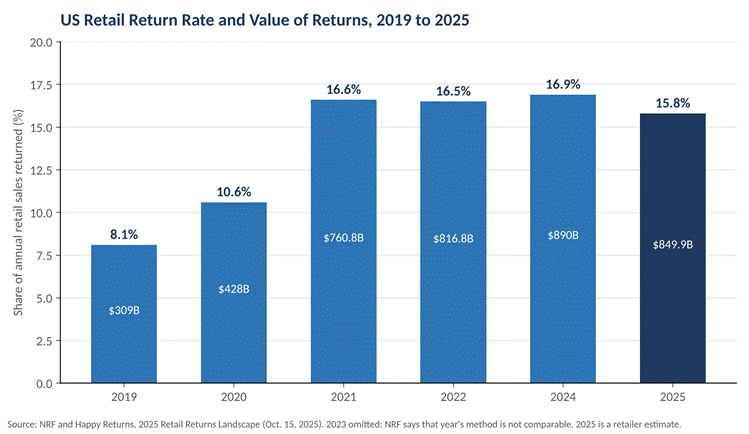
Returns currently cost retailers a significant amount of money. According to the NRF and Happy Returns, in 2025 shoppers will return around $849.9 billion worth of products, accounting for 15.8% of all sales. The NRF expects returns of online purchases to increase to 19.3%.
There is a cost associated with each return. There is handling, inspection, and repackaging. If a seller wants to recoup some costs, they can implement a restocking fee. Generally, customers don’t agree to this fee. This article explains restocking charges, along with the situations in which large retailers implement it. The article also describes laws pertaining to restocking fees and how the fee is charged. Restocking fees are also evaluated in the context of a chargeback situation.
Restocking charges are the portion of refund money a seller holds back when a buyer sends an item back. This term is not frequently defined by the law; however, Arizona Revised Statutes, Section 44-1377 provides one such definition. Under this definition, the seller charges this fee for readjusting an item back to stock. The Connecticut Department of Consumer Protection also provides a simpler definition for this term. According to them, this is the charge borne by a seller for transporting an item back to the seller’s warehouse.
Restocking fees are either charges based on a set share of what the item cost or a flat rate charge. Connecticut General Statutes, Section 42-110aa states that sellers must list any restocking charges in their refund policy. Restocking fees should also not be confused with damage charges. The customer return policy of Amazon illustrates that a restocking fee and a damage fee are two different charges.
No US federal law restricts the amount a seller may charge for restocking. Return policies, however, are governed mainly by the state. The FTC’s Cooling-Off Rule is an exception to this. The consumer information page of FindLaw states that this rule applies to certain sales made by vendors through the ‘door-to-door’ sales method.
There is no national average for restocking fees published by any government agency or trade group. The best available information is published schedules by retailers. Of the major U.S. retailers, two publish their restocking fee policies.
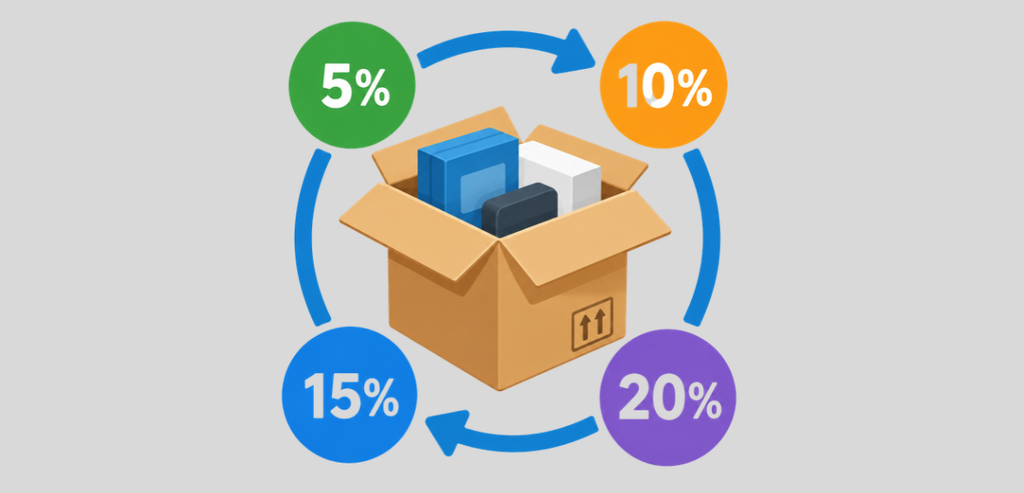
Best Buy’s return policy states that certain electronics are subject to a fee. This policy was checked on November 6, 2026, and two fee tiers were listed. The first tier, a $45 flat fee, was associated with cell phones, tablets, hotspots, and wearables. The fee excluded prepaid phones. The second and more inconsistent fee tier was 15% and was applied to drones, cameras and lenses, camcorders, projectors and projector screens, cold tubs and saunas, special order items and other products.
Best Buy skips the fee when a product comes back sealed and unused. Shoppers in Ohio, Iowa, Hawaii, Alabama, Colorado, South Carolina, Oklahoma and Mississippi also pay no fee. The policy also states the fee is charged and collected by the state.
In the past, Best Buy charged the 15% fee on additional products. Engadget reported on December 19, 2010, that Best Buy eliminated this fee for a long list of items including video games, MP3 players and portable DVD players. The 2015 Consumer Report also reported that some sellers charged the 15% and 25% fees on laptops and cameras.
Amazon’s customer return policy page separates two charges. A damage fee of up to 50% of the item price applies when an item comes back damaged, missing parts, used or no longer as it was shipped when neither Amazon nor the seller caused the problem. Luxury Stores items are charged 100%. Amazon keeps 100% of the price on any collectible card, tabletop game, board game or chase-edition figure once its package has been opened. Amazon says tax may apply to restocking fees for customers in Connecticut, Maryland, Nevada, Pennsylvania, Virginia, West Virginia and Wisconsin.
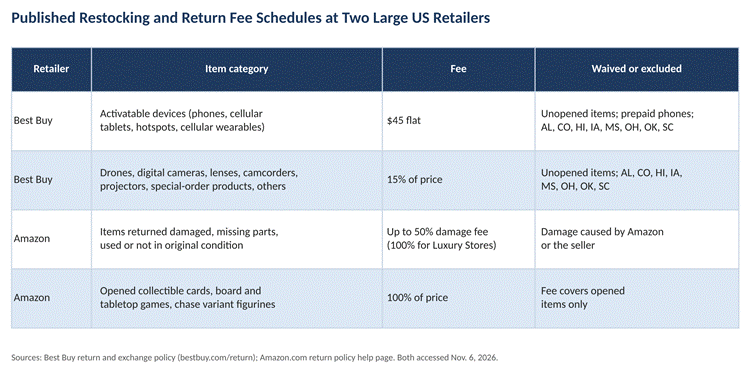
The sample agreements for both Amazon and Walmart provide a useful framework. The agreements state that each will charge a fee based on the type of product. The agreements also exempt charging the fee in situations where the item stays sealed or where the merchant’s employee caused the defect.
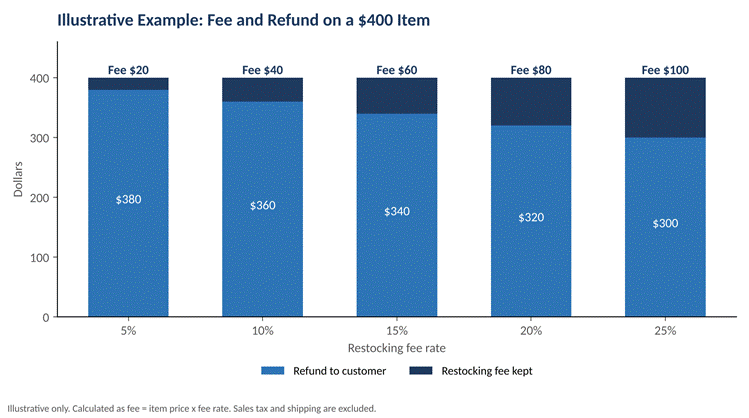
To get the refund, multiply the item price by the fee percentage. The result is subtracted from the original item price. With an item price of 400 and a fee percentage of 15, the refund would be 340. A flat fee functions the same way. If the fee is 10, then the refund would be 310.
You have the discretion to decide what the percentage is reflected in. In responses to sellers on the seller forums, Amazon’s seller support stated that the fee is a portion of the item price, and therefore does not include shipping. A seller must also account for sales tax. Some states’ laws state that fees are nontaxable, but Best Buy and Amazon state that fees are taxable. A spreadsheet restocking fee calculator only requires formulas to multiply the item price and fee percentage.
Defending a fee is easiest when it covers a cost. Electronics can be resold as open box items. Special order items can be hard to resell. Items like large household goods are expensive to transport. The CT Dept of Consumer Protection indicates merchants charge a fee for large goods like TVs and refrigerators.
Abuse of return policies is another rationale for fees. The Appriss Retail report indicates that in 2025, approximately $706 billion was returned and of that, approximately $100 billion was returned due to loss from fraud and abuse.
The cost of implementing a return policy and fees is lost sales. Approximately 82% of consumers indicated that free returns is a value-added benefit and factor into their purchase decision. Return fees protect profitability.
A charge should not be imposed for defective goods. In a judgment regarding a defective faux fur coat published on FindLaw, a New York judge held that a consumer had the right to claim under the Uniform Commercial Code in disregard of the store refund rule. Best Buy and Amazon also waive their charges in cases where the seller is in the wrong.
Size does matter. House Bill 5571, which was introduced to the Connecticut Legislature in 2025, would have limited the fee charged for a transaction in which the merchant failed to provide a refund to 5% of the purchase price. The bill passed out of the General Law Committee with a 22-0 vote, but was not enacted.
States generally require that an insurance policy be shown to the customer before payment is received. A few do specify particular locations and ways to provide evidence of insurance to customers.
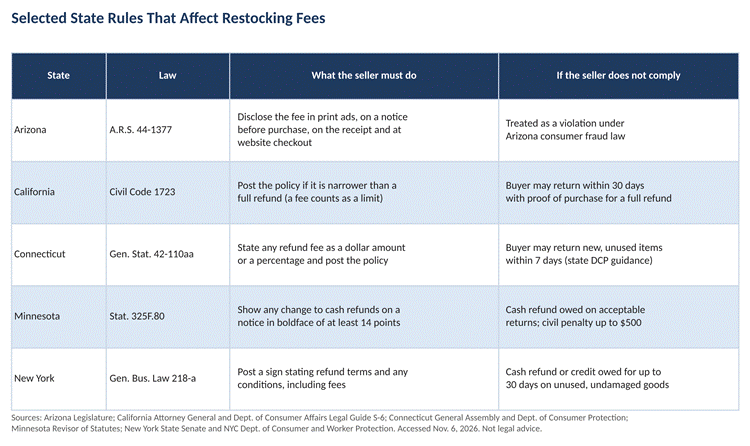
Under Arizona law, any business charging a fee must disclose it in multiple ways. The business must give notice at the place of business, on receipts, in advertisements, and on its website. Arizona defines a failure to follow these requirements as an unfair and deceptive trade practice.
Section 1723 of the California Civil Code states that a seller must post its limited refund policy, if the seller offers a refund, and charges a restocking fee. California’s Department of Consumer Affairs provides that a limited policy may include a restocking fee. The California Attorney General says a buyer can get all of their money back for 30 days after purchase when a seller charges a restocking fee without posting its policy.
A New York City business must post a sign stating its refund policy. New York City’s consumer protection agency states that a notice must state restocking fees. A Minnesota seller must provide notice to consumers, in boldface type, if the seller gives less than a full cash refund.
Each of the summaries is limited and may not reflect more recent changes in the law. Because online businesses may be subject to the laws of the state where the consumer is located, a business lawyer may be able to provide more useful information.
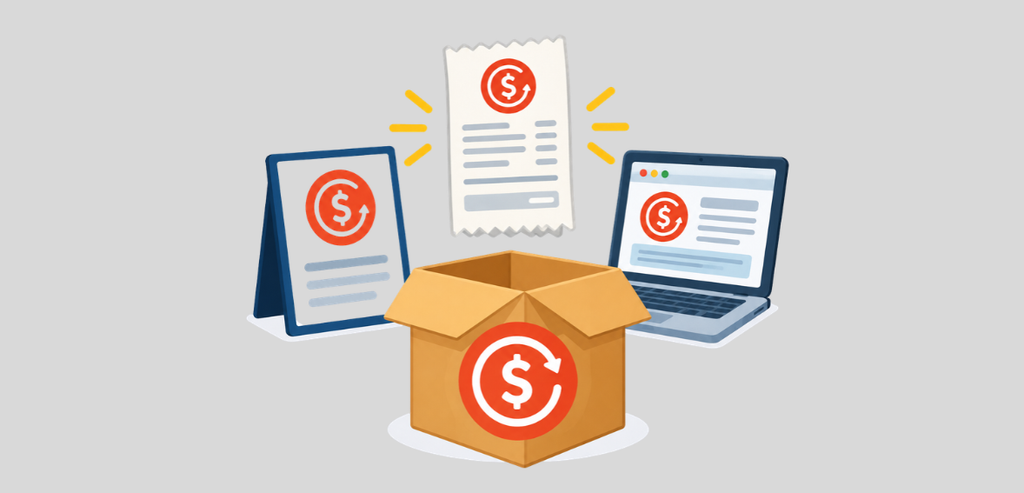
Place signs listing restocking fees where customers pay. New York allows placement at each public entrance, cash register, or on individual products. Signs must show how much the fee is, products charged a fee, the return period, and exemption of unopened items. A line requesting a copy of the policy is also required.
An example sign reads, “Restocking Fee: 15% for cameras, drones, and projectors that have been opened. Fee will not be charged on unopened or defective items. Request a copy of the policy if you would like more information.”
Receipts are considered secondary notification. In a 2019 report, Georgia’s consumer protection division noted policy statements printed on receipts do not constitute notice to customers because receipts are provided to customers after a purchase is made. Arizona statute requires policy statements disclosed on receipts to be printed in a size commensurate with other information on the receipt.
Restrictive return policies should be disclosed on product pages and during checkout to prevent chargeback losses. Visa instructs merchants to obtain a signature indicating acceptance of restricted return policies. Kount advises the use of a “click to accept” policy statement located near the purchase transaction button.
You can use the restocking fee template below to quickly create your own restocking fees. Adjust the sample data to reflect your products and costs.
Return and Restocking Fee Policy
Returns are accepted for up to 30 days after delivery or pickup with a receipt or order number.
Unopened items in original packaging are refunded in full to the original payment method.
Opened items in the following categories carry a 15% restocking charge based on the item price: cameras, drones, projectors, and special-order products. The fee does not apply to shipping charges.
Items that arrive damaged, are defective or were sent in error carry no restocking charge.
Items returned used, damaged by the customer, or missing parts may be refused or refunded in part after inspection.
Refunds are issued within 10 business days after we receive and inspect the item.
A written copy of this policy is available at any register and on our website.
Keep the wording for the website, in-store signs, checkout receipts, and transaction receipts identical. Any variation allows the consumer and the card issuer to contest which of the variations was relied on.
A restocking fee does not deter customers from initiating a chargeback. Customers can always contact their issuing bank to reverse the charge. A fee policy provides evidence to the merchant in a chargeback case.
Visa reports in its Dispute Condition 13.7 that merchants can lose authorization to submit charges for merchandise or services if they do not disclose their policies to customers. Visa outlines instances where charge authorization can be denied and indicates that the merchant must provide evidence to Visa that the Customer limited return policy was disclosed to the Customer at the time of purchase. Visa states that the documentation must also be signed by the Customer.
The Mastercard Chargeback Guide states that policies about restocking fees or store credits constitute restrictive terms, and if a merchant wishes to impose such terms, they must disclose the terms to Customers. If a merchant does not disclose their terms about refunds, the Guide states that the merchant is obligated to accept the return of the Goods.
If a merchant charges a fee and is unable to demonstrate to Visa that the Customer was presented the opportunity to accept the fee before charging the Customer, the merchant will likely be unsuccessful in their chargeback case and will be required to absorb the chargeback fee.
While state laws vary, restocking charges are usually allowed across the US when the buyer is told about them before purchase. California, Arizona, Connecticut, Minnesota and New York have specific disclosure laws, and Arizona actually mandates the name of the fee. Best Buy, for example, charges a fee in the range of 15% and a flat fee of $45, which applies only to phones. Best Buy as a store policy, caps the fee on other opened items.
Return policies are acceptable to the card associations if the policy is disclosed and accepted at the time of the transaction. A merchant is authorized to refuse a return if it can present evidence, in the form of signs, receipts and/or other records, that it has a returns policy.
Yes, provided the buyer sees the fee before paying. Restocking fee laws vary from state to state. In Arizona, for example, you must disclose restocking fees as a separate line item.
An average is hard to find, but Best Buy takes 15% off the refund on certain products that have been opened. Be ready to back up your fee amount with your actual handling costs.
Yes. Restocking fee signs are required in California, Arizona and New York (and probably other states as well). If you operate a multi-state business, it makes sense to post signs in as many states as possible to be safe.
No, but charging a restocking fee gives you a better case for closing the dispute if it is charged back.
Reduce Your Fees, Upgrade Your Service.
Your information will not be distributed
We received your request. A payments specialist will reach out shortly.
