
Posted: November 11, 2026 | Updated: November 13, 2026 at 11:20 AM
Small businesses rely on tax deductions to decrease what they owe in federal tax. For sole proprietors, a decrease in income results in a decrease in self-employment tax liability. Unlike two years ago, the tax rules for 2026 are different.
Public Law 119-21 took effect on July 4, 2025. It modified various business tax laws. It more than doubled the Section 179 cap. It also made full first-year write-offs permanent for assets acquired on or after January 20, 2025. Starting in 2026, a contractor must receive $2,000 or more before a 1099-NEC is needed. In July 2026, the IRS also raised the per-mile rate for business driving partway through the year.
The checklist included in this reference guide lists and describes commonly claimed small business tax deductions for 2026. The guide discusses the records small businesses must retain to support a tax deduction. This guide only discusses tax deductions available to small businesses under federal tax law. State and local laws may differ.
The article is printed below and can be saved as a PDF. Bring this page with your year-end receipts. Each line in the table contains the name of a cost, how the expense is classified by the Federal Government for 2026, and the documentation supporting the cost.
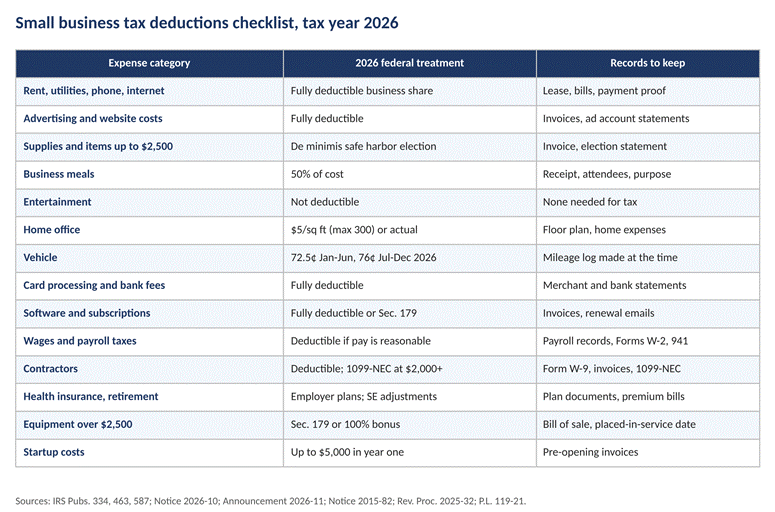
Figure 1. One-page deduction checklist for tax year 2026.
Each entry in Section 162 of the federal tax code is a standalone row. The costs associated with each row must be ordinary and necessary for your business. According to the IRS, a cost is deemed ordinary if it is typical and accepted in your business. A cost is necessary if it is relevant and fits your business. A cost need not be essential to pass this test. Expenses that are incurred in the course of a trade and are paid from business funds are not treated as costs incurred in the trade if the expense is personal.
Operating expenses are costs of doing business. Expenses paid in a given year are deductible in that year for businesses that keep cash-basis books. Examples of operating expenses are business rent, utilities, business phone and internet services, business insurance, and advertising. Expenses that are paid in a year can be written off in full that same year for cash-basis businesses.
Costly items that serve the business for years are usually written off gradually as depreciation. Some exceptions apply. The IRS allows small businesses to fully expense, or write off, small business assets that are $2,500 or less. A business can use this exception on an item or on each line item on an invoice. For example, a business owner can fully write off a business computer that costs $1,800 all at once when it is bought.
Meals must be charged 50% by IRS Ruling 463. A business meal must be charged to an employee and involve a business discussion. Meals charged this way must also be separated from any entertainment charges. The deductibility of meals changes drastically based on the type of event charged. Since 2018, tickets to sporting events and concerts, as well as tickets to golf events, are 100% nondeductible. Food purchased at the event may be charged at 50% provided the cost is separated from the ticket. Section 274(o) changed the rules to state that beginning in 2026, meals a company serves its staff on its own premises, for its own convenience, are 100% nondeductible.
A similar cap exists for startup costs. New section 195 allows a new business to deduct $5,000 of startup costs and sets a limit at $50,000. The deduction available is reduced by one dollar for each dollar of startup costs in excess of $50,000. Any costs not deducted are recovered over 15 years.
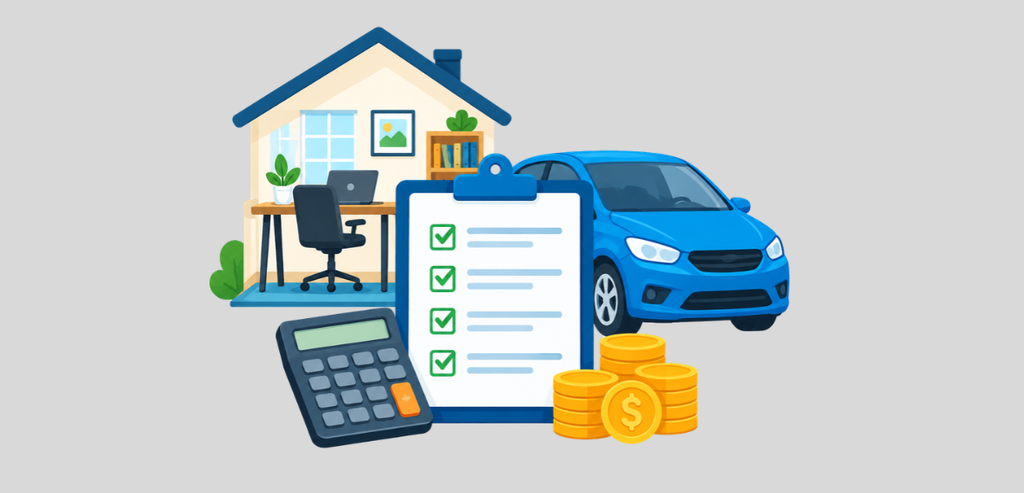
The home office deduction is based on usage. According to IRS Publication 587, a space has to serve the business exclusively and on a regular basis to qualify. For example, a guest room would not qualify. Nor would using a laptop on the kitchen table qualify. A home office must be a place where you meet with clients. It may also be a studio, detached from your home.
There are 2 methods for calculating this deduction. The simplified method sets the limitation at $1,500 a year by taking $5 per square foot, only if the home office does not exceed 300 square feet. The other, more complex method requires completing Form 8829 and calculating the share of the residence given over to the business and deducting it from the true costs of owning and maintaining the home. The home may also lose value due to aging (depreciation), and that may also qualify for the deduction. The limitation set on this business loss is the gross income the home business generates. Unlike the simplified method, the regular method of calculating this loss allows the carryover of an unabsorbed business loss to the following year.
Deducting business driving expenses happens in two ways. The first uses a flat cents-per-mile figure that the IRS publishes. In Notice 2026-10, the IRS announced the business per-mile figure for January through June of 2026 would be 72.5 cents a mile. In Announcement 2026-11, the IRS lifted it to 76 cents a mile for any trip taken on or after July 1, 2026. Drivers should be aware of the separate rates for January through June and July through December and take a mileage log to show which rate they should use each month.
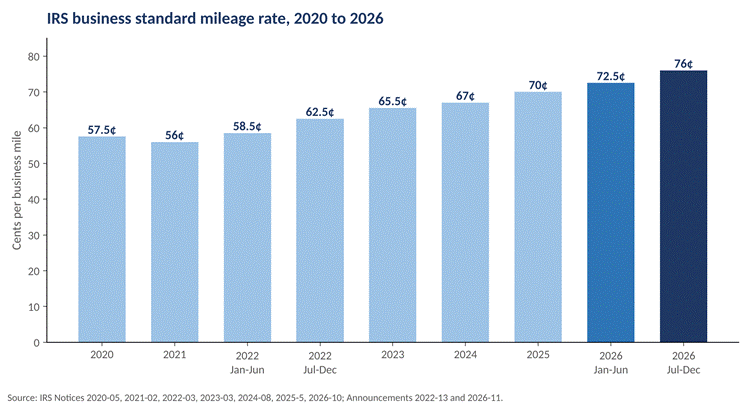
Figure 2 shows the standard business mileage rate for 2026, showing the mid-year increase.
CPA Practice Advisor reported on July 16, 2026, the 2026 rate of 76 cents was the highest rate since 2022, when the rate increased to 62.5 cents from 58.5 cents.
The second option for claiming a deduction is to determine your actual expenses. These expenses are the costs of operation and maintenance (repairs, oil changes, tires, registration, etc.) and mileage used for business. Tolls and parking fees are also deductible. The cost of driving to and from work is a personal expense and is not deductible.
You must decide which method to use for the first year you own or lease a vehicle. If you own the vehicle, you may choose which method to use for the first year and use the other method in subsequent years. If you lease the vehicle, you are locked out of the other method for the duration of the lease.
Deductions exist for ordinary and necessary business expenses, including fees financial institutions charge to accept payment methods from customers. Examples of these expenses include credit card processing fees, payment gateway fees, ACH fees, terminal rental fees, and fees charged to process payments. Fees charged by financial institutions, including monthly fees charged on business checking accounts, are also ordinary and necessary expenses and can be written off in full. Further, fees for sending wires and fees charged to complete a business transaction can also be claimed in full. Interest expense related to business loans and credit is also claimable in full.
Many businesses mistake the reporting of sales and the deduction of cost of sales on the tax return. Sales reported on a Form 1099-K by a payment processing app or service is inclusive of all fees charged by the processor or app. The Form 1099-K reports the gross amount of sales made using the payment processing service or app. Businesses should report the gross sales made via the payment processing app or service and take a direct business expense deduction for the processing fees. The IRS will compare the net amount of sales reported on the 1099-K and the business’s tax return income and may challenge the business if these figures do not correlate.
A provision in the 2021 tax law reversed the change made by the 2018 tax law that increased the reporting threshold for payment processors. As a result, payment processors will once again only have to report payments made by payment apps and online marketplaces if the payee receives more than $20,000 and more than 200 payments in a given year. Transactions processed by card readers are reported by the card processor; Merchants are not required to wait for a form to report business income.
Naturally, there are exceptions. Expenses can only be reported if a Form 1099-K is issued. Thus, a subscription-based service charged on a monthly or yearly basis can be reported as an expense if the service is relevant to the business.
When software is purchased outright, e.g., off-the-shelf design or graphic software, its price can be expensed under Section 179 rules or the small-purchase safe harbor (items costing $2,500 or less) during the purchase year.

For businesses, payroll expenses are normally the largest expense and, accordingly, payroll expenses are among the largest deductions. For a payroll expense to be deductible, the compensation must be reasonable in relation to the service provided. Accordingly, salaries, wages, commissions, and bonuses qualify as deductions. So are the employer’s Social Security and Medicare taxes and the employer’s share of federal unemployment tax. Draws taken by a sole owner are not wages and are not deductible.
Money paid to freelancers and other outside contractors can be written off in full. Before 2026, a business had to send a 1099-NEC to any contractor who received $600 or more in a year. The 2025 tax law changed this and requires a Form 1099-NEC be issued only if a contractor receives $2,000 or more over the year. For 2026 payments, these forms must be provided to the IRS and to the contractor by February 1, 2027. A Form W-9 must be completed by the contractor before the first payment, even if the payment is less than $2,000.
Expenses benefit the business. Health insurance, pensions, and tuition reimbursement are business expenses. The same is true for business owners. Other expenses benefit the owners. Self-employed persons may write off the premiums they pay for health coverage for themselves and their family members. This income adjustment is not allowed for months when the person could obtain health insurance through their employer or their spouse’s employer. The other adjustment to income is for self-employment tax.
Retirement plans are an opportunity for the self-employed to take large business expense deductions. Notices 2025-67 and 2021-36 state that, for 2026, the IRS limits deductions for SEP-IRAs to the lesser of 25% of compensation or $72,000. Based on IRS Publication 560, the effective deduction rate for an owner who works for themselves is approximately 20%.
In addition, a business owner may take a deduction for a franchise (Section 199A) of up to 20% of their business’s qualified business income. Congress made this deduction permanent in the July 2025 tax law. The House version of the bill would have increased this deduction to 23%.
Capital assets are defined as equipment, machinery, vehicles, and furniture that stay in use for more than a year. Spending on these assets is normally written off over time as depreciation. Depreciation is a method of expense recognition that spreads an asset’s price across the years it serves the business. Two special methods let a business recover an asset’s price during its first year of use. These methods are; Section 179 and 100% First Year Expensing.
This rule allows businesses to expense eligible property during the first year it goes to work in the business. The 2025 tax law increased the cap to $2.5 million for tax years from 2024 to 2028, and created a phase-out from $4 million. Purchases were indexed for inflation in Rev. Proc. 2025-32, resulting in a cap of $2.56 million for 2026 and a phase-out beginning at $4.09 million. Consequently, for 2026, qualifying purchases exceeding $4.09 million would be subject to a dollar-for-dollar reduction for the write-off.
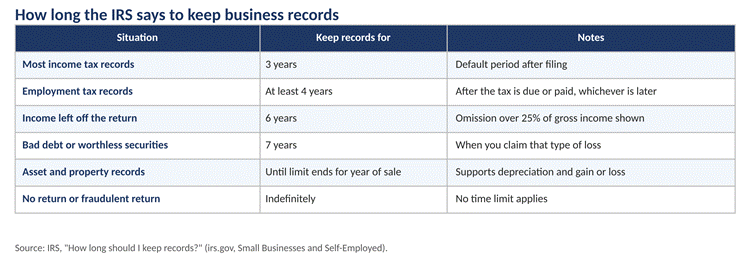
Figure 3. 2018-2026 Section 179 Deduction Limits and Phase-out
The deduction is limited in two ways. First, the deduction cannot be more than the individual’s taxable income from the active business in that year. The excess, if any, is allowed in later years. Second, the asset can be used in the active business no more than 50% of the time.
The second method is bonus depreciation. Permanent 100% bonus depreciation was included in the same statute and covers assets acquired from January 20, 2025 onward. It has no dollar ceiling, which Section 179 does, and it may push a taxpayer into a loss. Section 179 is taken on an asset-by-asset basis. Bonus depreciation is taken on a class-by-class basis. To use bonus depreciation with respect to a class of property, a taxpayer must disapply (opt-out) bonus depreciation with respect to all property in that class.
The strength of a deduction depends on the evidence supporting it. The IRS states records must show the amount and that the expense was for the business. Receipts and invoices are records of an expense. Canceled checks and statements show payment. The IRS usually accepts records as they were when prepared. Therefore, records made many months after the expense was incurred may not be as persuasive as records created at, or near, the time of the expense.
This is particularly true for records relating to the use of a personal vehicle for business (i.e. odometer readings taken on January 1 and December 31 to show the mileage used for business). Records relating to the use of personal property (i.e., a copy of the bill of sale and when it was first used for business) should also be kept. Home office records (i.e., a copy of the utility bills and a floor plan showing the dimensions of the office space) should also be kept.
Figure 4. IRS record retention periods for business tax records.
Records are generally kept for the time periods specified by the records they support. The IRS states that records should be kept for 3 years. Employment tax records must be kept for 4 years. Records about property should be kept for as long as the statute of limitations for the year in which the asset is sold or disposed of.
Tax year 2026 increased limits in several areas. For section 179, the cap now stands at $2.56 million. Bonus depreciation returned and is set at 100% with no expiration. The business mileage rate returned and stood at 72.5 cents through June, then rose to 76 cents starting in July. Forms 1099-NEC are only required to be filed in the 2026 tax year if more than $2,000 in non-employee compensation was paid during the year.
Card processing fees, bank fees, and Software are still deductible. Gross Receipts are still reported. All deductions are for expenses that are ordinary, necessary, and paid by the business. Rules change and no two businesses are the same. For peace of mind, consult a CPA before filing.
Yes. Generally, business expenses are deductible, and credit card processing fees fit within that definition. Report your gross sales on your tax return and then deduct the fees.
Maybe. It is assumed that you conduct administrative tasks at your shop. However, if you do not conduct administrative tasks at your shop, and your home office meets the other requirements of a qualifying home office, then you could claim the home office deduction.
You should keep a journal with your business travel and trip details, and yearly odometer readings. You should also keep expense receipts if you use the actual expense method.
You should hire an accountant when you experience major changes to your business such as hiring employees, purchasing large business assets, selling your business, or if the IRS audits your business.
A checklist cannot consider the facts and circumstances of your business the way an accountant can.
Reduce Your Fees, Upgrade Your Service.
Your information will not be distributed
We received your request. A payments specialist will reach out shortly.
