
Posted: October 21, 2026 | Updated: October 21, 2026 at 10:45 AM
Business payments are evolving. In the past, businesses have been using checks to pay their suppliers, process invoices, and settle expenses. However, as companies seek to digitize their operations and reduce paperwork, costs, and delays, electronic payments are set to play an increasingly important role.
One such electronic payment method is the Automated Clearing House (ACH) network.
According to the Federal Reserve’s analysis, as of September 2026, US businesses sent around 8.7 billion (B2B) payments via ACH in 2024. This is nearly 2.5 times more than 3.6 billion ACH transfers in 2015. At the same time, the number of business-to-business payments made by check has dropped by almost 40%.
These numbers reflect the industry trend towards the transformation of payment methods and practices. ACH is now the most common B2B payment method in terms of transaction volume, and checks are slowly being phased out.
The question that arises for businesses is whether to adapt their payment sending and receiving methods. To do this, it is necessary to consider ACH and understand its differences from other B2B payment methods, as well as its advantages in invoice processing and accounting.
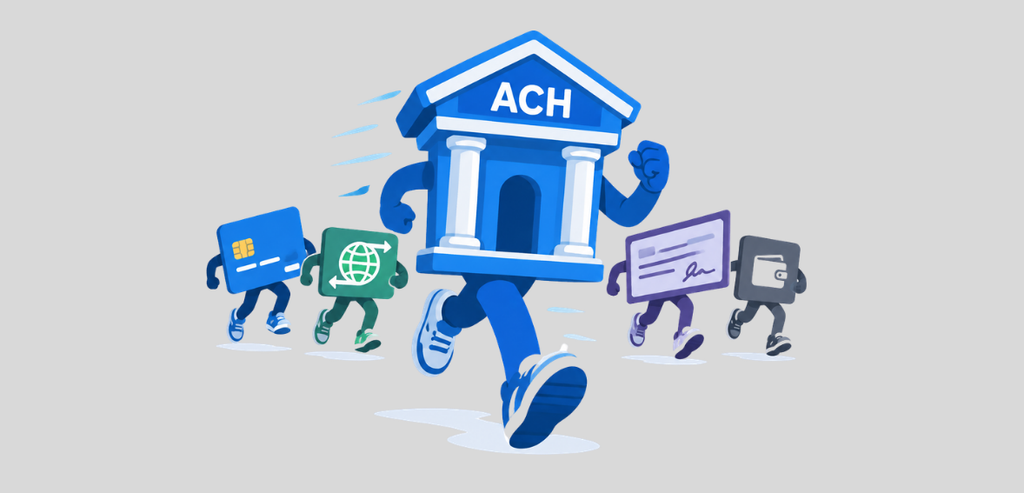
According to the data provided by the Federal Reserve, there is a noticeable trend in US business payment methods. While the use of ACH transfers continues to rise, check payments decline.
In 2015, checks were the most common method of B2B payments in the US by volume. Indeed, 4.6 billion B2B payments were made using checks and 3.6 billion using ACH transfers. Meanwhile, in 2024, ACH transfers took the lead, providing 8.7 billion B2B payments, while check payments decreased to 2.7 billion.
In 2015, 25% of B2B payments were made through ACH transfers, which increased to 41% in 2024. At the same time, the share of B2B payments made using checks as a medium dropped from 32% to 13%.
However, it does not mean that companies have given up on using checks. Nearly 90% of firms used checks for some of their business payments. The main reasons for this are the existing payment infrastructures, vendor preferences, and internal policies.
The report also covers disbursement volumes and values, including ACH and wire transfers. The latter have the highest value among others, at about $1 quadrillion, while ACH handles an estimated $70 trillion in B2B payments in 2024, and checks handle about $15 trillion.
This difference is essential because the most popular method of payment is not entirely suitable for all types of transactions. Thus, businesses are expected in the future to choose between ACH, checks, and wire transfers for their unique needs. The former is perfect for recurring transactions, checks are typically part of the process for many businesses, and wire transfers are used to facilitate large-value transfers.
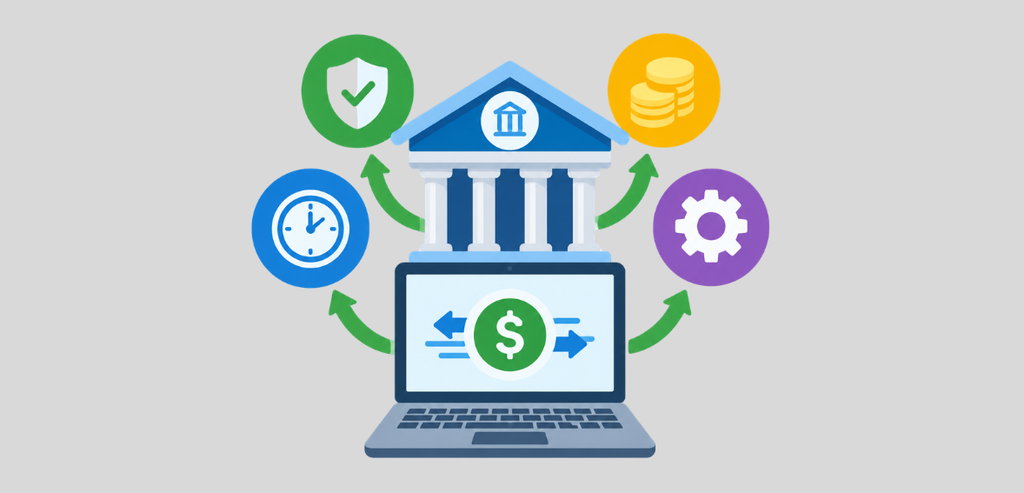
ACH is a payment method that allows businesses to make electronic transfers between bank accounts. Firms can use it to pay suppliers and receive invoice payments from other companies, as well as for other business expenses. Several factors contribute to why ACH business-to-business payments have become widespread.
Payment fees can be expensive for a company with hundreds of payments received and sent on a monthly basis. ACH typically has lower fees for transfers than credit cards and wire transfers, and therefore companies are interested in processing payments through ACH.
According to the Federal Reserve analysis, the median ACH fee for both sending and receiving organizations is approximately $0.25 to $0.50 per transaction, compared to a median of about $1 for a check. In comparison, wire transfers had a median fee of around $7 for the sender and recipient.
The figures presented are based on industry estimates, and actual fees may depend on the particular processors and banks. As such, companies need to consider ACH to reduce their expenses in the case of a high transaction volume.
Paying by check involves several steps. First, the buyer should prepare and deliver the check, which should be deposited and accounted for by the supplier. Thus, if the check is lost or misplaced, both parties will have to spend time and effort finding it.
ACH reduces a lot of paperwork. Electronic transfers are made from one bank account to another. This means that businesses do not have to write, deposit manually, and process checks into their own accounts.
This can significantly reduce the hassle involved in the payment process for finance teams and save them valuable time on mundane payments. However, businesses need to keep track of payments and update payment records.
Many expenses of a business have a repetitive nature. Firms make recurring payments to suppliers, get paid for services, and make other regular payments under contract.
ACH can help with such transactions by letting businesses collect or pay money electronically and, if necessary, set up a payment schedule without requiring a check every time.
For instance, a company that offers monthly maintenance services to its clients could allow them to pay for these services via ACH. This way, once the customer authorizes a direct debit, the company will be able to collect payments in accordance with the agreed-upon schedule.
Such a method seems convenient, although the businesses should still keep track of the due dates, failed transactions, and customer approvals.
Electronic payments can help businesses track money going in and out of their bank accounts: they can check the dates of transactions, amounts of money moved, and more, all without having to look over paper records.
If ACH is connected to invoice or accounting software, it might also help businesses ensure payments are matched to the right invoices, depending on how much information comes with the payment.
ACH can help reduce some payment issues, but it cannot eliminate them all. ACH can help businesses establish better payment procedures.
If your business sends invoices to other businesses, offering ACH can make paying those invoices easier for your customers. It can also help save your employees time on processing checks and chasing down payment details.
First, determine whether your payment processor supports ACH and what information is required to enable payments. Based on your payment processor, you may want to add a toggle for ACH within your online invoices, payment portal or customer billing area.
Make the payment instructions clear. Customers should know how to choose ACH, what payment data they need to enter, and whether they need to authorize the payment.
It is also essential to describe the terms for when one expects the payments to clear. The reason why standard ACH deposits do not clear right away is that they are dependent on numerous external variables, which include the submission time, the banks involved, the payment type, and whether Same Day ACH was used.
For regular business invoicing payments, offer ACH as an alternative to other payment methods. Some of your clients might want to pay via bank transfer, while others might be required to pay by credit card due to their financial and accounting needs.
Make sure that the invoices have all the necessary information needed to identify a specific invoice – numbers, client’s reference, and description of the payment. This will help the finance department to sort and process the payments quickly.
Although ACH usage is growing, cards still play a significant role in B2B payments. Cards are convenient and often allow businesses to make payments without giving the bank account details for every transaction.
For instance, when a customer logs into a supplier portal, they may want to pay the invoice with a credit card, as it is a secure and convenient method. Also, businesses can use a credit card to pay for goods or services and profit from the rewards program tied to their card.
Cards could also be more convenient for organizations that need to collect payments via an online checkout. The customer would be able to enter the card information, make the payment, and get a confirmation message from the payment system.
However, card payments can cost more for the business receiving the money. Processing fees are often based on a percentage of the transaction amount, which can make cards expensive for large invoices.
ACH has become the most common B2B payment method in terms of transaction volume, as companies are gradually shifting from traditional paper-based payments to electronic transfers. According to the Federal Reserve’s data, ACH payments more than doubled from 2015 to 2024, while check payments are declining.
ACH payment methods can be beneficial for companies, as they help automate repetitive transactions and reduce the volume of paper-based operations, thus cutting costs. At the same time, checks, cards, and wire transfers still play an important role in business payments, and the choice of a payment method depends on the payment size, cost, timing, and other factors.
If your business relies on checks, consider offering ACH on your invoices and reviewing how payments are recorded and reconciled. This improved efficiency will free up your employees’ time for other tasks.
Simplify the way your business accepts payments. Sign up free. The platform is free to use, with costs covered through payment processing.
Yes, ACH payments often cost less than card payments, especially for large invoices. Actual fees depend on your payment provider and pricing plan.
Standard ACH payments usually take 1–3 business days. Some eligible payments can be processed faster.
Yes, you can set ACH as the preferred payment method for large invoices, subject to your customer agreements and applicable rules.
