
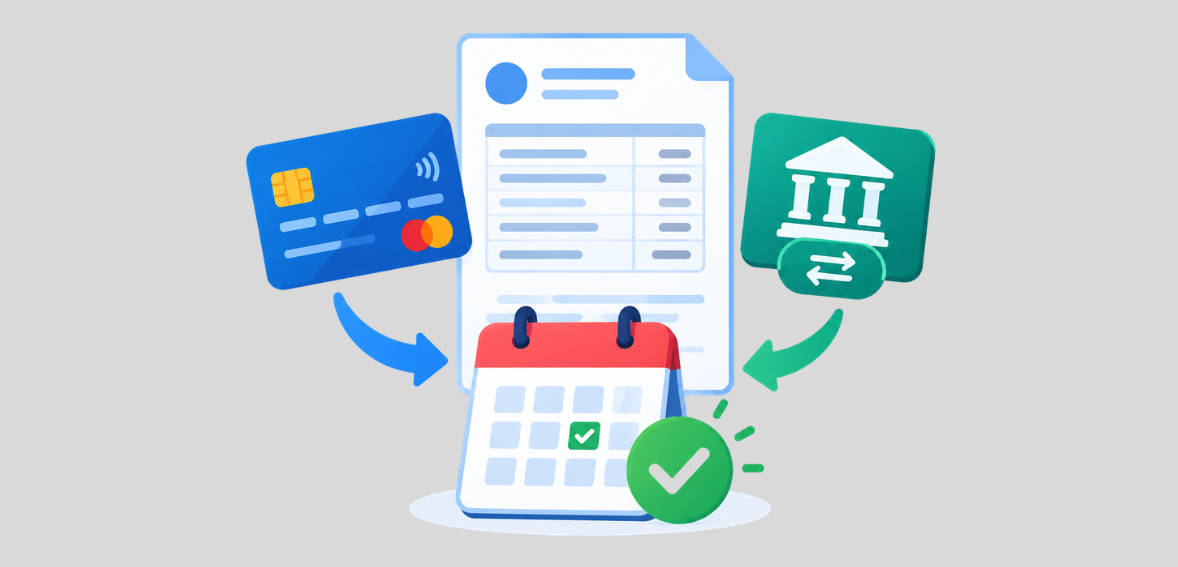
The movement of money from the customer to the seller and the recording of that transaction against the correct invoice is called invoice payment processing. The ACH Network, which is run by Nacha, processed a record high of 35.2 billion payments worth $93 trillion in 2025, as reported on January 29, 2026. Nearly 8.1 billion of those payments were business-to-business (B2B) payments, a nearly 10% increase from 2024.
The other side of that statistic is the prevalence of late payments. The 2026 Atradius Payment Practices Barometer for North America, published September 16, 2026, revealed that 69% of surveyed businesses experienced late payments. On average, 23% of B2B receivables are made up of delinquent invoices.
This guide explains how electronic invoice payments work, the costs associated with cards and ACH, how the use of Level 2 and Level 3 data impacts card transaction fees, and how to tie each payment to the correct invoice.
Atradius conducts an annual survey on B2B payment behavior. Its 2024 report on the US market found that approximately 50% of all B2B invoices remained unpaid past the due date. The average rate of bad debts was 8% of all B2B credit sales. Atradius’s 2023 report revealed that over 55% of all B2B invoiced sales remained unpaid past the due date, and the rate of bad debts was approximately 9%.
The 2024 report identified the main reason for late payment. US respondents stated that the main reason for payment delays was administrative inefficiencies in the customer’s payment process. On average, overdue invoices were collected 20 days past the due date.
The 2026 edition for North America showed similar findings. Most overdue payments were collected within 30 days from the due date, according to Atradius. Additionally, Atradius noted that more respondents were concerned with the creditworthiness of their customers.
The Intuit QuickBooks 2025 Small Business Late Payments Report, published March 26, 2025, surveyed 2487 U.S. small businesses in January 2025. It found that 56% of small businesses had unpaid invoices and the average amount owed was $17,500.
The same report tied the acceptance of digital payments to the small business’s acceptance of digital tools and services. Small businesses that were more impacted by overdue invoices had lower adoption of digital tools and services, such as accounting software and cloud services. Intuit reported this as a correlation, not a cause.
Pay-now options allow customers to make payments directly from an invoice. Selecting one of the payment methods and completing the payment will automatically record the payment and the associated invoice in the seller’s books.
Invoicing tools provide different payment methods on their site. Generally, customers have the options to pay by card or by ACH. For business customers, ACH payments are made in the CCD format. For consumers who authorize an online debit, Nacha classifies the payment as a WEB entry.
Nacha sets the rules for the ACH Network. Effective March 19, 2021, Nacha’s WEB Debit Account Validation Rule requires a seller who accepts ACH debits online from consumer accounts to validate the account number before its first use and before any change to the account number. Nacha outlines different methods to validate an account number, including micro-deposits and Application Programming Interface (API) based validation services.
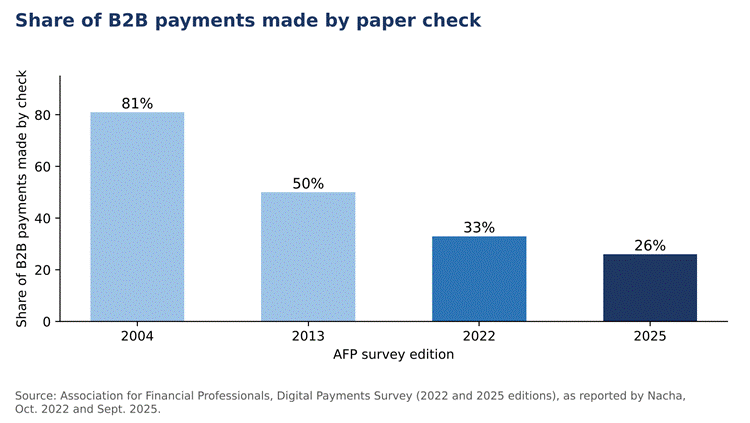
The Association for Financial Professionals (AFP) studies how companies pay each other. The 2025 Digital Payments Survey revealed that checks comprised just 26% of all B2B payments, the lowest level recorded since AFP began tracking, and a dramatic decrease from the 2004 level of 81%. On the payments received side, checks comprised 25% of B2B payments received in 2025, a significant drop from the 2004 level of 75%.
AFP said the switch from checks to ACHs is primarily due to convenience and safety as well as cost factors. According to Nacha, citing AFP, the cost to send/receive ACH payments is 26 cents to 50 cents. The cost to issue a check is $2.01 to $4. In the 2026 AFP Payments Fraud and Control Survey, released April 14, 2026, 58% of the surveyed organizations reported check fraud in 2025. Fraud via ACH Debits was 30% and via Wire Transfers was 25%. Business Email Compromise was reported by 74% of the surveyed organizations. According to AFP, 72% of the surveyed organizations that still issue checks plan to continue doing so.
Business Email Compromise is of significance to pay now initiatives as a fraudster who alters an invoice email can easily replace the payment request or bank details with a payment request or bank details of a fraudulent account. Sellers can minimize the risk by sending invoices from a consistent domain and by verifying any changes to bank details requested through a known phone number.
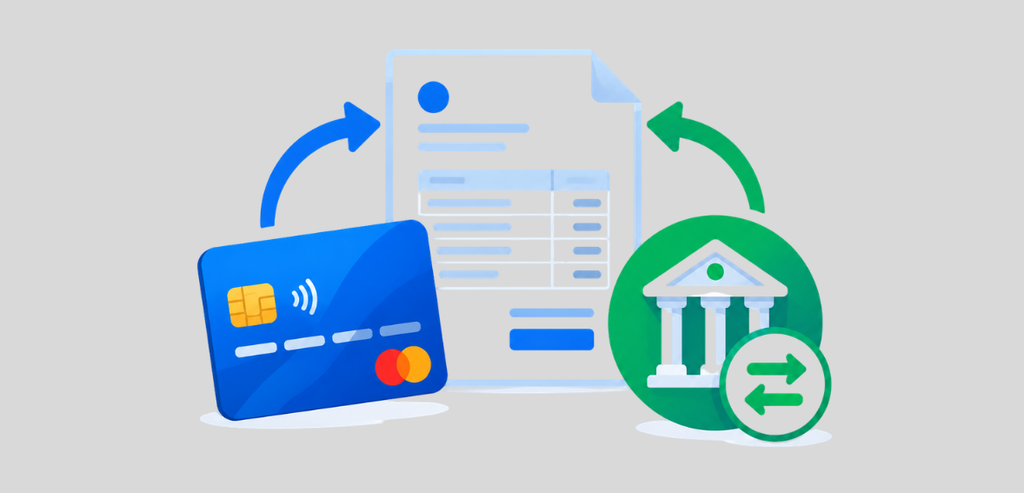
Card and ACH payments both have their advantages and disadvantages. Real-time authorization with Card payments allows customers to make purchases up to their credit limit, while ACH payments charge less to process, but take longer to settle.
Fees for Card payments are often a combination of a percentage of the payment and a set fee. Most of both parts is interchange, which goes to the card-issuing bank, plus the processor’s markup.
Sellers can pass on Card fees to customers by charging a surcharge in certain cases. Visa has lowered its US surcharge cap to 3% effective April 15, 2023. A Visa surcharge cannot exceed the lower of the seller’s cost of acceptance or 3%. Sellers should confirm current notice requirements with their acquirer. Credit cards are the only cards surcharges can be charged on. Surcharges are not allowed on debit or prepaid cards, even when run as credit. Some states have laws that restrict or prohibit surcharging, so these laws set a second limit. A seller that wishes to surcharge should check current laws with their processor and attorney.
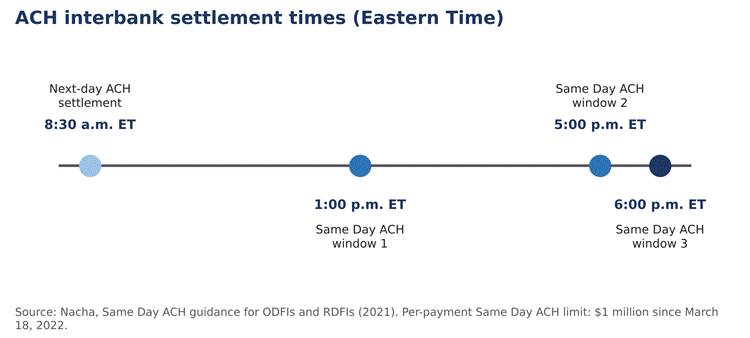
The ACH Network processes payments in batches. Next-day ACH credits process and settle payments by 8:30 a.m. Eastern Time on the settlement date. Same Day ACH processes and settles payments in three windows at 1:00 p.m., 5:00 p.m. and 6:00 p.m. Eastern Time. Each Same Day ACH payment can be up to $1 million since March 18, 2022.
Funds availability and settlement are two different things. According to Nacha, the receiving bank must make funds from Same Day ACH credits available by 5:00 p.m. local time. Next-day ACH credits funds availability is by 9:00 a.m. local time on the settlement date. The receiving bank must receive the file by 5:00 p.m. local time on the previous banking day.
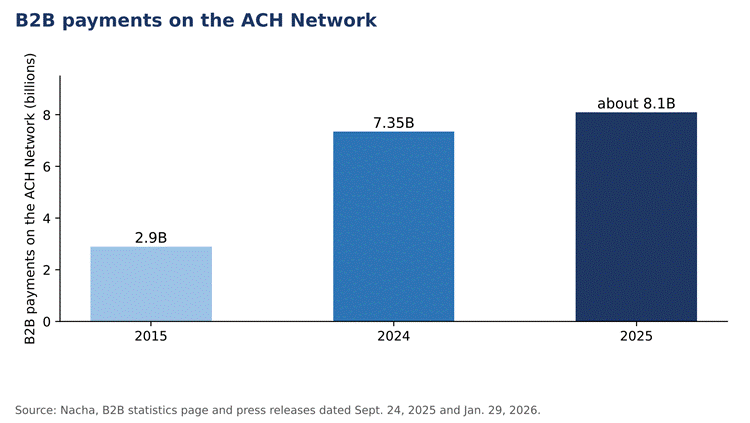
According to Nacha, ACH has further penetrated the B2B space. Between 2015 and 2024, the volume of B2B payments made on the network surged from 2.9 billion to 7.35 billion. In 2025, Nacha reported that 8.1 billion B2B payments were made. Same Day ACH settled 1.4 billion payments worth $3.9 trillion in 2025. On average, this equates to 5.8 million Same Day ACH payments per day. From Nacha’s October 16, 2025 report, between July and September 2025, B2B payments made on the ACH network totaled $16 trillion, representing 69% of the total ACH payments made in that period.
One detail that distinguishes ACH from cards is that a debit can come back after it has settled. The majority of returns (insufficient funds (R01) and an unauthorized debit to a business account (R29)) must be sent to the seller’s bank within two banking days of settlement. Debits to a consumer account can be returned within 60 calendar days. Debits for insufficient funds can be reinitiated up to two times within the 180 days following the original settlement date.
| Factor | Card | ACH |
| Settlement timing | Set by the processor’s funding schedule | Next-day, or Same Day windows at 1:00, 5:00 and 6:00 p.m. ET |
| Per-payment limit | Customer’s available credit | $1 million per Same Day ACH payment; no Nacha cap on next-day |
| Passing fees to the customer | Credit card surcharge up to 3% on Visa, where state law allows | Not covered by card network surcharge rules |
| Main return or dispute window | Card network chargeback rules | 2 banking days for most returns; 60 days for unauthorized consumer debits |
Commercial cards (e.g. corporate and purchasing cards) generally bear a higher interchange rate than many consumer cards. For a transaction to be processed, the acquiring bank sends a request to the issuing bank and returns the authorization to the merchant. The cardholder and merchant do not know what happens during this authorization process, which typically happens within seconds. The card networks charge a higher interchange fee when less data is sent with the transaction (e.g., Level 1). Level 2 data adds fields such as sales tax and customer or purchase order codes. Level 3 data adds additional information such as the line-item description, commodity code, and the quantity and the unit of the item, and the unit and line item cost. Mastercard integration guides state that, along with Level 2 data, additional line-item details and financial totals are required to qualify for the lower interchange rate.
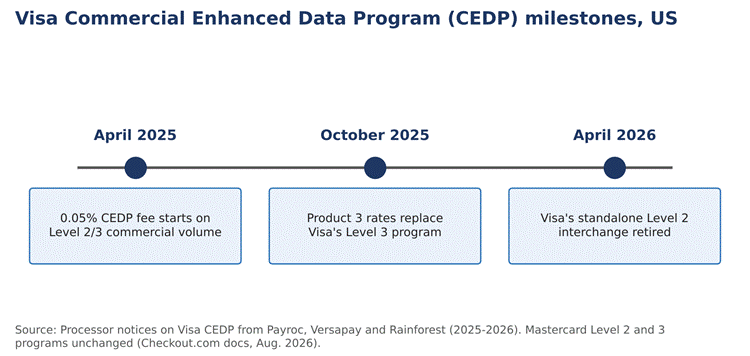
Visa updated its US program with the Visa Commercial Enhanced Data Program (CEDP). A 0.05% fee for Level 2 and Level 3 data was introduced in April 2025. From October 2025, the new CEDP Product 3 replaced Visa’s Level 3 program. Visa stopped having a standalone Level 2 Interchange program from April 2026, only allowing it for commercial fuel transactions. For Visa, the accuracy of the data matters. Visa’s program documentation indicates it uses the enhanced data to automate reconciliation and card program audits for the banks that issue the cards. For CEDP Product 3, merchants must qualify by submitting accurate and complete Level 3 data.
No change for Mastercard. Per processor integration documentation dated August 28, 2026, Mastercard’s Level 2 and Level 3 programs are not impacted with Visa’s change. The same documentation mentioned that American Express supports Level 2 data only.
Invoice payment does not require any additional input other than what is listed on the invoice. To qualify for the lower rates, the payment request page just needs to pass the line items, tax and purchase order to the card payment page. With the invoice data, there is no need for additional input.
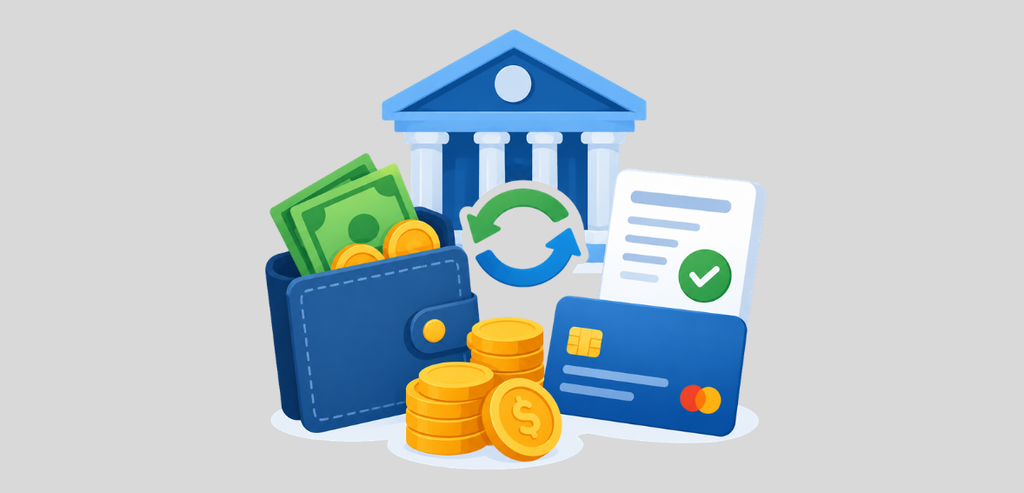
Invoices are seldom paid in a single transaction. Often the work begins with a deposit. Large balances get paid out in many installments. Credits are issued for pricing and other adjustments. In every case, the payment record and the balance of the invoice have to be kept in step.
Deposit invoices may be issued with a separate number, but on the final invoice, the deposit is shown as a payment, and the balance is shown as payable.
Partial payments are best done by the customer entering the payment amount on the payment screen. Each payment is then applied to the same invoice number and the balance is updated. Without this link, the finance team receives payments without any relation to which bill is being paid.
A credit memo is issued when the customer is due a reduction for some reason. The credit memo references the original invoice. The invoice balance and the pay now amount are both reduced with the credit applied. A customer may see an outdated payment amount on the payment link. If the customer pays the full amount shown, this results in a refund or an unapplied credit.
If a payment is made on an invoice and that payment comes back for insufficient funds within the 2-banking-day window, that invoice needs to be reopened for that amount. A card chargeback works the same way.
Matching, also known as cash application, is when a payment is linked to its corresponding invoice. Payments are typically made using the invoice’s pay-now link. In those cases, the invoice number is included in the payment, and matching is not a problem. Payments made through other means, like check, require the remittance information be included to facilitate matching.
Addenda records, used by ACH, allow remittance information to be sent with a payment. In the formats supplied by Nacha, remittance information can be included in a payment with a CCD+ entry. CCD+ entries allow up to 80 characters of payment information. The CTX format allows up to 9,999 addenda records per payment. This means a single payment can settle many invoices with full remittance information.
The following must be reflected in every payment record for a matching process to work successfully:
Card payments can also have the references attached. Level 3 data has the purchase order number and line items. Processing the invoice number in the transaction description makes matching easier on the card side.
Atradius 2024 has relevance here as well. Administrative inefficiency was the #1 reason U.S. customers paid late. A payment that cannot be matched remains open on the seller’s ledger and the invoice can look overdue, even though the customer has paid.
The US has largely shifted to electronic processing for invoice payments. As reported by AFP in 2025, checks comprised 26% of B2B payments, down from 81% reported in 2004. Nacha reported that in 2025 there were approximately 8.1 billion B2B ACH payments. Late payments are still common, with Atradius reporting that in September 2026 seven out of ten North American companies experienced this issue.
Processing payments by ACH is cheaper than by credit cards. The median cost by ACH, reported by AFP, is 26 to 50 cents. If the business accepts payment by credit card, it can surcharge within the 3% cap, as imposed by Visa, if allowed by state law. Business card fees are lower if the seller sends full Level 3 data to the buyer, which Visa has required since April 2026 to qualify for its lower commercial rates. Each payment should close against its invoice. Remittance data sent via ACH or credit card authorization allows each payment to close the correct invoice.
Yes, invoices can include a “pay now” button to accept credit card payment. On Visa credit cards, a surcharge of up to 3% may be charged where state laws allow.
The card processing fees are charged to the seller by default. The seller may pass the fees to the buyer by adding a surcharge to the card transaction. This may occur within the limits of the card network and state laws, but not for debit card transactions.
Next-day ACH payments are settled by 8:30 a.m. ET on the settlement date. Same Day ACH payments, which may be sent at 1:00, 5:00, and 6:00 p.m. ET, are limited to $1 million.
Reduce Your Fees, Upgrade Your Service.
Your information will not be distributed
We received your request. A payments specialist will reach out shortly.
