
Veterinarians depend on local trust, perhaps unwillingly. Pet owners will trust you not to kill their pet via negligence, and they will trust you to put appropriate charges on their invoices. The second kind of trust is often unconsidered, but is very important.
Payment fraud is a silent attack on customer trust. Every business that handles cards is susceptible to payment fraud, and so are veterinary clinics. One instance of a fraudulent transaction can steal a clinic’s staff time and payment.
EMV technology was invented to combat this. EMV technology uses a stronger method to combat fraud than the weak security of old magnetic stripe cards. For veterinary practices, this technology greatly reduces the risk of fraud, and in turn, retains clients.
This article describes EMV technology and the payment difficulties that veterinary clinics face. It also describes how EMV technology reduces fraud, how to implement the technology, and how to protect payments made outside the veterinary clinic service counter.
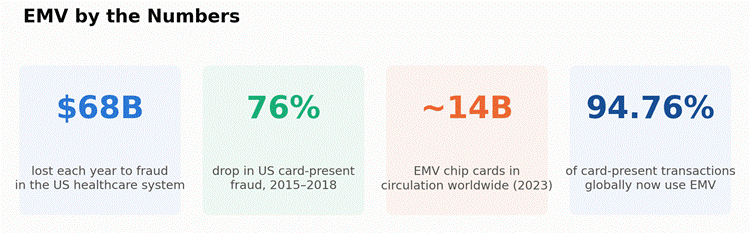
Figure 1. The scale of the fraud problem and EMV’s global footprint.

Fraud is an opportunistic crime that is often predicated on the movement of large sums of money in a short period of time. This is why fraud can be so prevalent in veterinary clinics. Clinics receive a large volume of payments for many different services and products. Fraud is prevalent in a large volume of money transactions in any country. The U.S. healthcare system is said to experience approximately $68 billion in losses due to fraudulent acts each year. Many experts believe that fraud contributes to 3- 10 percent of the total spending in the healthcare system. Veterinary services fall under the same umbrella of services.
High volumes of transactions is just one of the many concerns. Many veterinary transactions are completed without a physical credit/debit card. Quite often, a client will complete a payment (for a refill or a follow-up service) over the phone.
Remote transactions pose an even larger threat because they often lack the payment verification that is standard in an in-person transaction. This creates an opportunity fraudsters will exploit.
Beyond the cost of a transaction, fraud will deplete resources intended to improve patient care, then further alienate the clients that are critical to the ongoing success of the clinic.
EMV is short for Europay, MasterCard, and Visa. These three organizations collaborated on the standard, and it has become the international standard for safe card payments.
The EMV standard has a microchip at its core. Each card has a microchip embedded within it. This chip performs a function that a magnetic strip could never do.
For each payment, that chip generates a unique code for the transaction. This unique code can only be used for that one transaction and will never be able to be used again.
This feature is a contrast to earlier card technologies. Once information is written to a magnetic strip, it becomes a fixed piece of information and can never be changed. A chip, on the other hand, can generate a new code for each transaction that is used.
Because information on the chip varies for each use, stolen information becomes really useless. For example, if a criminal captures the unique code for a transaction, they gain nothing because that code is no longer valid by the time that criminal tries to use it.
To understand the significance of EMV, we should first consider the history of payment fraud. Payment fraud has always been practiced in concert with available technology. As payment cards evolved, so did the corresponding payment fraud methods.
The first magnetic stripe cards were introduced in the 1970s. American Express introduced the first of these cards in 1970. Unlike the cards in use today, those magnetic stripe cards held static data.
The card’s magnetic stripe data served its purpose, but its static data became a problem. Because it was static, fraudsters developed the capability of reading and copying the magnetic stripe data.
The invention of skimming and cloning payment cards soon followed. Hidden payment card terminals were used to read, and thus capture, a payment card’s data. The data was then written to a blank payment card, which was used for free spending.
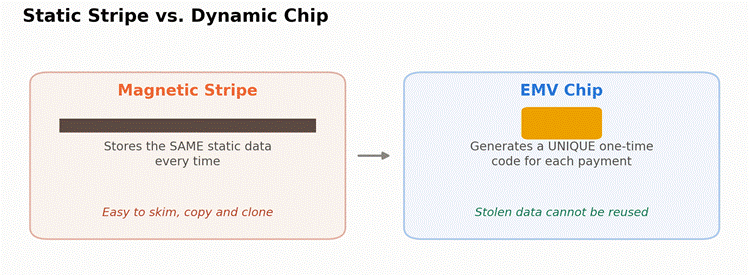
Figure 2. Static magnetic-stripe data versus the one-time codes generated by an EMV chip.
EMV shifted the paradigm. With EMV, instead of static data, a unique code is generated for each transaction. Since this code is tied to a specific transaction, there isn’t a reused code, so stolen transaction data is worthless.
Once the EMV chip gained adoption, the results from issuance were significant. In the United States, between 2015 and 2018, there was a 76% decrease in card-present fraud. This significant decrease happened after the U.S. made the transition to chip-based payments.
EMV improves card transaction security through authentication. The EMV card chip authenticates by proving the existence of the card in the transaction by utilizing data that is not static and changes with every transaction.
A major source of card fraud is creating a duplicate card to conduct a transaction in person. When cards only had a magnetic stripe, this was easy to do. EMV cards make this a much more difficult process to replicate.
Creating a duplicate card with a chip embedded with a microprocessor is virtually impossible. As a result of these advancements, the most prevalent source of in-person transaction fraud is eliminated.
Many veterinary clinics experience the benefits of EMV chips through every transaction conducted at the clinic. Fraudulent cards are easily detected during a transaction, as the EMV chip validates the existence of the card, protecting the clinic from fraud.

Adopting EMV has several clear benefits, some of which concern the clinic and some of which concern the client, but all of which improve the operation overall.
EMV greatly enhances the security of the clinic and the client. Because EMV incorporates dynamic authentication and uses embedded chips, the risk of card information being captured and replicated by an unauthorized entity is virtually eliminated. Because of this, the security of all transactions done in the clinic is greatly improved.
EMV also shifts the liability for fraudulent transactions from the clinic to the card issuer. Because all payment networks require the latest technology in a business, a clinic that uses the older technology may still be liable for covering fraudulent transactions.
EMV also promotes the trust of the client. Because chip technology is used, clients can feel sure that their financial information will not be compromised. Of course, the client’s trust ensures that they will return to the clinic.
EMV also reduces chargebacks. This is because the improved security minimizes the number of fraudulent transactions. The financial operations of the clinic are greatly improved because of the reduced number of chargebacks.
EMV also promotes the ability of a clinic to be modern. Because all payment technology of today is compatible with EMV technology, adopting EMV allows a clinic to be relevant in the world of changing payment technology.
The rollout of EMV requires some planning, but there is an obvious path to follow. A smooth transition will be the result of careful planning. The processes will need to flow through several connected stages.
The first of the several stages will be upgrading your point of sale terminals. Start by reviewing your current POS systems for any chip support. POS terminals from the past may need a complete replacement or an upgrade in order to read and process the chip cards. The ultimate goal is hardware that interfaces with your Practice Information Management System that processes chip cards.
The second stage will be training staff to be competent in executing EMV chip payments, including both chip and pin and chip and signature transactions. It is important that during this training the staff is informed on the reason this technology is important so that fraud may be prevented.
The third stage will be achieving compliance with the PCI DSS. This is the Payment Card Industry Data Security Standard, and it mandates safe handling of payments by adhering to certain practices and protocols such as constant monitoring of the network and the encryption of data.
As for the fourth stage, clientele should be informed of the clinic’s migration to EMV systems along with the enhanced security measures protecting their payment information. Updated instructions will be needed at each point in the checkout process to help clientele learn to use the new systems.
The last stage consists of monitoring and maintaining the systems. Security systems should be active and ongoing to be effective. Staff training should be periodic, and point-of-sale systems and software should be updated regularly.
This ongoing diligence ensures the practice remains compliant and secure for the long term.

EMV can only do so much. It protects in-person card transactions. However, payments made over the phone or online get no protection.
Card-not-present transactions are extremely common in veterinary practice. Clients will call in to pay for medication refills or pay an invoice over the phone. These transactions require additional protection because the payment chip will not be in use.
The most advanced protection for these types of payments is called tokenization. During a tokenization transaction, the card data is replaced with a unique token. The card details are not transmitted or stored, so the payment data is worthless to a thief.
Payment gateways that have tokenization also protect by encrypting payment data as it moves from one system to another. Many of these payment gateways offer fraud protection by performing fraud checks for every payment that is processed.
Another advantage of payment gateways that perform AVS checks is that the billing address is verified by the card issuer. If the address does not match, the payment is flagged for fraud.
To further prevent fraud, card verification values (CVV) are also checked. The CVV code is another protection the payment gateway provides to validate that the payment is made by someone who is in possession of the card.
Increased protection in payment processing is provided by the requirement of two or more verifications of identity.
Passwords, mobile confirmations, or biometric data such as fingerprints can be considered as proofs. The use of even two or three of these checks makes remote fraud much more difficult to carry out.
EMV isn’t a minor improvement. It’s become the global standard for payment processing. Its widespread adoption is remarkable.
By 2023, there were almost 14 billion EMV chip cards issued. Around 70% of the payment cards issued globally are EMV chip cards. Payment cards are issued with chips in almost every case.
The stats for the use of EMV chip technology are just as impressive. Globally, 94.76% of card-present transactions are processed using EMV chip technology. This statistic illustrates near-complete adoption of chip technology for securing payment transactions at points of sale.
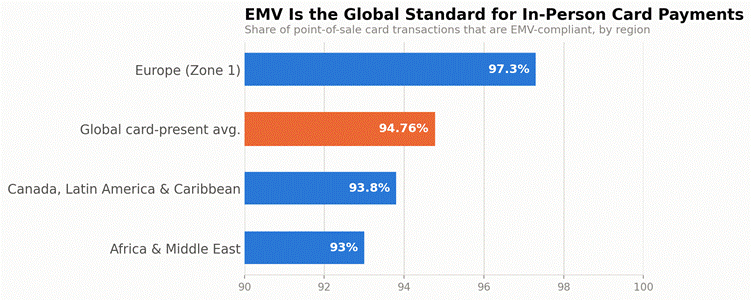
Figure 3. EMV compliance for in-person card payments across major world regions.
Adoption levels are high across major global regions. For Zone 1 Europe, nearly 97.3% of point of sale transactions are EMV compliant. Canada, Latin America, and the Caribbean have an adoption level of 93.8%, while Africa and the Middle East follow at 93%.
This global adoption is good news for veterinary practices. EMV has become the standard, and the expectation of the client is EMV. Having EMV compliance will keep the practice in line with the current payment offerings.
Fraud can be an expensive problem for veterinary practices. The combination of the high volume of transactions and the predominance of remote payments creates an opportunity for fraud. The expense of ignoring the risk will siphon the limited financial resources of a veterinary practice and ultimately serves to diminish the reputation of the practice.
Fraud liability falls to the veterinary practice. EMV chip technology eliminates the vast majority of card-present fraud. Card-present fraud has dropped significantly since the EMV standard was adopted.
The strengthening of fraud protection and the shifting of liability to the card issuer add to the trust of the client, and the chargeback reduction benefits the entire veterinary practice. EMV prepares the practice for the future of payment technology.
The shift to EMV requires an upgrade of payment technology, client communication, and staff training. Meeting the various payment technology standards and regulations allows the practice to combine the new technology with other risk management controls to protect the practice from fraud.
The payoff is client trust. Secure payments safeguard both the clinic’s monetary interests and its partnerships. In a business established upon concern, that safeguard is definitely worthwhile.
Unique transaction codes are generated by chip cards used in EMV technology for each individual payment. Since the codes are single-use, it is practically impossible for fraudsters to replicate or reuse card information. In a veterinary clinic, this technology helps reduce the risk of fraudulent card use at the clinic.
Upgrading eliminates most in-person card fraud by using verified, changing data for each transaction. It also transfers the liability of the fraudulently used card to the card issuer and not the clinic. In addition to that, it demonstrates to the clients that it is protecting their payment data and builds the clients’ trust.
EMV protects face-to-face payments where the chip is read. It does not secure phone or online payments as the chip is not used. For these types of payments, clinics can use tokenization, encrypted payment gateways, and additional checks such as Address Verification Service (AVS), Card Verification Value (CVV), and Strong Customer Authentication.
Yes, and the reasons go beyond prevention of fraud. EMV shifts liability, and the reduction of expensive chargebacks provides reassurance to the client and secures their investment. It also secures the clinic in the future for contactless and mobile payments, which makes it a good investment for a clinic of any size.