

Posted: November 09, 2026
The FDIC’s April 2025 assessment revealed that Discover had incorrectly classified millions of personal credit cards as commercial cards over an approximately 17-year period. This has resulted in Discover Financial Services agreeing to pay between $540 million and $1.225 billion, plus interest, to merchants, acquirers and other intermediaries.
The settlement is for the higher fees processed on the misclassified cards issued during the period spanning 2007–2023. The fees are the amounts charged above Discover’s correct interchange rates.
The judge granted final approval on May 20, 2026. Payments have not been disbursed. Here, we discuss the missteps by Discover, the status of the lawsuit, the expected beneficiaries, and how the Discover interchange settlement differs from the Visa and Mastercard settlements.

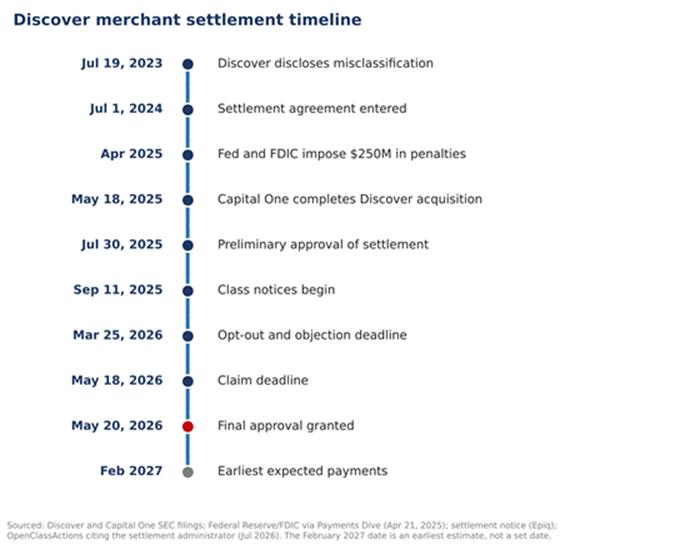
On July 19, 2023, Discover revealed it began miscoding certain credit card accounts in about mid-2007. Specifically, Discover revealed it had been classifying certain personal credit card accounts as commercial cards, which fall in its highest interchange tier. Starting in 2007 and extending to the time Discover corrected this misclassification, thousands of merchant locations accepted Discover cards at a higher interchange rate than otherwise was required.
The correct classification of a Discover card depends on several factors, including, among other things, the issuing bank and the type of card. Discover Bank classified a credit card account as commercial if it thought the credit card account was a rewards, premium, or premium plus credit card account.
Based on the Federal Reserve’s findings, Discover classified approximately five million personal credit cards as commercial in 2022, nearly 98% of which were improperly categorized. The Federal Reserve assessed a $100 million penalty against Discover. The FDIC assessed a $150 million fine against Discover.
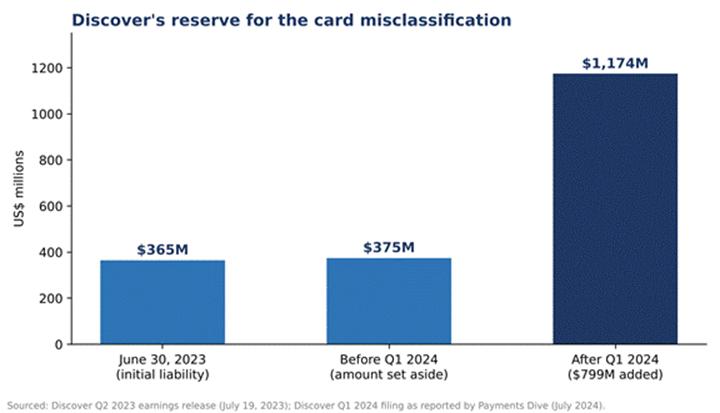
Discover recorded a liability of $365 million as of June 30, 2023. During the first quarter of 2024, the company added $799 million to the $375 million it had already set aside, bringing the reserve to about $1.2 billion. In its Q2 2023 report, the company noted that misclassification-related revenue was less than 1% of the company’s gross discount and interchange revenue.
Capital One acquired Discover on May 18, 2025, as reported in its Form 8-K. Discover Bank became part of Capital One, National Association. Capital One is the surviving bank in the merger.
The case is In re Discover Card Misclassification Litigation, No. 23-cv-04676, in the U.S. District Court for the Northern District of Illinois. Discover disclosed in a filing with the Securities and Exchange Commission that it had entered into a settlement. Judge Steven C. Seeger granted preliminary approval to the settlement on July 30, 2025.
Notices to Plaintiffs were mailed on September 11, 2025. The deadline to opt out and/or object was March 25, 2026. The deadline to submit a claim was May 18, 2026. Judge Seeger granted final approval on May 20, 2026.
According to the notice to class members, payment will be sent once the Court finalizes the settlement. According to Open Class Actions, the claims processing administrator expects payments to be issued to class members no earlier than February 2027. As of October 2026, no firm date had been set for payment.
The class covers merchants, merchant acquirers, and other intermediaries that processed misclassified Discover card transactions in the United States.
The notice recognizes four types of merchants. The steps for Indirectly Affiliated Merchants require them to file a claim by May 18, 2026. Most class members are in this category. Claims for Direct Merchants with Inactive Status are also included in the notice. For Direct Merchants with Managed Active Status, the notice states that an acquirer will send payment to the receiving entity.
For Direct Merchants with Unmanaged Active Status, the notice states that the acquirer will send payment to them. Payments will be issued for the amount of overcharges, plus interest. The administrator has determined the overcharge for every Discover merchant ID from 2007 through 2023. This is called the “MID Amount.” The administrator will determine how the overcharge will be distributed among the acquirer and any intermediaries.
Each eligible person will get at least $10.00. The $10 minimum top-ups are capped at $50 million in total, with other payments reduced proportionally to fund them. If the total overcharge determines that the restitution will be under $540 million, payments will be increased to reach this amount. If the overcharge determines that the restitution will exceed $1.225 billion, payments will be reduced to reach this amount. Payments will be mailed to the class member or their bank via ACH. If a check is not cashed, the funds will be donated to a nonprofit organization.
This process uses your Discover Merchant identifiers. Claimants who received a packet can go to DiscoverMerchantSettlement.com to enter their claimant reference ID and PIN. The site shows the MIDs associated with the claimant’s business.
Find out how your processor passed through Discover interchange. If your processor used interchange-plus pricing, the overcharge was passed on to you. In a flat-rate pricing model, the processor may have absorbed it. The settlement distributes the MID amounts based on who bore the overcharge.
The notice indicates that the administrator may require you to complete a W-9 to verify your identity before making a payment. Update your mailing address if it has changed. You should do the same for your ACH account.
Think twice before paying a filing service. The notice indicates that you are not required to use a filing service to receive a payment. Epiq may be contacted for free at 888-655-3176 or at the email address: [email protected].
Discover is concerned about a dispute over a billing error for a single network. The cases involving Visa and Mastercard are antitrust cases for swipe fees and have two separate settlement tracks.
The first is a $5.54 billion settlement for merchants that accepted Visa and Mastercard from January 1, 2004 to January 25, 2019. The deadline for merchants to file a claim was Feb 4, 2025. The interchange refunds merchants hear about are usually tied to this settlement. As of October 2026, Epiq reported, in a court filing, that $631.7 million had been distributed to 689,340 merchants. (Payments Dive)
The second, a $38 billion rules settlement, was announced in November 2025 and received preliminary approval from Judge Margo Brodie on June 9, 2026. It would reduce credit interchange by 0.10 percentage point and cap standard consumer credit rates at 1.25%. Merchants would save an estimated $38 billion over the span of the settlement. The agreement states, “Class Members shall receive no money payments.” Final approval will be decided at the fairness hearing on November 16, 2026.
Sources: Discover settlement notice (Epiq); Payment Card Settlement FAQ; Reuters and Payments Dive coverage, June to October 2026.
| Feature | Discover settlement | Visa/Mastercard $5.54B | Visa/Mastercard $38B |
| Legal basis | Card misclassification | Antitrust damages | Antitrust rule changes |
| Court | N.D. Illinois | E.D. New York | E.D. New York |
| Period covered | Jan 1, 2007 to Dec 31, 2023 | Jan 1, 2004 to Jan 25, 2019 | Future fees and rules |
| Cash to merchants | $540M to $1.225B plus interest | $5.54B fund | None |
| Claim deadline | May 18, 2026 (passed) | Feb 4, 2025 (passed) | No claim process |
| Status (Oct 2026) | Final approval; payments pending | Partial payments underway | Preliminary approval |
Merchants will receive refunds under the Discover settlement. The fund ranges from $540 million to $1.225 billion, plus interest. Each claimant will receive no less than $10. The final judgment was signed May 20, 2026. Payments are expected to be issued no earlier than February 2027. Businesses that filed a claim should keep their merchant account information (MIDs), tax information, and settlement information up to date with Epiq, the claims processing administrator.
Yes, unless you are a Direct Merchant with Unmanaged Active Status, in which case payment comes automatically through your acquirer. The claim deadline of May 18, 2026, has passed.
The overcharges go back to January 1, 2007, and end on December 31, 2023.
This is a different settlement from the Visa/Mastercard Swipe Fee Settlements. The Discover settlement is for a misclassification on a single network, and the Visa/Mastercard settlements are for antitrust claims.
