
Every veterinary clinic has an identifiable purpose. All clinics desire to provide the best care to animals possible. Like with any profession that yields a product or a service, both the medical and business components, as well as the compassionate element, are equally important.
Payment processing falls within the category of business tasks and is typically an overlooked component of a veterinary clinic. Although the processing of payments is typically not time-sensitive and does not evoke the most enthusiasm, if payment processing is inefficient, it can significantly affect the revenue of a clinic.
A veterinary integrated payment system provides an opportunity for improvement. Each component that is part of this payment system is integrated with the other systems that are used in the clinic. This has a positive effect on the operation of the clinic.
This article is intended to provide an overview of this system and the solutions this system offers. This article also focuses on the enhancements this system provides to the daily activities of a clinic, the relationships with clients, and the finances of the clinic.

Most clinics invest most of their resources into patient care. While this is an admirable focus, administrative tasks still need to happen, and payments are a big part of this.
There are many issues with all of the payment tasks being done manually. For one, staff will spend hours doing data entry when they could be spending that time helping patients. Not to mention, payments and the resulting cash flow become increasingly unpredictable due to the errors that occur.
When you pair your payment system with your Practice Information Management System (PIMS), it resolves the majority of these issues. A PIMS is where clinics keep their clients’ details, their clients’ medical records, and their clients’ invoices. PIMS users will see the clinics’ payments and the associated cash flow benefit.
A lot is riding on this system. The clinics that lose an hour a day to payment busywork lose a great deal more over the course of a year. It means time lost that could have been spent with patients, clients, or taken as a much-needed break.

Looking at the actual problems helps us point out solutions. Most clinics run into a small number of the same problems. These challenge billing, technology, staff and clients.
When it comes to traditional billing methods, records are kept in a paper format and manual entry is required. Details of the invoice are written by someone. Paperwork is filed by someone. Missing information is requested by someone.
This method is slow, and errors are easy. If a number is entered incorrectly, it can result in a confusing payment to the client or a payment that is delayed.
Cash flow gaps are created from these delays. Thus, employees are not able to focus on patient care. The repetitive nature of this work creates burnout.
Multiple practices utilize one system for managing payments and another for maintaining client records. Unfortunately, the two systems are not integrated. The staff compensates for this integration issue by carrying out manual bridging processes.
The manual bridging processes cause several underlying issues among the staff. Data begins to be recorded in both systems. The records tend to be out of sync. To add to the staff’s inconvenience, reconciliation of the records becomes a tedious daily process.
To illustrate, one of the team members is required to manually input the total of an invoice into a card payment system. A mistake in the input leads to a system mismatch, and the team member is required to spend even more time to resolve the mismatch.
The impact of these issues go beyond the first point of contact. Staff waste valuable time and energy managing routine tasks that could be automated. Coding inaccuracies and omissions lead to claim denials. Denials cause more work for staff and further limit the clinic’s already stretched resources.
The effects are felt by clients too. They experience longer wait times at checkout and receive incorrect bills. They are left confused by varying communications of their financial obligations.
Trust is eroded from the cumulative effect of these inconveniences. When a client is confused and loses trust, they are less likely to follow the prescribed course of treatment for their companion animal. This treatment avoidance is likely to result in poorer health outcomes for the animal as well as create greater financial challenges for the clinic.
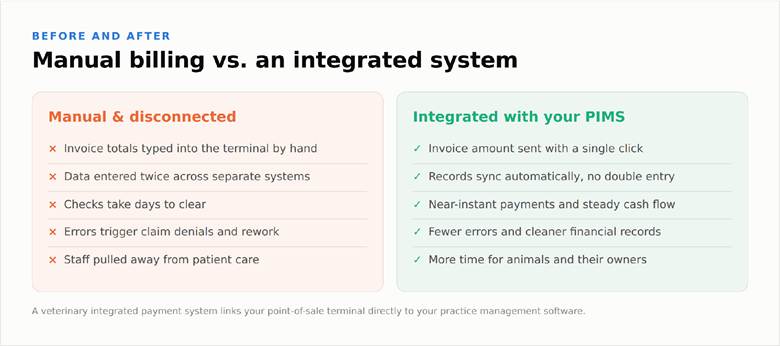
Infographic: Manual billing versus an integrated system.

A veterinary integrated payment system connects your point-of-sale system and your practice information management system (PIMS). These two systems become the same, so information transfers between the two systems without any manual input.
Here’s an example of how it works. After an appointment, you open the practice software to the invoice. With one click, the invoice amount is sent to the payment terminal with no manual input.
The client pays the invoice amount with a card on file. After a card payment clears, the transaction automatically updates the patient’s record.
The same process is used for refunds & adjustments. Any adjustment is made automatically with no manual input. Your financial records are automatically updated and accurate with no effort.
The ultimate goal of the system is connection. There is a single flow of information. Therefore, no information is lost in the system.
The integrated payment system is designed to work silently with your veterinary practice management software. It helps reduce errors, makes financial record matching easier, and enables your staff to focus on caring for the animals instead of administrative paperwork.
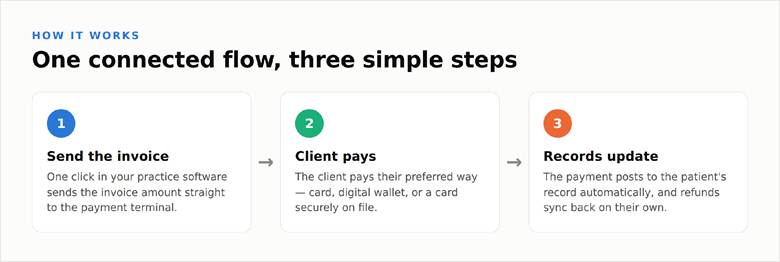
Infographic: How an integrated payment system works in three steps.

The advantages of integration spread throughout the clinic. Some benefits are more direct and assist clients. Others have a more indirect, positive impact on operations. The combination helps the clinic function better and stay stronger at the same time.
Checkouts are the ultimate way to summarize the success, or failure, of a visit. The final summation is often based on the speed and ease of the payment process. If the payment process is slow, or just poorly executed, the result is often a frustrated client and a negative impression of the entire visit.
Current payment trends have pet payment behavior changing as well. Payment by credit card is the most common payment method, but many other payment methods are available, such as cash, eChecks, Apple/Samsung/Google Pay, etc.
As a solution, an integrated system works best. This will allow pet owners to choose the payment method that suits them the most. Transactions become efficient, and the closure of the visit is on a good note. For the clients and for the clinic.
Integration automates processes that would otherwise consume employee hours. Reconciliations are done in the background. Data entry is reduced to a single click.
Invoice totals go to the terminal. Patient charts update without the need to click. Manual input errors are eliminated.
Your staff can concentrate on less tedious tasks. There is more time to spend on the patients with less time spent on admin tasks. The clinic is more efficient and has a better overall atmosphere.
Entering data by hand introduces a high degree of variability in the internal accuracy of the data. Especially with financial transactions, an inaccurate entry can frustrate a client and/or cost the practice money. These errors are difficult to pinpoint and even more difficult to correct.
Incorporating an integrated system reduces the risks associated with manual entry. An integrated system transfers payment information across domains automatically, thus maintaining the high accuracy of records.
This has a positive impact on accounts receivable as well. In this case, payments are recorded and reconciled with minimal manual effort. In this instance, every dollar is accounted for.
Solid information leads to solid answers. With integrated systems, as soon as a payment clears, the system automatically updates your financial records. You won’t have to wait for the end of the week.
You’ll have a real-time perspective of your clinic’s finances. You can monitor emerging revenue trends. You can identify your revenue streams and determine if a payment has not been made.
With this level of visibility, you’ll be able to make better decisions. You are able to evaluate the current financial status of your practice. You are able to make plans with certainty as opposed to relying on your best estimates.
Paying via the traditional methods– like sending a check or an invoice– is inherently a slow process. Checks take multiple days to clear, and sending invoices requires follow-ups and reminders.
In a typical busy clinic, these delays become cumulative and create a huge problem. The clinic funds its operations with the money it receives from its patients. Late payments mean the clinic is unable to pay for its staff, equipment, and supplies. It creates panic and stress over the clinic’s cash flow.
Fortunately, modern systems have solved the problem of slow cash flow with instant transactions. Some integrated systems have reduced the time for completing a payment and a transaction to even 4 seconds. Some of these modern systems even reduce payment checkout time by 90%.
These systems have improved the payment system immensely. Transactions reach the clinic’s revenue instantly, creating a constant cash flow and a shorter, smoother checkout for clients.
Operating a clinic and managing a multitude of screens is tough work. Balances exist in one place. Invoices are in another. Payments are somewhere else.
An integrated system brings these strands together. It unifies client balances, invoices, and payments in one place.
This brings everything within reach and makes work systematic. It gives you control over time and alleviates mental strain.
The basis for client loyalty is trust. A payment process that is secure and easy builds that trust. When owners have confidence in the safety of their payment, the entire experience is more positive.
The numbers support this. Facts indicate that 81% of consumers determine the trust in a brand before making a purchase, and more than half (56%) of them are willing to spend more to purchase from that brand.
A payment process that is convenient and secure demonstrates that you are a serious business. It shows clients that the clinic is concerned with the details and that concern fosters loyalty and repeat clients.
Keeping client data secure is a large concern and responsibility for businesses that offer payment processing systems. These systems employ encryption and tokenization technologies to provide data security.
Encryption technology prevents data breaches caused by intercepted communications. When data is in transit, encryption changes data to an illegible format. Only the authorized recipients are able to decrypt the data.
Tokenization technology minimizes the risk of data breaches caused by payment transactions. For example, tokenization replaces the actual credit card number with an arbitrary identifier, or token. Only the payment processing system has the ability to revert the tokenization and therefore reveal the actual credit card number.
Payment processing systems also comply with industry standards. The Payment Card Industry Data Security Standard (PCI DSS) is the global standard for secure payment processing. Many integrated payment systems provide tools to help veterinary practices comply with the standard.
Robust and secure systems provide peace of mind and protect reputation. Payment processing systems that exhibit data security are a wise investment for protecting the goodwill that has taken years to build.
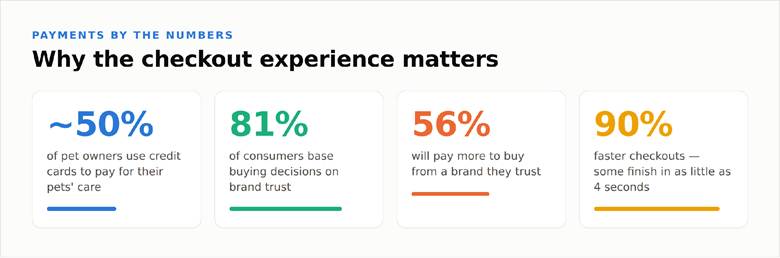
Infographic: Payments by the numbers.
Implementing a new system takes time. However, carefully designing the new system enables the busy periods to be minimized. This can be broken down into stages.
The first of these stages is looking at the payment methods that your clients desire and the likely volume of payment transactions. Identify any other requirements. For example, do you need to receive payments associated with unbundled wellness plans? Would you like to offer online payment options? Once the requirements are clear, you can perform a cost-benefit analysis of the new payment system.
The next stage is integration. Payment systems can perform different levels of integration with practice management systems. The payment system that performs the greatest level of integration with your practice management system is the best choice.
The next stage is training. This new system should be piloted before full system implementation in order to write new procedures for the system.
The final stage is the transition to the new system. Data transfers should be performed to ensure that no data is lost. Client surprise should be avoided by communicating payment method changes in advance. Also, system support should be maintained to assist with any post-transition issues.
A veterinary integrated payment system addresses the issues clinics experience on a daily basis. It eliminates administrative issues. It increases customer satisfaction. It provides clinics with a stronger financial position.
The benefits extend beyond just accepting payments. These systems decrease workload and reduce errors. They help clinics comply with security regulations and help build trust with pet owners. Each of these benefits contributes to a more stable and healthy business.
Implementing an integrated system is more of a business strategy solution than a technology solution. It helps solve operational issues on a deeper level.
Clients have higher expectations as the veterinary field continues to evolve and change. Payment systems that are integrated help clinics remain competitive. An integrated payment system is a valuable and permanent resource that helps clinics operate more efficiently and effectively with a focus on improving the care provided.
They automate payment data transfer between your terminal and practice software. This eliminates required data entry and associated errors. Checkouts move faster, freeing staff to spend more time with patients.
They offer various payment options. Whether a preference is cards, digital wallets, or contactless payments, consumers are given the ability to pick their choice. A few systems create a payment link on the customer’s phone, simplifying the entire process.
With real-time reporting, you will always know your revenue and outstanding balances. They will also invoice and bill automatically. This accuracy minimizes mistakes and simplifies even tax reporting.
Certainly. They use encryption and tokenization to safeguard client and card information. Several companies provide additional functions that assist your practice in achieving PCI DSS compliance.