

From tracking employees’ working hours to calculating deductions and processing payments, managing payroll is no less than an uphill battle for a growing business. As the team expands into different departments, these tasks become difficult to manage alongside other business operations.
A better way to solve this is by payroll outsourcing to a service provider. This means you outsource your payroll to a third party that handles employee payments. This third party may also handle your taxes, pay stubs, and payroll reports.
However, it is not always the best option for every business. The right decision depends on your team size, budget, payroll complexity, and how much control you want over payroll.
Let’s look at what payroll processing outsourcing covers, what it costs, and how to decide whether it makes sense for your business.

Outsourcing your payroll means handing some or all of your payroll responsibilities off to a third party. This depends on your provider and the package you choose.
Some providers offer a basic payroll service, including calculating pay and producing pay stubs. Full-service providers can also calculate taxes, submit payroll information, handle direct deposit, and produce end-of-year documents.
Here are the tasks commonly included in outsourced payroll services.
Wage and salary calculations: The provider will calculate employees’ wages based on their salary, hourly rate, approved hours worked, overtime, bonuses, and other income.
Tax calculations: Depending on your agreement, the provider will calculate the amount of payroll tax to be withheld and prepare and submit payroll tax forms. Some providers will also pay the payroll tax on your behalf.
Pay stub generation: Employees will receive a pay stub showing how much they earned, what was deducted from their pay, and their net pay. You can send it via email or the employee portal.
Direct deposit: Many providers let you set up direct deposit so your employees’ wages are deposited into their bank accounts on the agreed pay date.
Some packages will not include all these services, and some may charge premium rates for year-end procedures, out-of-cycle payroll, onboarding new staff, and additional reporting.
Ask for a clear breakdown of services included and what will incur additional charges. Although the monthly rate may seem low, if regular tasks incur additional charges, it may not be the most cost-effective solution for you.
By outsourcing your payroll tasks, you will reduce your team’s workload; however, you remain responsible for providing accurate data. When you use a payroll provider, they will work with the data you provide. If your employee data or approved hours contain inaccuracies, you could make incorrect payments.
Your business should continue to oversee several important tasks:
The goal is to eliminate day-to-day payroll activities while ensuring you have insight into your employees’ pay, taxes, and business costs.
The cost of payroll outsourcing depends on how many employees you have, how often you pay them, what services you need, and how complex your payroll is. You can expect to pay a flat monthly rate, an hourly rate, or a combination of both.
A basic payroll package will include calculating wages and generating pay stubs. A more advanced package will include tax submissions, direct deposit, end-of-year documentation, and employee assistance. If your business has multiple locations, different pay schedules, commission, or complex overtime rules, it may be best to choose a more advanced package.
The main factors affecting the price include:
Size of the workforce: Providers may require payment based on the number of employees. The more employees you add, the more records and payments you’ll need to process, and the more your monthly fee may rise.
Payroll frequency: If a business pays employees weekly, it may need to run more payrolls than if it pays monthly. Some offer a fixed number of runs and charge extra for additional processing.
Payroll complexity: This can involve overtime, employee classifications, bonuses or benefits, various deductions, and multiple locations. Check whether the quoted cost covers your specific payroll needs.
Extra charges: Setup fees, software integrations, off-cycle payments, special reports, and year-end services may be charged in addition to the base fee. Do not sign with a provider without obtaining a complete fee schedule.

If a provider charges you a $50 monthly base fee plus $8 per employee, then using their service would cost around:
Note: This is just an example, and the actual price can vary depending on the provider, location, and package you select.
Also factor in your employees’ time when comparing this to your current payroll costs. This could include time spent calculating, keeping records, maintaining the software, training, and fixing errors.
Whether you want to keep payroll in-house or outsource depends on how your business works. Keeping it in-house gives you more control over the process, while outsourcing means you hand agreed tasks to a third party. Neither option is automatically better for every business.
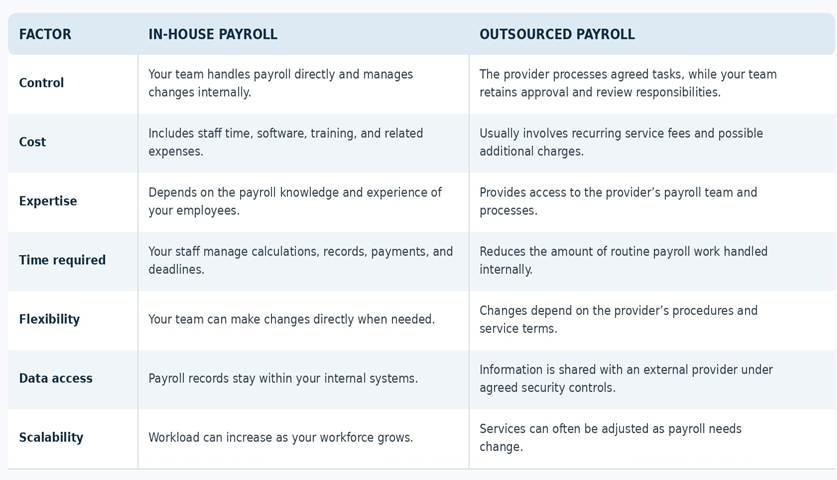
If your business has experienced staff, simple payroll processes, and plenty of time to get payroll right, an in-house payroll may be a good fit. It can also be ideal for businesses with frequent payroll changes or those that prefer to keep employee information in their internal system.
If payroll takes up too much of your staff’s time, makes it hard to keep track of tax requirements, or you want support without hiring more payroll staff, outsourcing may be the best choice. But you should consider the cost of their services, how quickly they work, and whether they can integrate with your systems.
Another option is to use payroll software within your business. This gives you full control of your payroll by allowing your team to collate employee data, calculate pay and generate reports. This can provide a good middle-ground for cost, control and convenience.

Accurate payroll depends on accurate timesheet data. If you record hours worked in different software than your payroll system, you’ll need manual data entry. This adds extra steps and increases the chance of errors.
If an employee worked 44 hours in a week but only 40 hours were added to their payroll, they might get paid less than they should if no one catches it before payday. This could also happen with overtime, approved time off, and shift changes not being logged.
By integrating your time-tracking software with payroll, you can reduce manual data entry and ensure accurate employee payments. When choosing a provider or system, look for features that will provide:
If you’re outsourcing payroll, ask the provider whether they’re compatible with your time-tracking system. Find out what information will automatically transfer, what your team will need to check, and how any changes can be made to your payroll.
There is no fixed employee count at which outsourcing becomes necessary. For example, a company with 15 employees and a complicated payroll might need outside help sooner than a company with 50 employees and a simple payroll.
Instead of focusing only on the number of employees, consider the effort required in the payroll process and whether it is reliable.
Outsourcing payroll can reduce the number of menial tasks you need to do. It can also give your business access to experts and make payroll easier to manage as your company grows. If your process is simple and your team can manage it efficiently, you may prefer to keep payroll in-house or use payroll software.
Before you choose, review your current costs, compare provider fees, and clarify roles. No matter what option you choose, your time recording must be accurate, and your approval process must be consistent.
Make payment management easier for your business. Sign up for free.
The platform is free to use. Host Merchant Services earns its revenue through payment processing.
Reduce Your Fees, Upgrade Your Service.
Your information will not be distributed
We received your request. A payments specialist will reach out shortly.
