
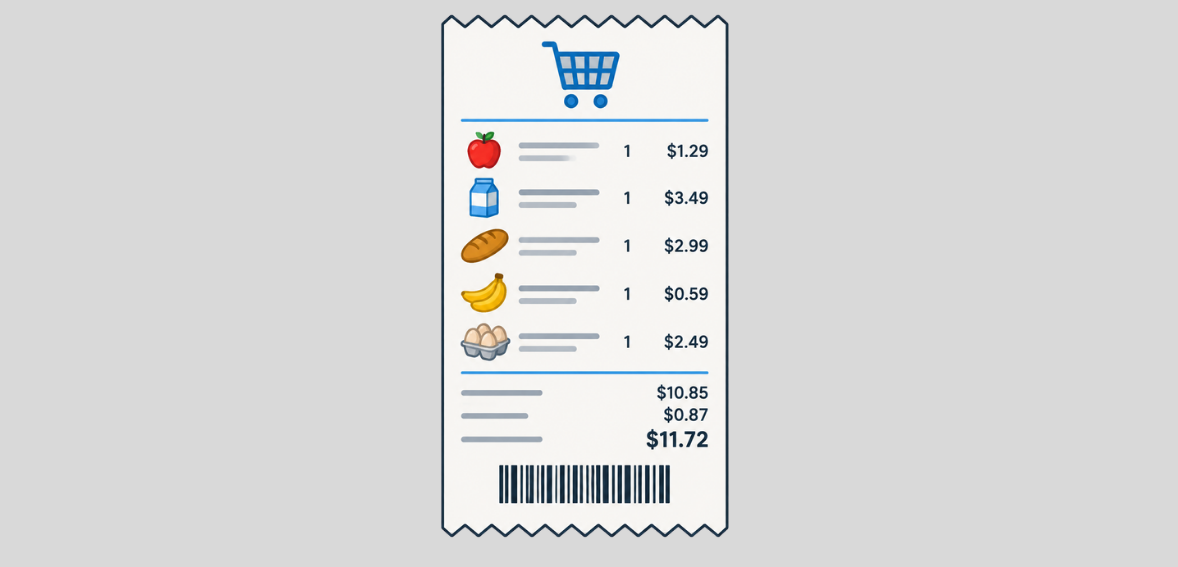
About 75% of all receipts printed in the U.S. end up in the trash. It’s only when money has to be explained to an outside party that a receipt gains value. Tax auditors, people who administer employee benefit plans, and credit card companies’ dispute departments all review receipts. Very few people in any of these departments will accept a receipt showing just a total.
The receipt reviewer wants to know the parts of the total and the way the total was worked out. This information appears on the itemized version. This article describes the elemental information and components of this type of receipt. It also describes who requests an itemized receipt and how a business can obtain one from its point of sale (POS) cash register.
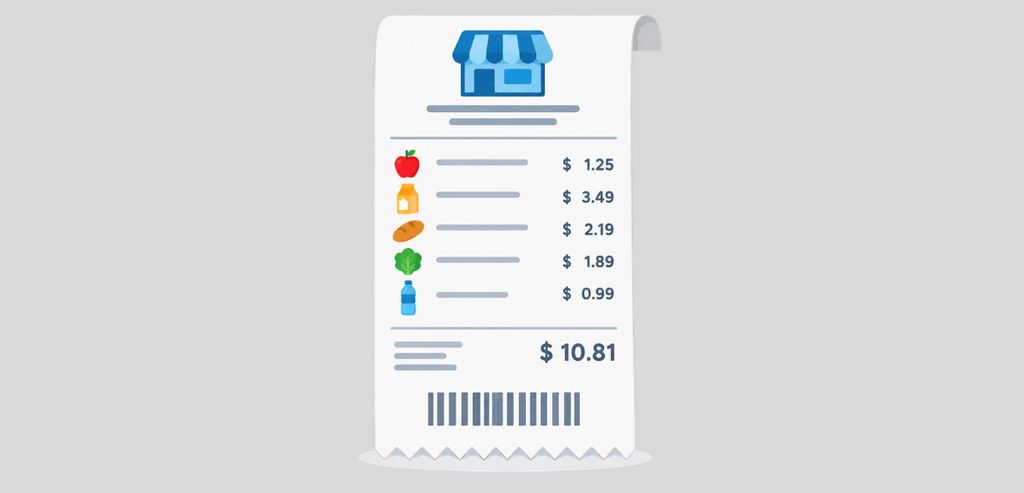
The itemized format separates one sale into individual line items. Each item can include the name of the item, the quantity, and the price.
Additional information like taxes, discounts, fees, and tips is shown on their own line as well. So is the total amount paid.
“Itemized” is an informal term. The U.S. has no single federal law that outlines the definition of this term. It is generally understood by the IRS, health plan administrators, and card networks. It is considered “itemized” if it includes the information required by these administrators.
Generally, IRS rules require a taxpayer to keep documentary evidence for business expenses of $75 or more (after taxes and discounts are applied). Expenses under $75 carry no such requirement. No federal law requires a merchant to issue an itemized copy, and some states have their own laws.
A normal receipt simply shows a payment was made. It may show nothing more than a store name, a date, and a total. A slip from a card terminal may show a masked card number and a merchant’s authorization code. Slips like these usually show no information about a purchase.
More information about a purchase may be available on the itemized version. With line detail, a reviewer may determine if an expense included an alcoholic beverage. Additionally, the itemized version may show if a hotel expense included a tip for room service. Line-item receipts also help determine if a purchase was made for a medical expense.
Publication 463 from the IRS provides information on substantiating business expenses related to travel. According to the publication, in the case where a business expense was incurred and paid for, a canceled check with the merchant’s bill shows proof of the expense. A copy of the canceled check alone does not substantiate a business expense. The tables below illustrate examples of each document type.
| Field | Regular receipt or card slip | Itemized version |
| Business name and address | Usually shown | Shown |
| Date of sale | Shown | Shown |
| Final amount paid | Shown | Shown |
| Individual products and services by name | Not shown | Shown |
| Quantity and unit price | Not shown | Shown |
| Tax, discounts and tips on separate lines | Sometimes | Shown |
| Masked card number (card sales) | Often shown | Often shown |
Table 1: Regular receipt vs. itemized receipt (general comparison; formats vary by merchant)
There is no single national standard for documentation. Complete records differ based on the reviewer. Three federal rules provide guidance on what documentation is required.
Business travel and meals are governed by Treas. Reg. §1.274-5(c)(2)(iii). Generally, every lodging cost while traveling for work needs documentation, as does each other expense reaching $75. Receipts show adequate evidence if they state how much was spent, the date, and the expense incurred.
This regulation also provides examples. A hotel bill showing the hotel and its location and dates and a separate meal and phone bill is adequate. A bill from a restaurant is adequate if it lists the date, amount, and the name of the place and how many diners the meal was for. If the bill covers items besides food or drink, the receipt should state that.
Flexible spending accounts (FSAs) work differently from the other spending accounts. The proposed Treasury regulation, 1.125-6(b)(3), states that, independent of the employee, the description of the item or the service must be provided, along with the date the service was provided or the product was purchased, plus the amount. With respect to FSAs, pharmacy slips do not include the name of the product; therefore, plan administrators routinely send back claims to the participants to provide line-level detail.

Figure 1: Receipt fields named in IRS rules for meals, lodging, and health FSA claims
FACTA, the Fair and Accurate Credit Transactions Act, sets standards for receipt issuance. According to 15 U.S.C. 1681c(g), businesses that transact using credit or debit cards must refrain from printing the card’s number and expiration date on receipts. The provision applies to all electronically printed receipts. In 2010, the Seventh Circuit, in Shlahtichman v. 1-800 Contacts, held that the provision does not apply to email order confirmations. Intentional violation of this provision is subject to a statutory damage award between $100 to $1,000, under 15 U.S.C. 1681n.
FACTA itself governs only the card data: no more than the final five card digits may be printed, and the card’s expiration date must be left off. The business name and address, date, description of each purchase, total, payment method, and a receipt or transaction number come from the IRS and card-network expectations above.
The people submitting these requests are typically seeking to validate an expense to a stakeholder. The largest group is people on business trips. Many corporate travel policies require employees to submit itemized proof on expenses less than the IRS threshold of $75, and the limits differ across companies.
The second largest group is people with an FSA. To get reimbursed, members submit receipts. Administrators of FSAs are also required to check receipts and confirm the nature of the expense. Insurance companies are also allowed to request itemized details of a claim if that claim includes only a subset of the expenses listed on that bill.
Currently, there are no federal statutes that require restaurants to provide a receipt. States are likely to regulate this area. Connecticut House Bill 5164 proposes that upon request, a merchant must issue a receipt listing each item. The bill is currently with the General Law Committee. It is best for a merchant to consult with a legal professional to understand local law.
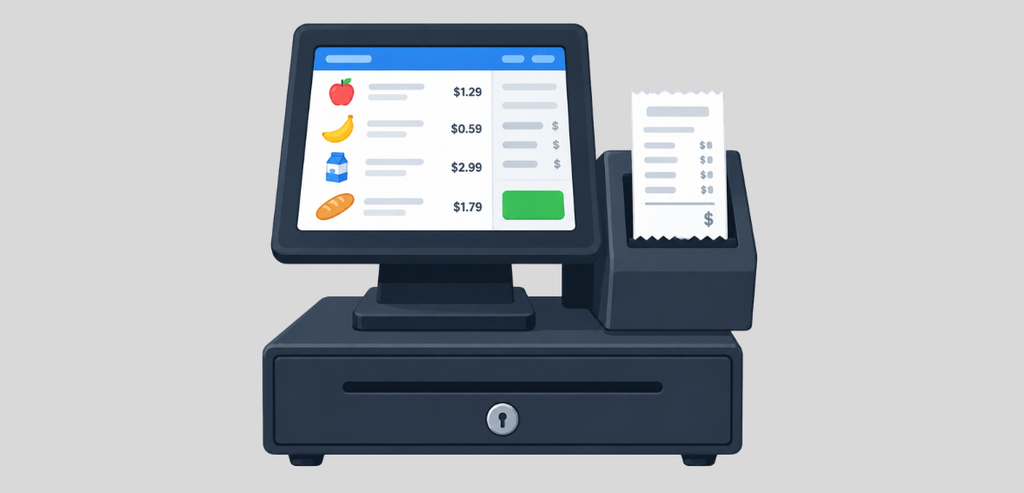
A POS prints only as much detail as its setup allows.
Begin by editing the item catalog. Use actual product names when printing receipts. A receipt tally should reflect the math. A reviewer cannot determine the item sold if the receipt reads “LG-CB-02.”
Next, edit receipts to separate lines for service, tip, taxes and discounts. Printing merged lines for “Fees” defeats the purpose.
Add the legal business name and contact information to the receipt headings. Include a receipt or order number.
Card transactions print purchase details. Test a card sale to ensure no more than the final five digits print, and no expiration date or other card details print.
Edit the POS to print service and tip details for service-based businesses and to print a written description of the service for each line item.
Staff should have a way to print a copy of any receipt. Offering the customer a printed receipt or an email copy of the receipt when service ends ensures the customer has a copy of the receipt.
A basic POS can be purchased online. A spreadsheet program can be used to generate itemized receipts. Businesses without a POS can handwrite itemized receipts. Save and date a copy of each itemized receipt.
This sample reveals the elements of itemized receipts. For this example, we used placeholders in place of the business name and amounts, and used a sales tax rate of 8% for illustrative purposes.

Figure 2: Sample itemized receipt with each required part labeled
The business name and address are on the header. The phone number is on the side. The next line is “date and time” and “receipt #”. Three items are listed. Two coffee purchases for $3.50 each and a sandwich and salad for $9.25 and $8.75 each, respectively.
The subtotal is $25.00. Sales tax is listed at $2.00, and a $4.50 tip is listed. The total is $31.50. The card information shows the card’s final four digits and no expiration date.

When a chargeback occurs, the merchant provides evidence through the acquirer. The itemized record indicates the date, price, and description of what was sold. Reconciliation of a chargeback dispute is accomplished through the evidence in the receipt if a cardholder claims the product was not sold, was incorrect, or was sold more than once.
The FAQ for Merchants released by Visa in March 2023 indicated that the Compelling Evidence 3.0 (CE 3.0) rules would be implemented for pre-arbitration attempts processed on or after 15 April 2023. The objective of CE 3.0 rules is to address instances where a cardholder disputes a transaction that was authorized by them.
As part of the CE 3.0 rules, Visa has required the description of the item being purchased. CE 3.0 also mandates that the merchant provides information of the previous two transactions that were authorized by the cardholder and were not disputed. The transactions should be made within the period of 120 to 365 days from the dispute processing date.
Of the four elements of the transaction (customer account number or customer ID, delivery address, device ID (and fingerprint), and IP address), at least two should be the same for the two transactions. Of the two elements, one should be the IP address or the device ID/fingerprint. Once the conditions are met, the dispute is treated as first-party misuse and the liability shifts to the card issuer.

Figure 3: The CE 3.0 lookback window for prior undisputed transactions
This window has a record-keeping effect. A merchant who discards transaction records after a few months can’t use CE 3.0. Keeping transaction records after a year would provide that option.
A receipt includes a record of all items and the charges that comprise the total. The IRS establishes rules for various travel, meal, and expense reimbursements. Likewise, a proposed IRS rule would set limits on reimbursed health FSAs. The federal FACTA law limits the card data displayed on a receipt to no more than the final five digits and bans the printing of the card’s expiration date.
Visa’s CE 3.0 requires merchant transactions to include an item description and to look back 120 to 365 days for disputed transactions. A Point of Sale (POS) terminal can be configured to display each item sold with separate line items for taxes and fees. Masking card data by the POS would produce receipts that satisfy all of these requirements.
This type of receipt includes not only the date and business name, but also the price and quantity for each item. Additional information such as the method of payment, tax, tip, and total is also included.
In most cases, slips provided by a merchant do not contain the items purchased. Such slips are usually known as card slips and contain the date, the name of the merchant, the full charge, and the card number’s final 4 digits.
Federal laws do not require restaurants to give itemized receipts. However, some state laws may require it.
A total amount does not explain what was purchased. In some instances, specific state laws mandate that employers and insurance companies provide a breakdown of the items purchased.
Reduce Your Fees, Upgrade Your Service.
Your information will not be distributed
We received your request. A payments specialist will reach out shortly.
