
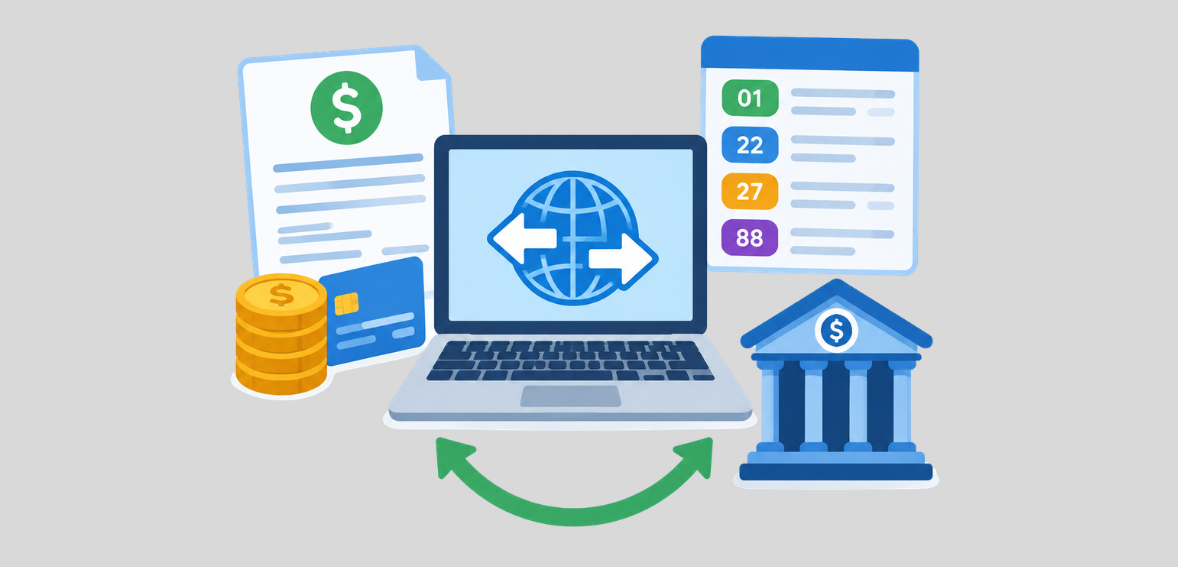
Business payments in the U.S. are moving from paper checks to ACH rails. Almost 8.1 billion ACH payments between businesses were made in 2025, a 10% increase from 2024, according to Nacha. Many of these payments include an accompanying structured data element that provides the recipient an explanation of what the money covers. The combination of the payment and the structured data element of the invoice is commonly called EDI payments.
The term EDI payment is becoming more commonplace and shows up on bank statements with little to no supporting information. This article provides a definition of the term, explains the differences between ACH and wire payments, and outlines the 810 and 820 documents. Additionally, this article covers the setup of the EDI payment system and the matching of invoices.
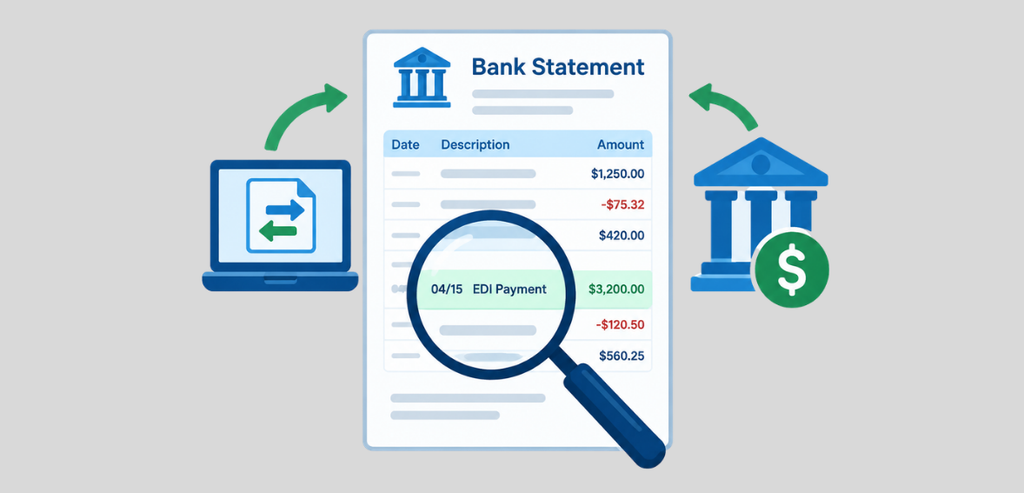
EDI, the electronic interchange of data, standardizes the exchange of business documents. Information that is normally transmitted manually or entered into a computer is digitally interchanged between companies’ computers. EDI payments are payments, typically sent over ACH, that include remittance data laid out in a predetermined format. The remittance data identifies the invoices that are paid and settled.
The term “EDI PMT” or “EDI PYMNTS” normally appears in the Company Entry Description. The Company Entry Description is a 10-character field included in each ACH batch. There is no prescribed meaning for the term “EDI” by the Nacha rules; therefore, the term is chosen at the payer’s discretion.
There are two prescribed values under the Nacha rules for the Company Entry Description field. As of March 20, 2026, wage credits transmitted via ACH and coded as a PPD Credit must carry the Company Entry Description PAYROLL. Consumer ACH debits for online purchases must carry PURCHASE. The Company Entry Description would not be required to have the value “EDI PYMNTS” for the prescribed value to be met.
A payment whose Company Entry Description does not describe a business you deal with may be a payment sent with EDI data. You should review the Company Entry Description with the Company Name, if available, to assist with the analysis. If the payment does not identify a customer with which you do business, you should contact your financial institution and request a full copy of the ACH Item and/or Additional Records that may provide further clarification.
While EDI and ACH are separate entities, they do work together. For example, EDI data can be sent along with ACH transactions or via separate wire transfers. ACH transfers can also be used to transfer batches of payments from U.S. bank accounts.
The ACH format determines the quantity of EDI data that can be sent with a payment. According to Nacha’s guide, a CCD entry can be merged with a single addenda record, and the industry has referred to these as CCD+. A more flexible format called a CTX entry can be merged with as many as 9,999 addenda. Each addenda record carries 80 characters, so a single CTX entry can be merged with a complete X12 820 transaction set, which can include numerous invoices.
| ACH format | Addenda records allowed | Characters per record | Typical use |
| CCD | 0 | Not applicable | Business payment sent without remittance data |
| CCD+ | 1 | 80 | One invoice number, tax payments, health care EFT with TRN |
| CTX | Up to 9,999 | 80 | Full X12 820 remittance for many invoices |
Source: Nacha third-party payments user guide; HHS health care EFT standard.
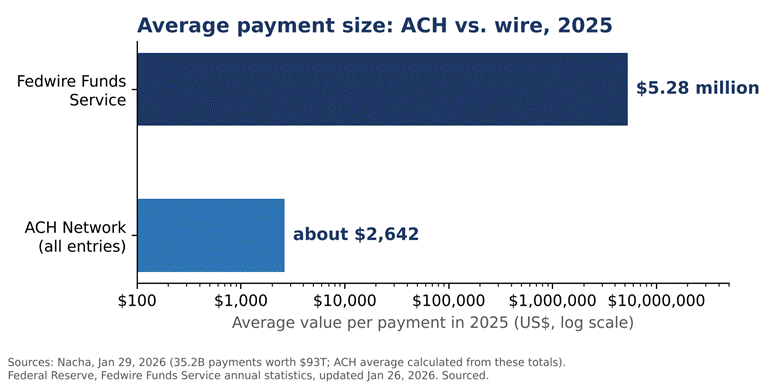
Sizes and speeds vary. ACH processed 35.2 billion transactions, valued at $93 trillion, and averaging $2,642 per payment, in 2025. The Federal Reserve System’s Fedwire Service processed 217.3 million transfers in 2025, with an average value of $5.28 million per transfer.
As of March 18, 2022, Same Day ACH payment transfers are capped at $1 million. In April 2026, Nacha members voted to raise the cap to $10 million, to be effective on September 17, 2027.
X12 is the body that sets the EDI transaction set standards used by most U.S. companies. The X12 810 is the EDI interchange for an invoice. An X12 820 is a Payment Order or Remittance Advice. The X12 820 allows for the provision of payment instructions, advice of payment, and instructions of payment application.
The cycle consists of five steps. In the first step, the supplier issues its invoice via the X12 810. In the second step, the buyer’s payables staff signs off on the invoice, then sends the X12 820 to the buyer’s bank. In the third step, the buyer’s bank, at the command of the 820, sends payment to the supplier. At this point, the bank holding the supplier’s account gives a credit and, via EDI, sends an interchange notice to the supplier. Last, the supplier’s receivables staff or EDI application aligns the payment with the appropriate invoices.
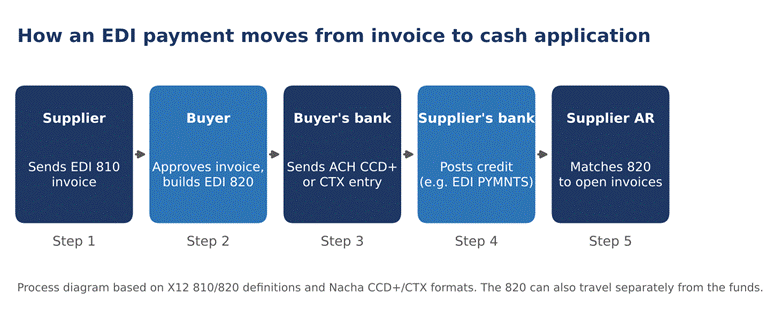
The 820 does not necessarily have to go with the payment. Its BPR segment holds a code for this choice. Code C means the payment goes with the remittance and code I means the 820 only gives remittance information. When payment and 820 get separated, the TRN segment has a trace number. The trace number allows the receiving office to connect the deposited payment with the remittance information.

Large companies that make a great deal of payments to suppliers typically use EDI. Some companies, like BJ’s Wholesale Club and Costco, even publish their rules for 820s. Stedi offers a library of 820s for many suppliers. The codes and reference numbers supplied by the buyer are included in each 820.
Health care is the biggest rule-based scenario. On January 1, 2014, HHS required all electronic funds transfers for the health care industry to be made according to the Nacha CCD+ standard. The addenda for health care claim payment must contain an X12 835, which serves as a payment advice. According to CMS, the TRN in the 835 should be associated with the payment. The health care providers use the TRN to identify which payment is associated with which claim. In 2025, there were 548,261,958 health care claim payments made through ACH according to Nacha.
From a business-to-business (B2B) payments perspective, in 2023, there were 6.6 billion B2B ACH payments, 7.4 billion in 2024, and 8.1 billion in 2025, according to Nacha. Nacha said the increase in B2B ACH payments from 2023 to 2024 was because businesses were writing fewer checks.
Getting started begins with your bank. Find out if the bank can send the addenda record and in which format (i.e., file or online). The total of your deposits does not provide enough information to your team. Complete the vendor setup form with your banking information and indicate if the addenda record is in CCD+ or CTX format. CTX provides full detail like a remittance letter.
Receiving the full 820 record is an option with larger payers. You will need to find a method of translation to import the record into your accounting system. Contact the organization to understand the codes for the 820 record.
Banks have rules in place to monitor fraud. Effective March 20, 2026, fraud monitoring became a requirement for banks that process ACH transactions on behalf of their customers and non-customer ACH originators that processed over 6 million ACH payments in 2023. All other originators followed on June 22, 2026.
The originator is required to enter into an ACH origination agreement with a bank and abide by the rules established by Nacha. In addition, the originator must validate the payee’s account details. A zero-dollar prenote can be processed to obtain the account details. A test transaction to validate account details can be processed.
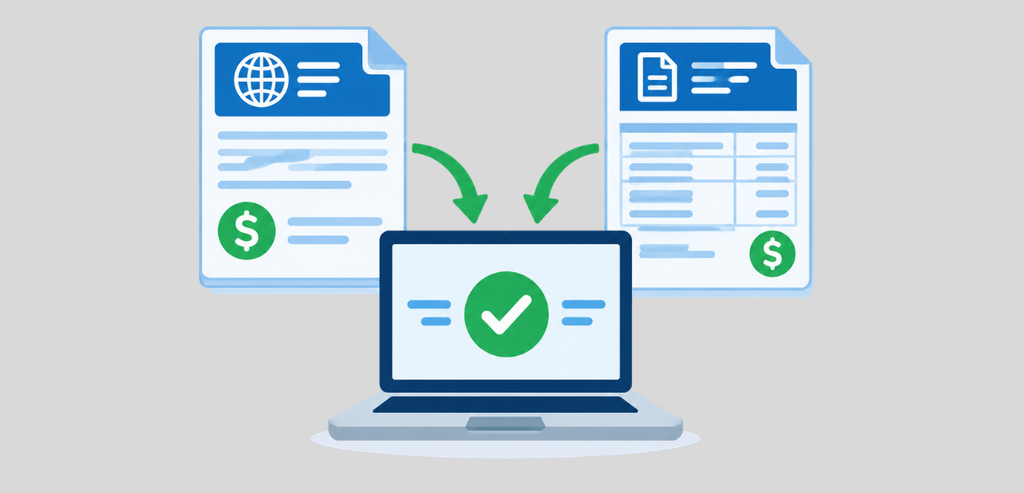
EDI transforms data. The most important part of Cash Application is matching total payment against individual invoices. The total payment is provided in the 820, BPR02. Total payment is supported by individual remittance advices (RMR). Each RMR supports an invoice payment. Payment adjustments are provided in ADX (Credit and Debit) segments.
Variances occur with the timing and the formatting of the 820. The 820 may be transmitted out of sequence with respect to the payment date. Invoice numbers may be truncated or padded with zeros. Segments may be provided for adjustments to an invoice. The logic used to prioritize cash application is to confirm RMR segments, in order, against payment amount and trace the adjusting credit (ADX) to the payment.
Healthcare providers use logic similar to cash application with the 835 Health Care Claim Payment/Advice. The 835 contains the remittance advice, and the credit is applied to the claim(s). The deposit may be posted to the healthcare provider only when the TRN is reconciled in both the 835 and the CCD addendum.
An EDI label on a bank statement indicates an ACH payment that includes an invoice. The wording is optional, and the Company Name field indicates who sent the payment. A CCD+ record can include a single addenda of 80 characters. A CTX record can include an 820 record across up to 9,999 addenda records.
In order to use EDI payments effectively, you need to achieve three things: confirm your bank is transmitting the addenda record, inform your payers what format you will accept addenda records in, and determine a mapping convention for RMR lines to opened invoices.
This is a payment sent over ACH that carries remittance details in EDI form. The payer name usually sits next to the EDI wording.
No. EDI is not the same as ACH. EDI is an interchange format to send data and can be coupled with ACH or used independently.
EDI 820 is an X12 standard for Payment/Remittance Advice.
Not really. If the customer is not asking for it and the volume of invoices is low, then it may not be necessary. For a low volume of invoices, a CCD+ payment with the invoice number in the addenda may work.
Reduce Your Fees, Upgrade Your Service.
Your information will not be distributed
We received your request. A payments specialist will reach out shortly.
