
Cards are the default payment method for most Americans. According to the 2025 Federal Reserve Diary of Consumer Payment Choice, credit and debit cards combined for 65% of the payment choices by number, with credit cards at 35% and debit cards at 30% in October 2024. Cash was at 14% for that month.
According to the 2025 Federal Reserve Payments Study, there were 120.6 billion debit card payments and 67.1 billion credit card payments for the year 2024. Acceptance of payment cards is inevitable for small businesses. Processing credit card charges is a variable cost for small businesses that depends on a variety of factors, including the provider and card type.
This guide explains small business credit card processing for 2026, costs associated with it, and the process to set it up. The rates cited are from the published card networks’ schedules, pricing pages of providers for 2026, and named reviews.
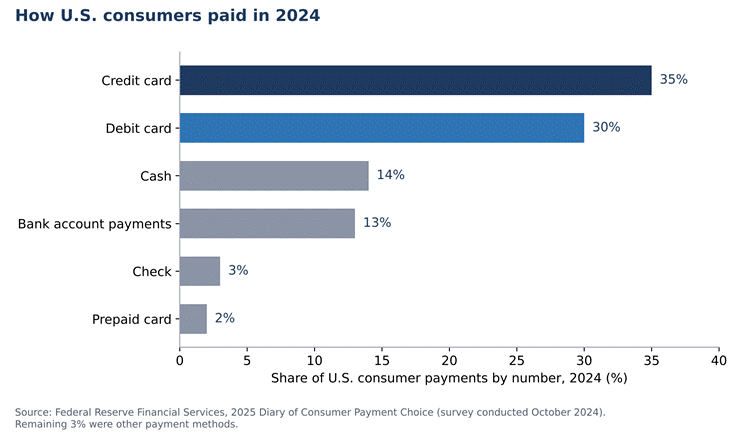
Cards accounted for nearly two of every three U.S. consumer payments in 2024.
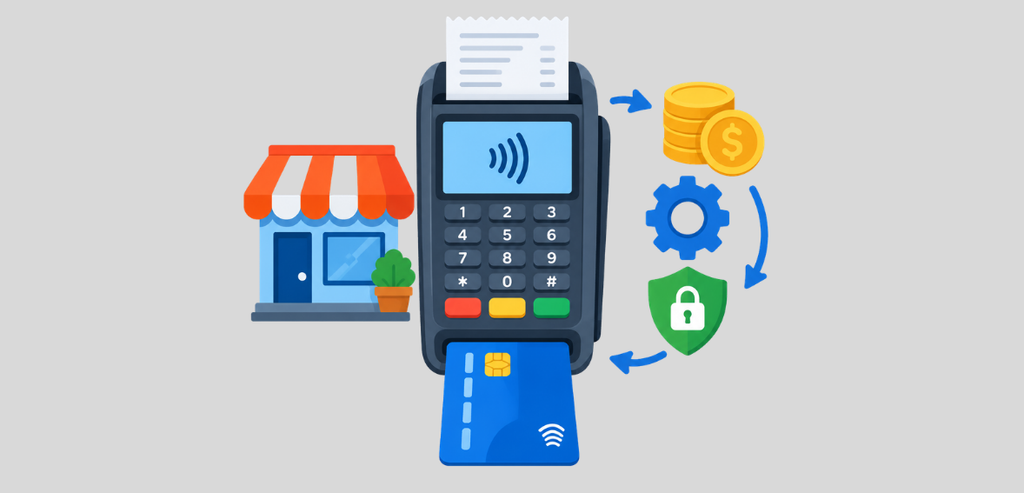
A card transaction involves five parties. The customer holds the card. The merchant accepts it. The processor and the acquiring bank are on the merchant side. The card network connects the two sides, and the customer’s issuing bank is the payer.
The process has two phases. The first is authorization, which happens at the time of checkout and takes only few seconds. In the second phase, the issuer clears and settles the sale. At this phase, the funds are sent by the issuing bank to the bank (acquiring bank), and then the acquiring bank credits the merchant’s account after deducting the fees.
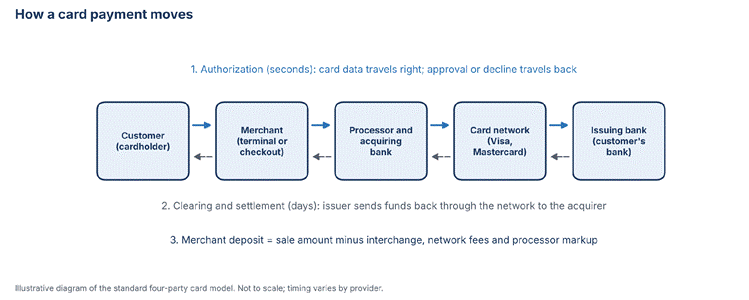
Merchant fees consist of three elements: interchange, network assessment fees and a markup by the processor. Visa’s revised interchange schedule, which takes effect on April 18, 2026, states that interchange is paid by acquirers to issuing banks, not by merchants directly. Merchants pay a “merchant discount” to their financial institutions for interchange and other bank services.
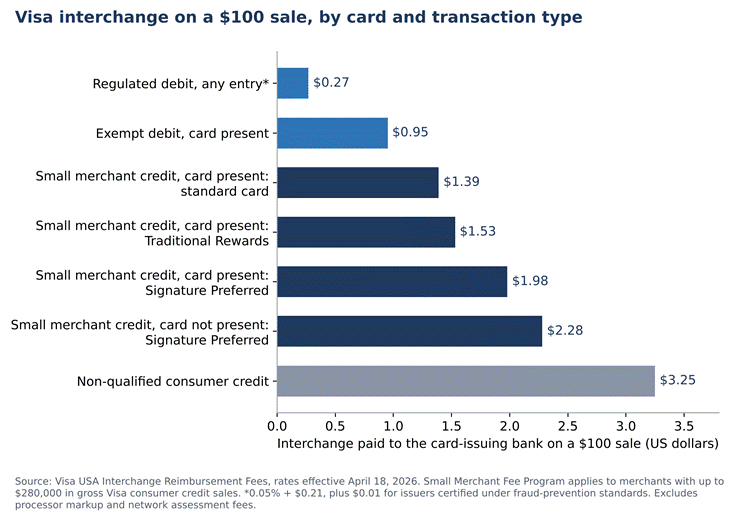
Visa has posted its U.S. Interchange Schedule. Effective April 18, 2026, Visa’s regulated debit rate is set at 0.05% plus 21 cents. Issuers that successfully meet Visa’s fraud prevention programs qualify for an additional cent. Exempt debit cards (issued by smaller banks) carry 0.80% plus 15 cents for card-present retail transactions.
Visa charges more for credit. Through its Small Merchant Fee Program, Visa subsidizes credit card transactions up to $280,000 in gross Visa consumer credit sales. Under the Program, a credit card swiped or tapped in person carries 1.29% plus 10 cents. A Traditional Rewards card carries 1.43% plus 10 cents. A Visa Signature Preferred card carries 1.88% plus 10 cents in person and 2.18% plus 10 cents when the card is not present. Transactions that fail to qualify for the Program fall to the Non-Qualified rate of 3.15% plus 10 cents.
The Federal Reserve’s Regulation II places a regulated cap on the cost of debit cards on any issuer with $10 billion or more in assets. In August 2025, a North Dakota federal court ruled the standard set by the Federal Reserve on interchange fees to be unlawful and granted a stay on the ruling while the Federal Reserve appealed.
In September 2025, a different federal court in Kentucky upheld the standard set by the Federal Reserve on interchange fees. The case involving the appeal of the North Dakota court ruling is set to be heard by the Court of Appeals for the Eighth Circuit on October 22, 2026, according to a September 2026 analysis by Pulse. The Fed’s proposal in 2023 to lower the base fee to 14.4 cents was still being evaluated at the time of the analysis. The 21-cent cap is currently in effect.

There are two ways to get approved for card acceptance. The first is to get a merchant account. With this, you have a direct agreement between your business and a bank. The bank then underwrites your business and provides you with a merchant identification number.
The other way is through a payment facilitator. Visa defines a payment facilitator as an entity that contracts with an acquirer to deposit transactions on behalf of sponsored merchants. The small business then signs up to operate under the payment facilitator’s master account.
Payment facilitators have limits as well. Under the Visa Rules, if the sponsored merchant hits an annual transaction volume of $1 million, the acquirer is then required to sign a direct merchant agreement with the sponsored merchant. Mastercard increased its comparable limit to $1 million in annual Mastercard volume, according to Digital Transactions.
Third-party payment platforms process payments and issue tax forms differently. The IRS confirmed on October 23, 2025, that third-party settlement organizations issue Form 1099-K only when a payee hits over $20,000 in gross payments and 200 transactions. The One, Big, Beautiful Bill restored that threshold retroactively. The IRS states that the absence of a Form 1099-K does not mean income is tax-free.
Processors charge merchant accounts in one of three main ways: flat rate, interchange plus, or tiered.
With flat rate pricing, the processor charges a blended percentage and a flat fee for each sale. Interchange-plus pricing passes on the actual interchange rates and adds a markup. Tiered pricing places transactions in buckets (e.g. qualified and non-qualified). Industry reviewers consistently rate tiered and enhanced billback pricing as more complicated and expensive than the other pricing structures.
Flat-rate pricing is fairly predictable. Rates do not vary based on the type of card. Flat-rate pricing works well for businesses that accept mainly regulated debit cards. For businesses with a high debit share, interchange-plus pricing is usually the better option, because debit interchange is low and the savings pass through.
Published U.S. flat rates at the large providers in October 2026 ran from about 2.5% to 2.7% plus 5 to 15 cents in person, 2.9% to 3.3% plus 30 cents online, and about 3.5% plus 15 cents for keyed or card-on-file payments, with base plans at no monthly fee. Interchange-plus providers publish a markup of roughly 0.40% plus 8 cents in person and 0.50% plus 25 cents online over interchange at entry volumes.
At those rates, a $100 in-person sale costs about $2.75 to process. The same sale online costs $3.20 to $3.60, and keying in the card number adds roughly 65 cents more.
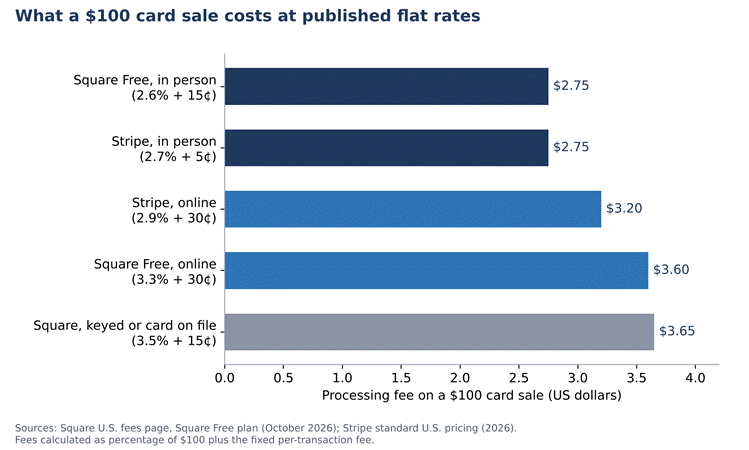
Interchange-plus pricing can be lower on standard cards. For a $100 in-person Visa sale that qualifies for the Small Merchant Fee Program, interchange would be $1.39. An entry-tier interchange-plus markup of 0.40% plus 8 cents adds $0.48, bringing the total to $1.87 before network assessment fees. Interchange-plus providers commonly report that in-person merchants land near or below a 2% effective rate.
There are additional fees beyond processing fees. For example, ACH bank transfers processed through an invoice commonly carry a 1% fee with a $1 minimum. Most providers offer custom pricing to businesses that process more than $250,000 a year.
Hardware choices vary based on the location of the sale. A business that sells at events may only need a phone. Tap to Pay on iPhone accepts contactless cards and mobile wallets by tapping the iPhone and using a supported provider app, with no additional reader. It does not support chip cards that are inserted into a slot.
A small reader can accept contactless and chip cards. Entry readers from the large providers list at about $59 to $199. Countertop terminals and complete point-of-sale stations cost more, and prices vary by the reseller.
Merchants must have a payment gateway or hosted checkout for online sales. All sales channels have the same security requirements. Effective March 31, 2025, the PCI Security Standards Council made all 51 of the future-dated requirements in PCI DSS v4.0.1. E-commerce merchants that outsource card handling to a PCI-compliant provider qualify to have the shortest self-assessment questionnaire, SAQ A. In January 2025, the PCI Security Standards Council eliminated two script-monitoring requirements from SAQ A, and replaced them with an eligibility requirement that the merchant’s site is not susceptible to script attacks.
Understanding credit card processing pricing starts with your own numbers. Understanding your expected monthly card volume, average sale size and the breakdown of your sales between in-person, online, and keyed-in sales helps you identify the pricing structure that is most advantageous to you.
Obtain quotes from providers on Days 2 and 3. Request each provider’s full fee schedule, the contract term and their cancellation terms. Review the total cost based on your real sales mix and not the advertised rates.
Complete the application on Day 3. A payment facilitator boards you under its master account; for a merchant account, the acquiring bank underwrites you. Bring your business legal name, EIN/tax ID and bank info.
Connect your systems, point of sale, terminals and/or online checkout, hardware and/or software, and ensure all is working as intended on Days 4 and 5.
You can begin taking card transactions and be in business on Days 6 or 7. Make sure you understand your provider’s payout schedule before you rely on the funds.
The FTC has pursued processors that have hidden contract terms. In July 2022, the FTC sued First American Payment Systems and two sales affiliates. The FTC claimed sales agents told merchants they could cancel the contracts at any time. The agreements, however, set a 3-year term, a $495 cancellation fee, and automatically renewed. The defendants agreed to pay $4.9 million. The FTC sent more than $2.6 million to 5,588 small businesses.
The FTC has some tips for small business owners. First, don’t be rushed by the sales agents. Second, before signing the agreement, search the processor’s name along with “complaint.” Third, take the time to fully read the agreement, including linked or embedded terms.
Surcharging is typically legal, but is limited. According to the March 2025 Goodwin report, Visa caps credit card surcharges at the lesser of 3% or the merchant’s cost of acceptance, and Mastercard caps surcharges at the lesser of 4% or the merchant’s cost of acceptance. Confirm any notice requirements with your acquirer before implementing surcharging.
In addition, the rules of the card brands do not permit surcharging of debit cards. Digital Transactions, July 2026 reports that Connecticut, Maine, Massachusetts, and Puerto Rico prohibit credit card surcharges. Laws and rules related to surcharges vary by state and change frequently. Therefore, it is important to confirm the laws and rules with an attorney before surcharging.
Card network rules could change again. On June 9, 2026, U.S. District Judge Brian Cogan preliminarily approved a revised Visa and Mastercard settlement with merchants. If the final judgment is entered on the settlement and nothing is appealed, U.S. credit card interchange fees would be expected to decrease by 10 basis points for the next five years, and Mastercard will be capped at 1.25% standard consumer credit card interchange fees. Merchant surcharging would also be expanded. The final judgment and approval are expected on November 16, 2026. The terms of the settlement would not be effective to anyone until the final judgment is entered.
The best credit card processing for any small business depends on how and where you sell. Flat-rate providers work well for businesses that want an all-in-one payments and POS package, or that sell mostly online. Interchange-plus providers suit businesses with a high debit share or steady in-person volume, where the pass-through pricing lands below a flat rate. Reseller-sold terminals carry contract terms and rates that vary by the sales channel.
Score each option against your own sales mix. A business that keys many phone orders pays the keyed rate on each one. A business with a high debit share gains more from interchange-plus pricing. Ask whether the provider charges for chargebacks, PCI compliance or early termination.
When considering costs associated with small business, there are three main components: the card, the entry method, and the pricing model. Visa’s April 2026 schedule shows interchange at $0.27 on a $100 regulated debit sale and $3.25 on credit sale that is non-qualified credit. Flat rate providers average these differences and come up with one rate. Interchange-plus providers pass these on to merchants.
Think about your card mix and volume. Get written quotes from at least two pricing models. Analyze the contract for the term and renewal and cancellation fees. Track two dates on the regulatory calendar: the Eighth Circuit argument on Regulation II on October 22, 2026, and the reported final approval hearing for the Visa and Mastercard settlement on November 16, 2026.
Published flat rates run about 2.6% plus 15 cents for tapped or dipped cards and about 3.5% plus 15 cents for keyed transactions. Interchange-plus rates vary by card type.
Using Interchange-Plus pricing passes through low-end debit interchange rates such as Visa’s capped rate of 0.05% + 21c. Sales done with a tap or dip cost less to process than sales done keyed or done online.
No, a payment facilitator lets you process credit cards without a merchant account. Visa requires a direct merchant account once a sponsored merchant processes over $1 million in a year.
