
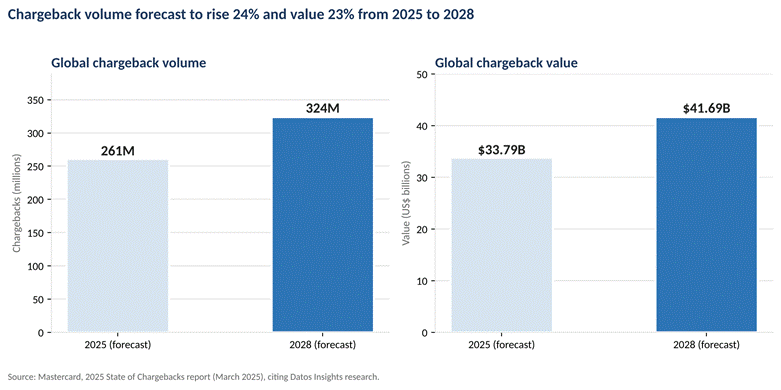
Global chargeback volume is expected to increase by about 24% in the next three years, according to data provided by Mastercard in its 2025 State of Chargebacks report, which relied on research by Datos Insights. The report projects that global chargeback volume will increase from 261 million in 2025 to 324 million in 2028. This would bring the total estimated value of chargebacks to $41.69 billion for 2028, up from an estimated $33.79 billion for 2025.
Chargeback reason codes are assigned by issuers, and each code carries its own evidence rules. Merchants are expected to provide the evidence that best answers the specific reason code assigned to the chargeback. The evidence varies based on the card network and the reason code assigned to the chargeback. Examples of evidence and the rules associated with the reason codes are provided in this article, based on the merchant guides published by the card networks.
Card networks set their own rules, and for those rules to evolve, authorization and settlement messages must change. Issuers use reason codes to assign responsibility to merchants. Merchants have the least amount of discretion with reason codes set by Discover and American Express.
The cardholder is the one who initiates a chargeback process. In this case, the cardholder contacts their card-issuing bank. The bank considers if a dispute right is applicable. If a dispute right is applicable, the bank returns the transaction to the card-acquiring bank with the reason code applicable to the dispute.
Visa’s Dispute Management Guidelines for Visa Merchants, June 2024 edition, describe next steps. The card-acquiring bank researches the dispute. If the dispute is valid, the card-acquiring bank deducts the amount from the merchant’s account and communicates to the merchant. The merchant, in this case, confirms the dispute or provides documents to refute the claim.
All four networks’ codes are divided into different categories of disputes. The labels vary, but the groups are similar. Some fraud cases are filed for transactions that the cardholder never authorized. An authorization case is filed for a sale that was processed without a valid approval. A processing error case covers mistakes such as duplications, wrong charges, and overcharges. A consumer or cardholder dispute case covers product and/or service issues such as non-delivery of product, service and/or refund, defective product, cancellations, etc.
The category of the dispute determines the documents to be filed. A fraud claim and a non-delivery claim on the same order require different documents.
The table below shows some dispute types and how each network codes them. Visa and Mastercard codes are from their 2024 and 2025 merchant guides, respectively. Amex codes are from its 2024 PROP disputes guide. Discover’s network operating rules are not publicly available, so we’ve relied on a published processor reference to capture Discover’s codes.
| Dispute type | Visa | Mastercard | American Express | Discover |
| Card-not-present fraud | 10.4 | 4837 | F29 | UA02 |
| Goods/services not received | 13.1 | 4853 | C08 | RG |
| Not as described / defective | 13.3 | 4853 | C31, C32 | RM |
| Cancelled recurring payment | 13.2 | 4853 | C28 | AP |
| Credit was not processed | 13.6 | 4853 | C02 | RN2 |
| Duplicate processing | 12.6 | 4834 | P08 | DP |
| Incorrect amount | 12.5 | 4834 | P05 | AW |
| No authorization | 11.3 | 4808 | A02 | NA |
| Declined authorization | 11.2 | 4808 | A02 | DA |
Mastercard lumps most cardholder complaints into one code, 4853. In its Chargeback Guide, however, Mastercard separates those complaints into various sub-conditions. Visa and American Express create separate codes for cardholder complaints.
| Category | Code | Condition |
| 10 – Fraud | 10.1 | EMV Liability Shift Counterfeit Fraud |
| 10.2 | EMV Liability Shift Non-Counterfeit Fraud | |
| 10.3 | Other Fraud – Card-Present Environment | |
| 10.4 | Other Fraud – Card-Absent Environment | |
| 10.5 | Visa Fraud Monitoring Program | |
| 11 – Authorization | 11.1 | Card Recovery Bulletin |
| 11.2 | Declined Authorization | |
| 11.3 | No Authorization | |
| 12 – Processing Errors | 12.1 | Late Presentment |
| 12.2 | Incorrect Transaction Code | |
| 12.3 | Incorrect Currency | |
| 12.4 | Incorrect Account Number | |
| 12.5 | Incorrect Amount | |
| 12.6 | Duplicate Processing / Paid by Other Means | |
| 12.7 | Invalid Data | |
| 13 – Consumer Disputes | 13.1 | Merchandise/Services Not Received |
| 13.2 | Cancelled Recurring Transaction | |
| 13.3 | Not as Described or Defective Merchandise/Services | |
| 13.4 | Counterfeit Merchandise | |
| 13.5 | Misrepresentation | |
| 13.6 | Credit was Not Processed | |
| 13.7 | Cancelled Merchandise/Services | |
| 13.8 | Original Credit Transaction Not Accepted | |
| 13.9 | Non-Receipt of Cash or Load Transaction Value |
Visa also changed how it monitors dispute levels. Visa said in a corporate post that its improved Visa Acquirer Monitoring Program began on April 1, 2025. With this change, Visa consolidated five of its fraud and dispute programs into a single acquirer program.
Mastercard’s Chargeback guidance for merchants, dated May 13, 2025, breaks down the Dual Message chargebacks into the following four groups:
There are three conditions for authorization-related chargebacks: required authorization not obtained, chargeback protection period expired, and stand-in approval following an issuer’s decline.
Cardholder disputes are covered by a single message reason code (4853). It includes goods/services not as described or defective, goods/services were not received, refunds not processed, counterfeit goods, and recurring transaction disputes, no-show hotel charges, and timeshares. Code 4850 refers to installment billing disputes, and Code 4854 pertains to U.S. domestic disputes not covered elsewhere.
There are four chargeback codes for fraud. Code 4837 is for transactions the cardholder says they did not authorize. Code 4870 is for any chip liability, and Code 4871 is for lost, stolen or never received cards. Code 4849 covers disputed/questionable merchant activities.
Interaction point errors are covered by code 4834, which includes debited cardholder twice, transaction amount discrepancy, ATM funds not dispensed, currency discrepancy, and credit not posted.
The May 2025 edition of the guide mentions a change in rules, “Revised Standards to Eliminate Legacy Chargeback Codes.” Older codes such as 4841, 4855, 4860, and 4863 do not appear as standalone codes in that edition. Section 4853 in that edition includes refund not processed and goods/services not provided as subconditions.
Mastercard calls the acquirer’s response on behalf of the merchant a second presentment. If the issuer remains unsatisfied, the case proceeds to pre-arbitration and arbitration.
American Express codes are published in “How to Manage and Help Prevent Disputes,” 2024PROP. Card Members can dispute a charge within 120 days of the transaction date.
| Category | Code | Description |
| Inquiry (3-digit) | 004 | Goods/services not received |
| 176 | No knowledge – card not present | |
| A – Authorization | A01 | Charge amount exceeds authorization amount |
| A02 | No valid authorization | |
| A08 | Authorization approval expired | |
| C – Card Member Disputes | C02 | Credit not processed |
| C32 | Goods/services damaged or defective | |
| F – Fraud | F24 | No Card Member authorization |
| F29 | Card not present | |
| P – Processing Errors | P05 | Incorrect charge amount |
| P08 | Duplicate charge | |
| R / M – Inquiry & Miscellaneous | R03 | Insufficient reply to inquiry |
| R13 | No reply to inquiry | |
| M01 | Chargeback authorization | |
| FR – Fraud Full Recourse / Immediate Chargeback Programs | FR2 | Fraud Full Recourse Program |
| FR4 | Immediate Chargeback Program | |
| FR6 | Partial Immediate Chargeback Program |
A response wins or loses based on whether it answers the code. Evidence showing delivery does not win a claim that the card was stolen.
The most elaborated rule is 10.4 of Visa’s fraud condition. Compelling Evidence 3.0 of Visa, which applies to disputes beginning 15 April 2023, as stated in Visa’s acquirer FAQ, specifies that the merchant has to show two or more previous transaction(s) on the same card. Those transactions have to have settled between 120 and 365 days before the dispute processing date, and the issuer must not have reported them as fraud.
The merchant must also share a Device ID, Device Fingerprint, or IP Address of the disputed transaction along with one other piece of evidence. The other piece of evidence could be a Customer Account Number/Customer Login ID, Full Delivery Address, Device ID, Device Fingerprint, or IP Address. A sale secured by Visa Secure requires a different response. The merchant has to tell its processor that the sale was secured by Visa Secure.
Visa requests different evidence depending on the dispute code.
Dispute Code 13.1 asks for evidence the cardholder or a person authorized by the cardholder received the goods/services as agreed.
Dispute Code 13.2 asks for evidence the cardholder used the service after cancelling the request to bill. Disputes processed before October 19, 2024, will require evidence the service was provided to the cardholder.
Dispute Code 13.7 requires the merchant to show its cancellation or return policy was disclosed to the cardholder, whether online or in-store.
In the case of a quality dispute, Code 13.3, Visa states a neutral 3rd party opinion may be necessary to resolve the dispute. Visa encourages merchants to respond to each of the cardholder’s issues.
Amex has its own set of standards. For F29, on digital goods, the merchant is required to show at least one prior undisputed e-commerce transaction on the same account within the last 12 months. Additionally, at least two of the following must match in case the chargeback is to be denied: ID of the device, complete IP address, and the email used for order confirmation. For C08, Amex requires proof of delivery and that the date delivered is included. Also, the full shipping address must be included.
Visa has its own requirements as well. For all conditions, the evidence must be legible and in English, or be accompanied by an English translation.
Some codes almost completely absolve the merchant. The networks’ guides demonstrate this in their how one should respond sections.
For Amex’s F24 No Card Member Authorization, the only example provided states the merchant must provide a credit showing the charge was processed. The same single example is provided for R03 Insufficient Reply, M01 Chargeback Authorization, and P23 Currency Discrepancy. The examples provided for FR2, FR4, and FR6 state the merchant must prove it was not part of the program when the chargeback was issued, or a credit was processed.
The same structure is followed by Visa’s 10.5 condition. Visa states that responses to the dispute are that a credit was already processed and a cardholder letter withdrawing the dispute. For 11.2 and 11.3, Visa states merchants should accept the dispute if the transaction is unauthorized.
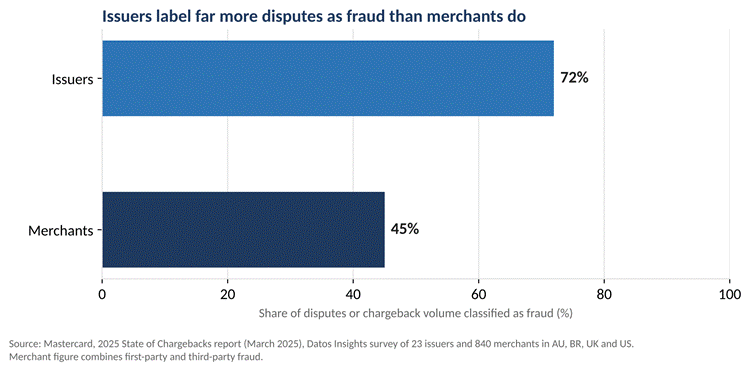
A gap also exists with fraud codes. In Mastercard’s 2025 Report, 72% of disputes were identified by the issuers as fraud. Merchants place about 45% of their chargeback volume as first-party and third-party fraud.
Win rates vary by market. According to the same report, merchants win representments on average 50% of the time. Win rates were 54% in the U.S., 49.1% in the U.K., 46.7% in Australia, and 36.9% in Brazil. Institutions in the study reported that merchants represent about 54% of chargebacks, and the institutions win about 75% of those cases.
Visa’s June 2024 guide and Amex’s 2024PROP guide name several prevention practices. Several are listed in both.
Descriptor issues cause multiple codes. Visa’s guide states an unclear merchant name is a cause of code 10.4. Amex lists descriptor fixes as prevention for inquiry code 176 and chargeback code F24.
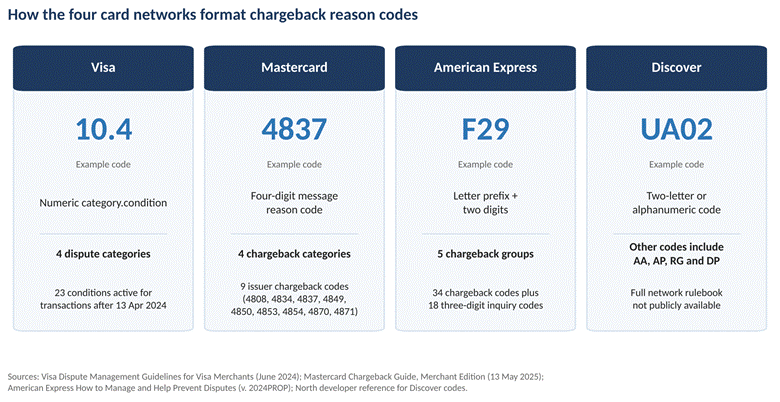
Despite the differences in the way chargeback reason codes are named and categorized by different card networks, they all break chargebacks down into a few major categories, like fraud, authorization, processing errors and cardholder disputes. Visa has 24 active dispute conditions broken across 4 categories. In its May 2025 version, Mastercard places most cardholder disputes under 4853 and most fraud disputes under 4837. Amex has an additional inquiry stage and 20-day response window. Discover does not publish any public documentation and relies on its processor code lists.
The conditions set the evidence. Visa condition 10.4 requires 2 undisputed transactions 120-365 days before the dispute. For Amex conditions F24, R03, and M01, the evidence requires a previously issued refund. Mastercard and Datos Insights forecast 324 million chargebacks globally in 2028, which represents a 24% increase from their 2025 prediction of 261 million chargebacks globally.
A chargeback code is a code an issuer issues to explain the reason for a chargeback. Visa uses codes like 10.4, Mastercard uses 4837, Amex and Discover use F29 and UA02 respectively.
This reason code will be included in the dispute notification your processor or acquirer sends you. Amex merchants can also find dispute information in their online Merchant Account.
Reason codes that accept only proof of refund, like Amex F24 and R03, or Visa authorization codes for unauthorized sales.
