Tag Archives: Debit Card

HMS Small Ticket Program

Today’s edition of the Official Merchant Services Blog will discuss the best way for merchants to save money on fees when accepting credit or debit cards for smaller transactions. Host Merchant Services is committed to bringing its clients the lowest fees in the industry. Our Small Ticket Program is a feature that helps us do just that for those merchants who process transactions at $15 or less.

Many merchants have seen debit savings thanks to the Durbin Amendment, which caps the Interchange Fees that Visa and MasterCard charge for debit cards at $0.24 and 5 basis points. Smaller merchants do not see the savings when running transactions under $15, since the 24-cent per item fee and the 5 basis points amount to 2.1% of the total ticket, before any additional fees are incorporated.

The Small Ticket Program however, allows qualifying merchants to pay a per item fee of only 5 cents, while paying an interchange rate of 1.6% for Visa. MasterCard has set its small ticket rate at 4 cents and 1.55%. This program saves merchants money on lower transaction amounts, since the per item fee is less of a burden on them in terms of overall effective rate.

The Interchange category for small tickets is available for merchants who are on Interchange Plus pricing, and who qualify under the Visa business types listed below.  Merchants enrolled in flat rate pricing or any type of three-tiered pricing will not be able to utilize these savings, which is just another way Interchange Plus pricing is truly the best out there.

While some processing companies hide added percentage points in the difference that exists between small ticket and large ticket processing, Host Merchant Services gives the savings directly to you. Our Small Ticket Program offers a better Interchange category and a lower per item fee, saving you more money in processing fees for all purchases $15 or less.

Visa opened up the types of businesses that qualify for Small Ticket Processing in November, 2010. Now each of these industries qualify:

  • Local Commuter Transport
  • Limos & Taxis
  • Bus Lines
  • Bridge & Road Fees/Tolls
  • Grocery Stores/Supermarkets
  • Convenience Stores
  • Service Stations
  • Fast Food Restaurant
  • Drug Stores
  • Book Stores
  • News Dealers, Newsstands
  • Dry Cleaners
  • Quick Copy, Reproduction & Blueprint
  • Parking Lots & Garages
  • Car Washes
  • Motion Picture Theater
  • Video Tape Rental Stores
  • Post Stamps/Government Only


If you qualify under any one of these categories, contact Host Merchant Services for your small ticket savings right away. Host Merchant Services promises: we deliver personal service and clarity and as always, we want to keep merchants informed of any potential savings.

Industry Terms: QR Codes

This is the latest installment in The Official Merchant Services Blog’s Knowledge Base effort. We want to make the payment processing industry’s terms and buzzwords clear. We want to remove any and all confusion merchants might have about how the industry works. Host Merchant Services promises: we deliver personal service and clarity. So we’re going to take some time to explain how everything works. This ongoing series is where we define industry related terms and slowly build up a knowledge base and as we get more and more of these completed, we’ll collect them in our resource archive for quick and easy access.

Today I will define the term Quick Response Code, or QR Code. These codes are two dimensional barcodes, sometimes called print based hypertext links, that are designed to be decoded at a high speed. QR codes are increasingly used to identify the URL of a company’s web site so that mobile phone users can photograph the code and retrieve information about the organization. Some companies have even created billboard-sized QR codes for this purpose.

barclay

The versatility of the codes doesn’t stop there, a QR Code can also contain a phone number, an SMS message, a link to a photo, contact information or just plain alphanumeric text, and the scanning device will respond by opening up the correct application to handle the encoded data appropriately. With the technology of mobile phones constantly expanding, especially within mobile internet, QR Codes seem like the perfect solution to quickly and efficiently bring mobile phone users onto the mobile web.

QR Codes can also be used to facilitate mobile payments. Recently, Barclays Bank launched a mobile commerce QR code campaign right here in Delaware, called BarclayCard Mobile Wallet.  The program works in conjunction with a merchant’s credit card terminal,  a customer’s smartphone and the corresponding BarclayCard app.  When paying for something, the merchant prints out a special kind of QR code and hands it to the customer, who uses the BarclayCard mobile wallet application to scan the code and authorize the payment.  We went over this program in detail here a few weeks ago, when our own Steve Myers was the first to use the app at National 5&10.  Advancements in technology will lead to expansion and advancement in the uses of these codes, including new games or more advanced methods of mobile payment.

Durbin Double Down

Durbin Double Down [2023 Update]

In this installment of the Official Merchant Services Blog, we look at the actions several retail trade groups and merchant advocates have taken to further the fight against the antitrust settlement proposed by Visa and MasterCard.  We have touched upon this subject several times before, however these steps may have been the most drastic yet.

In an open letter last week to leading members of congress, the National Retail Federation (NRF), the Retail Industry Leaders Association (RILA), and seven other large retail-related groups expressed their frustration with the pending litigation in the U.S. District Court for the Eastern District of New York, saying that the outcome could further “entrench the Visa/MasterCard duopoly.”

The groups called on congress to pay attention to the state court settlement, in an attempt to escalate the issue and garner attention from lawmakers and Americans.

The groups argue, “The proposed settlement, which was negotiated by Visa, MasterCard and lawyers purporting to represent the merchant community, is one-sided and preserves the very anti competitive actions that were the genesis of the lawsuits.”

“Given the important oversight role of Congress and your continued interest in this important issue, we write today to urge you to reject the false claims from the card networks and their representatives.” The letter also stated “The proposed settlement does nothing to resolve the failures in the electronic payment market and continued Congressional involvement in these issues is imperative. We look forward to keeping you fully informed as the legal process moves forward and the chorus of objections grows.”

RILA’s Brian Dodge described the problem retailers face, “Visa and MasterCard centrally set fees that are ultimately paid by merchants and collected by issuing banks. With two fee schedules imposed by two companies that control 70 percent of the marker there is no meaningful competition.”

The groups argue that the $7.2 billion dollar settlement is not the problem, even going so far as to accuse Visa and MasterCard of using the pending settlement exchanges as penitence for maintaining the status quo.

In a statement released in July, just after the settlement was announced Visa said it believes that the settlement is in the best interests of all parties involved. “This agreement should remove the distraction of litigation for all parties,” said Joshua R. Floum, general counsel of Visa Inc. “We will go forward with a focus on helping retailers grow their businesses and providing them with efficient and valuable payment options.”

On October 3rd, these retail and trade groups will appear before a court seeking to order the Federal Reserve Board to start over in devising regulations for implementing the controversial amendment’s provisions because the Fed allegedly did not follow the amendment’s dictates in setting the debit card rules now in place. The trade groups and retailers sued the Fed last November in an effort to start the rule-setting process anew. In a May filing, the plaintiffs said the board “manufactured ambiguity” in its interpretation of the amendment’s language. A Federal Reserve spokesperson would not comment about the upcoming hearing, although attorneys for the Fed said the board properly implemented the law’s directives regarding the authorization and settlement costs that could be considered in regulating debit card interchange, as well as which costs to exclude.

Retail groups continue to fight both the Interchange settlement and the Federal Reserve Boards Durbin rules.  There seems to be no end in sight for this case, and only time will tell if the Fed will be forced to reset its Durbin amendment rules and regulations and start anew.

Durbin Amendment Fallout

Today The Official Merchant Services Blog offers a really quick update on the fallout from The Durbin Amendment. You’ll recall Host Merchant Services offered a thorough analysis of the legislation before it took effect.

Much of the current media coverage for this topic revolves around something we predicted in that analysis: “The banks, not wanting to take a $9 to $10 billion dollar loss in revenues for the year, will simply add fees to other payment options or get rid of premiums and extras that they had been offering.” We also stated: “Higher fees on checking accounts and the removal of debit card rewards programs were suggested as a response banks would have.”

Banks Lead the Charge With New Fees

This article from twincities.com reports pretty much what we’ve been reporting about the response banks are having with the Durbin Amendment. The article, dubbing this strategy as Bank Fees 2.0, states: “Three months after banks scrapped plans for debit card fees, it’s becoming clearer how they intend to recoup money lost in the Dodd-Frank financial reform law. Instead of one new fee, prepare to be sold more products, offered new service packages, lose debit rewards and face more fees in general.”

This creditcards.org article reports the same: “So [the banks] enter 2012 chastened … and still facing a revenue gap. How are they going to make it up?  In fees, of course!  Just not the fees you were expecting. The Bank of America mess taught them a lesson; trying to unilaterally slap all their customers with a new fee is going to end badly, especially in the current climate, where the man on the street is hopping mad about big bank behavior.  So instead, they’re going to be sneaky about it.”

The article then offers a checklist of fees that could be forthcoming.

  • Minimum Balance requirements to increase for formerly free services such as checking accounts.
  • Penalty fees to go up.
  • One-time service fees — such as for opening a safety deposit box, or taking out a money order — to go up.

And then finally The Baltimore Sun offered this article which states that banks plan to add a wide variety of fees to help offset the losses from the Durbin Amendment. The article states “There are nearly 50 different fees consumers can wind up paying, depending on the services they use and how they use them, according to some consumer advocates’ latest estimates.” The article then quotes Alex Matjanec, co-founder of MyBankTracker.com, a consumer-finance information website describing the fees, “Most of these fees are not the in-your-face charges, such as the debit-card fee that caused the big uproar. Many are flying under the radar. But they could have a big long-term effect on your money if you aren’t paying attention.”

The sneaky fees were something we covered in The Official Merchant Services Blog entry on November 16, 2011: “Banks are now going ninja style with their plan of action. Sneaky fees hidden and peppered about their services. All combining to help make up the ground they were going to lose. But most of them deposited around their whole suite of services that it is much harder to latch on like a pit bull and berate them for doing this.”

Big Bank, Big Losses

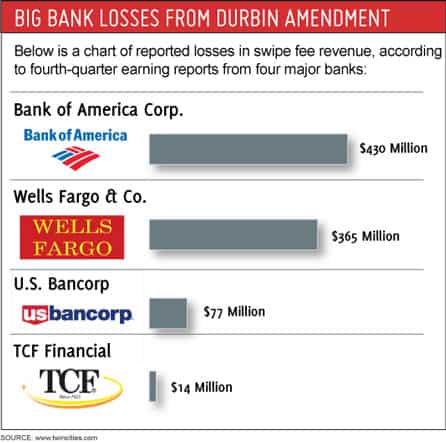
The losses that banks need to make up are starting to come in and be reported. It was predicted they would be in the billions, and the latest analysis of fourth quarter earnings reports state that right now it’s about $6 billion in loss. The two largest banks handling these types of transactions — Bank of America and Wells Fargo — equal roughly $800 million of that loss. Here is an infographic breaking down the four biggest banks and their fourth quarter losses from the Durbin Amendment cap:

Host Merchant Services Infographic on Big Bank Losses related to the Durbin Amendment

The Allure of Credit Cards for Holiday Shopping

With the Holiday Shopping Season fast approaching –– Black Friday is 11 days away, Cyber Monday is 14 days away –– the payment processing industry is still getting the last pieces in place for a brisk rush in the use of credit and debit cards. The Official Merchant Services Blog continues its series focusing on the impact the holiday shopping season is going to have on both the e-commerce industry and merchant services in general.

The battlefield is set between Debit cards and Credit cards. Debit cards received a huge boon from the federal government in the form of a cap on interchange fees that went live on October 1, 2011 in the form of the Durbin Amendment. This cap restricts the interchange fees that can be applied to Signature debit card transactions. The cap restricts the charge to between 21 and 24 cents per transaction. This is a huge cut from the previous average of 44 cents per transaction, and presents debit card transactions as an attractive option for merchants to start accepting right as we slip into the big holiday shopping rush.

That has left Credit card issuers scrambling for a response, trying to stay competitive and keep consumers answering “Credit” at the checkout line.

This Reuters article suggests one of the big campaigns that credit card issuers are going to push this year is a significant raise in rewards programs for their customers, tempting them to choose credit as their swipe of choice to get access to those sweet sweet rewards. A focus on cash back and travel rewards push the right buttons for consumers while holiday shopping.

A Look At The Numbers

Here’s a small chart detailing the dichotomy between debit card usage and credit card usage from consumers in 2010:

Merchant Services graphic for debit card versus credit card usage

The chart breaks down the chosen method of payment among a survey of credit card owners from 2010. Key numbers to note are the Travel category –– which is dominated by credit card use. It is unlikely that the Durbin Amendment and its changes are going to really affect that sector. But looking at the category listed as “Personal Items” –– which would tend to be the category for holiday gift purchases –– you’ll see a much tougher competition between the two transaction choices. This is where the Durbin Amendment changes to debit card swipe fees are going to have a large impact. And this is where the juicier cash back rewards have credit card issuers hoping they can keep things competitives.

According to the Reuters article: “For example, both Chase (CCF.A) and Citibank C.UL have cards that are offering new applicants $200 in cash back after they spend $500 on their cards.”

You Have to Dig to Find the Best Deals

Some of the best deals are not always displayed in easy to find places. The Reuters article cites a Citibank deal. On the Citi website it advertises the deal as $150 cash back on your first $500 of purchases. But then if you dig deeper by google searching “Citi Dividend $200” you find the better deal directly.

Making it Work For You

The really effective strategy to maximize these deals is to combine them with other deals you will be hit with during the holiday shopping season. The Reuters article notes: “Some cards (such as the Upromise card) have their own shopping portals that combine their rebates with rebates from merchants. In other cases, you can use your rewards points directly for holiday shopping; American Express (AXP.N) awards can be paid directly to Amazon for purchases, for example.”

This type of deal stacking gives consumers a lot of shopping incentive to choose credit as their swipe choice.