
Adventure awaits you. Your love for carefully planned trips from airplane to restaurant creates a perfect opportunity for you to start a travel agency. More people engage you to plan their travel because they trust your style and taste for the best travel experiences. Travel agency startups are always a dream for many, but are more easily attainable than you might think. Savings don’t have to be a barrier. Travel startups can be done without a storefront and a substantial nest egg if you have the accreditation, a solid structure, and a good plan for your first year.
This guide helps you figure out how to start your travel agency specific to 2026. It explains why the majority of new travel agents start with a host agency, and the accreditation you must understand: IATAN, ARC, and CLIA. This guide also covers commissions and the kind of technology you will need to run a good travel business. You will have a good idea of your travel agency payout and your first-year travel business plan when you finish this guide. Your agency will help you earn a paycheck from your love of travel while helping others do the same!
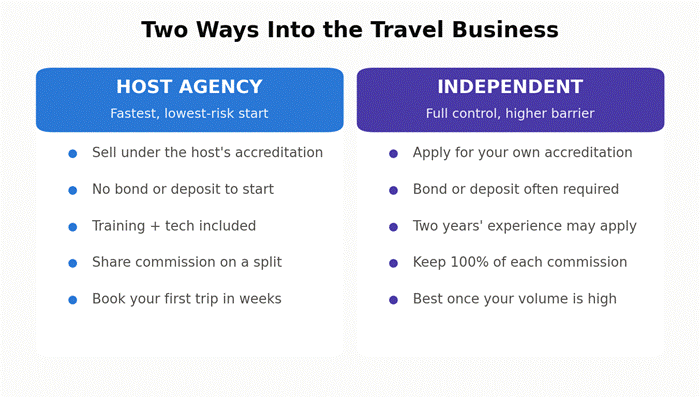
Figure 1. Two paths into the travel business: host agency or fully independent.

Your most important decision is not your logo or your name. Your most important decision is choosing to partner with a host agency, or not. A host agency is a travel company that has its own industry accreditations. Partnering with them means you can sell travel with your own clients and your own brand. The agency takes care of supplier relationships and back-office work.
Accreditation is important in the travel industry. Suppliers like cruise lines and tour operators pay agencies they recognize. If you want to be recognized, be prepared to spend time and money. A host agency provides you recognition on day one. You get to use its numbers, its contracts, and its commission rates.
The most appealing part is how quickly and safely you are able to get your travel business operational, with a host agency. You can sell your first trip in weeks instead of years. You skip bonding, deposits, and the two-year experience rules, and you get training and technology included. In exchange, the host agency takes a portion of your commission, which is totally worth it for new agents.
Going completely independent means that you have to apply for your own accreditation. You have all your supplier connections made directly. You take home all commissions in full. That level of independence is very enticing, and it will pay off over time for large volume agencies. The only problem is, you have to pay to get in.
Several challenges come with independent accreditation. Some programs require two years of work experience within the industry. Some programs require a $20k bond or security deposit. On top of all that, there is the full administrative work of vetting and interviewing, along with annual compliance. New agents usually don’t sell enough to cover the costs.
With the host agency, the math is the opposite. Your barrier to entry is almost nothing. You give up a share of each commission, but your overall earnings are often higher because you can sell right away. A lot of agents stay with the host agency for their entire careers. Some agents sell with the host agency to gain the volume they need, and then go independent. There is no wrong answer because it all depends on your experience, the amount of money you have available, and your willingness to do administrative work.
Accreditation, in plain terms, is a number that identifies your company as a travel agency. Suppliers use the number to identify your company to pay your commissions and allow you to book airline tickets. Many organizations provide these numbers. Each organization has a different focus in the travel realm. Knowing what each does is the quickest way to select appropriately.
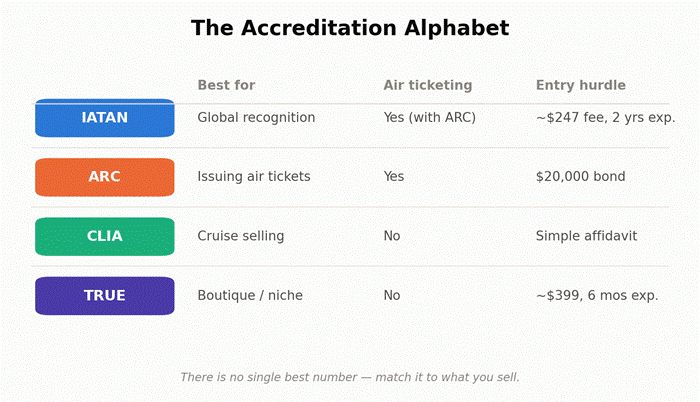
Figure 2. IATAN, ARC, CLIA, and TRUE compared at a glance.
IATAN is IATA’s arm in the USA, and holding its accreditation is seen as a sign of professionalism. The IATAN ID card that comes with it is recognized by travel suppliers around the globe. Agencies receive many benefits when they obtain an IATAN ID.
IATAN is of interest to travel agencies that prefer Global supplier recognition. It is a one-time payment of approximately $247. Agencies must have two years of experience in travel, a travel business license, and a travel business’s financial statement. IATAN also asks for errors and omissions insurance, with waivers available depending on credentials. IATAN also offers a non-ticketing option for travel agencies that do not sell air transportation directly to the clients.
ARC is the critical link between the travel agencies and the airlines. It is responsible for airline ticketing and the settlement of those funds in the US. If issuing airline tickets is a core function of your business plan, then you need to deal with ARC. It handles airline ticketing and related transactions worth tens of billions of dollars annually.
Of all the airline accreditation processes, ARC is the toughest. A full ARC agency must undergo background and credit checks, and post a twenty-thousand-dollar bond or deposit. It also must go through an on-site review and must name qualified staff. ARC provides a lighter option called the Verified Travel Consultant program for leisure agencies that infrequently issue airline bookings. This option drops the bonding requirement, but limits the transaction volume, which fits agencies that focus on cruise bookings or tours.
CLIA is the cruise sector’s professional body. It is the identifier cruise lines use to assess a travel agent for commission payments and for the associated perks. Although CLIA avoids calling its number an accreditation, it serves the same purpose as accreditation for bookings. It does nothing for air ticketing.
CLIA is the obvious choice for the cruise selling specialist. Their basic travel agency membership requires a simple affidavit confirming the agency is operational and in legal standing. This makes the application process much simpler than it is for ARC or IATAN. There is also a separate individual membership for agents working under a host, which focuses more on education and benefits, and less on booking authority. CLIA is essential for any cruise selling specialist.
One recent identifier can be included in the category of the big three. TRUE (Travel Retailer Universal Enumeration) is administered by the travel association CCRA. TRUE was developed for boutique agencies and niche specialists. Their membership is valid for a maximum of twenty-five advisors and requires only six months of selling experience to qualify. Membership is priced at an initial fee of three hundred and ninety-nine dollars. Some suppliers do not recognize TRUE numbers; therefore, make sure your key partners recognize TRUE before you rely on it.

Here is something that confuses many new agents. In the United States, there is no such thing as a federal travel agent license. Someone could decide to be a travel agent tomorrow. Some states do require a seller-of-travel registration. However, this is not a license, but rather a consumer-protection filing, as many states refer to them.
The regulations take effect depending on where your clients reside. That’s the part people overlook. If you sell to the resident of a regulated state, you could be required to register there. Four states account for the bulk of the compliance, and each is broken out below so the differences are clear.
To be compliant with California’s travel laws, you must register with their restitution program and pay an annual fee of approximately $100 for each program location. Client funds must be protected in a trust account, a surety bond, or a credit card-only booking policy. Additionally, a California business registration is required. Due to its size, California is the most cited seller-of-travel state.
Florida requires a yearly registration of about three hundred dollars and an additional charge for those who sell vacation certificates. Florida also requires a twenty-five-thousand-dollar surety bond that increases for certificate sellers. The bond is often waived for agencies that have five or more years of a clean record. Also, Florida provides fee waivers for active duty military, veterans, and spouses of veterans.
Hawaii and Washington also have their own specific rules. Washington requires an annual payment of about $222 and also requires either a trust account or a bond arrangement for the protection of client funds. Hawaii also requires an annual payment, but it is aligned with the calendar year.
They also require a client trust account with a bank located in Hawaii. A few other states (e.g. Louisiana and Delaware) have additional requirements for the agencies that have a storefront. If in doubt, confirm the rules in all of the states in which your clients reside.
It is easy to fall into the trap of trying to sell all kinds of travel to all kinds of clients when starting an agency. The most successful travel agents specialize. Specializing allows you to target and tailor your marketing and develop your knowledge of your specialty. Specialization also naturally leads you to focus on travel products with the highest commissions. Cruises, tours, and all-inclusive resorts are often the most profitable travel products, and agencies that focus on them often find the greatest success.
Commissions are the most important part of the travel business, and they vary by product. Hotels typically pay a commission of between five and ten percent, though preferred partnerships may increase that rate. Cruises generally pay a commission between ten and twenty percent, with ocean cruises returning an average of sixteen percent. Tours and all-inclusive packages tend to fall in that same commission range.
Air travel is the great exception and will most surprise your new travel agents. Most domestic tickets pay little or no commission, and international tickets pay slightly more. This is most likely a contributing factor to so many leisure travel agencies avoiding an air travel-centric business and focusing more on cruises and all-inclusive packages. A single luxury cruise booking can be more profitable than a dozen bookings of domestic flights.
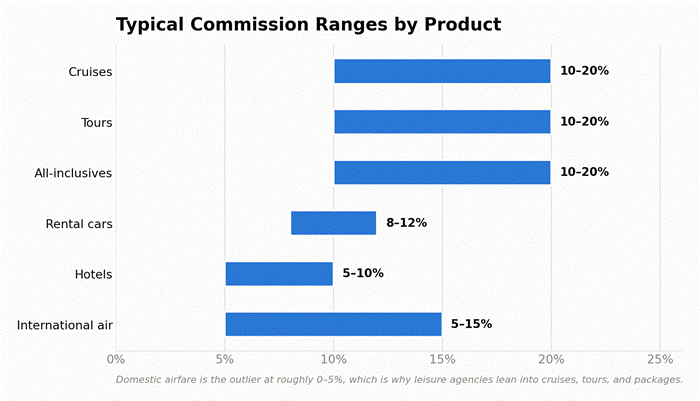
Figure 3. Typical commission ranges by travel product.
You do not need a large server farm to get started. You need a small, sensible tool stack. The necessary tools depend on your niche and if you decide to go with a host. Most hosted agents automatically inherit a lot of this technology, which is one of the many reasons the hosted path is the preferred choice.
The two essential items are a booking solution and a client management solution. Agents who primarily sell air usually do their bookings through a Global Distribution System, and it’s worth knowing the three major players in their respective spaces.
These three global distribution systems are the reservation backbones of the industry. They centralize agents to access live inventory of airlines, hotels, and cars in one place. Amadeus is the most prominent in Europe but offers good global coverage. Sabre holds the largest market share of agencies in the U.S. Travelport operates the Galileo and Worldspan systems, and competes based on the flexibility of their technology. The majority of new leisure agents will access one of these systems via their host and will avoid direct contracting, as this is more expensive.
Besides a reservation system, you will need a booking and client management system. A client management system will keep your leads, itineraries, and follow-ups in one system. Specialized systems for travel advisors help to streamline the process for quotes, invoices, and payments. Combine this with a professional email, a simple website, and a payment processor, and your basic systems are in place. Build from this foundation as your business grows.
Almost all new agents struggle to grasp how the payment model works. In most situations, the customer pays you zero. The payment comes from the supplier, and you make your income from the commission after the customer has traveled. You act as the supplier’s external sales team. This is why the service you provide can seem to cost nothing to the customer, yet your income is intact.
The delay in receiving the income is the most challenging part of the model. Although you have booked the trip, the income is only paid after the trip has been completed. This can be for many months in the case of a cruise that has been booked far in the future. For this reason, new travel agents will have to accommodate this delay on their cash flow. This is also why many agents will charge a small professional service fee for their time.
When you have a host agency, your commission is a split. The supplier pays the host agency, who in turn pays you the commission. The typical split is that the travel advisor receives seventy percent and the host agency receives thirty percent. As your sales increase, the split will improve in your favor. One popular host agency moves travel agents to an eighty percent split at three hundred thousand dollars in bookings and to a ninety percent split at two million dollars.
Independent agencies pay for the service with their overhead and accreditation costs, with the split being eliminated. The federal government’s labor statistics report a median income for travel agents of about forty-eight thousand dollars, and industry surveys show experienced hosted advisors earning significantly more.
Building a foundation in your first year instead of trying to get rich quick is key. It’s important to break the year into phases to simplify what is often an overwhelming process. The first phase is prepping the business. You need to register your travel business as a sole proprietorship or LLC, choose a travel niche that you enjoy, and find a host agency and complete its training. You’ll need to set up some travel tech in the process. This phase is short and can be done in weeks of focused work.
Once set up, the focus shifts to selling and learning during the middle of the year. This is often accomplished through booking trips for family, friends, and referrals, to practice the booking process, learn the travel suppliers, and get to know your host agency’s support team. You complete seller-of-travel registration in the states where your clients reside.
The goal by year-end is strong, steady bookings. If your bookings are not strong, you focus on improving your marketing and letting your reputation grow. This first year builds the foundation your business will grow on.
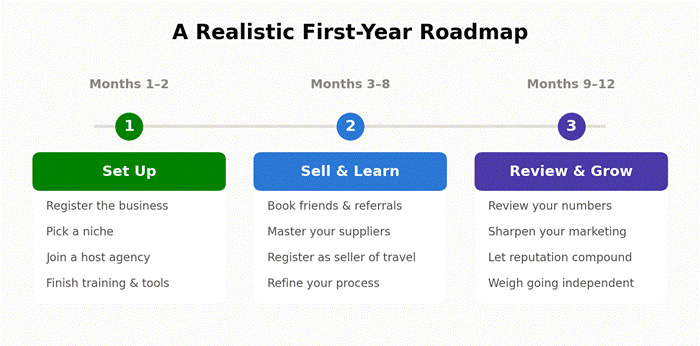
Figure 4. A stage-by-stage roadmap for your first year in business.
Starting a travel agency is not as complicated and daunting as it seems. There is no storefront to rent and no federal license to earn. You simply have to choose a business structure, pick a niche, and decide how to get accredited. For almost all new travel agents, the fastest and easiest way to get in the business is by joining a host agency. A host agency gets you accreditation, the necessary technology, and the ability to book travel arrangements and supplier relationships right away.
After you choose a host agency, your travel business has IATAN, ARC, and CLIA at your fingertips as well as the ability to register as a seller of travel in the states that require it. You will earn commissions for booking travel arrangements. You will be paid by the travel suppliers, which is typically done after the arranged trip has been completed, with your host taking a commission. Prepare to be patient in your first year of travel planning, and your business will continue to grow in the years after. Choose your niche and your host and book travel to earn income.
First, decide if you want to form an LLC or a sole proprietorship, and choose your niche, cruises or luxury travel for example. After that, find a good host agency. Becoming an agent with a host agency provides you with technology and supplier relationships. After you complete the required training, you will set up your core tools. After you complete your training, you will be able to register as a seller of travel in the states that require it. You will be able to book your first travel within weeks of the registration process.
A host agency is a travel industry provider that has legally required travel industry licenses and accreditations. They let you work under their business umbrella. In this model, you keep your clients and your brand while using the host agency’s contracts with travel suppliers and commission rates. Technically, you don’t need a host agency, but most travel agents starting out use a host agency because it removes the need to post a bond, pay deposits, or have the prior industry experience required to go independent. It is the fastest and lowest-risk way to earn income.
You won’t need your own if you operate through a host agency, as you will be selling under the agency’s accreditation. An ARC number is required if you plan on selling airline tickets, and it carries a $20,000 bond requirement. An IATA, IATAN, or CLIA number provides you with global supplier recognition and an official agent ID card. Cruise-centered agents usually prefer CLIA numbers over IATA and IATAN.
In the U.S., there’s no federally issued travel agent license, which means anyone can sell travel. However, some states, especially California, Florida, Washington, and Hawaii, require a seller-of-travel registration. This filing is for consumer protection and is not a skills license. With this registration, there is typically a fee and a bond. The rules apply based on your clients’ residences, so check every state you sell to.
Travel agencies earn commissions from suppliers like cruise lines, tour operators, and hotels. Commissions typically range from 10% to 20% for cruises, tours, and travel packages and are lower for airfare. Suppliers pay commissions after clients return from their trips. Hosted travel agents share commissions with their hosts according to their agreement. Many travel agents charge small, non-refundable fees for trip planning to improve their cash flow.