Posted: September 24, 2026
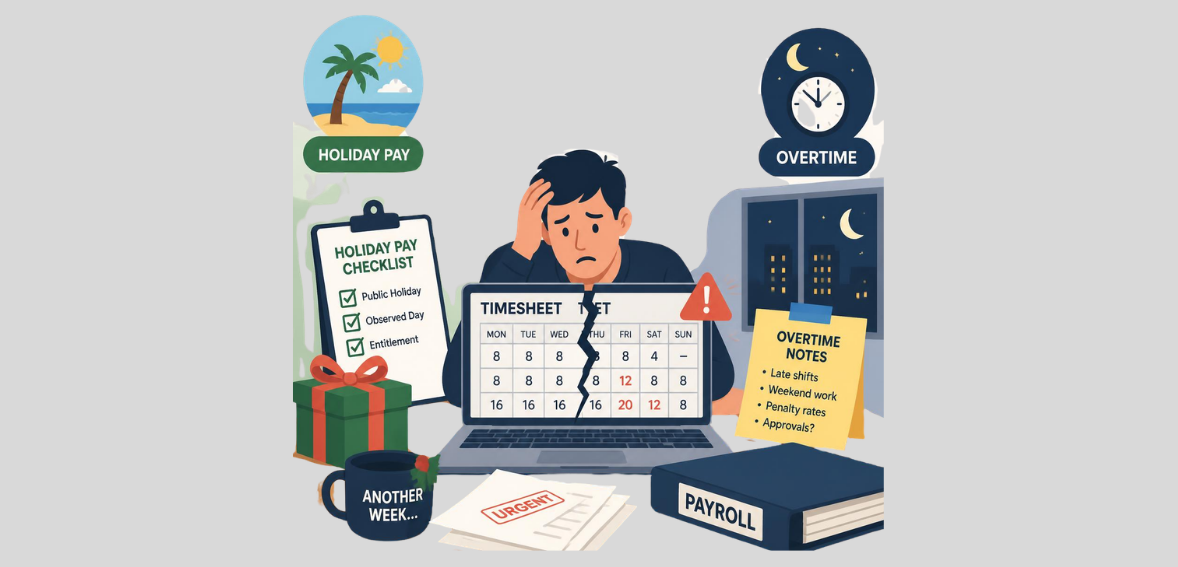
Start with a small payroll puzzle. An employee got holiday pay in a week where he also put in 40 regular hours. Is any overtime due? Answering that means understanding how paid holidays and overtime interact. That’s the major part of holiday payroll that can be a little tricky.
Understand the difference: paid time and time actually worked are two separate things. No federal statute obliges employers to offer paid holidays. And the FLSA counts only hours an employee genuinely worked past 40 in any week toward overtime. That’s one big tangled knot, which makes a holiday week payroll confusing.
Here is what it takes to run holiday payroll with confidence.
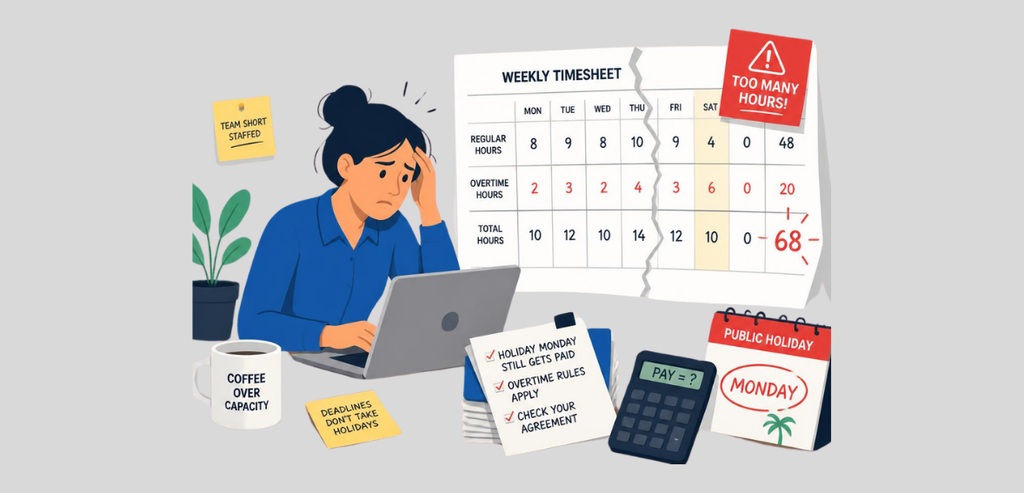
Federal law does not make employers give workers time off, paid or otherwise, for Christmas, Thanksgiving, or any other holiday. Nor does it make employers pay a special rate to staff who work those days. Holiday pay is a voluntary compensation or benefit that an employer offers employees during holidays, such as Christmas, Thanksgiving, or Labor Day. Where it is offered, it usually takes one of two forms:
This section spells out the federal position. The Labor Department puts it plainly: nothing in the FLSA compels private companies or small business owners to pay staff for hours they did not work, whether that is a vacation day or a holiday. Whether to pay is the employer’s decision, or something the employer and the worker settle between themselves.
This is a valid question because many employers get confused when creating payroll for holiday weeks. As stated previously, overtime under the FLSA attaches only to hours genuinely worked past 40 within a workweek, never for paid hours in which no work was done.
For example, one employee puts in eight-hour days, Monday to Friday. The company was closed on Thursday for a paid holiday. Because it was a paid holiday, the employee gets paid for a full 40 hours but actually worked 32 hours, excluding the Holiday. So his final paycheck will also show 40 paid hours, as the company voluntarily decided to give a paid holiday on Thursday. Therefore, the employee will not receive overtime, because only 32 of those hours were actually worked.
Let’s take one more example,
Suppose the same employee gets an eight-hour paid holiday and also logs 44 real hours across the rest of the week.
That is 44 hours of actual work plus an eight-hour paid holiday. For federal overtime purposes, those holiday hours generally drop out, leaving four worked hours above the 40-hour line. At a $20 regular hourly rate, the basic federal overtime rate would be $30 an hour for those four hours, assuming other forms of compensation didn’t affect the regular-rate calculation.
That comes to $120 in overtime, on top of regular wages and the holiday itself. The point of the example: overtime kicked in because actual work exceeded 40 hours, not because paid hours crossed 40.
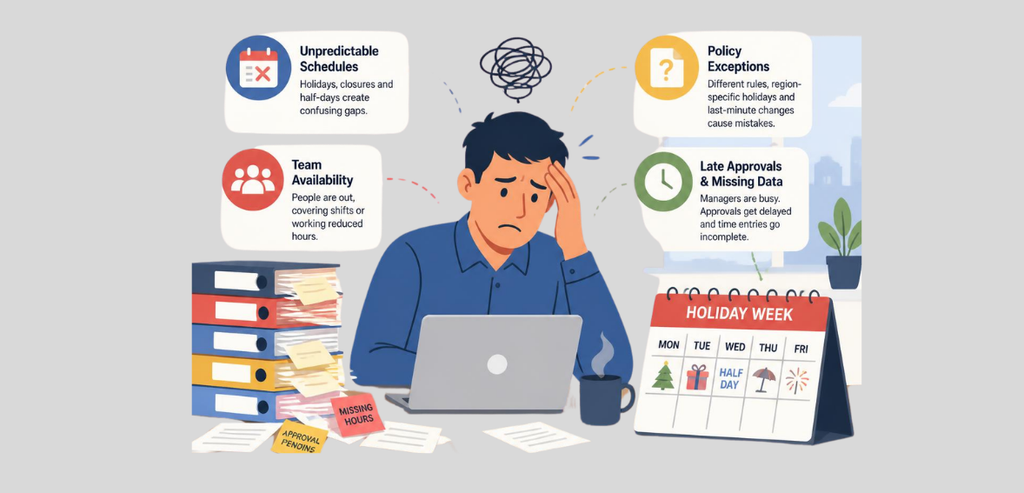
The biggest reason for payroll complexity is the timesheet. For example, an employee might expect to receive a paycheck for eight hours that he assumes will be counted as overtime. But that’s not the case; the difference between hours genuinely worked and hours paid has to be understood. These two are different things. The same principle applies to other forms of compensated time off. Vacation, sick leave, and holidays all increase paid hours without increasing the hours an employee actually worked for federal overtime purposes.
Your payroll system should distinguish between hours worked and holiday hours. Distinguishing between these two makes it easier for your payroll personnel to calculate overtime compensation and explain the calculation should an employee raise questions.

Every business owner should create a clear paid holiday policy to prevent future confusion and avoid answering employees’ emails about holiday work pay. First, identify paid holidays, such as Christmas, New Year’s Day, Thanksgiving, or other holidays that you may feel are important for your business.
Then clearly explain what happens when a holiday clashes with a weekend: whether an employer offers an alternative day off, and what kind of paid holiday the company is offering.
If your company stays open during the holiday season, plan how you’re going to compensate staff who cover those holidays.
Some businesses pay their standard hourly rate, while others offer a holiday premium as a bonus for covering a day when many people would otherwise be off. No federal requirement mandates time-and-a-half or any other premium for holiday shifts.
If a business chooses to offer such a holiday premium, it should clearly document the policy. That way, every employee knows which holidays they qualify for, who qualifies to earn the premium, and how much a holiday shift pays. This is especially important for businesses with more than one manager, so different supervisors don’t give different answers.
It’s important to place extra focus on holiday week payroll. It should not be an uphill battle to work out which employees have qualified for overtime in a holiday week. For instance, a payroll record showing “48 hours” doesn’t provide enough information if eight of those 48 hours are paid holiday time. A better payroll record would show 40 regular hours worked, 4 overtime hours worked, and 8 paid holiday hours.
Doing so would make the payroll process more transparent and give the employee a clear explanation of how the final paycheck was calculated. It will also allow the employer to spot mistakes before finalizing a payroll record, rather than trying to detect them after an employee has been paid.
Federal FLSA rules matter when creating a holiday pay premium policy, but it’s equally important to include employment agreements and other state and local wage-law arrangements that can also affect holiday pay. Certain federal contracts can have their own requirements. That’s why, to avoid errors, businesses should check the requirements that apply to their employees, location, and industry, rather than relying on the federal standard to answer every holiday pay question.
If you are unsure about how a holiday premium, paid holiday, or overtime calculation should be applied, you should consult a payroll professional or employment-law adviser before processing the affected payroll.
Before finalizing the paycheck during a holiday week, pause and take a few minutes to review the timesheet carefully. Check which employees got a paid holiday and determine whether they qualify under the company’s policy. Then separate the paid holiday hours from the hours employees actually worked.
Next, check whether any of your covered, nonexempt employees logged over 40 worked hours during the workweek. If yes, calculate overtime by applying applicable federal and state rules and consider any other compensation that may impact the regular-rate calculation.
Finally, review if your company’s holiday policy is applied consistently. Should an employee ask why no overtime appears when paid holidays pushed their total past 40, explain the difference between hours of paid leave and hours worked.
Holiday payroll shouldn’t be complicated once you separate paid holidays from overtime. Federal law does not oblige private employers to provide paid holidays. Nor does a holiday shift automatically earn premium pay. Federally, overtime applies only when actual work exceeds 40 hours within the week.
The best way to avoid holiday payroll chaos is to create a holiday policy before the holiday arrives. Include every detail, such as how an employee qualifies for holiday premium pay under your policy and how overtime will be calculated.