
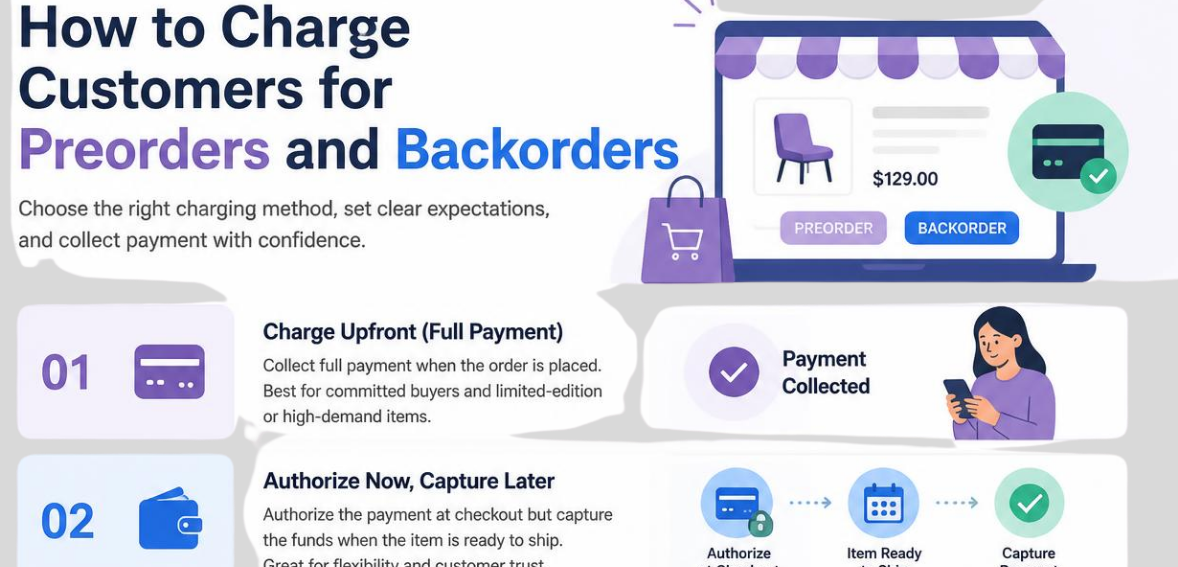
There are two main options, and a lot of waiting. Charge at order works when a merchant discloses it and when an order ships on the specified ship date. Authorize-then-capture works when a merchant captures within their network’s timeframe and if split captures track shipments, not warehouse milestones. If a merchant promises a ship date and fulfills it after that date, the FTC’s delay-notice and consent rules apply in addition to either payment pattern.
A merchant’s paper trail of notices in a delayed shipment case is the evidence it will use to respond to a non-delivery chargeback. The individual components of the payment framework are relatively straightforward, but the real challenge is integration: a checkout page that charges preorders and backorders without disclosing any terms, an authorization that simply expires, a capture that is triggered by a status update, not a shipment.
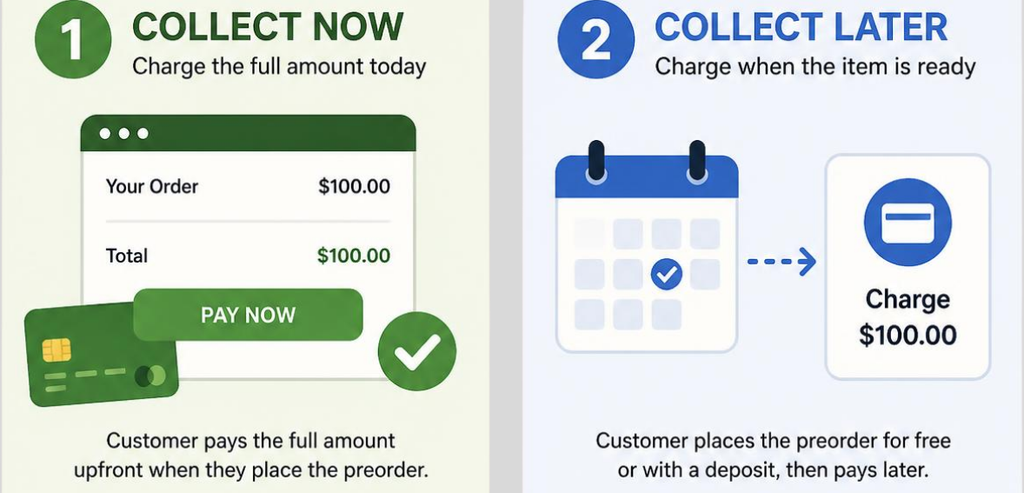
There are exactly two lawful methods for merchants to process preorder and backorder transactions. The first is charge at order. In this method, the customer’s credit card is charged when the order is placed and before the order is shipped. The second method is authorize at order, capture at shipment. In this method, a merchant places a hold on the customer’s credit card and converts the hold into a charge once the order is shipped.
A charge at order method is typically used to sell products that are made to order, have a limited sale, or have a specific date of release, such as a book or game that is preordered. In this method, the seller is able to indicate a firm date of release for the product. The authorize-then-capture method is preferred for orders that are backordered for an indefinite period. This avoids holding a customer’s money for a product that the merchant may not be able to ship for a long period of time.
Per the Mail or Telephone Order Merchandise Rule (16 CFR Part 435) that was first issued in 1975 and pertains to orders that are made by phone, mail, or online, and that are not prohibited from charging a customer’s credit card before shipping the order. Sellers are required to have a reasonable basis to believe that they are able to ship the order within the advertised time period, and if no time period is advertised, then they are required to ship within 30 days. It is the merchant’s decision on which method is used, and it is not a legal issue independent of the requirement.
It is allowable to charge at the time of sale for services or goods that will be provided without shipping, as long as the customer is notified of this before the sale is completed. Notifications must include the price of the charge, the ship or delivery window, and what will happen if the window is exceeded and the delivery is not confirmed. Notifications embedded in general terms of service are inadequate. The notification must be made during the checkout process and must be visible to the customer at the time of payment.
The FTC’s rule requires the merchant to have a reasonable basis for any shipment date that is communicated to the customer. If no shipment date is communicated, the merchant is required to ship within thirty days of completing a properly filled customer order. There is a case to be made that the merchant is practicing an unfair trade practice if the merchandise is offered for preorder by stating “ships in March” (or “shipping in March”) and if the merchant has no justification for that statement.
The FTC has pursued such cases. In 1999, the FTC settled with several top Internet sellers, among them Macy’s.com and Toysrus.com, and seven others, for failing to provide timely notification to their customers during the holiday season. Charge-at-order without an adequate date disclosure is, by far, the most common way merchants convert a standard backorder into an unfair trade practice.
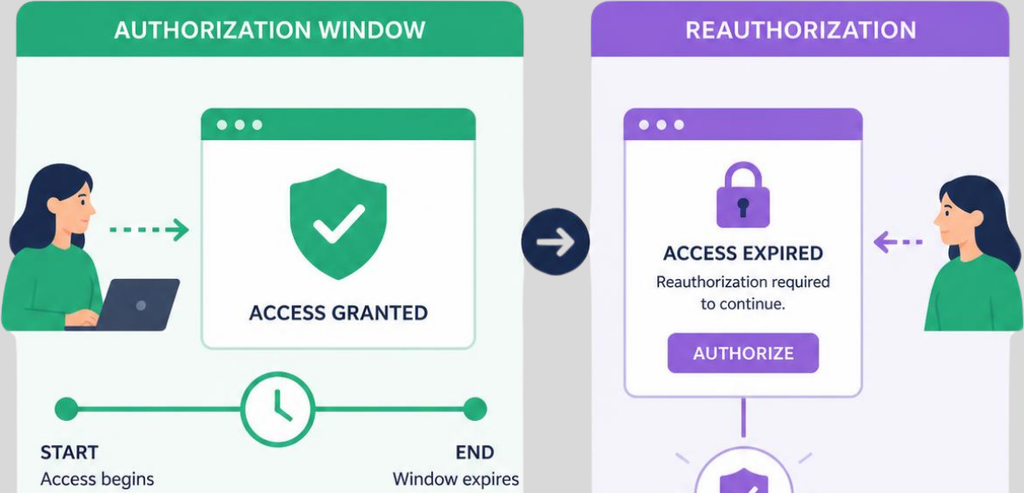
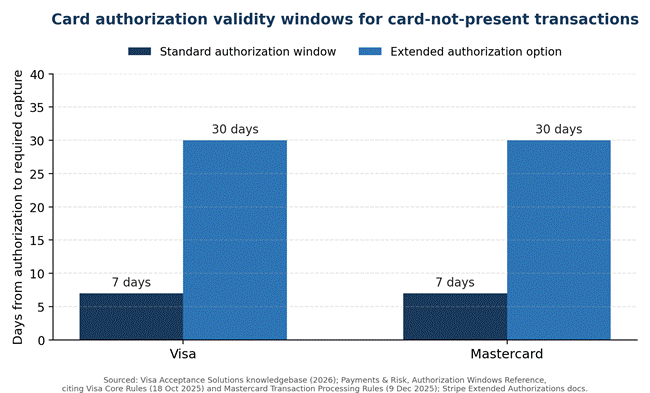
The authorize-then-capture method resolves the disclosure issue, but introduces a clock. For card authorizations, this means that a merchant cannot hold funds unconstrained. As explained by Visa, authorizations must be captured within 7 days of the authorization date. After this time, interchange fees increase and the authorization may be reset or expire.
Seven days is the card-not-present policy of both networks, and merchants may be provided additional authorization periods by both Visa and Mastercard. Visa’s Extended Authorization Service and Mastercard’s equivalent extended validity period, both documented by Stripe and several processors, provide a 30-day capture extension from the time of authorization.
Seven days covers most in-stock preorders with a known ship date in a week. It will not cover backorders that are 6 or 8 weeks out. When ship dates move outside of the authorization window, even with the extended authorization, there is only one option: let the original authorization expire and run a new authorization much closer to the ship date. Reauthorization is a routine step, not a failure state, but it does introduce risk.
The card on file may have been canceled, expired, or fully used in the time between the original authorization and the subsequent attempts. A reauthorization may decline for reasons having nothing to do with the original transaction. Systems that hold preorders for any useful period of time should have a reauthorization process that runs a few days prior to the promised ship date, with a contingency to contact the customer if the reauthorization attempt fails.
The chart below lines up the standard and extended windows side by side.
When an order has multiple line items, and one item is on backorder, the other items do not wait to ship until the backordered item does. The backordered item ships after the others. The payment also must be processed after the other shipment(s). Processing the transaction and taking payment before the backordered item has shipped repeats the charge-before-ship problem that the disclosure rules seek to resolve.
A split capture, or partial capture, is the answer. A partial capture allows the total amount of a request to go through. Once a merchant requests a certain amount, each subsequent shipment can only go through up to the total amount of the original authorization. Many payment gateways, including Cybersource, Clover, and Worldline, document this mechanism. The first of many partial captures needs to have the original authorization, a sequence number, and the running total. It is desired to have the customer’s credit card statement show many charges, each for a shipment, instead of having a single charge for the entire order.
Split capture has a large limitation: the same time frame applies to authorizations. If one of the items in a multi-item order will not ship in the next 7 days or 30 days, then split capture fails, and the merchant must wait for the plastic authorizations and capture the remaining balance a lot closer to the actual ship date. Most Gateways limit the number of split transactions that can be performed under a single authorization, in the range of three to four. Orders that are shipped in pieces need to have a different solution than orders that are shipped in two or three large batches.
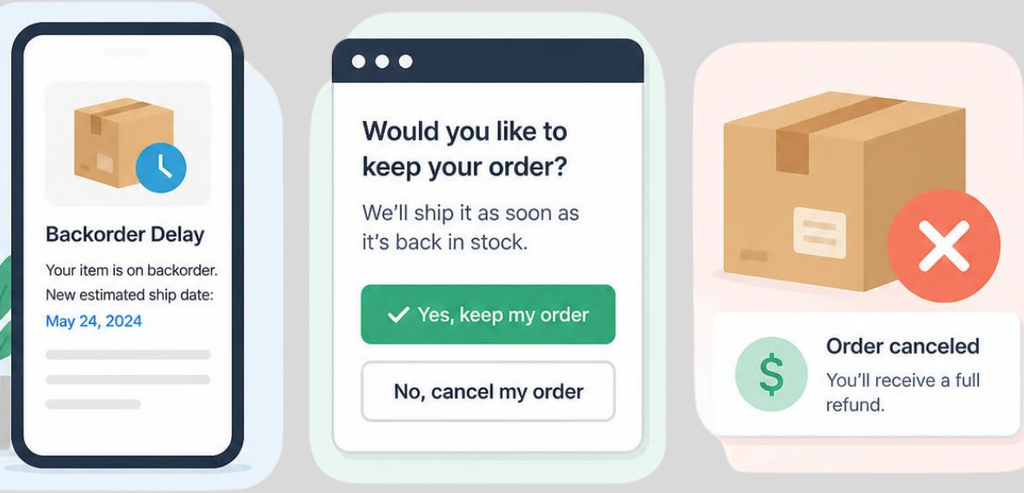
The FTC rule establishes a methodology for post-missed ship date requirements that are the same for merchants that use any type of charging pattern. When a shipment date is missed, the first notice to the customer must include either a new ship date or a statement that the ship date is unknown along with the customer’s right to cancel and request a full refund, at no charge to the customer. Email, fax, or even a phone call satisfies the requirement for notification to the customer.
Consent to delay processing would depend on the length of the delay. A delay of 30 days or less after the promised ship date, by default, would be considered a request to continue to process the delay, and this would be noted in the delay notification. A delay of greater than 30 days would mandate a refund and cancellation of the order unless the customer affirmatively requested a continuation of the delay. An unknown revised ship date would result in an indefinite backorder. A notice would then be required to provide an explanation of the delay to allow the customer to have an understanding of how long the delay would take. A cancellation option would remain available to the customer at any time before the shipment of the order.
If a merchant is unable to fulfill an order within the revised deadline, the merchant has to send a notice of the delay to the customer prior to the new deadline. The merchant must follow the same consent requirements as before. Records of enforcement of this rule in the last few decades show that the U.S. Federal Trade Commission obtained an $800,000 civil penalty from the Telebrands Corporation and its president in 1999. The penalty was due despite the company’s failures to notify consumers of shipping delays and its failures to issue refunds promptly, which affected the terms of a 1996 consent order involving the same violations.
Whether the cancellation of a backorder is initiated automatically by the 30-day rule or by the customer, the refund has to go back to the original card promptly. The rule states that a prompt refund is mandatory for merchandise that has not been shipped. Delaying the refund is, in fact, the violation that the FTC has pursued in its enforcement of the rule. Store credits and issuance of vouchers will not suffice when the customer has requested a refund on the card and paid by the card.
Misdelivery or delivery of merchandise well beyond the promised time is also a covered reason for chargebacks in both networks. Visa’s reason code 13.1 applies to instances where the cardholder maintains that the merchandise or services were never received. This code is also applicable to instances where the merchant processes the order and the services/goods have not been shipped, or the merchandise has been shipped and it was lost in the mail.
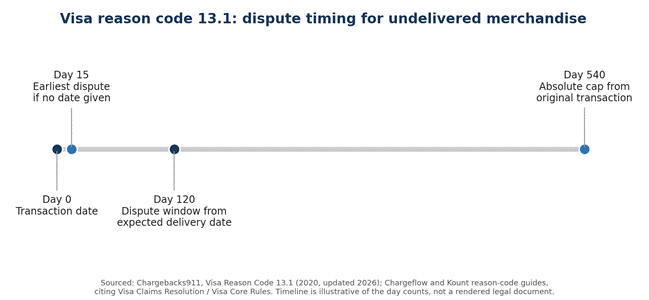
Mastercard’s equivalent code 4855 also applies to cases of non-delivery. On the Visa side, the issuing bank has a maximum of 120 calendar days after the transaction date, or the last expected delivery date of the customer, to process the chargeback, which can be extended to a maximum of five years after the transaction. In the absence of an agreed delivery date, the issuer has to wait at least 15 days after the sale to file the chargeback.
A merchant who sends the delay notices required by the FTC rule and keeps a record of them has most of the evidence to help answer a 13.1 or 4855 dispute: prove that the customer was aware of the delay, consented to the delay or was refunded, and was never charged for something that had no shipping date.
The mechanisms mentioned only derive value if the framework has been established by the gateway before the first preorder is made. Of the numerous framework elements, three major components are of relevance. The first of these is configuration for a hold-based order in backorder cases. The second is configuration at the processor level for a multi-capture/split shipment, which several of the large processor companies put behind a support request, so it is good to verify it during configuration to avoid an issue during the launch.
The final component is a framework for orders with reauthorization designed to be tied to a shipment promise interval, not just a standard or extended authorization period. A six-week backorder and a ten-day preorder order will have very different requirements for order reauthorization.
Integration for order management systems and payment systems is also necessary. A capture request must be associated with a shipping event and cannot be associated with a warehouse status event if it is not a shipping event. “Ready to ship” systems will probably process a charge before the product is actually shipped, which puts the merchant in the same situation of charging before shipping, even if the gateway framework is configured correctly.
There are two options (one way the merchant discloses and an order ships on the specified ship date; the other way the merchant captures within their network’s timeframe and split captures track shipments based on shipment data, not warehouse data) and a waiting game. If a merchant gives a ship date promise and fulfills that promise after the stated date, the FTC’s delay-notice and consent rules apply, along with one of the two payment patterns.
A merchant’s paper trail of notices in the event of a delayed shipment is the evidence a merchant will need to respond to a non-delivery chargeback. Each of the building blocks of the payment system is simple; however, the failure is typically a gap between systems: a checkout page that charges but discloses no terms, an authorization that expires in the background, a capture that occurs with a status update, not a shipment.
Yes, if the checkout tool states the charge and the estimated ship date. Charging before shipment might result in a violation of the FTC rule if there is no disclosure.
Visa and Mastercard typically keep authorizations for card-not-present transactions for 7 days. Authorizations can be extended to roughly 30 days for both networks if requested.
Authorization for the full amount is done once, and a separate capture is done for each shipment as it goes out. Captures must be no more than the original authorization.
Customers must be notified about the delay, and for any delay beyond 30 days of the original date, if there is no communication, merchants have to process refunds unless customers agree to wait.