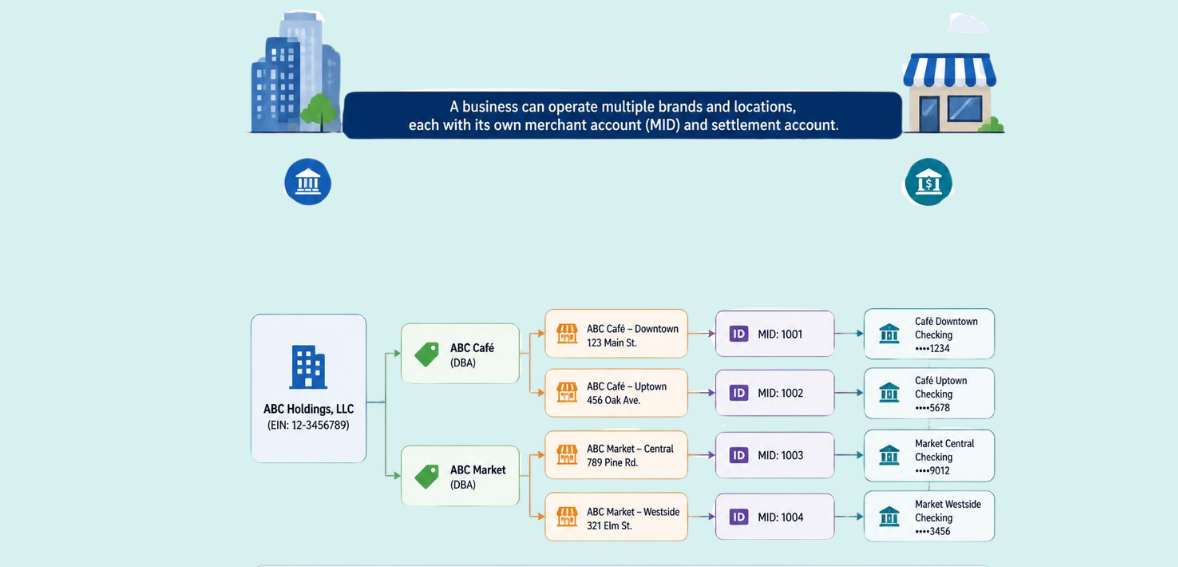
A café owner who opens a second location probably thinks the payment systems will be the same at both locations. A franchisor onboarding forty independently operated locations under one processing agreement learns that a payment system can no longer be just an additional terminal. Somewhere in between these two examples lies one of the many questions that all growing businesses ask: should we have one or multiple merchant accounts? Sadly, there is no set answer to this question.
It has less to do with the size of your business and more to do with the structure of your business. The entities of your business, the brand names, the risk profiles, and your reporting needs, among several other factors, will all affect the answer to your question. Getting the structure of your business wrong in the beginning will result in long and costly fixes to your tax reports, bank transactions, and agreements with payment processors.
This guide will help you understand the terminology and the criteria used to make the decision influenced by the structures utilized by many businesses that are in the process of scaling.
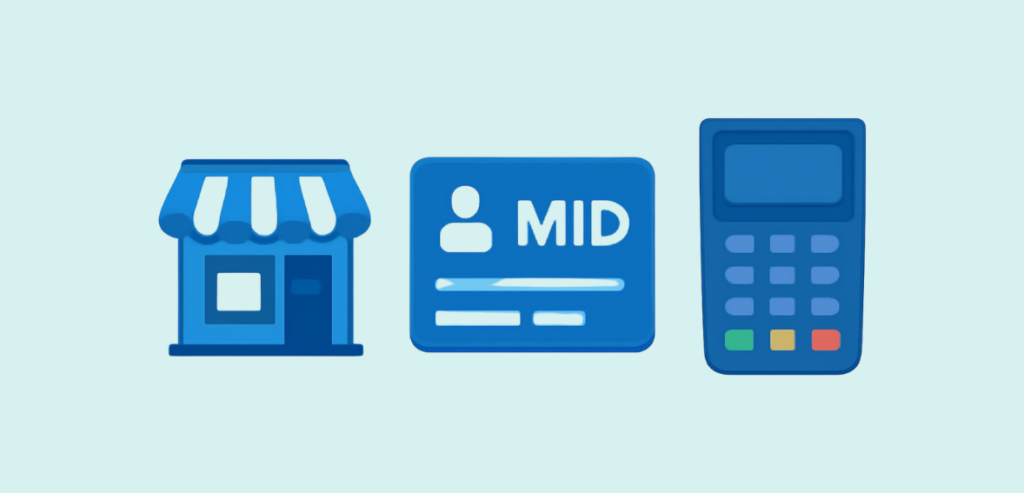
These words can often substitute for one another in casual speech; however, each has a separate meaning in terms of a processing agreement. A Merchant account is the foundational account of a company with an acquiring bank or payment processor that enables the company to process card payments. A Merchant ID (an MID for short) is the specific ID for the account that the bank assigns.
The MID is like a card account’s fingerprint that is embedded throughout the card networks. Consequently, all parties to the card transaction (Visa, Mastercard, and the card issuer) will know the account to which the payment should be made and the account on which the payment should be charged in the event of a chargeback.
A terminal (or Terminal ID) is one level beneath the MID. It represents a specific card reader, checkout lane, or POS device that is associated with the account. A MID can have many terminal IDs, which is why a merchant account can support multiple store locations or multiple checkout counters.
The confusion arises because of the incorrect substitution of “merchant account” for “MID,” and “terminal” for “MID.” The three levels of hierarchy (merchant account, MID, terminal) make the different sections of this guide easier to understand and make the rationale behind each decision clearer.
Most companies over-engineer this process. Assuming a company consists of a single legal entity, operates under a single brand, and desires consolidated financial reporting, then a single merchant account with multiple terminals is often the best solution. The example of a single-owner coffee chain with two shop fronts is a familiar illustration. Both locations report to the same tax ID, both use the same brand name on their receipts, and the owner prefers to see a single, consolidated statement rather than having to review two separate statements. In this case, it is definitely easier to add a second terminal to the existing MID as opposed to establishing an entirely new merchant account.
The deposits will fall into a single settlement account, the statement reconciliation is done once, and the payment processor should be able to issue the new terminals within days instead of conducting a new underwriting review. This solution also keeps chargeback ratios consolidated for both locations, which is acceptable so long as the combined transaction volume and risk level are low. The single-merchant-account solution begins to break down and is the indication for separate merchant accounts if there is a new tax ID, a new brand, a higher chargeback risk level, or a request for financial statements for each location separately.
Four primary scenarios lead a business to seek additional merchant IDs (MIDs) instead of terminals. Separate legal entities can lead to additional merchant IDs. If a company owns two different brands that are incorporated as different LLCs or as different corporations, most acquirers will assign a separate MID to each, as the underwriting, tax reporting, and risk will be managed by a separate legal entity. The second situation involves risk isolation. Chargeback ratios are tracked by MIDs. Therefore, separating MIDs protects the processing capabilities of one line if the other line experiences chargebacks.
The third situation involves reporting. Some finance teams need to report profit and loss statements for different brands or for different revenue streams. In this case, separating MIDs allows the finance teams to avoid the complexities of reporting within the same MID. The final situation involves separation of sales channels. Some businesses find it useful for fraud management purposes to have separate MIDs for e-commerce sales and for in-person sales. All of these situations retain the benefits of integrated reporting. The integration, however, occurs at the reporting level as opposed to within a single account, as will be discussed in the section on reporting.
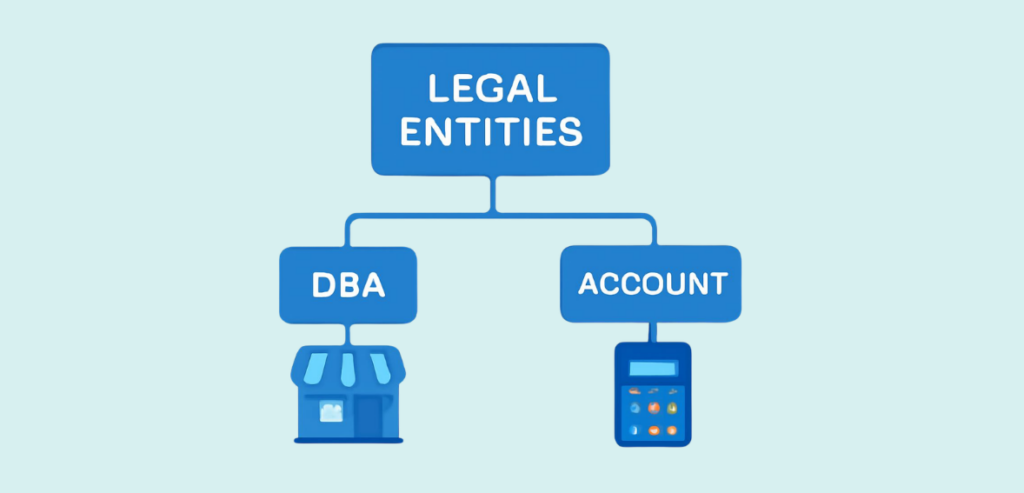
A merchant account is tied to a legal entity, not a brand name. Each legal entity can have many public-facing brands by registering a DBA (Doing Business As) name. For example, a company can have many DBAs, and usually run all the DBAs on one merchant account, meaning receipts will have one merchant name (which is really the DBA). This is all good and fine in relation to the tax ID and banking relationship, and the differences are cosmetic. Problems happen when the owners think that having a DBA means that they do not have to create a separate entity for a separate business.
A restaurant that opens a separate food delivery brand as a DBA, under the same LLC, as the dine-in restaurant, may want a separate merchant ID, not because of the entity structure, but because the delivery business has a different chargeback risk than the dine-in restaurant. As a general rule, the entity that shares risk may sit on one merchant account, even if it has several DBAs, but different legal entities will almost always need different accounts. Because choosing a business entity can also affect taxes and liabilities, this is an area where the advice of an accountant or attorney is worth more than any decision regarding payment processing.
A settlement account is the bank account to which a payment processor sends funds for settlement after a batch of payment transactions has cleared. A settlement account should not be confused with a merchant account, as they serve different functions. While the merchant account helps the processor identify the client business to the card networks, a settlement account is simply the bank account to which the processor has been instructed to send the funds. Generally, a single merchant identifier (MID) settles to one bank account, although many payment processors allow merchants to change or add settlement accounts without issuing a new MID. This can be advantageous for a multi-brand or multi-location business.
A café that has two locations, and thus two bank accounts, but operates with a single MID can give location-level visibility of cash without requiring separate merchant accounts. On the other hand, a franchisor that has several separate entities that each have their own MID can still retain visibility of all the deposits by issuing reconciled statements from the payment processor, even though the funds from each of the franchisor’s entities is deposited to a separate bank account. The flexibility with MID and settlement accounts configurations is what allows businesses to construct the most optimal payment ecosystems beyond the payment processor’s predefined systems.
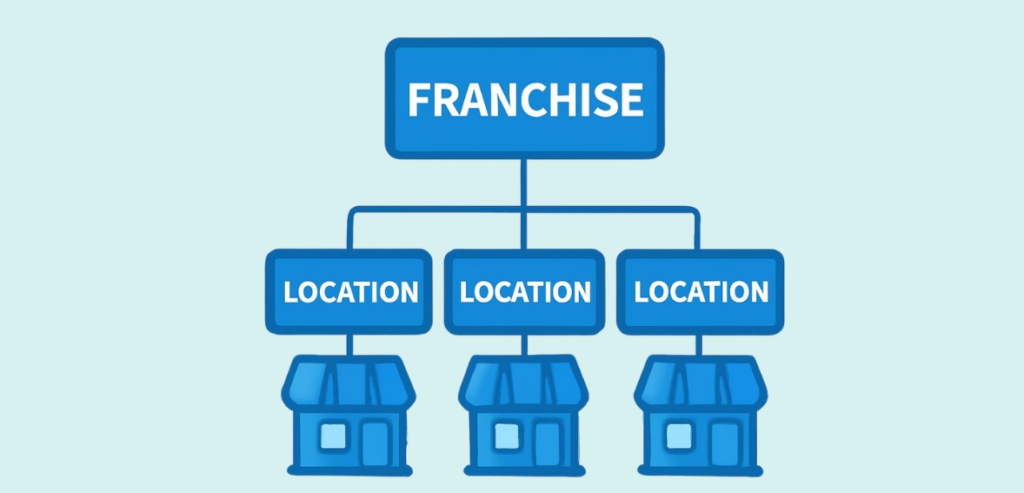
Franchises are some of the most complicated businesses to configure because most of the ownership is decentralized. A franchisor that owns every franchise location could configure the franchise like the single-location café: one MID (Merchant Identification Number), multiple terminals, reporting automatically rolled up because the data was never partitioned.
By contrast, once each franchise location is owned by a franchisee, normally each franchisee is its own legal entity and its own tax-paying entity, which means it has its own MID and its own settlement account. The franchisor goes from being an owner to being a coordinator: negotiating a master agreement with a processor or payment facilitator that allows each franchisee to onboard under the agreement and the facilitator preserves the franchisor’s reporting rights to calculate sales and potential royalties at every franchisee location for brand-level reporting.
Some franchisors implement this solution through a payment facilitator model whereby the franchisor becomes a sub-acquirer, and each franchisee becomes a sub-merchant under the franchisor’s master account, as opposed to a fully independent MID that is bank-underwritten. This drastically reduces the time it takes to onboard a new franchisee, but adds a burden to the franchisor to assume liability and compliance responsibilities for each sub-merchant. The solution is usually determined by how much control the franchisor wants to have over the operations versus how much liability the franchisor is willing to incur.
Multiplicity of MIDs addresses the entities, risks, and channels problems, but introduces a new problem of having to log into five different processor dashboards to see how the business performed last month. We can continue to solve the consolidation problem by treating it as a reporting-level issue instead of an account-structure issue. Most processors and payment gateways provide a parent-level reporting view. This offering would allow the business to pull the statements for every MID associated with that business, even when those MIDs are settling to different bank accounts.
In cases where processors and gateways do not offer that parent-level reporting, businesses typically export the settlements and transaction data for each MID, merge that data in their accounting system or a simple spreadsheet, and tag the data by the entity, brand, or location, before merging the data. Those businesses that are good at this type of reporting have standardized their naming conventions early (e.g., consistent location codes, consistent DBA labeling, consistent date formats, etc.) so that the reporting from four or five MIDs is a simple append task instead of a reconciliation task. The multiple MID approach separates risk and reporting granularity at the account level. Reporting discipline brings back the integrated view at the ownership level.
Businesses typically do not implement architecture perfectly at the beginning. As businesses expand, get rid of a brand, or re-incorporate, this restructuring happens often. The main risk is not the paperwork during the migration. The main risk is the downtime at checkout. This happens while a new merchant identification number (MID) is assigned, and the terminals are configured. This risk is eliminated with a staged migration. In this process, new MIDs are assigned, and the terminals are configured in a new account, as a parallel account.
The old account is closed when the new account, with all configurations, is present, and all the locations successfully completed transactions. Businesses that do not use this process and try to migrate all at once always end up with at least one location that cannot accept card transactions for a day. Before a migration, a suitable process should be chosen to ensure that old MIDs will serve the transaction reports, as some processors will restrict reports after a certain amount of time. Deciding which MID will serve which account reporting in advance eliminates one more variable during the stressful migration day.
A single-entity café with two outlets (both owned by the same LLC and offering the same menu under the same brand) requires one MID, two terminals, and one settlement account. The owner maintains everything as is and adds a terminal for the new location. A two-brand restaurant group under a single LLC (e.g., a full-service restaurant and a quick-service restaurant) has a crucial decision to make. If both brands are similar in risk, and the owner desires combined statements, one MID with two DBAs will work. However, if the quick-service brand has a greater volume of delivery and a different chargeback profile, then a second MID will safeguard the full-service brand from the operational risks of the quick-service brand.
Franchisors are the most complicated of the three. The franchisor will have a consolidated reporting relationship (either through parent-level statements across independently underwritten MIDs or through a sub-merchant structure if the franchisor acts as a payment facilitator). The same fundamental question applies to all three: is the entity, risk profile, and reporting need shared or separate? The answer to this fundamental question will reveal which of the three structures is most appropriate.
To support businesses in this kind of restructuring, HMS Pay helps clients build their payment architecture as part of their processing-services bundle. HMS Pay helps clients structure their business entities, merchant IDs, and settlement accounts architecture before onboarding to help resolve payment issues proactively. HMS Pay helps clients plan payment structures before migration as it is less costly to plan payment structures to prevent mid-year migration.
When choosing between one or multiple merchant accounts, it’s rarely solely a question of how large the business is. Rather, it’s about how the business segments legal entities, risk, and the need for reporting. Most of the time, sharing an entity, risk, and the need for reporting means one MID with multiple terminals. There are separate MIDs with their own reporting and risk, and they justify their administrative costs.
Settlement accounts provide additional flexibility since funds can be allocated based on the location or brand regardless of how the MIDs are structured. Franchises are the most complex since the split ownership is applied across multiple legal entities. There will be a structure that is best for the business, and this should be evaluated over time as the business grows. Before adding more legal entities, an accountant or an attorney should be consulted since the added complexity will be reflected in the legal entities and not in the way the card payment processing is conducted.
A merchant account is a processing relationship with an acquirer’s network. A merchant ID (MID) is the account’s identifying number with card networks.
Not necessarily. Locations with the same legal entity where reporting requirements are the same can generally share one MID and add terminals.
Usually, no; in most cases, an acquirer would require a separate MID per legal entity. A legal entity may have multiple DBAs sharing the same account.
If available, use the processor’s parent-level reporting view. Otherwise, export each MID’s data according to a set schedule. Merge the data using standard location and brand codes.
Franchisor-owned locations usually can share a single MID. Independently owned franchisees are often required to have both their own MID and settlement account. This is managed through a master agreement or a payment facilitator model.