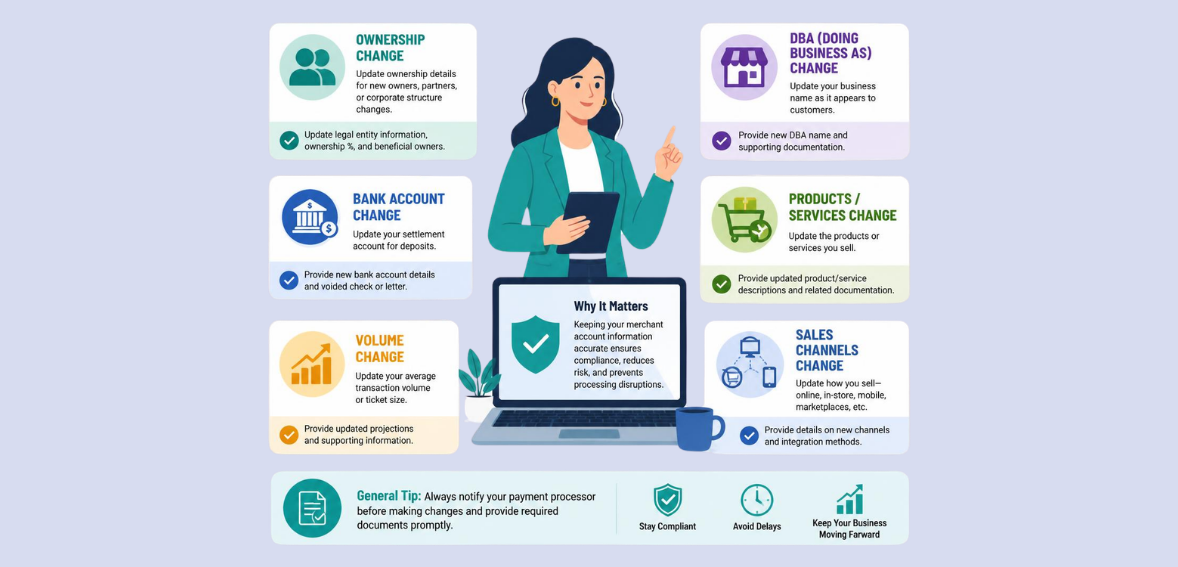
A merchant account is not a set-and-forget subscription. It’s a risk profile a processor makes for a particular business at a certain time. If you sell your business, change your bank account, introduce a new product, or begin selling online, that risk profile becomes outdated. Chargeback spikes, frozen payouts, and file reviews are just a few ways a processor will notice. However, you should tell them first. This guide explains the merchant account changes that are necessary, the documentation required, and how to modify a merchant account to keep access to the funds.
The majority of processing agreements identify identical foundational triggers. Reportable changes include ownership changes, changes to a new settlement bank, changes to the legal entity, changes to the d/b/a name, changes to the business address, changes to the product/service line, changes to processing volume, and new sales channels such as selling goods and services online instead of a retail/physical sales counter. Each of these changes affects the original processing decision made by the processors. Therefore, the absence of communication or the failure to update the portal should not apply.
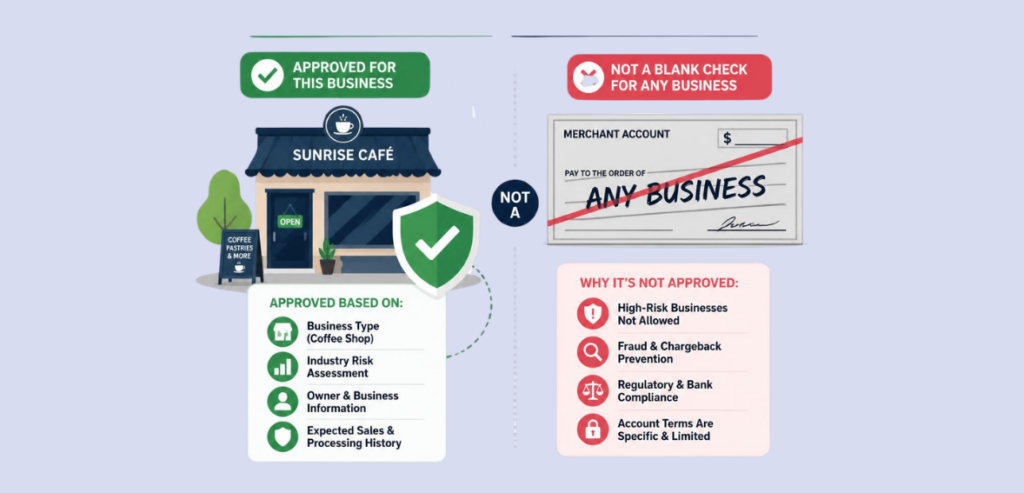
Merchant account underwriting is a dynamic process that involves consideration of many factors. These include the credit history of the account owner, the associated business model, size of transactions, estimated transaction volume, and the appropriate merchant category code. This information provides a baseline for the processor. An approved brick-and-mortar furniture store may have a different risk score than a store selling custom furniture orders with a 60-day online order fulfillment.
While the processing account is the same, the business model is different and that creates risk for the processor that may result in a hold, reserve, or account closure. From a process perspective, merchant accounts are designed to support a particular business model. Using the account for a different business model will most likely lead to an unexpected outcome.
There are many different ways that the legal entity of a merchant account can change, such as adding a business partner, selling a business, incorporating a sole proprietorship, or changing an LLC into a corporation. Merchant account processors conduct their business underwriting for each tax ID and each set of owners. This means that for a merchant account, a new majority owner or a newly classified entity means the old account can not continue.
Most merchant account processors will require a new application, new owner ID, new EIN, and new bank information. There is also a risk of a compliance violation, and funds can be frozen until the paperwork is done, for running the old account with the new ownership, even for a short time.
Stripe associates its underwriting with the business representative and the beneficial owners on record. Hence, a change in majority control means that Stripe will request updated identification and may require the affected parties to open a new account. Square has a similar policy. Square requires sellers to open a new account and close the existing one when there is a change in the business’s legal ownership. Square does not transfer account history to the new account. These policies have the same principle: the account is associated with the business entity that was verified, not with the store or brand.
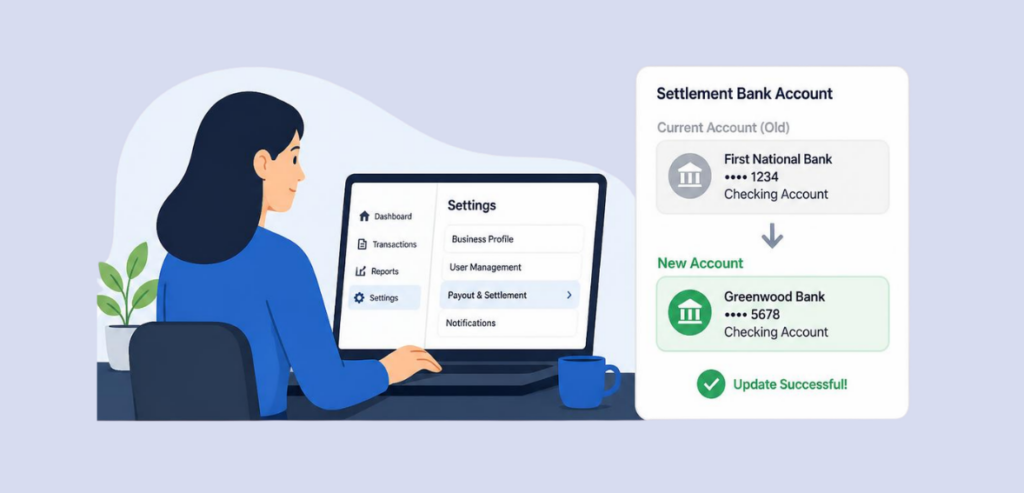
A merchant account’s bank account is where all sales batches land. For processors, a change to this bank account is not a formality. It is a fraud checkpoint. In most cases, you will have to submit a voided check or bank letter to confirm that the new account is the same business name on file. Then, there is a wait. The wait time to verify the change is a few days and can take the form of two test deposits.
Processors flag mismatched names on the merchant account and the new bank account almost immediately, as it is one of the patterns of account takeover. To avoid extra scrutiny, changes submitted via the official portal or verified support line (as opposed to email) will still be processed.
Even the slightest changes to your business—like a new rebrand or address—will show up on customer statements and impact chargeback rates. If customers don’t recognize the business name on the statement, they’re much more likely to dispute the charge. Because of this, processors will require a newly filed DBA or business license before changing the business name.
A changed address may also move the account into a different local jurisdiction for licensing or tax, which some processors will verify before the address change. While this generally does not require a new account, the failure to notify the changes leaves customers in the dark and increases disputes for no apparent reason.
Merchant accounts contain Merchant Category Codes (MCC). These codes indicate to card networks the nature of business involved in the transactions. Depending on the business conducted, sometimes adding a completely different product line changes the MCC assigned to the account. For example, a bakery that starts selling a line of bakery-related alcoholic products or a consulting firm that starts a line of Financial Consulting.
This change in MCC, in turn, means a change in interchange rates, a change in reserve requirements, and in some cases, a change in whether a processor will support the account or not. Many adult-related, CBD, and firearm-related businesses operate outside the risk appetite of most processors, and in some cases are unsupported. Informing the processor of the new product line helps ensure the business won’t face unexpected account holds or declined transactions due to a change in MCC after the lines are drawn.
Each approval includes a reported estimate for average ticket and monthly volume based on information collected from the merchant during the onboarding process. Volume can be impacted by a variety of factors, including the acquisition of a large customer account, a product gaining sections of the market, or seasonal changes.
Processors monitor these changes. An account typically will be placed on a payout hold by a processor while the risk team evaluates whether the increase in volume is legitimate or a fraud concern, layering, or a bust-out. Consideration is often given to the processor to elevate the approval in advance if the company has given notice of a volume increase for predictable reasons, for example, a holiday promotion or a large customer contract.
Switching from a retail counter to an online store changes a merchant account’s fraud profiles, even if the products are the same. This includes switching from card-present swipes to phone and keyed-in orders. Compared to card-present transactions, which are verified during the swipe, sales made without a card present (CNP) – be it online, via telephone, or through a mobile application – are at a significantly higher risk of chargebacks.
Because of this, processors underwrite these channels differently. Thus, a merchant that has only been approved to conduct sales in a physical location may find that online sales are either declined, put on hold, or processed at significantly higher fees. To avoid the disruption of sales to accommodate a compliance review, the merchant should register the new sales channel (along with the URL for the website or order-taking process) prior to the sales channel being made active.
Some changes require a simple edit to the file, while others send the account back through the full underwriting process. Typically, changes to the account’s primary bank or address are simple updates and are verified in a day or two. Changes in the account’s majority ownership, movement to a more-natively associated higher-risk Merchant Category Code (MCC), or a significant increase (typically, several multiples) in the account’s approved estimate are likely to cause a full re-underwriting.
This would require another credit check, business verification, and possibly a new risk-based pricing review. Generally, the size of the deviation (gap) of the approved amount to the current/ongoing business activity is the more influential factor, as opposed to the nature of the change.
The submitted documents usually follow a consistent pattern depending on the request. Generally, the submitted documents for an ownership change will include a government-issued ID for each new owner, a new EIN letter (if applicable), revised articles of incorporation, and a voided check for the settlement account. Changes to the bank account will require a voided check and/or check letter from the bank confirming the account name and routing number.
A change in the Doing Business As (DBA) name will require a filed DBA certificate or a business license with the new name. For the introduction of a new product line, submitted documents will include a description of the new product line; additional documents may include a sample of the marketing materials and a supplier or licensing agreement (if the goods are regulated). For an increase in processing volume, submitted documents will include the most recent processing statements or a signed agreement that accounts for the increase. Submitting the required documents in advance will greatly decrease the review time.
The table below maps the six most common changes against what a processor typically expects, so a business can locate its situation in one glance.
| Change | Notify Processor? | New Docs Likely? | Re-Underwrite Possible? | Funding-Interruption Risk |
| Ownership or legal-entity change | Always | Yes — ID, EIN, entity docs | Yes, often a new account | High if not reported in advance |
| New settlement bank account | Always | Yes — voided check or bank letter | No, usually a simple update | Low to moderate during verification |
| DBA, name, or address change | Always | Yes — DBA filing or license | Rare | Low |
| New product or service line | Always | Yes — product details, licensing | Possible, if MCC shifts | Moderate if MCC changes |
| Volume or average ticket spike | Yes, ideally in advance | Sometimes — statements or contract | Possible, for large jumps | High if unreported and sudden |
| New sales channel (online, phone) | Always | Yes — website URL or order process | Possible, separate underwriting | Moderate to high if unregistered |
A merchant account is established based on a certain version of a business. When a business evolves in important ways, corresponding updates to the merchant account are required. Changes in business ownership, swaps of bank accounts, changes in DBAs, launch of new product lines, increases in business volume, and the opening of new business sales channels each affect the original underwriting decision. Depending on the change, a merchant account may need anything from a simple update to a full re-underwriting.
The businesses that do not experience frozen payouts and surprise reserves are the businesses that proactively notify their payment processors of changes, provide necessary supporting documents, and communicate with their assigned payment processor, rather than allowing automated payment processing systems to control the process. A merchant account is only as good as the business operations that it supports. Failing to update a merchant account in order to support the continued smooth business operations and cash flow from the account is a disservice to the purpose of a merchant account.
Generally yes, as the account is underwritten to the current owner’s identity and tax ID rather than the storefront.
Submit a voided check or bank letter using the processor’s official channel. A short verification period should be expected before it activates.
It can, notably if the new product moves your merchant category code into a different risk tier.
To ensure spikes are legitimate, processors may temporarily withhold payouts. They will either release the funds or adjust your limit after spikes are confirmed.
It frequently does, because sales that do not require the cardholder’s presence (card-not-present sales) have a fraud profile that differs from sales where the cardholder is present.