
You finished the month busy, with every hour booked. The crew was working at full speed. Then you saw the bank balance. Your busy month left you broke. The problem isn’t sales. It’s costing. Most business owners set prices based on their intuition without consideration of expenses. Guessing prices isn’t costing. Job costing shows how much every job makes. This guide will explain job costing, and show you one estimate with its corresponding actuals. Let’s simplify job costing.

Revenue hides mistakes. A busy calendar looks good. However, working hard without making a profit just speeds up bankruptcy. This is an easy trap to fall into. You bid on a job, it takes longer than expected to complete, the materials cost more than estimated, and the profit disappears. It is even more difficult to recognize this error when working with averages. When looking at the overall business, a few successful jobs can hide the many unsuccessful jobs. It takes a while to realize, but those unsuccessful jobs continuously drain your profit.
Job costing eliminates this problem by looking at the smaller details. Instead of asking whether the business made a profit, it looks at whether this specific job made a profit. This is a huge shift. You stop making the same unprofitable bids. You do more of the work that pays. And you finally see which customers, crews, and job types are worth your time.
All job costs can be categorized into three types. Add them all together and you get the total cost of the job. Unlike most costing techniques that average labor, material and overhead costs, job costing, as the name implies, tracks costs for each specific job. Two of the three categories are relatively easy to identify. The third category is more of an educated guess. Here is the breakdown.
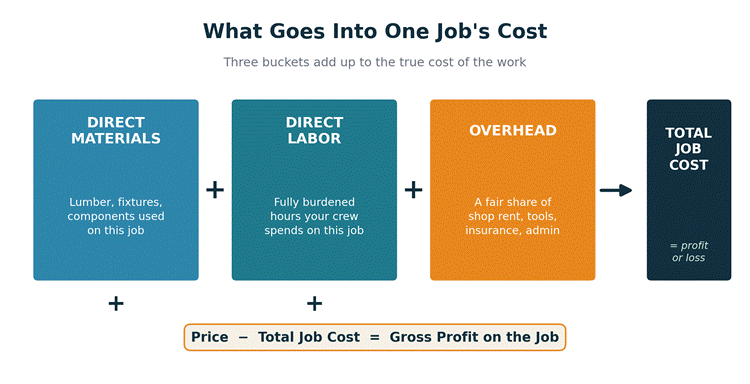
Figure 1. Three cost buckets combine into the total cost of a single job.
Direct materials are the tangible components of the end product. Examples of direct materials are lumber, wiring, fixtures, steel, and paint. They can be found in the bill of materials for the job. Since they are purchased for that specific job, they are easily traced to the job. Indirect materials are used for minor items such as glue, screws, and sandpaper that are not worth the trouble of tracking to individual jobs. These are accounted for in overhead.
Direct labor refers to the financial cost of hands-on workers. It also refers to the hours your crew logs against a specific project. A time sheet or time ticket connects those hours to a project. Unfortunately, there is more to direct labor than just hands-on work. Direct labor is actually the hourly rate plus payroll taxes, insurance, and benefits. That full cost to the company is known as the labor burden, and it is addressed in its own section below.
Overhead includes all the costs of doing business that cannot be tied to a single job. This includes things like rent, utilities, and shop equipment, and even your tools, insurance, and supervision. These costs support every job at once, so you cannot directly relate them to any single job the way you can with labor and materials. Each job then gets a portion of the overhead. This refers to production overhead, and not the office and marketing costs that are typically recovered through markup.

The actual formula is Direct Materials + Direct Labor + Allocated Overhead = Total Job Cost. The real work is determining the correct numbers. Start with Direct Materials and get the actual job receipts and requisitions. Next, Direct Labor is calculated by multiplying the hours worked by the fully burdened hourly rate (not the raw wage). After this, use a simple rate for overhead as described below, and add the three together for the total cost. Subtract the total cost from the sales price to determine the gross profit for the job. Do this for every job and you will quickly see trends.
Margins vanish here. Labor burden is every employer cost beyond base wage. It’s not just the base wage that gets paid. Payroll taxes increase the burden. Employers pay 7.65% for Social Security and Medicare. It includes federal unemployment tax and state unemployment tax. Workers’ comp adds to the burden. It’s the most variable cost and can add up to a lot for a higher risk trade. There are also the employer paid benefits such as health insurance and paid leave. Most of these add to the burden. Labor burden in construction generally ranges from 35% to 60% of the base wage. This means, for a wage of $30, the real cost is $46.50.
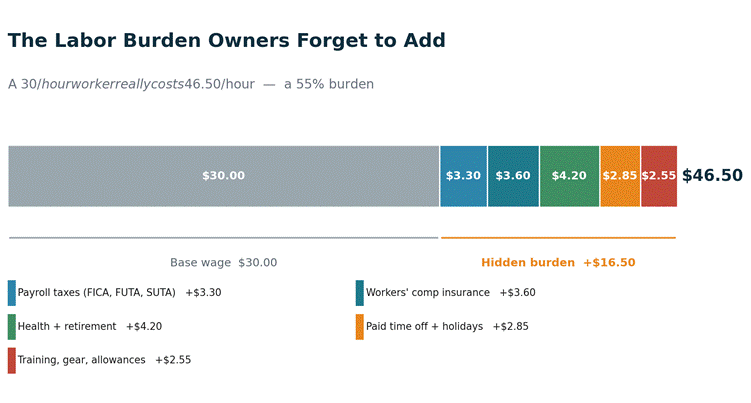
Figure 2. A $30 base wage becomes roughly $46.50 once labor burden is added.
To arrive at the fully burdened rate, add to the base wage the result of dividing the total indirect costs of an employer for a given time period, by the total hours actually worked. One best practice is to recalculate this rate at least twice a year. Insurance premiums and the costs of providing employee benefits have already risen steeply in 2026. A rate that has not been recalculated results in bidding on stale costs. If you bid using the base wage, you will bid at least 30% below the true cost of the job, and you won’t discover the shortfall until your employees are on the job site.
It makes sense why overhead worries people, but it doesn’t have to. Take shop rent. It’s impossible to link it to a specific job. So instead, a rate is estimated, and the rent is applied. The most popular method is to use a predetermined overhead rate set for the coming year. You start with an estimation for your total overhead for the year. Pick an allocation base. It’s usually direct labor hours or direct labor dollars, and divide total overhead by your chosen base to get the overhead rate per the chosen unit for the year.
Let’s say total overhead is estimated to be $150,000, and direct labor hours for the year are 12,500. This comes to a cost of $12 per labor hour. If a job consumes 60 labor hours, this job, then, has an overhead cost of $720. This method also works for machine hours. This method will not be perfect, and it doesn’t need to be. Consistency is what’s most important. Overhead rates need to be reasonable and consistent across jobs. A reasonable, consistent rate is far better than a perfect rate you never actually calculate.

Not all businesses need to track costs by job. The costs tracking method you need depends on what your business produces. Job costing is ideal for businesses that do custom, one-off work. Each job is unique and therefore needs its own record. This method is appropriate for contractors, remodelers, agencies, print shops, and repair businesses. On the other hand, process costing is appropriate for businesses that produce the same unit in bulk.
Each unit is identical and therefore total costs are calculated for the whole batch. Coca-Cola bottling, paints, chemicals, and packaged foods are all process costing examples. The test is, if no two jobs are the same, choose job costing. If you produce a continuous flow of the same product, choose process costing. It is also acceptable for some businesses to integrate both of these methods.
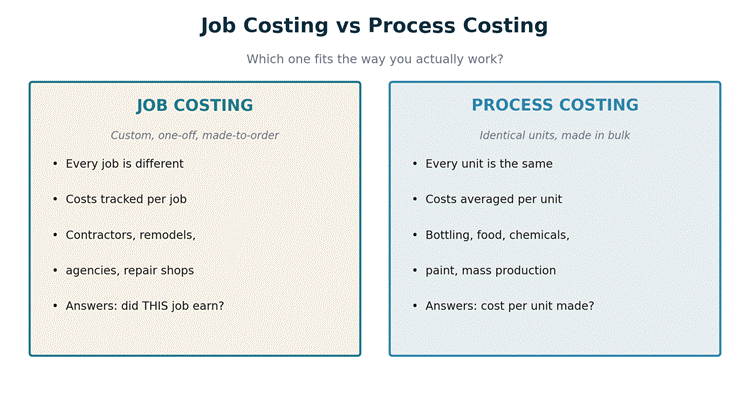
Figure 3. Custom work calls for job costing; identical bulk output calls for process costing.
Total cost numbers illustrate one side of the equation. The other side shows the impact on profit. To determine gross profit in dollars, subtract total job cost from selling price. To calculate gross margin, take the gross profit and divide it by the selling price. In this context, profit dollars represent size and margin represents quality.
A large job with low margin could potentially earn less than a small job with high margin. Analyze the gross margin of jobs and you will begin to see the trends. For example, if kitchen remodels are consistently at 32% margin and bathroom remodels are hovering at 12% margin, you have the proof you need to make a decision on where your focus should be.
Job costing pays off with the next bid. It’s all about comparing your estimates with your actuals and learning from the gaps. Are your estimates for hours too low? Then you know your labor is always running over. If you see an increase in your material costs, you need to examine your supplier pricing or look into your waste. Apply these lessons to your next quote. Your estimates will improve and your margins will hold. This loop is what distinguishes the shops that grow from those that are just busy. The hard part, as you probably guessed, is collecting clear data without being overwhelmed by spreadsheets. This is where a good system will help.
Manually keeping track of time, materials, and burden is a recipe for failure. Cloud Job Manager, the free field-service platform backed by Host Merchant Services, automatically associates time tracking, materials, and payment processing with each job. Labor costs are tied to the correct job as time is logged, instead of being reconstructed weeks later through guesswork. It keeps the paperwork flowing so that your cash won’t get stuck due to delays in getting paid. For those who deal with progress payments, combine great job costing with clean lien waivers to secure the payment you are entitled to for your work. Understand how HMS integrates costing and collections for field-service and contractor businesses.
Let’s look at Job #1042 to analyze some real numbers on an actual job. This backyard deck job shows the contractor’s estimate at the time of bid. The contractor budgeted materials at $3,200, budgeted labor at 60 hours (at a fully burdened cost of $46.50 for a total of $2,790), and budgeted overhead at $12 per hour (for a total of $720).
This estimate provided a total of $6,710. The contractor’s quote to the customer was $9,600 to secure a 30 percent profit margin on the job. What actually happened to the job? The price of lumber spiked as well as the cost of an extra supply run. The crew used 72 hours to complete the job instead of the budgeted 60 hours. The chart below shows the differences between estimate and actual.
| Cost bucket | Estimate | Actual |
| Direct materials | $3,200 | $3,650 |
| Direct labor (fully burdened) | $2,790 | $3,348 |
| Overhead applied | $720 | $864 |
| Total job cost | $6,710 | $7,862 |
| Price charged | $9,600 | $9,600 |
| Gross profit | $2,890 | $1,738 |
| Gross margin | 30.1% | 18.1% |
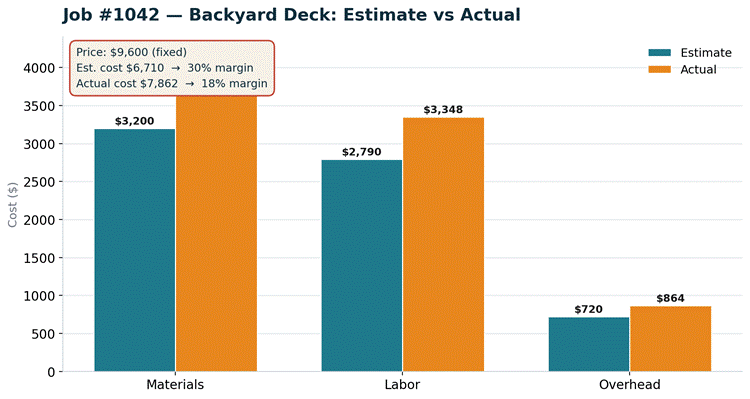
Figure 4. Every overrun came straight out of profit, cutting margin from 30% to 18%.
Every overrun directly impacted profits because the price stayed the same. Margin fell to 18% from 30%. The good news is the job was still profitable. Without job costing, the owner wouldn’t be able to connect a busy month to a shrinking bank account. With job costing, the owner can see exactly where the money went. For the next job, the owner should account for more hours and pad material costs to allow for price changes. This insight will protect that margin for future jobs.
Job costing gives you the answer to the question “what does this job cost?” Instead of hiding it somewhere in a monthly average, Job costing shows you what each individual job earns. There are three buckets that you must get right. In order to get these buckets right, add the labor burden. This is the burden that you are most likely to neglect. Apply overhead in a simple, consistent way. The gross profit and margin for each individual job can be read easily after this. The busy-but-broke cycle is broken when you are able to see which work pays and which work does not.
The process begins with your next bid. Make sure to track it this time. Compare the estimate to the actuals when the job is closed to see how accurate you were. You should begin to see a shift in accuracy after you repeat this a few times. The true goal of this process is to reduce how much you work while increasing how much you earn from each job.
Job costing determines the cost of a single job or customer order. To determine job costs you break down the direct materials and labor and overhead costs for the individual job, rather than averaging job costs like you would with process costing. This method works best in an environment where you have made-to-order or custom work. The value of this method is that you can find the exact cost of a job and, when you work out the difference, you find the exact earnings from that job.
To calculate the total cost of a job, add three costs together. First, use the direct materials cost found in the receipts for the job. Second, use direct labor cost, which is calculated using the burdened hourly rate and the hours worked. Third, calculate the cost for overhead using the predetermined rate of overhead per labor hour. To find the gross profit for the job, subtract the total cost of the job from the selling price of the job.
Labor burden is the cost to an employer beyond just the wage. This includes cost to the employer for items like payroll tax, workers’ compensation, health insurance, retirement, paid time off, and more. To determine the burdened labor cost, calculate the total indirect employment costs for a time period, then divide the total by the labor hours worked in that time period. This cost then gets added to the wage to provide the fully burdened rate. In the construction industry, labor burden can cost an employer about 35% to 60% of a wage. This would mean a typical wage of $30 for an employee can cost the employer about $46.50 for that employee.
Contracting, remodeling, and repair work are examples of custom work that fit job costing. Process costing would fit the mass production of bottled goods, paint, and packaged foods. A simple way to differentiate between the two is if each job or order is unique, use job costing. If each job or order is the same, use process costing.
Job costing allows you to compare estimates with actual job costs. Typically, the biggest gaps are in labor hours and material pricing. Addressing these issues through job costing will make future estimates more accurate. As you continue to implement job costing, you will see profit margins become more stable and predictable. You will also see profit margins improve on the types of jobs and with the clients you most want to work with.