Deep down, you know you charge too little. You know this every time you send an invoice. But when you think about raising your prices, you get that anxious feeling. You wonder, will your customers leave? Will they see you as greedy and money-hungry? Will your competitor step in and take your customers?
Just relax. Know how to raise prices and not lose customers. In fact, this is the best approach for growing a successful business. The best part is that this is not about finding a certain number that is a magic number. It is all about your approach. If you raise your prices according to the value you offer, along with a well-timed, honest communication of a price increase, most customers will stay. Many won’t even notice.
This guide is all about helping you understand the best approach to raising your prices. You will gain an understanding of how to decide when to raise your prices, what to charge, how to write a price increase letter, how to deal with customers’ objections, and much more. You will also see how some of the best brands, like Netflix and Costco, approach price. Let’s begin.
Most business owners fear losing far more customers than they actually do. The term for the phenomenon is loss aversion. The fear of customers leaving keeps owners up at night, when the thing actually costing them sleep should be their shrinking profit margins. This fear causes paralysis. Many owners proudly maintained their prices through the pandemic, and years later, their prices are still the same as they were in 2019.
Let me be frank. Your loyal customers did not become your customers because you were the most competitive. Your loyal customers do not purchase from you just to save a few bucks, but because you solve a problem they value you for. A fair price increase is not a deal breaker for them. The customers who do leave over a fair increase were never loyal in the first place; they were shopping on price alone.
Losing a few of those customers is actually a good thing, and it frees you from the bargain-hunters who cost you more to serve and do you a disservice by not referring anyone. This loss is a filter, not a tragedy. The customers you keep at the right price are the loyal ones your business is built on.
Underpricing doesn’t feel like you have to pay a price because the costs are not apparent to you. But the costs are still huge. For every dollar you don’t charge, that is a dollar you will never see again. There’s no added charge for production, no added freight, no added salaries. The money just disappears.
Pricing research done by McKinsey & Company illustrates this clearly. A price increase of 1% results in an increase in operating profit of 8 to 11%, assuming stable volume. The return on price outperforms the return of cutting costs or selling additional units. Price is the strongest lever for profit that you have, and the one lever owners chronically use last.
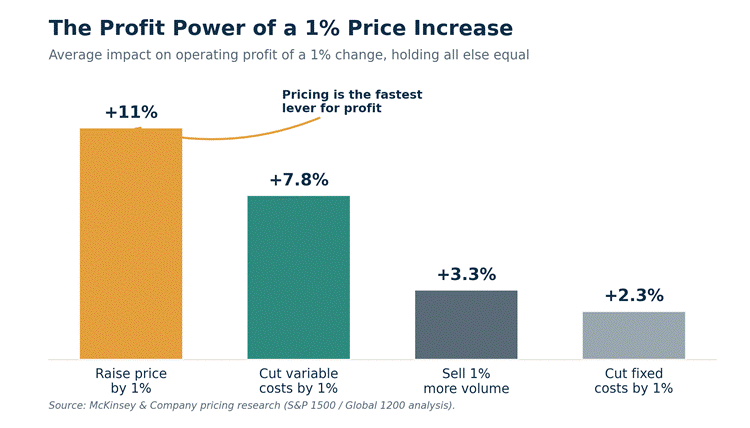
Infographic 1: A small price increase moves profit more than any other lever.
Naturally, this assumes your customers stick around, and that’s part of the equation. Raising prices only fails if you just increase the number and don’t increase or communicate the increase in value. So, we will start with the value.
Success is never guesswork, and neither is pricing. You will find your pricing framework in the five distinct steps. Pricing increases do not have to fail. To avoid losses and to create a repeatable process when increasing pricing, follow the steps in order.
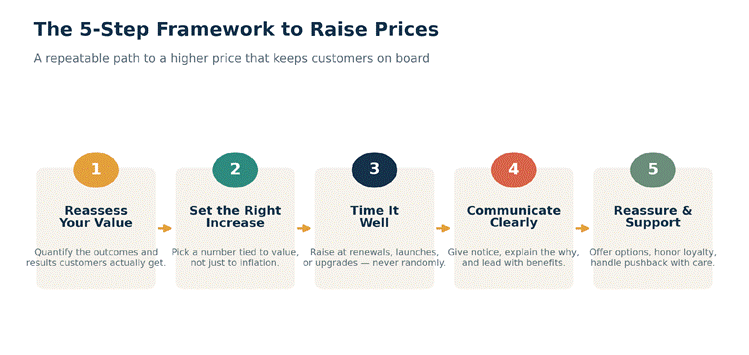
Infographic 2: The five-step framework for a price increase customers accept.
Get clear on what you offer before changing your prices. Think about if you added new features, services, or if you do your job better. Take time to write the things that you think provide outcomes to customers, and that evidence will justify your price and will help you answer questions or comments that you will receive.
Choose a number that aligns with its inherent worth, not simply its inflationary increase. When a customer pays a price, it should be reflective of the benefit the customer receives, not just the increased costs. We do provide the math below, but the principle is easy enough to understand. When a price increase occurs and feels proportional to the benefit the customer receives, the price increase is perceived to be fair.
Some moments for price increases can feel more natural than others. These can be contract renewals, anniversaries, upgrades, or launches. Customers expect some form of evaluation of value during these events. Increases done at random, unevaluated points mid-contract are the most frustrating for customers. These are most likely to generate negative feedback.
The wording you choose to justify a price increase is almost as important as the price increase itself. Notify customers ahead of time and do not use complex language. List the benefits that your customers continue to receive. When a price increase is communicated with a transparent message, it earns the customer’s trust and eliminates the element of surprise.
For a period of time following the announcement, it is important to remain close to customers in a reactive manner. This means providing timely alternatives to customers if they ask for them, honoring reasonable requests for loyalty rewards, and responding to objections with empathy. Loyalty is protected during this step, and it is important to show and reinforce to customers that the relationship is still worth more than the most recent transaction.
Value-based pricing focuses on the value your product or service delivers to the customer, not the costs incurred or the pricing of competitive offerings. Value-based pricing is the pricing strategy of choice when a business is seeking to implement a permanent price increase. When your price is associated with value delivery, a price increase is viewed as reasonable, rather than taking advantage of the situation.
Value-based pricing is compared with a couple of other pricing strategies. Cost-plus pricing is one of the easiest pricing strategies to implement. However, the products or services priced with this strategy are unlikely to meet buyer expectations. If a business prices its offerings with a competitor-based pricing strategy, the price of the offering is identical to that of competing businesses. Most businesses employing this strategy incur losses as a result of price wars. Value-based pricing asks a different question than the strategies mentioned above: what is this worth to the customer? The answer to that question is what creates the opportunity for businesses to increase their pricing.
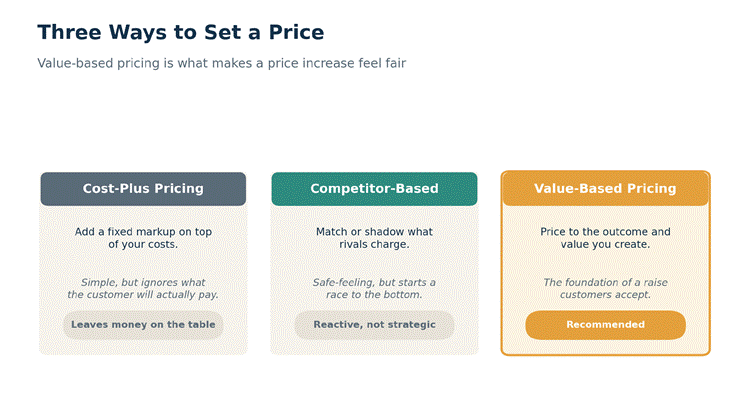
Infographic 3: Value-based pricing is what makes a price increase feel fair.
To price based on value, understand what the customer is truly purchasing. A bookkeeper does not sell hours; they sell peace of mind during tax season. A software tool does not sell logins; it sells time savings and reduction of errors. Framing your offer around the outcome of an offer changes the conversation from cost to worth. This change in the conversation allows you to price your offering at a higher price.
Knowing when to raise prices is half the battle, and there are some clear indicators. Are you booked all the time, to the point of having to turn customers away? That means demand, and likely that the price you set is too low. If prices have risen in general, but you have not raised your price, your profit margin is eroding. If you’ve added some additional value to your good or service since the last price increase, then you are due for a price increase. If your prices have not changed in the last year, it is practically a guarantee that you are due.
The time of year is also important. January is always a good time for a price increase. So is the start of a new contract, the launch of a new version, or an incremental improvement of your product. These events give a good, built-in justification for price increases. The bad time to raise a price is during a product or service failure that garners bad press and lots of complaints. Wait until you are giving good service or value to your customers before you raise prices.
While there is no one-size-fits-all percentage, there are some reasonable boundaries. As a general rule of thumb, an annual increase of about 3% to 10% should suffice. This increase will put you ahead of inflation while not shocking the customer base. Most customers will not even notice a single-digit increase when the service is valuable.
There are times when a large increase is warranted. If you have been underpricing your services, or your service has experienced a large increase in value, you can justify a larger increase. A large price increase can be made to feel more justified if you do the increase in two steps, or if you implement a large visible upgrade at the same time. Large price increases can be justified as long as value is clear to the customer. Small price increases can be met with outrage if value is not clear.
Lastly, avoid increases that feel over-precise. Round numbers are easily justified, while over-precise numbers invite negotiation and look arbitrary.
This is the tipping point. How you communicate a price increase matters more than the price increase itself. Customers don’t leave over a few dollars. Customers leave when you blindside them, take them for granted, or when they feel disrespected. Get your communication right, and most people will remain your customers.
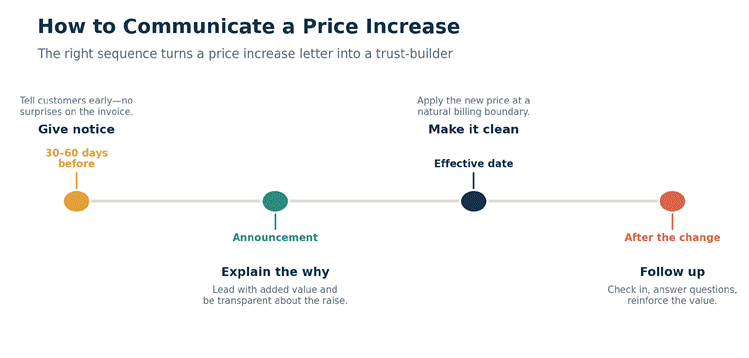
Infographic 4: The right sequence turns a price increase into a trust-builder.
Start early and provide customers a 30 to 60-day heads-up so that no one feels ambushed when they receive an unexpectedly high bill. Use the new pricing message to lead with the value proposition and the thank you. State the price justification and the value proposition. Then communicate the new price. Select a natural billing break to change the price. Communicate price changes one at a time to reduce the customer burden. Answer any questions on the new price and reinforce the value proposition after the price change has been communicated. If done in this order, a price change communicates that the business is healthy and price changes are expected due to growth.
Tone is key. Be confident and succinct. Do not offer overly verbose explanations. A brief, matter-of-fact justification is a better response than a defensive over-explanation.
Writing to inform customers of a change in price is the most effective way to communicate the direct consequences of your decisions. This type of letter is most successful when concise and to the point. An effective letter of this type includes the important details of the new price, when the new price will go into effect, and the justification for the price change, all in a direct manner, without apologizing. Below, find a template you can use.
Subject: A small update to your pricing — effective October 3, 2026
Hi [Name],
Thank you for being a valued [client/customer/member]. I am writing to let you know that starting October 3, 2026, the price of [product or service] will move from [old price] to [new price].
Over the past year, we have [added feature, improved service, expanded support], and this change lets us keep delivering that level of quality for you. Your current rate will remain in place until October 3, 2026, so you have plenty of time to plan.
I truly appreciate your business, and I am always here if you have any questions.
Warm regards, [Your name]
Pay special attention to what this letter does. This notice gives the news and states the changes clearly. By connecting the price increase to added value, it remains gracious throughout. This letter does not apologize for existing. Adjust the tone for your audience and send before the effective date. Keep it under a page.
Grandfathering allows loyal customers to keep their old pricing while new customers purchase at new pricing. Depending on your pricing model and your margins, grandfathering can be a good business solution for rewarding loyalty and easing the impact of the pricing change, but may not always be the right call.
Grandfathering is a good solution for pricing changes if your brand values loyalty and the price difference is small enough to grandfather customers. It rewards the early customers who helped you build the brand and can give your business goodwill. Pricing grandfathering can perpetually lock your pricing at an unprofitable level and can be goodwill pricing for early customers, but can be detrimental if your newer customers discover the pricing difference. A good middle ground is to establish a grandfathering period of 6 to 12 months, after which pricing is brought to a new level for all customers with ample notification. This allows a balance of rewarding loyal customers and the goodwill of early customers at the needed long-term pricing level for the health of your business.
Theory works for most, but for others, practicality needs to coalesce with theory to build a better understanding and to ultimately satisfy customers. Let’s analyze two businesses with completely opposing philosophies. The first company raises its prices boldly across the board, and as a result, its customer base continues to grow. The second company never raises the price of its signature product and refuses to raise the price across the board. Surprisingly, both companies are equally successful, and you are likely to remain loyal to both.
Raising prices while keeping customers is an art Netflix has mastered. Prices went up across all U.S. plans in March 2026, with the standard ad-free tier reaching twenty dollars. Normally, consumer exodus follows this kind of decision, but that wasn’t the case. Netflix surpassed 325 million members in 2025, securing a 16% increase in revenue, and company officials observed that customer churn decreased across the board.
So how do they do it? Price increase to Netflix is a promotional opportunity. Every dollar has to bring more value to the consumer. With billions of dollars going to investment in members’ favorite programs, Netflix points customers who pay the new price to the new perks it funds. The philosophy is simple: Pay more, get more, and it worked because of value-based pricing.
Costco has a less common example with its strategy of not raising prices. The company has sold its hot dog and soda combo for $1.50 since 1985. Adjusted for inflation, that 1985 price would be about $4 to $5 in today’s dollars. Leaders at Costco have been very protective of the price, as it has become a company tradition to keep the combo at that price. Should any successor to the leadership position decide to raise the combo price, they will have a strong warning. The company even altered the supply chain for the hot dogs, going so far as to start producing the hot dogs itself to maintain the price.
Could the strategy of selling the product at a price that nets the company no profit be worth it? Yes! Costco believes that the price brings more return as it fosters good relations with each customer. The product price also helps keep Costco’s trust and loyalty with its customers, as evident in membership renewal rates over 90%. Keeping the combo price constant, even as other prices change, helps the company win the loyalty of its customers.
Even reasonable changes can have negative consequences if not executed correctly. Raising prices with no warning is the worst move. Customers will feel blindsided when they see the price change on their next bill. Almost as bad is when you raise prices with no discussion of the benefits that come with the change, and customers feel as if the change is just you being greedy. You will just as quickly lose customers if you raise prices and then apologize over and over. It’s obvious to customers that you don’t think you’re worth the price you’re charging, and they will start to negotiate with you.
You will lose business if you make price changes during an especially bad service period, if you unnecessarily raise prices and hide the change in the fine print, and if the price change isn’t being uniformly applied to all customers, as some customers will feel cheated. Trust will be lost with all of these. You will diminish the chances that your customers will leave if you avoid these mistakes and follow the framework for price changes. It will become just part of running a strong, successful business.
Knowing how to increase prices for your products and services is probably one of the most lucrative skills that one can learn as a business owner. While it’s completely understandable to worry about losing customers, one should keep in mind that the expectation of customers leaving is almost always worse than the reality. When you have value-based pricing, implement changes at the appropriate time, and most importantly, convey price changes with transparency, confidence, and appropriate justification, your customers understand why and how your business is evolving, and almost all customers remain. As a result, your profits increase, your business is more successful, and your most important customers believe in you even more and appreciate your confidence in your business’s value.
If you feel you should increase your prices, do so thoughtfully. Value-based price increases, when clearly conveyed and given time for customers to prep for the increase, is most of the time successfully implemented. The most difficult step in increasing your prices to your customers is almost always starting the process. After the starting line, most business owners have a hard time understanding why this process of value-based pricing wasn’t implemented sooner.
Prioritize value and communication. Assess the outcomes you currently achieve for customers. Set prices reflective of that value, notifying customers 30-60 days prior of the price change. Provide a plain-language description of the price change that is benefit-focused. Customers will appreciate a reasonable price increase. The customers most likely to leave over a fair increase are the least loyal ones.
Most established businesses rely on a yearly price hike of between 3% and 10%. It keeps you ahead of inflation, and most customers don’t even notice. If you’ve been underpriced or made a significant improvement to your offer, then you can justify a larger increase — ideally, over a two-step approach or with a visible improvement. The right number is always anchored to value. If you’ve demonstrated increased value to the customer, a large price increase can usually be absorbed without too much resistance.
Consider increasing prices when demand is high, costs have increased, real value has been added, or prices have not changed in the last 12 months. Customers can expect a price change when natural occurrences such as contract renewals, the end of the contract, a new calendar year, or a product upgrade happen. You can avoid complaints about a price increase when you wait until you are meeting service expectations.
Use a helpful, friendly tone. Lead with the value customers receive. Provide the new price and the effective. Briefly explain the reason for the increase. Be confident and gracious; no need to apologize or make it hard to find. Give 30 days’ notice. Make it effective at a natural billing point. Follow up to reinforce value and answer any questions.
It depends on your margins and your brand. Grandfathering rewards loyalty and softens the impact of a change on customers, but it can lock you into unprofitable rates and create friction if new customers see the old rates. A grandfather period is a compromise in which the old price is honored for six or twelve months, and then everyone is moved to the new price with advance notice. This protects loyalty without a revenue cap.