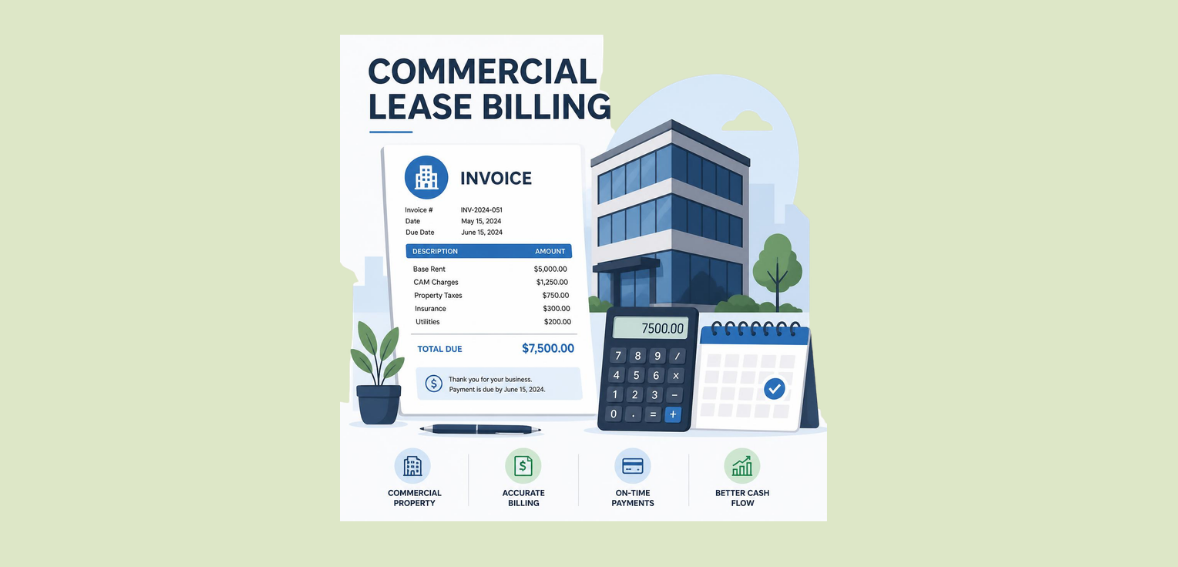
A commercial tenant received a $14,000 CAM reconciliation invoice in February. While this tenant was baffled by the seemingly arbitrary CAM reconciliation charge, most commercial lease invoices are sent systematically for base charge estimates and true-ups. Most commercial lease tenants do not understand the true-up system until they are surprised with an invoice. A commercial tenant’s ledger includes base rent, common area maintenance, real estate taxes and insurance, utilities, and an earned percentage rent, where applicable.
The confusion surrounding an invoice lessens for tenants or property managers once they understand the breakdown of each charge and how each charge is estimated, and the reconciliation of each charge. This guide is designed to explain the commercial lease billing process, provide a breakdown of each major billing charge, and explain the process of estimate reconciliation for each charge.
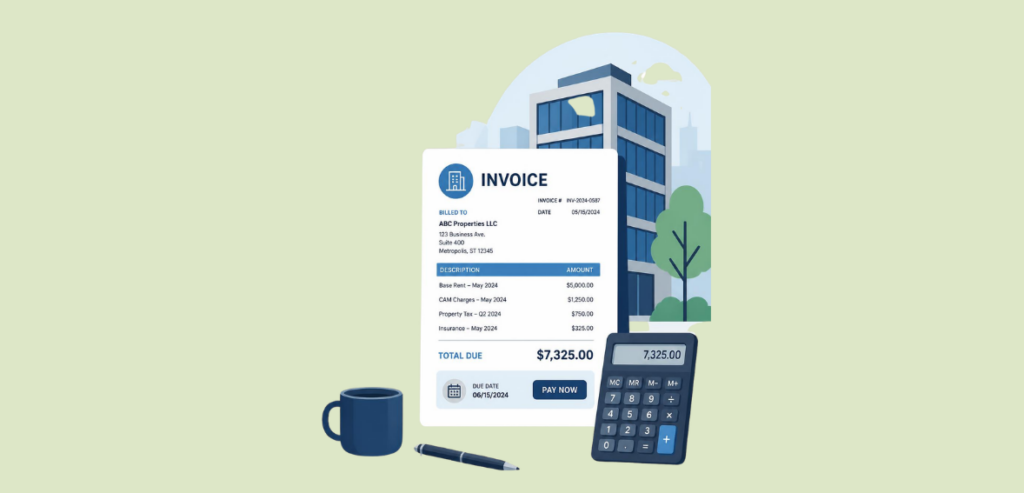
Renting a residence is straightforward. A resident pays a fixed monthly amount. The landlord then uses that money to pay for all repair and improvement costs, taxes, and insurance. Renting a business space is entirely different. A business tenant’s monthly rent bill may include base rent, an estimate of the cost of common area maintenance (CAM) charges, and escrows for real estate taxes and insurance, plus, where applicable, percentage rent that accrues over the term the tenant occupies the space, and, in many cases, charged separately, metered, or submetered utilities.
Landlords of commercial properties with shared areas that are frequented by many tenants and potential customers, such as a parking lot, lobby, or loading dock, need to have a fair way to manage these costs and charge them to each tenant, depending on the square footage of their leased commercial space, or some other agreed-upon prorated amount. Because of all these complexities and layers in commercial leasing, reconciliation is a formally defined process, as opposed to a courtesy, as it is in residential leasing.
This guide explains how the different charge types for the leasing of commercial space will be described in the lease document. As the leasing of commercial space is inherently flexible, even two tenants in the same building may end up with completely different billing arrangements, so no two commercial tenant ledgers are alike, even within the same building.
A person who is leasing commercial space for the first time, after having only lived in residential rentals, should be prepared to learn about the lease’s different terms. The property manager will explain the various terms related to the escalation of CAM charges, the landlord’s right to charge percentage rent, and the utilities clauses, as well. Preemptively explaining these lease terms will diminish confusion caused by the first reconciliation.
Base rent is the initial cost in a commercial lease (typically expressed as an annual cost per square foot and charged monthly). For instance, a 10,000 square foot lease at $30 per square foot would cost $25,000 monthly (prior to additional costs). Nearly all multi-year commercial leases contain a rent escalation provision, which details the increase of base rent throughout the lease term.
With fixed percentage escalations, the annual increase is a set percentage, generally between 2-5 percent, whereas CPI-based escalations link the increase to the Consumer Price Index, meaning the rent would increase in line with inflation, as opposed to a fixed amount. With step escalations, the lease would set a specific dollar amount for each year of the lease term, eliminating ambiguity as to what the increase would be. The following chart provides a basic example of how a base rent of $30, with a fixed 3 percent annual escalation, would increase over the course of a 5-year lease term.
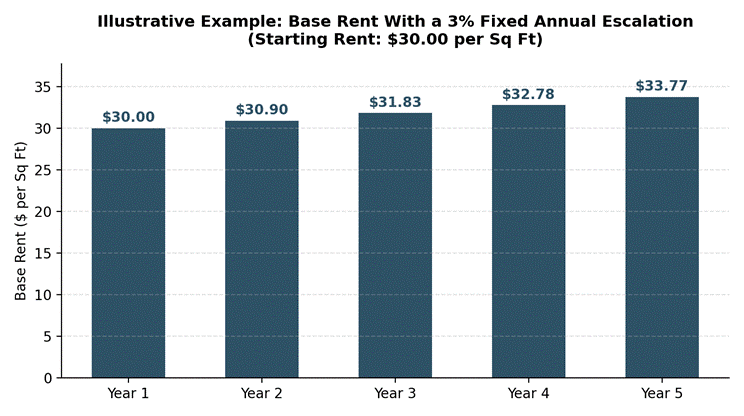
Figure 1: Example for illustration. Actual leases will differ for starting rents and escalation rates.
The pattern in this illustrative example is important because of the compounding effect of escalations. Each new year’s increase is based on last year’s rent, not the original starting rent, so while the percentage increase is the same, each subsequent year’s increase is, in absolute terms, larger. While negotiating leases, many tenants will ask if the escalations are applied to base rent only or to base rent and all pass-throughs. Some landlords have escalations worded in such a manner to encompass the entire monthly bill, not just the base rent.
Additionally, the rent-free months that are often included in the first few months of a lease are also included in this scheduling, so tenants may notice that the first month of a lease may have a base rent of $0, with the full monthly escalated rent charged starting in the second month.
Common area maintenance charges (“CAM” charges) cover maintenance for shared spaces. Common area maintenance charges typically go towards parking lot maintenance, landscaping, utilities in the common areas, hall janitorial services, snow removal, security, and a management fee charged by the landlord. Landlords charge a management fee to cover the cost of managing and maintaining the property.
The actual costs to the landlord of providing the services are not known in advance, so the landlord estimates the CAM charge for the upcoming year based on the prior year’s expenses, plus known cost of service adjustments. That amount is divided into twelve equal monthly payments and billed along with base rent, providing a predictable cash flow for both the landlord and tenant. The graph below is a breakdown of how a landlord typically estimates CAM charges and allocates that estimate to the various services.
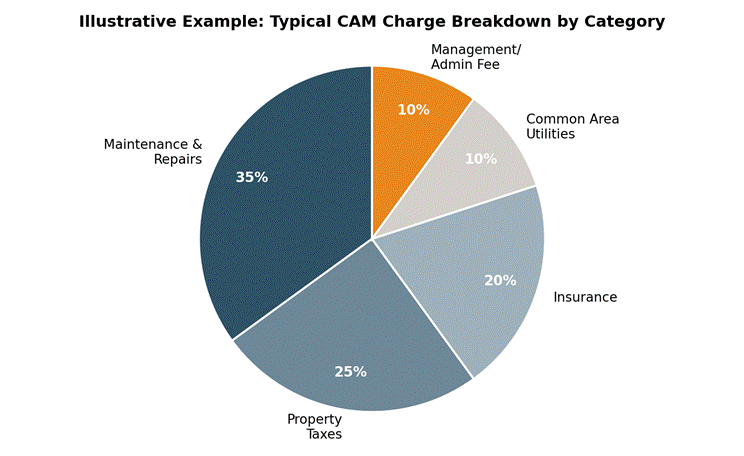
Figure 2: This is an illustrative example only. Actual CAM category weighting differs by the type and age of property.
Every property will have a distinct breakdown. When considering old and new buildings, old buildings generally require more upkeep while new buildings are more expensive in terms of tax and insurance. Also, a lot of leases will have a CAM cap.
This limit sets a cap on the controllable portion of CAM charges each year, regardless of the landlord’s actual costs. The controllable portion of CAM charges may cover a landscaping contract or a cleaning contract, while a non-controllable portion of CAM charges may cover snow removal in an exceptionally bad winter, which, again, is out of the landlord’s control. It is important to the tenant to understand what portion of the CAM charges is subject to the negotiated cap, as this will set the upper limit for the tenant’s future cost reconciliation.
A triple net lease (NNN lease) is a type of lease in which the tenant is responsible for paying base rent, plus their share of real estate taxes, building insurance, and maintenance for the common areas. Many companies use triple net leases for properties that include multiple tenants, which is often the case in shopping centers. Unlike other lease types, billing for triple net leases separates these costs, providing transparency for tenants.
A modified gross lease falls between a full-service gross lease and a triple net lease. In a modified gross lease, some costs (i.e., maintenance and repairs) are absorbed by the landlord, while other costs are passed on to the tenant. Full-service gross leases are more common in office buildings, while triple net leases are typically used in retail and industrial leasing. Understanding the different lease types is important since tenants will interpret billing differently based on the lease type. For example, a triple net tenant will expect insurance and tax costs to change based on market conditions, while a gross lease tenant will not see these costs billed separately.
The way commercial leases handle utility billing largely depends on the building’s metering system. In buildings with direct meters, each tenant has their own utility account. Tenants pay for the actual utility consumption, with the landlord having no involvement. In buildings with submeters, the landlord installs a meter to measure utility consumption by each tenant. The building has one utility account, and the landlord bills tenants based on the submeter reading at the rate the landlord is charged by the utility company.
In buildings that do not have suite-level metering, utility costs are allocated by the floor space a tenant occupies, and are charged as part of the CAM. For example, a tenant with energy-efficient equipment may end up subsidizing a tenant with equipment that runs 24/7. Submetering helps resolve this issue as it charges tenants for the utility consumption, reducing disputes for differing levels of utility use.
Percentage rent is a retail lease provision where additional rent is charged as a small percentage of gross sales above a threshold known as a breakpoint. To illustrate one way to calculate one breakpoint, a tenant with a base rent of $60,000 and a retail lease with a 6% percentage rent clause would have a natural breakpoint of $1 million. Breakpoints can also be negotiated as a fixed dollar amount and, in that case, would be referred to as an artificial breakpoint.
Beyond the breakpoint, the tenant is responsible for paying the landlord the agreed percentage for every dollar above the agreed breakpoint, and this is reported on a monthly or quarterly basis and adjusted to the sales figures at the end of the year. Percentage rent is most often used in shopping centers and malls because it allows a landlord to retain a lower base rent while allowing the landlord to participate in the success of their retail tenants.
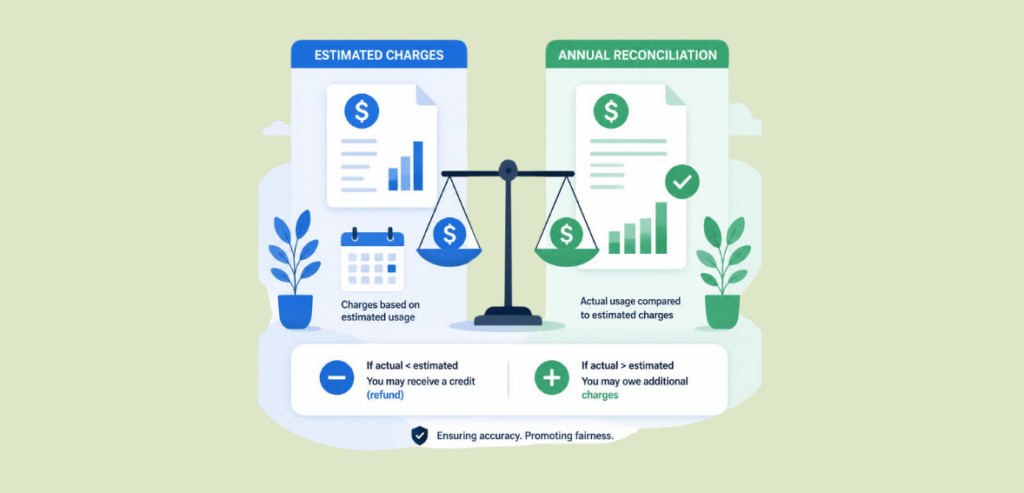
Any pass-through will start as an estimate, and CAM reconciliation will bring every estimate to actual. Throughout the lease term, a tenant pays a monthly estimate based on the Landlord’s forecast. At the end of each year, the landlord compares the actual expenses with the estimates that were billed to the tenant, and issues a reconciliation statement. A one-time catch-up reconciliation invoice is sent to the tenant if the actuals come in high. If the actuals come in low, the tenant is owed a credit, which can be refunded or offset against next year’s estimated payments.
This estimate-then-reconcile cycle is repeated through the life of the lease, which is the most important aspect of a commercial lease. CAM reconciliation statements are usually issued after tax bills and insurance premiums are finalized, which is typically 90-120 days after the year-end. Even if a tenant moves out of a leased space, they are still obligated to pay their share of the CAM reconciliation based on the time they were in the leased space, and this should be considered when planning to move out.
Most commercial leases provide a defined period to tenants to dispute charges, generally stated as thirty to one hundred eighty days after the tenant receives the reconciliation statement. If a tenant believes a category was improperly calculated, the tenant may have the right to request an audit of the landlord’s working papers. Many leases dictate the bearing of the audit cost, depending on whether a material overcharge is determined. The true-up process completes the reconciliation where both parties have agreed to the revised figure, followed by the issuance of a new invoice or a credit memo to adjust the tenant’s account balance.
To avoid large unexpected reconciling amounts, tenants should track their payments throughout the year, as tenants are often shocked by the amounts that appear on the year-end statement. Good documentation is essential to avoiding protracted disputes and a good tenant/landlord relationship.
A commercial tenant ledger creates a single account history for a tenant by compiling all the charge types. The ledger begins with the tenant’s scheduled monthly base rent. Then the ledger includes the current CAM estimate, tax and insurance escrow (if the lease is an NNN), any percentage rent that accumulates after a retail tenant reaches their breakpoint, and any applicable metered or submetered utility charges. After the annual reconciliation, the ledger is adjusted for a reconciliation charge or credit, which is carried forward to the balance of the next month.
The ledger also includes late fees, interest for overdue balances, and any agreed-upon concessions, including free rent periods. Therefore, the ledger helps both the landlord and tenant see what charges have been billed, what payments have been made, and what adjustments have been made throughout the lease term. Understanding a tenant ledger means understanding the rental charges and the lease term. Familiarity with base rent, CAM, NNN pass-throughs, utilities, and percentage rent makes the ledger far easier to follow during a lease audit.
Commercial lease billing may appear complicated, but each charge correlates with a clause in the lease and a defined billing methodology. Base rents increase according to a defined schedule. Common area maintenance (CAM) charges are estimated and adjusted (reconciled) once a year. Tax pass-through and insurance pass-throughs are impacted by the type of lease. There are numerous ways to structure a lease, such as NNN, gross, modified gross, or full service leases.
Each method of utility billing relates to the type of lease and how the space is metered. Retail sales that are subject to a threshold use a defined sales tracking method (percentage rent). When all of these lease billing methods are combined in a single tenant ledger, what is normally a confusing year-end reconciliation process provides a number that is verifiable and trusted by both the landlord and tenant.
CAM stands for common area maintenance. This refers to expenses for maintenance of common items such as the parking lot and landscaping. Charges are paid monthly in estimated form and adjusted (or reconciled) to the actual cost at the end of the year.
The landlord analyzes the real annual CAM costs in relation to the monthly estimates paid by each tenant. Tenants are charged for the cost shortfall, or alternatively, they receive a credit.
Percentage rent is an additional cost to the tenant whereby the landlord receives a share of the gross sales over a predetermined breakpoint. It is a good way for a landlord to share in a tenant’s good fortune.
A triple net lease makes the tenant responsible for base rent as well as a proportion of property taxes, insurance, and CAM. Under this lease structure, the landlord transfers most of the risk of operating cost increases to the tenant.
An escalation clause typically allows for one of three bases of rent increases, including rent increases by a fixed percentage, increases aligned with CPI, and increases by a set amount as mutually agreed. Generally, an increase occurs based on the most recent (prior) year’s rent in the first two cases.
Commercial lease billing: one piece of collecting rent. The rest of our property management payment guides are in Property Management Payment Resources.