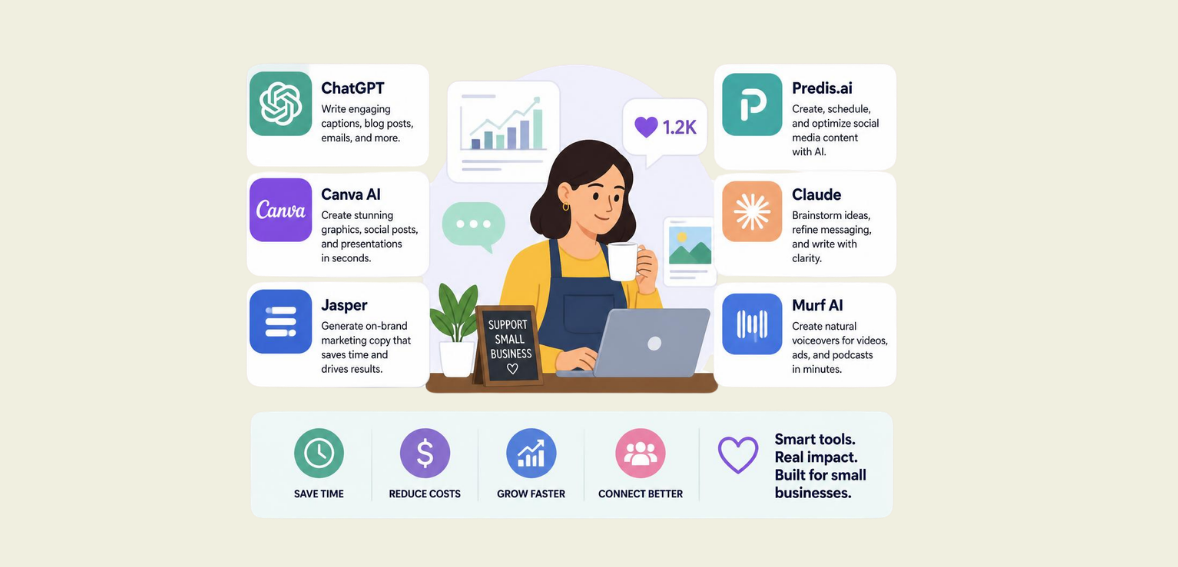
You can bet somewhere, right now, a plumber is up at eleven, posting her finished job for the day on Instagram.
She’s on her ninth job for the day and is not hiring an agency. She will open an app and post the rough caption. Whatever the app spits back will be posted, with two words changed.
This is what small business “AI marketing” looks like in 2026. AI marketing will not change the game, and it will not come with strategy. It’s for the business owner who has a job to do and would rather spend four minutes on it instead of the usual forty.
The data supports this marketing theory. Constant Contact’s Q1 2026 Small Business Now found that 54% of small businesses already used AI tools. Another 27% are predicted to start using the tools this year, making it virtually 80% of small businesses using AI tools by December. Based on the March 2026 survey done by the Small Business & Entrepreneurship Council, the small businesses already using AI run a median of five tools.
This is not a list of forty apps. It’s an honest overview of each of the ten tools small businesses are using, with a breakdown of the jobs each tool does.
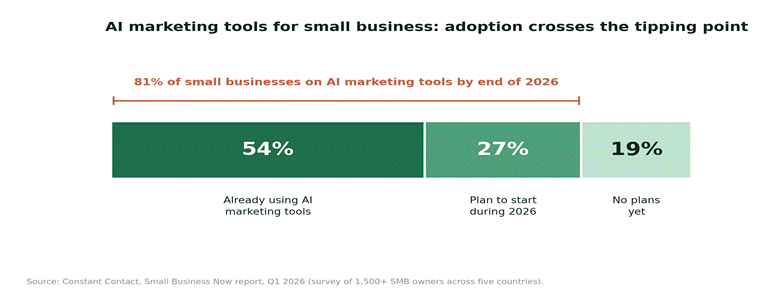
Figure 1: Adoption of AI marketing tools among small businesses, 2026.
It’s not the tools that are the issue; it’s the way we buy them. What’s the latest thing that has you rushing to buy?
We’re seeing a lot of new people bringing in new tools and strong beliefs that what we learned before is obsolete. The barrier to entry is so low that it is hard to create a business moat with the latest tools. Building with a focused set of tools is much more valuable.
Start with a problem, not a tool. For example, think about what you should have posted last month. What emails did you forget to send? Did you respond to your reviews? The answer to these questions is why you should buy the tool.
When you do buy the tool, set a 60-day time limit. The tool should save you time, or else you should cancel it. Most people accumulate tools but don’t use them, and subscriptions that should’ve cost $19 eventually turn into $340 monthly subscriptions that go unexamined.
The last thing to remember is that you should buy one tool at a time. The biggest problem with adopting AI at a small business is that the owner thinks tools are the problem, when actually their crazy idea of buying five tools in one week is the problem.
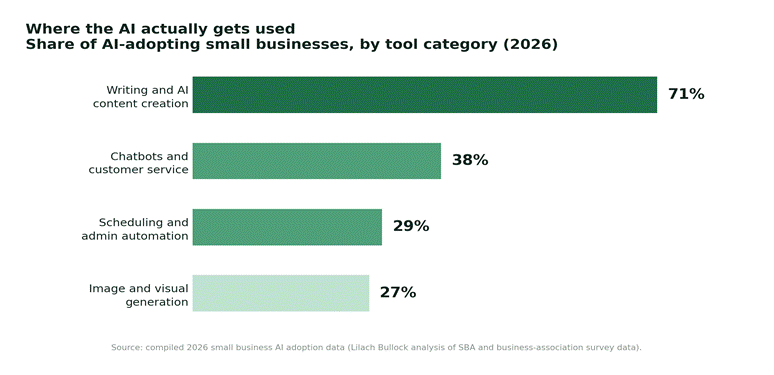
Figure 2: Where small businesses actually apply AI, by category.
Writing is the front door. AI content creation is a huge field, and 71% of small businesses adopting AI have used these tools. This makes AI content creation far and away the most popular and most useful field. This is also where failures are most visible to your customers.
Here is the truth: Customers can tell when things are written by AI. While they might not be able to explain the reasons for feeling this way, they are able to feel your work’s flatness. To overcome this, take a first draft from AI and use pen and paper to finish the job by adding what only you can.
AI makes a great first draft; it even makes a great second draft, and it makes great placeholder structures for content. Use it for all of this, then fill it in with your thoughts, your opinions, your ideas, your content, and most importantly, what you are selling.
The default choice for a reason. This is something your employees already know how to use, thanks to it being widespread, meaning there’s little to no cost to train everyone. Owners use this for drafting, service offers, tricky emails, and to phrase stuff before deciding.
The strength of this option is the lack of constraints. As a result, it does produce very generic copy. Treat the first output as a starting point, not a finished delivery.
Owners with blogs, newsletters, or rough drafts in need of a tone tweak drift toward this for a reason. It’s best for longer texts and anything that needs a voice. It can be easier to have it edit your text rather than writing from scratch. Have it digest three of your drafts and it will better match your tone. Feeding it samples works much better than describing your tone in words.
This was purposely built as a tool for marketing teams as opposed to general-purpose use. To justify the cost, you’d need multiple people publishing under the same brand; it was built with brand voice tools and campaign templates to keep everyone publishing on voice. For the solo owner, that cost would be difficult to justify.
People will not engage with your paragraphs if your images look like they are from a 2011 clipart catalog. About 27% of AI-using small business owners use graphic design tools. That number is low considering how often poor design is blamed for weak engagement. Talent is no longer the issue. Time and a template are.
You can expect a lot from Magic Write and Magic Design. Magic Write generates copy inside the design while Magic Design creates branded templates from a prompt. The video editor automatically generates subtitles. If your business does not have a designer, these tools provide the most value beyond the AI assistant.
These tools come with their own cautions. Making templates so easy can lead to them being overused. The fix is simple: change the fonts, lock in two brand colors, and swap the stock images for real photos of your business. A “good” stock design with a random stock image is going to pale in comparison to a rougher design with a real image of your store.
Editing a video is like editing a document. You can remove sections of the video along with the corresponding audio simply by removing the text. Filler words. Gone. This really matters for non-professional presenters. Owners were reluctant to jump into short-form content for good reason. That reason is gone.

You’ll be much better off in the long run using AI tools to keep a consistent social presence than trying to be funny or witty online while not posting regularly.
Spending your time creating new content doesn’t make sense when you can repurpose it. A single blog post can be used as a social media carousel, three different social media captions, the intro to an email, and even a video script. Most content creators will create all of this separately, and that is where the real time is lost.
Conveniently, the AI Assistant is made to produce captions for Instagram, LinkedIn, X (formerly Twitter), and Facebook from a single piece of source material. Each caption is made with the platform’s unique cadence and is produced simultaneously. The free plan allows you to use three social media channels to produce posts. This is usually more than enough for most small businesses.
For best results, plan your posts to go out two weeks in advance. Feel free to break your scheduled posts if something notable happens. For example, an unplanned post about a pipe bursting will get more traction than your scheduled posts.
This category contains the most important aspects on the list, and the ones most owners speed through.
Review responses are not press releases or corporate communications. They are a public record of your behavior during the critique of your business. The prospective buyer sees the one-star review. Then they are shown your response. They will make a decision based on your response. An AI tool can draft your responses for you, but it cannot send them for you.
Both systems are geared towards local businesses. They collect and unify reviews from multiple platforms, draft responses in the user’s writing style, and can even recognize and address negative feedback before it becomes an issue. For a multi-location service business, the cost is easily justified just by the consolidation offered.
Use the draft, but always change at least one thing. If your response does not contain a detail specific to your business, it is going to look automated. And a consumer prefers a genuine response to a canned response, especially to an automated “I’m sorry.”
Reputation management teeters near illegality. The FTC’s Endorsement Guides are clear about reputation management. You can’t buy reviews, and you can’t offer discounts for positive reviews. You also can’t request reviews only from customers you think will leave positive feedback. You can’t publish positive reviews faster than negative ones, though a reasonable moderation delay applied equally to all reviews is fine.
Your employees and their family members can’t review your business unless they disclose the relationship, and a vague disclosure buried in hashtags or comments is not sufficient. If you give someone the product to review it, the reviewer must disclose that they received it for free every time, and their opinion must remain their own.
You still carry all the legal responsibility for the response — the AI does not.

Paid advertising is where AI is extremely useful, even if it isn’t glamorous. It’s useful because of the need for speed. Everything about advertising is all about testing. Testing requires variations, and those variations take time. And time isn’t something you have when it comes to advertising. AI models are capable of producing 15 headlines in a minute, and 15 mediocre headlines tested fairly will beat the one assumedly brilliant headline almost every time.
The AI ad tools most small businesses overlook are already embedded in their ad accounts. These systems take your budget and creativity and make targeting and placement decisions with the platform’s model. When working with a low budget, the use of built-in business ad tools likely achieves better performance than the use of manual audience segmentation due to low data volume. Less budget, more algorithm.
Give the algorithm a chance. Feed it multiple distinct creatives, but don’t hand it the same creative five times. Run the model for a couple of weeks with a small budget and don’t optimize the model until the end. Judge results based on cost per inquiry instead of views. Pay attention to what those inquiries actually say. The algorithm will optimize for inquiries; it won’t know why customers choose your business.
Think with Google is likely the best free resource for understanding how AI is changing consumer behavior and measurement, and it is not a sneaky plug for paid services.
Email is definitely the best channel for small businesses, because with email you OWN the channel. About 41% of small businesses believe email will drive business in the coming year, and unlike social media, people (or competitors) can’t change an algorithm and delete your email list overnight.
An AI component produces offerings like intelligently segmented lists with behavior-based segmentation, subject line drafts, and predicted send times. Send-time optimization is easy to overlook, but it silently increases open rates without you putting in the work to write anything additional.
You should actually revise the lines suggested by the model. They come out as somewhat snarky. Snarky is outdone by being straight to the point. Something along the lines of “Your boiler service is due in April” will reliably beat “Spring into savings,” and the former will continue to win as long as people have boilers.

Chatbots deserve their bad reputation. The 2016 era bots did not comprehend anything and were just there to act as a barrier on your path to a human customer service representative. The current generation is indeed different from the previous one. This difference is also one of the reasons why the use of customer service AI is predicted to double from 2023 to 2025.
The bot scans your FAQs, previous chats, and your website to manage the repetitive half of your inquiries. Do you have parking? What are your opening times? Will you deliver to my postcode? When will the black one be in stock? These questions make up about 60% of enquiries to small businesses and 0% of interesting questions.
Implement a single rule. The bot must refer the customer to a human employee in the following instances: when a customer is upset, when the customer is willing to make a large purchase, and when the bot has already failed to handle the customer’s request twice. The existence of a working escape hatch is what truly differentiates a useful bot from a one-star review bot.
Search shifted for everyone. It used to be that people searched and got a list of ten blue links. Now they ask an assistant to recommend something, and the assistant answers with a handful of names. Local marketing is no longer about ranking. It’s about being the business the answer refers to.
Semrush can look up keywords, see your competition, and see whether AI-generated answers mention you. Surfer will score your drafts based on web pages that are already ranked and helps you avoid the common mistake small businesses make of publishing content that is thinner than it should be.
While each application offers its own features, neither eliminates the need for you to update your Google Business Profile. It is free, and is the most valuable local business asset, and is most likely out of date. Fix your hours, upload new photos, and respond to questions. Do this before spending money on any of these services.
Because AI assistants now sit between you and the consumer, the structure of your content matters more than how many keywords you cram into it.
The tenth tool is never listed on a marketing tool list, and it is the one that amplifies the other nine.
Here’s a concrete example of how it works: You fill out a form, and it sends an automatic welcome email. A task generates inside someone’s project management app; a note appears in a customer’s CRM. You just have to describe the workflow in plain English and the AI creates the workflow for you. For the free tier, you get 100 tasks a month, which is plenty to test it out. This is where you start to see meaningful automation in small businesses. That can easily save you 15 minutes a day.
One caveat: automation that can be rule-based should be rule-based. When you make a purchase and get an automated receipt, that should stay an automated receipt. If you add a model to that, it’s just going to complicate the workflow. For language-based tasks, use AI. For everything else, just use a rules-based framework.
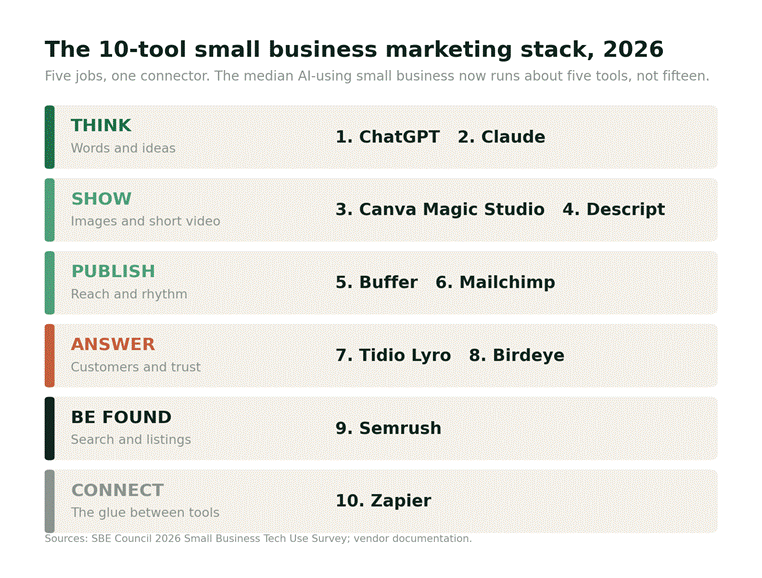
Figure 3: The ten tools, grouped by the job each one does.
If you have no budget and no time, here is the whole answer.
That’s around $0 monthly. Only spend once the full two months is up. After that, purchase the tool that hurts the most. It’ll usually be because you’ve hit a volume threshold that impacts your ability to do real work.
Now, onto the avoiding, which is more important.
Never buy an annual plan in the first month. You don’t know your actual use yet, and the savings are not worth the lock-in. Publishing shouldn’t be on autopilot. Content that gets no engagement is the same whether it is time-delayed or published in the moment. Do not combine a bunch of tools in one week, and don’t buy anything that is developer-intensive to set up because almost always a non-technical version is closer to what you need, and you are much more likely to use it.
The final trap is more nuanced. Don’t let AI amplify your volume without improving your quality. Competitors have access to the same AI tools, and the market is overrun with indistinct yet very competent content. In 2023, having a high volume of content was an edge. In 2026, high content volume will be the minimum expectation, and expressing unique ideas will be the key differentiator.
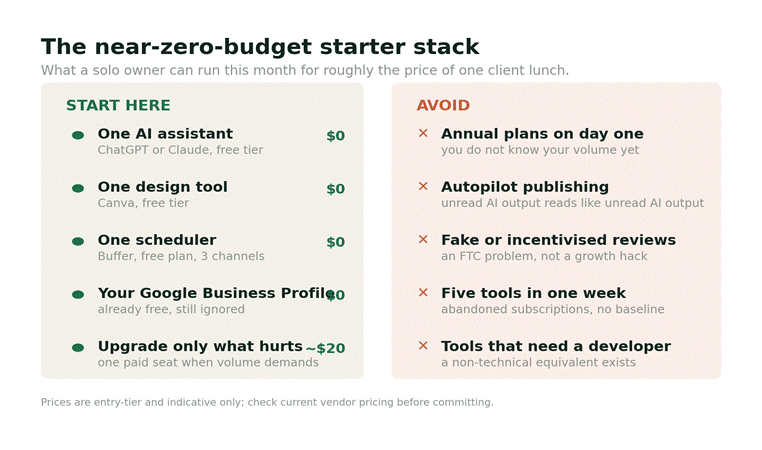
Figure 4: The near-zero-budget starter stack and the five traps to skip.
Most AI spending seems unclear because most owners check very little.
Establish your target number for each tool before implementing it. For the assistant, your target number should be hours saved per week. For the scheduler, put your target as monthly posts published and compare that with the number you had previously. For the chatbot, your target number should reflect the percentage of enquiries that get resolved without your involvement. For the email tool, put your target as the email revenue per send. For the review tool, the target number should be the average response time for reviews.
Most of the time, the reported benefits show a positive impact after about 60 days of real use. The companies that utilize the tools beyond the surface level and fully integrate the tool into their work sustain the most benefits. In comparison, the companies that have a surface-level integration of the tool and claim, “we use ChatGPT for emails,” don’t sustain any benefits. The difference between these companies is how they choose to implement the tool into their work processes, not the tool itself.
When you consider an average, about 14% of small businesses claim that AI is in their core operations, while the number of small businesses that state that they use AI is about 75%. That gap is the competitive advantage, and it is available to any business willing to stay systematic for the next two months.
The truth about AI marketing in 2026 may be alarming for some. The tools have lost their value as differentiators.
The same as you, your local competitor uses ChatGPT, Canva, and Buffer. When everyone has access to the same resources, access is not an advantage. What is differentiating progressive businesses now is less exciting than software. It is the selection of a few tools, proper connection of the tools to a real bottleneck, proper learning of the tools, a human review before anything a consumer would read, and the patience to stick with the tools to measure results.
It is advisable to aim for smaller beginnings. This is an assistant, a design tool, a scheduler, and an ignored Google listing. Try this for sixty days along with one true metric.
A caption-writing plumber does not need an AI strategy. All she needs is a caption that sounds like her — and twenty minutes of her day back. The tools are just meant to help you achieve this goal more quickly than last year.
Choose one general assistant: ChatGPT or Claude, and start with a free tier account. They can help with drafting, rewriting, and brainstorming, as well as difficult customer emails, so they can cover a very wide range of use cases as a single tool. You can implement a design tool (e.g., Canva) once visuals are integrated, and a scheduler tool (e.g., Buffer) once consistent output becomes the limiting factor in your process. Only then add the fourth tool, and make sure the first three are used regularly before considering a new tool.
AI is a great tool for small businesses! More often than not, the free tiers are where the return on investment is highest. An assistant subscription at $20 that saves five hours a month is a clear benefit, and SBE Council data shows 93% of AI-using small businesses are planning on the continued use of AI, while 62% intend to spend more. That is certainly a sign of a high return on investment. The real cost comes from not using the tool. It is the risk of quietly having six tools and doing audits on none of them.
Drafting is the majority of the work. But AI can’t input the little specifics that make a post interesting: the job that went wrong, the regular who has come in every Thursday for nine years, or an opinion your competitor would not publish. AI can help with the first draft. But there’s a significant difference in quality between a post that has been written in a personable way and an AI model draft. Edit the draft to add a human touch, and keep the post direct and to the point. AI-generated text is usually well structured, but on its own it is so generic that it is ultimately unengaging.
AI is safe to use for drafting, but unsafe to use for submitting. You should treat a response to a review like a statement of your business to the public. Customers look at review responses more closely than they look at your home page. In drafting a response to a review, reading the response, adding a unique detail that pertains directly to your business, and leaving no automated responses to negative reviews are all must-do actions for business owners. Additionally, the FTC’s Endorsement Guides apply regardless of who wrote the response: honesty, proper disclosure, and no suppression of negative reviews are required either way.
Yes. This is the one point with no nuance, and for good reason. Text models are confident. They may be confident in stating wrong information on your pricing, service area, policies, or your personal claims. These confident errors are published as if written by you personally, and the liability of a confident error lands on your business. There are worse things than having no content. Having a human review is not a formality. It is what legitimizes the entire system.