Posted: September 15, 2026 | Updated: September 22, 2026 at 3:53 PM
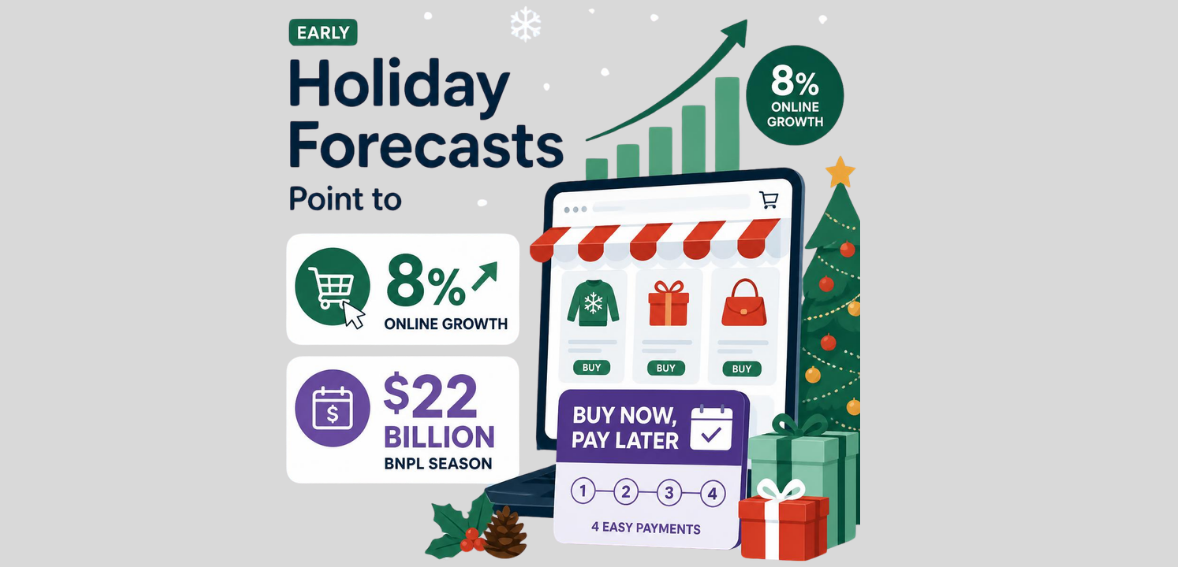
What if waiting until November to prepare for Black Friday is already too late? The holiday shopping season may still be weeks away, but retailers don’t have to wait to see what could shape the 2026 season. Early forecasts are already highlighting various important trends. According to Salesforce’s holiday shopping data, last season set records. Shoppers worldwide spent $336.6 billion during Cyber Week, and online spending for the full season reached $1.3 trillion globally.
Deloitte’s September 2026 forecast puts online holiday sales growth at 7.5% to 8.4%, call it 8%. And if BNPL keeps growing at last year’s pace, American shoppers will put over $22 billion of their November and December online orders on installment plans.
These numbers may sound like a reason to go all-in on holiday inventory and promotions. But that’s not necessarily the message. For ecommerce retailers, that means the goal isn’t to make dramatic changes based on predictions. It’s to use those predictions to make a few practical decisions while there’s still time to test, fix, and adjust. So, what do the online holiday sales and early 2026 holiday ecommerce forecasts actually mean for your business? Let’s break down each prediction and turn it into a September action.
Let’s first start with the number most retailers care about: online sales. Deloitte’s early forecast points to roughly 8% growth in ecommerce sales this holiday season. Eight percent may not sound huge, but for an ecommerce retailer, even modest growth can bring real operational challenges.
Imagine your online business generated $1 million in sales during the 2025 holiday season. An 8% increase would put your sales around $1.08 million.
That’s an additional $80,000 in sales. This also means that:
This is why retailers shouldn’t read forecasts only as a sales number. They should know what that growth means for the rest of the business.
Start with last year’s holiday numbers. Look at your:
Then use those numbers as your baseline for 2026 planning. For example, if your business sold 10,000 units of a particular product last holiday season, that doesn’t mean you should order 15,000 units this year. Instead, look at the product’s actual sales trend, current demand, margins and inventory position. The same principle applies to your overall sales forecast.
Holiday shopping can be expensive and can push people over budget. Customers buy gifts for their loved ones, upgrade electronics, or spend on products they wouldn’t buy during the rest of the year.
Paying in installments has obvious appeal in December. Shoppers like being generous, but they don’t want a whole season of gifts landing on one month’s budget, and they don’t want to carry that balance on a high-interest card either. That’s one reason buy now, pay later (BNPL) can become especially relevant during the holiday season. BNPL allows customers to split a purchase into multiple payments rather than paying the entire amount. Adobe put last season’s BNPL total at a record $20 billion, a 9.8% rise. One more year like that clears the $22 billion mark.
For retailers, that makes BNPL worth evaluating before the holiday rush.
If your business doesn’t offer a BNPL option, determine whether it makes sense for your products and customers. If you’re already offering it, it’s time to test the experience. Don’t wait until Black Friday to discover that the BNPL option isn’t showing correctly on mobile or that customers aren’t clear on the payment terms. Review the complete customer journey:
Product page → Cart → Checkout → Payment option → Confirmation
AI has entered the market, and now customers have more ways to discover products. Instead of looking for a particular product on search engines, a buyer might prefer an AI-powered shopping tool for recommendations. Adobe’s data from last holiday season showed shoppers arriving from AI tools converting 31% more often than visitors from other channels. The gap was 54% on Thanksgiving itself and 38% on Black Friday.
There’s no reason to expect that gap to close this year, and Salesforce predicts one in five holiday ecommerce visits in 2026 will come from AI agents.
Retailers should start reviewing their product catalog. Product pages should clearly communicate:
For example, compare these two product titles:
Basic: Premium Winter Jacket
More useful: Men’s Waterproof Insulated Winter Jacket, Black, Sizes S–XXL
The second title gives shoppers and shopping systems much more information. The same principle applies to product descriptions.
Don’t rely on vague phrases such as “high quality,” “premium product,” or “great for winter” without explaining what actually makes the product useful. September is also a good time to review your structured data and product feeds. Make sure important information such as price and availability isn’t outdated.
Cyber Monday and Black Friday aren’t just domestic shopping events anymore. Buyers can make purchases from retailers based overseas and ecommerce makes those purchases easier than ever. Practical Ecommerce’s 2026 predictions have cross-border orders making up about a fifth of global Black Friday and Cyber Monday spending. In DHL’s 2026 report on e-commerce trends, 70% of online shoppers worldwide said they purchase from merchants based abroad, compared with 60% the year before, and 45% said they do so at least monthly. Chinese sellers take the biggest share of that business. Nearly six in ten international buyers (59%) have purchased from a Chinese merchant, compared with 32% who have bought from an American one.
The biggest motivation for people to shop overseas is lower prices. The Chinese discount apps are a big part of it: 41% say they shop on Temu, Shein gets 32%, and AliExpress or Alibaba 22%.
This is a real opportunity for retailers who are already selling across borders. But it can also create problems, because preparing international orders can be complicated.
For example: a customer in Canada is buying a $150 product from a US retailer. The customer may want to know:
If those answers aren’t clear, the customer may abandon the purchase—or be surprised after placing the order. Before you open up to international customers, set your international shipping policy. If you are already shipping to international customers, review the countries you serve and make sure your shipping details are accurate and up to date.
If this is your first year selling internationally, determine which markets you can realistically support. Be clear about where you ship, how much international shipping costs, who is responsible for duties and taxes, and how long customers can expect their orders to take.
The 2026 holiday season could bring more online spending, increased use of BNPL, more AI-driven product discovery and cross-border shopping. But that doesn’t mean you’re heading for a massive sales surge. An expected 8% increase in online sales is meaningful, but it’s still moderate growth. It’s better to prepare carefully. Use last year’s sales as your foundation. Add reasonable growth assumptions. Review your payment options. Clean up your product data. And settle international shipping and duties policies before the holiday rush. If you’re also looking at cash flow, “Ways to Tighten Your Cash Flow Before the Holiday Crunch” can help you prepare for the financial side of the season.
Black Friday may be the headline event, but September is when many of the decisions behind it can still be made calmly.
If you need the broader holiday preparation checklist, read “The Holiday Season Plan: 10 Moves Retailers Should Make Before October.” And for payment-specific preparation, “E-Commerce Payment Optimization” can help you review the checkout experience before the holiday rush begins.