
Posted: July 14, 2026 | Updated: July 14, 2026 at 4:42 PM
There’s a wave of holiday shoppers who have no time to waste and expect the best. They look for the ideal gifts and dislike long waits and unexpected inconveniences. The retailers who win those shoppers know that the key to those preparations is a commitment made in August. They lay out the holiday season plans, conduct the necessary tests, and prep well in advance of the shoppers who arrive looking for holiday savings.
This document is your holiday battle plan. There are ten strategies to help you turn the most chaotic shopping season of the year into the calmest, most profitable month of the year. The concept is rather straightforward. The early bird gets the holiday sales. Delay means you will be solving crises to get through the month, selling what you can, and making no money. Miss the October deadline, and you will be working the holiday season just to survive financially. Hit it, and you will be counting your profit for the season.

Ask most owners when the holidays begin, and most will answer Black Friday. Your customers can afford to think that way. You cannot.
Every year, the shopping season begins earlier, while the hard deadline at the other end never moves: shipping cutoffs land days before Christmas. With the Christmas season shopping window falling between Thanksgiving and Christmas, the time is only about four weeks. This is the hard reality of the short and busiest season of the year for your business.
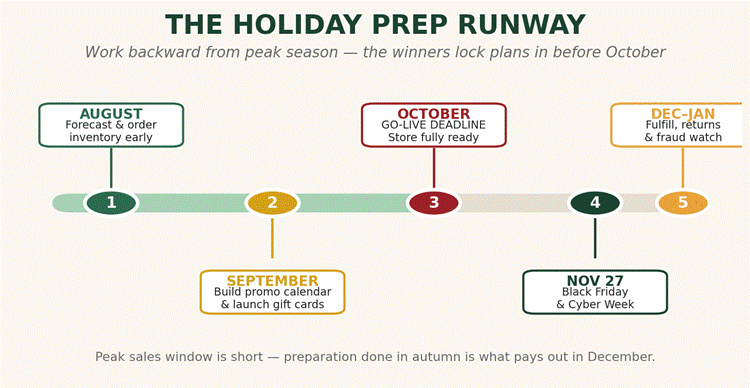
So when does the holiday rush begin for retailers? To put it simply, you should begin preparations to make holiday sales by the end of summer, and bookings for holiday sales should be completed by August. According to the National Retail Federation, many large retail companies begin to stock holiday inventory and start to sell holiday merchandise as early as October.
Essentially, the start of holiday season shopping is October deal days, and shopping continues after this until the end of Cyber Week.
You should treat October 1 as the go-live date for the season. As October begins, the time to focus on selling merchandise has come, and preparations should be built and tested before this date. This includes inventory and promotions, as well as staffing, checkout, and gift cards.
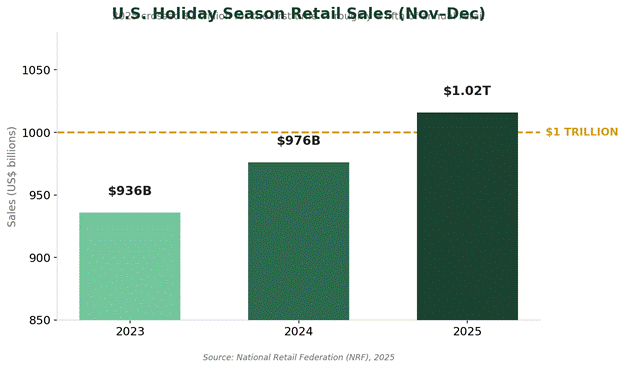
The effort will pay off. Sales during the U.S. holidays hit over $1 trillion, according to the National Retail Federation’s estimates for 2025. Just these two months account for close to twenty percent of yearly retail sales. Online sales increased approximately eight to nine percent. For small businesses, these numbers indicate even greater importance. According to an Intuit QuickBooks survey, ninety-three percent of small business owners reported that holiday sales were critical to their success.
With the possibility of explosive growth, there are boundless upsides and downsides to consider. While having more orders leads to increased revenue, it also adds stress on your checkout process, your inventory/supply, your team, and your defenses against fraud. The ten strategies described below will help you anticipate growth and the downsides that come with it.
Preparation will always be superior to reaction in business. Start with your most hectic deadlines, moving backward. Mark the dates for Black Friday, Cyber Monday, and your deadlines for the shipping cutoff. Then trace back the required prep time for each task.
Inventory orders take time. Holiday gift cards need design and setup. That prep time can’t be bypassed. Your business’s promotions require scheduling and creative work. Your website needs time to be tested. This work will be impossible to achieve at the last minute. Having a written small business holiday checklist gives order and ownership to all of the moving parts. Assign a name and a deadline to all your tasks. Then reserve all of October as the time you will make everything go live.
The wrong inventory can ruin your holiday season. Ordering too little means customers won’t find what they’re looking for. Ordering too much results in hefty markdowns in January.
Analyze last year’s holiday sales data. Determine product sales and the timing for each. Using that information, determine which products you need to avoid running out of, and which you need to avoid overstocking. Understand that customers are being more cautious with their shopping and looking for more value. It is safer to stock your proven best sellers. If you want to stock unproven products, order them as soon as possible. Timing is everything with this supply chain, and products will not arrive if you reorder too late.

Your checkout is where interest becomes revenue. Minor issues become much more expensive during peak holiday periods. Holiday checkout prep focuses on making the entire purchase path quick, consistent, and able to handle high volumes of traffic.
Be sure to stress test your website and point of sale systems in advance of the purchase rush. Even the pages for your checkout process need to be quick and responsive. Every one of your customers’ preferred payment methods needs to be fully functional. Consider your customers’ preferred payment methods; options that don’t require the customer to enter their payment information, like digital wallets, continue to dominate. It is all but mandatory to have a seamless payment process. Be sure the customer’s payment method is processed and the transaction is completed with a payment descriptor that clearly identifies your business. Confusing payment descriptors are considered a sign of fraud, and customers who don’t recognize the charge will file a fraud dispute. Fix the payment descriptor now before it becomes an expensive problem.
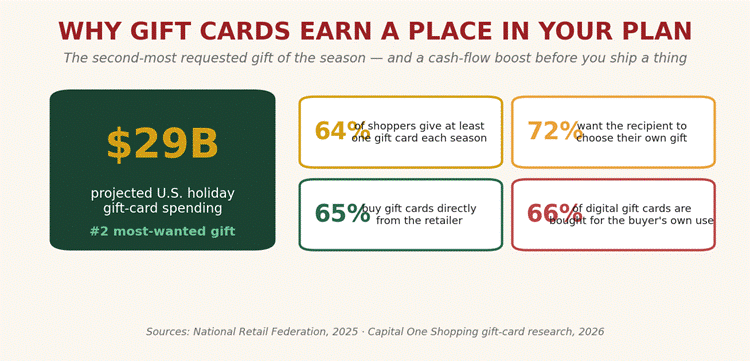
A retail business strategy that sells only physical products misses a profitable opportunity. According to the National Retail Federation, gift cards were the second most popular gift in 2025, with projected sales reaching twenty-nine billion dollars. Additionally, two-thirds of consumers purchase at least one gift card each year.
Gift card promotions are a great way to generate early cash flow. Because the gift card recipient will need to visit the store, gift cards often generate additional sales when the card’s value is exceeded. Gift cards also alleviate the “I don’t know what to buy” conundrum because most shoppers prefer to give the gift card to allow the gift recipient to decide what to purchase. Also, gift cards protect against return fraud, since gift card refunds keep value in the store rather than converting to cash.
The gift card program needs to be set up before October to capture the full season. If digital and physical gift card options are created, then sales can be continuous during the holiday season. Last-minute and digital gift cards can be sold during the shopping season for consumers who tend to wait to complete their shopping.
Square’s gift card system seamlessly connects to its point-of-sale and online systems. Selling electronic gift cards from a website and accepting them at the point-of-sale (POS) gives small merchants a complete solution. Square’s integrated system keeps the balance and redemptions in one place, which is important as their volume grows.
Shopify simplifies online stores’ abilities to offer gift cards with included functionality across all plans. Stores can create gift cards with the option to customize branding, deliver gift cards digitally, and track gift card orders within store order management. For online retailers using Shopify, enabling gift card functionality can be implemented in no time, just before the sale season begins.
Margins can be lost, and customers can be confused by arbitrary discounts. A plan provides the opposite. Your Black Friday activity should be part of an extended plan that provides offers throughout the entire runway.
Thanksgiving will be on November 26 in 2026. November 27 will be Black Friday, November 28 will be Small Business Saturday, and November 30 will be Cyber Monday. These dates anchor the peak of the shopping season in 2026. They shouldn’t be the only focus of the shopping season. Many retailers begin the shopping season early with deal days in October, and the last-minute shoppers will continue to shop all the way to the cutoff for shipping in mid-December.
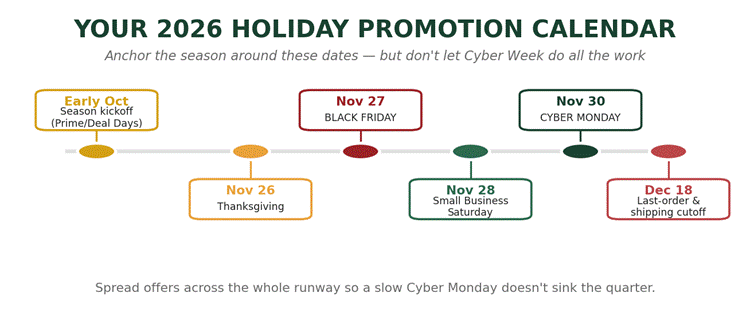
What does a small store holiday promotion calendar look like? For starters, space things out. A great way to do this is by starting off the promotions in early October to get the early holiday deal shoppers. Next, you can bank on the Small Business Saturday promotion to get the shoppers who are looking for small business sales. After this, you can use a different promotion for Cyber Monday sales, then have a final promotion push for your shipping deadline. To finish off the calendar, have a post-holiday promotion to capture the January gift card redemptions. A single promotion weekend should not make or break your quarter.

As sales grow, so does fraud. This is a gap that a lot of retailers ignore, and it ends up being extremely costly.
Retail e-commerce chargebacks rose a staggering 233% between the 1st and 3rd quarters of 2025, according to Sift’s Digital Trust Index. This was the fastest increase of all categories. Most of these chargebacks were attributed to friendly fraud, where the customer actually receives the order but STILL disputes the charge. ACI Worldwide expected the friendly fraud rate to increase 25% between Thanksgiving and Cyber Monday. Unfortunately, the friendly fraud pain doesn’t stop with the holidays. Dispute rates increase 40%-60% every January when consumers run out of discretionary spending.
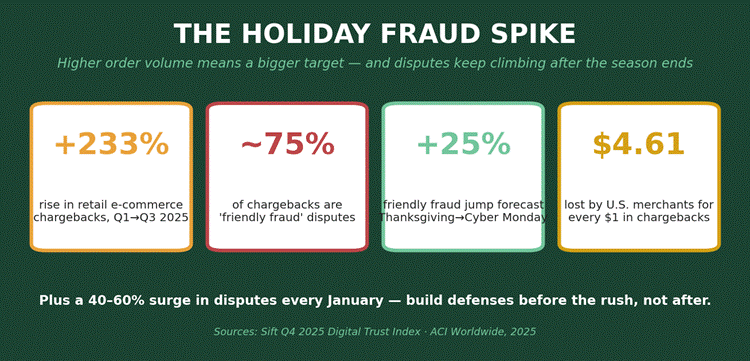
What types of payment challenges can you expect during the holidays, and how can you mitigate the impact of holiday fraud and chargebacks? Account takeovers occur prior to major shopping days. During this time, accounts that have been preloaded with payment methods are targeted. Also, during this time, card testing is done to check the validity of stolen cards. Fraud that is perpetrated by customers themselves, as well as refund fraud, is most common after the holidays.
The best way to combat these is by layering fraud shields. Step up your fraud shields in November. Implement address and card verification during checkout. Document all confirmations, shipments, and deliveries. You may lose some disputes, but these fraud shields are very effective. Have a clear, concise, and firm return policy. Offer store credit to retain value within the company. Also, keep your customer service easily accessible. Most disputes stem from the customer simply being confused, which can be easily resolved with a response.
Technology cannot carry every customer interaction; during the holidays, your people make or break the season. Hire and train temporary staff before the business rush starts to avoid ineffective training during the rush.
New staff require training to understand the processes for sales, returns, and spotting fraud. Staff trained in September save your business the stress of untrained staff in November. Don’t create liabilities for your business by hastily training staff in the middle of the rush (for example, on Black Friday). Train staff on multiple processes to avoid holding up the entire business if a critical point in the process (for example, the register) gets jammed.
Customers prefer shopping on the go. Those on the go increasingly include mobile shoppers, as the majority of web-based holiday shopping is now done from a mobile device. If your web page is still sluggish and clumsy when accessed from a mobile device, sales go to the competition, taking with them customers you have already paid to attract.
Test every part of the mobile shopping experience. Would you want to surf, select, and shop from the page? If that part of the experience is poorly designed and consists of too many steps to complete, no one wants to use it. AI is becoming more commonplace and is particularly useful for quickly and easily finding gifts or determining competitive price points. As such, a clear and concise title and description, and a clean, uncluttered, and organized shopping page greatly assist the AI in recommending your products.
Until the shipment arrives and the customer is satisfied, you cannot say a sale is final. Shipping and returns are particularly important to first-time buyers during the holidays to determine if they will shop with you again in the future.
Be transparent about shipping deadlines and do not change them. Offer multiple shipping options in case last-minute holiday shoppers want to choose an expedited delivery. Be prepared for the returns wave in January, as the majority of returns from holiday purchases occur after Christmas. Simple returns with no hidden costs are essential to earning customer loyalty. While some businesses view returns as a cost, they are an opportunity to create further business, as positive return experiences are often followed by purchases, especially gift cards.

Each of your strategies relies on the assumption that your systems are functioning properly. This is the ultimate stress test. Peak-season traffic should not be the first time your systems are actually put to the test.
Take time in early October to do a complete dry run of your systems. Do a test order and buy a gift card to be redeemed. Hold a practice return and direct traffic to your website to see how the systems hold up. Create time to verify your payment systems, your transaction descriptors, and your fraud rules. Find the gaps in your systems now while it is easy to do. When the initial traffic crush occurs, the goal is to avoid having to build anything on the fly. Best-case scenario, you will simply be watching your dashboards.
This is the time to prep for the opportunity of the season, not to panic. The trillion-dollar opportunity is something you cannot ignore. Each of these plans has the same target. The target is before October because you don’t want to be controlled by the season; you want to control it. Start your plans now, and you will appreciate it in December.
Earlier than one might imagine, early fall is certainly not too early to begin planning for the busy seasonal sales time! Serious preparations should ideally begin in the late summer and finish by the end of September. The selling season for some businesses actually begins before it does for the customer!
Some businesses may see slow or no sales activity before the Christmas holidays, and the peak time for sales may only be about a month. Many aspects of the business, including inventory, staffing, checkout, gift cards, and promotional offers, need time to prepare, sometimes weeks! You may want to think of the first of October as the kick-off date for the holiday sales season, and the weeks from the beginning of October onward as live selling season.
Most current POS and online selling systems (like Square and Shopify) use built-in gift card tools. Decide if you want to offer digital cards, physical cards, or both. Digital cards are better suited for online customers and purchases that need to happen at the last minute. Once you have a design, you can set the gift card values, and you should test the buy-and-redeem process. Gift cards can be sold throughout the season, but especially during the last few days, so promote them whenever you can!
Strengthening your business in anticipation of high-traffic seasons is imperative. Bottlenecks in your checkout process, along with failed payment transactions, may result in a loss of potential sales during peak traffic. Card-not-present (CNP) fraud attempts and account takeover attacks will increase in anticipation of your sale. Chargebacks will increase as well. The solution is preparation. Prior to your busy sales season, ensure your checkout process is seamless, check your business name on billing statements, make sure every payment method is functional, and improve your fraud monitoring.
Use multiple layers instead of one lock. Raise fraud monitoring by mid-November. Confirm addresses and cards at checkout. Maintain complete records of confirmations, tracking, and delivery, as you will need them to deal with illegitimate disputes. Draft an understandable return policy and provide store credit in these cases, as credit is not a cash refund. Make your customer service as accessible as possible, because most disputes are honest confusion, which is resolved with a quick response.
The goal is to spread risk across the entire runway. Use an early October teaser. Center the big weekend around Black Friday, November 27, and Cyber Monday, November 30, and include Small Business Saturday on November 28. These shoppers look for local shops. Include a last-chance promotion before your shipping deadline in mid-December. Then in early January, include a promotion for gift card redeemers. Don’t let any single weekend decide your season.