Posted: August 14, 2026 | Updated: October 06, 2026 at 6:03 PM
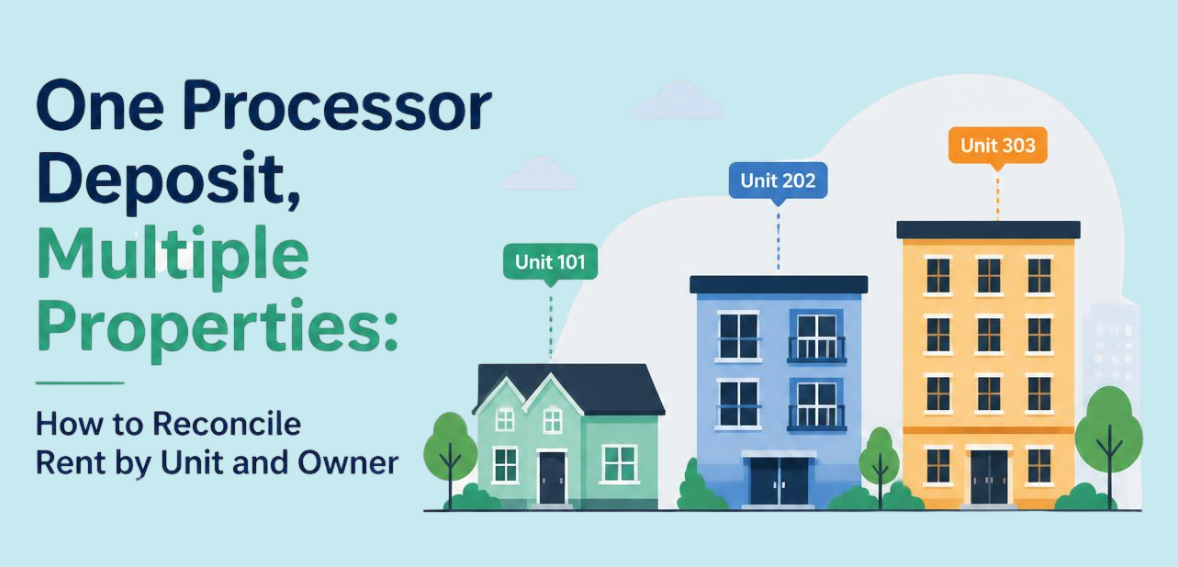
One line on a bank statement represents many net figures, including forty tenants, twelve owners, and three fees. This is what a processing batch deposit looks like when a property management portfolio grows, and it is why rent payment reconciliation teams cannot consider multi-property batch deposits as one-line entries. Each of those deposits contains gross rent, processing, convenience, and refund fees, and must be associated with the correct unit and the correct owner.
Misassociation of fees will result in an unexplained owner statement, an unbalanced trust ledger, and finding notes during audits. This document describes the process of reconciling a single batch deposit for multiple properties, accounting for fees and refunds, and maintaining the scalability of the reconciliation process as a portfolio of a few dozen units grows to a few hundred.
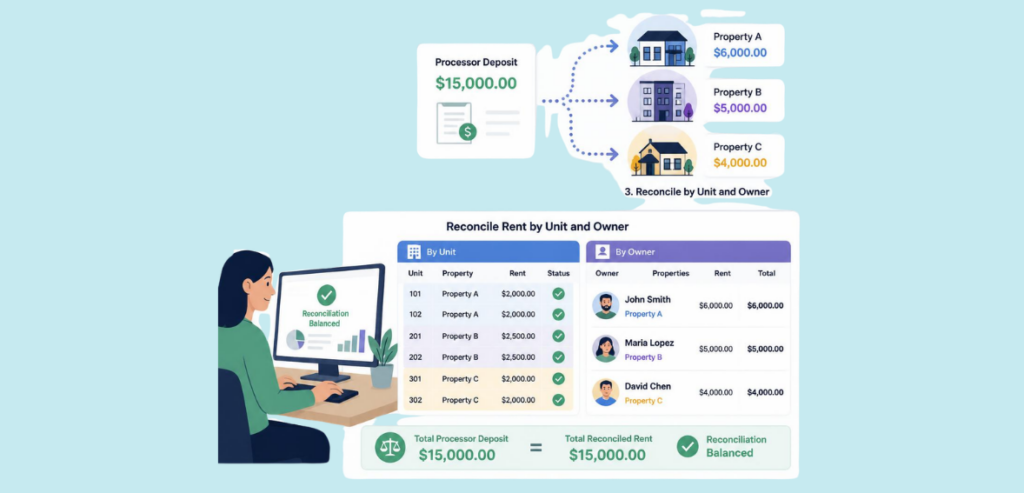
Most tenants pay property management companies by electronic payment instead of mailing checks. Processors collect payments on a daily basis and perform a single settlement with the bank to net funds. From the perspective of the bank, there is a net deposit of $7,775.
To the property management company, there are potentially 50 individual records. This disparity between transaction collection and recording practice is the crux of reconciling processor deposits for multiple properties. The record of a $7,775 net deposit might include gross rent for five units of $8,400, less processing fees, a convenience fee which was retained, and a refund which was issued.
The bookkeeper requires a clear separation directive. If no such directive exists, the bookkeeper will have to guess as to which part of the record relates to which property. A trust account is not permitted to have guesses.
It is more complicated if different tenants of the same batch make payments using different methods. One tenant may pay using ACH, the other may pay using a debit card, and a third may pay using a credit card with a convenience fee. The cost and timing of settlement for each of these methods are different. Property managers who do batch level versus unit level reconciliations end up dealing with unexplained variances.
Each payment is associated with a tenant, a unit, and a fee amount in a batch in the transaction detail report that is not provided in the bank statement. You must match this detail report with the gross rent collected for each unit for the reporting period in order to determine a paid in full or partial payment status for each property, irrespective of how the batch settled.
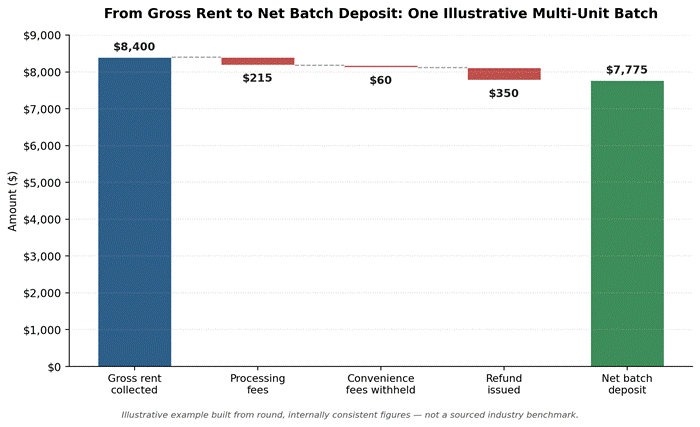
Figure 1: A batch deposit disassembled. Figures are for illustrative purposes and do not contain information from a specific processor.
The waterfall shows how batch-level fees are taken. It shows how the net amount that is deposited is calculated by subtracting the fees charged by the processor and any refund that is issued from the gross rent on the batch, and adding back the convenience fee that was retained.
The gross amount collected is the rent the property manager collects. A property manager trying to reconcile by checking the statement will never see the gross amount collected. This is the reason for accurate unit-level rent accounting to rely on the transaction detail file instead of the deposit total.
cashThere are several approaches to the math with property management software, but the end goal is the same. In some platforms, the Adjusted Cash Balance is equal to Property ledger balances adjusted for unreconciled deposits and post-period receipts, and ACH batches as well as uncleared checks. These platforms also require the Adjusted Cash Balance to equal the Statement Balance and Cleared Balance for a given period in order to close the period.
Other platforms prefer a more traditional approach of requiring receipts to be batched and deposited before appearing in reconciliation, and then matching the ending balance of the bank statement against cleared items until the difference is zero. Even though there is no “better” logic, think on the batch that reconciled perfectly in one system; it would appear unbalanced in the other. A bookkeeper moving between different software systems needs to understand the different logic being used.
When designing your rental contract, convenience fee allocation decisions have meaning. Even though in the industry convenience fees and surcharges have different definitions, the ways property managers utilize them is the same. A convenience fee is the expense of utilizing an alternate payment method, a payment option other than mail. This convenience fee can be applied regardless of the payment method used.
Surcharge, on the other hand, is utilized to cover credit card processing costs and cannot be used in combination with a debit card. The disclosures and rate limits on surcharges are regulated by the credit card networks and the states.
As a result of these components and restrictions, some states prohibit these surcharges, so the best approach that can be used for a multi-state portfolio is to consult a payments lawyer or compliance group at the processor prior to instituting a fee, as opposed to using the rules related to one state to another.
Operationally, the fee associated with a payment method has to be noted against the rental unit where the payment was made. It cannot be consolidated in a single fee income line. If done correctly, a manager can recover net fees and provide a justification to the tenant for charging a higher card processing fee versus an ACH transaction processing fee.
HMS Pay captures each convenience fee at a transaction level. Because of this, the system knows the unit and the tenant that created the convenience fee. HMS Pay does not capture fees in a batch totaling all fees. The reason this specific functionality exists is to successfully credit the correct ledger. HMS Pay prevents the bookkeeper from having to unbundle, or break down, a large lump-sum convenience fee across multiple units.
Refunds processed in a cycle’s middle part will be handled by the next batch. This means the batch that originally processed the refund will show a negative variance until the next batch reconciles the refund. This will happen for every refund processed and will happen for every unit. A future batch reconciliations user may suspect theft or misconduct for each negative variance and may try to investigate.
Refunds processed in the middle of a cycle are made via a different process for chargebacks. In most cases, card networks will give their customers a maximum of 120 days from the date of the transaction to process a chargeback. In instances like a delivery of goods or services, this can even extend the chargeback window to 180 days.
This means for rental payment chargebacks, it can take months for a tenant to have a chargeback processed and taken from a rental payment batch, even though the rest of that batch does not relate to them.
There is a similar system to ACH payments; however, it is a different system in itself. Per Nacha operating rules, a receiving bank has 60 days to return a consumer ACH transaction because of an unauthorized transaction, compared to 2 business days for most administrative returns like an incorrect account number.
A property manager who understands both systems can differentiate a payment that was returned for a number of administrative reasons, which a manager should have addressed in a few days, from a valid chargeback on an unauthorized transaction, which can claw back a payment that a manager recorded as settled and paid weeks ago.
Each of these events deserve their own entry on the affected unit ledger, which stems back to the original transaction ID, ensuring the audit trail is valid years after the event occurred.
Before trust accounting is even a consideration, owner statement reconciliation is your first true vetting ground. When a payment, fee, refund, or chargeback is correctly attributed to its respective unit, most of the work is done in preparing the owner-level statement. The owner operating three units should not see one lumped gross statement.
He/she should see three individual summaries and one statement after the processing and convenience fees have been itemized. When an auditor or owner looks at a statement and something doesn’t look right, the first question is, “What is this net figure?” A truly effective reconciliation should identify the individual unit transaction and the date with no explanation needed. It is the true test of ‘systems’-based trust accounting.
This is where trust accounting rules are rigid. Most states have trust account or escrow account reconciliation policies where reconciliations must occur on a monthly basis and records must be maintained to show that such reconciliations have occurred and that the owner/tenant funds have not been commingled with another owner/tenant’s funds.
The specific requirements vary by state and by the type of license; hence, a trust accounting policy that operates across multiple licensing jurisdictions must be clarified by the real estate attorney and CPA practicing in those licensing jurisdictions.
Batch deposit property management reconciliation that functions correctly for twenty-five units usually does not function correctly for three hundred. As the number of transactions increases, the matching on a line-by-line basis that a small portfolio can do manually becomes a bottleneck. As the number of transactions increases so does the risk of missing a variance.
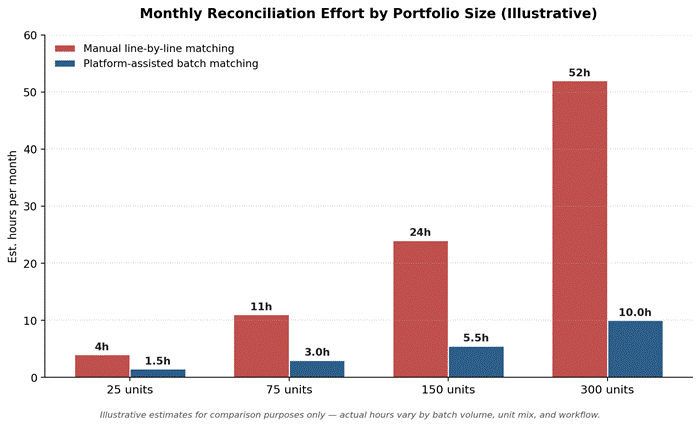
Figure 2: Estimated monthly reconciliation hours by portfolio size. Figures are illustrative estimates for comparison, not measured benchmark data.
The comparison shows that, across methods, the effort needed for reconciliation increases with portfolio size. With manual matching, that effort scales in a straight line. The batch matching workflow, however, scales across a curve that depends on the level of automation employed. The slope for manual matching is much steeper, but for a batch matching workflow that ties transaction detail to unit ledgers, the effort required for reconciliation can be managed and controlled on the platform.
The eventual workflow to review exceptions will require less effort for a portfolio, but portfolios that wait until they are overwhelmed with volume to develop this workflow will actually end up spending more time on backlog than they would have if they developed the process earlier.
Batch reconciliations can be performed daily or weekly rather than being saved for monthly reconciliations in order to achieve portfolio-wide close. Without these daily or weekly batch reconciliations, the last week of the month is fully devoted to the review and validation of unit ledgers, trust bank balance, and roll-up total owner level confirmation and alignment. This review and validation is done under pressure to reconcile unmatched deposits and validate the trust bank balance and unit ledgers.
The standard practice is to ensure that a three-way check is performed prior to closing the books. This check is comprised of the trust bank balance, the total of unit ledger balance, and the internal books.
Any deviation at this point should be tied to a specific unresolved item (e.g. a check that has not posted) or a batch that is in transit. Variance without an explanation is the number one reason for state trust account audits, making this step more than worthwhile even in the busiest month.
Tax reporting requires the same effort and discipline as the rest of the year. An owner should receive gross rent received, fees, refunds, and net proceeds for the year in their 1099 or year-end statement. Last minute, year-end recalculations are not reported on this document.
The management company passes on processing or transaction fees to the owner (or management company) and this cost is deductible, but it depends on how the management agreement defines this allocation, and this must be done consistently throughout the year and not in January.
An area where a management company will once again only need to forward clean, itemized information to the owner and will not need to make the final tax call is around the tax treatment of fees and the records needed to support that treatment. This occurs at the owner level and will vary by the owner’s entity type and jurisdiction.
A CPA will be able to apply the correct treatment if the unit-level data is recorded correctly, and will not have to piece together data that was entered in a batch mode from a processor statement after the close of business.
Merging many properties into a single processor deposit creates reconciliation issues, and this is where most of the errors occur. The best long-term solution to this issue is not a managed month-end effort, it’s having a routine of pulling every batch and tagging gross rent, fees, refunds, chargebacks, etc, to the appropriate properties on a continuous basis and bringing unit ledgers to owners on a regular basis in order to avoid slippage.
Portfolios that implement this practice early on will scale it much easier. Portfolios that implement this practice later spend significantly more time reconciling the past than they would have spent the time to regularly reconcile in the present.
Reconcile against the processor’s transaction detail report rather than the bank’s total for each unit. The detail file is the most accurate source for the batch split.
Allocate convenience fees to a specific unit and tenant rather than collecting them in a single income line at the portfolio level.
Combine clean, itemized ledgers at the unit and roll them to each owner.
A refund offsets a future batch rather than cancelling the prior batch. Document this on the unit ledger to prevent an unexplained variation.
Reconcile batches as they settle using the platform to assist in the matching process. Instead of redoing a week of unmatched deposits, month-end totals confirm reconciliation will then be completed.
Related reading on reconciling rent by unit and owner: Property Management Payment Resources.